Contents
Here’s the deal. An H1B visa ties you to a specific employer. That’s right, you’re basically “sponsored” to do one type of job for one company, and that’s what your visa is based on. Step outside that box, even if it’s just one freelance project for $200, and you risk more than just a slap on the wrist. We’re talking immigration violations, trouble with extensions, and even green card denials down the road.
Now, don’t panic! I know it sounds harsh, but this article isn’t here to scare you. It’s here to show you exactly what you can and cannot do, why freelancing can be risky, and what alternatives exist if you’ve got that entrepreneurial itch. Because let’s be honest: the world of work is changing. Freelancing gives freedom, flexibility, and a sense of ownership over your time — and I get why you’d want that, especially if you’re living far from home trying to build a life here.
So, if you’ve been wondering whether you can freelance as an H1B holder in 2025, stick around. You’ll learn the rules, the risks, the loopholes (yes, there are a few legal ones), and some smarter options that might still give you that flexibility you crave — without putting your status on the line.
If you’re on an H1B visa, you probably already know this: your work life in the U.S. is tied to one thing — your employer. Think of it like a contract marriage between you, your skills, and your sponsoring company. You can’t just wake up one morning and say, “Hey, I feel like designing logos on Fiverr for extra cash.” Nope. Immigration law doesn’t work like that.
Here’s why. The H1B is what’s called an employer-specific visa. That means:
Sounds strict, right? It is. And the reason is simple: the U.S. immigration system is designed to protect American jobs first. Your sponsor went through a lot of hoops (and fees 💸) to bring you here legally. So, if you step outside of that job, it undermines the whole sponsorship process.
Now, here’s a point many folks miss: just because something is “remote” or “small” doesn’t make it legal. You might think, “What if I do freelance work for a company outside the U.S.? They pay me abroad, so it doesn’t count, right?” Wrong. If you’re physically in the U.S. on an H1B, you’re still subject to U.S. work authorization rules. Even if the money comes from overseas, it can be considered unauthorized work if you’re the one doing it while in the U.S.
👉 Another key detail: The H1B doesn’t stop you from learning skills, networking, or even building a business plan. What it stops you from doing is working for compensation outside of your authorized employer. That’s where most people cross the line without even realizing it.
So what can you do?
Think of it this way: your H1B is like a ticket 🎟️. It only gets you into one event — your job with your sponsor. If you try sneaking into another event (like freelancing), you’re risking being kicked out of the whole stadium.
Let’s cut to the chase: No, you cannot freelance while on an H1B visa — at least not in the way most people think of freelancing. I know that sounds like a bummer, but it’s better to face the truth than risk your entire immigration status over one “side gig.”
Here’s why. When we talk about freelancing, we usually mean working as an independent contractor — finding your own clients, setting your rates, and being your own boss 👩💻. But USCIS doesn’t allow H1B holders to be “their own boss.” Your visa status is tied to an employer–employee relationship, where your sponsor controls your job duties, pay, and reporting structure.
So if you go rogue and sign up on Upwork, Fiverr, DoorDash, or any of those gig economy platforms, you’re essentially working outside the terms of your visa. Even if you think, “But it’s just a few hours a week,” or “I’m doing it for a company outside the U.S.,” it still counts as unauthorized work. And that’s a huge red flag for immigration officers.
Let’s tackle some common myths:
Now, is there any version of freelancing that could be legal? Technically yes — if another company files for a concurrent H1B for you, you can legally work for them too. But that’s not “true freelancing” in the sense of being an independent contractor. It’s just being employed by two different employers under two approved petitions.
At the end of the day, freelancing on an H1B is like playing with fire 🔥. Some people do it and get away with it for a while, but the risks far outweigh the rewards. All it takes is one tax filing mismatch, one USCIS check, or one unhappy client reporting you — and your immigration path could get derailed.
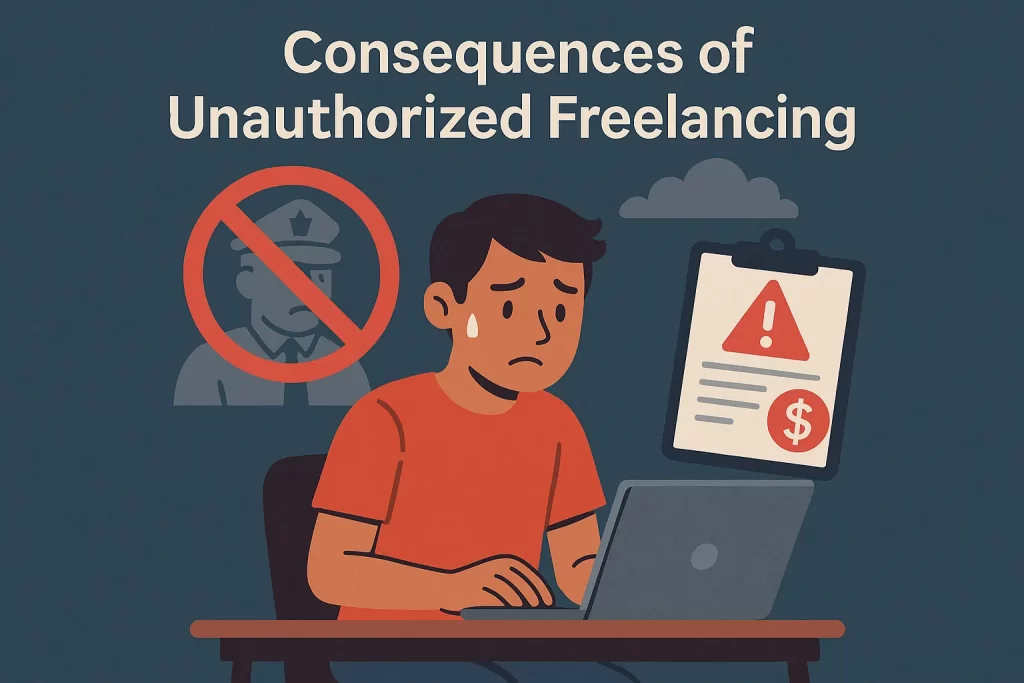
Okay, so you might be thinking: “What’s the worst that could happen if I take on a small freelance project?” Honestly? A lot. Freelancing on an H1B isn’t just bending the rules — it’s breaking them. And the consequences can stick with you for years, even if it feels like “just a side hustle.”
First off, status violation. The moment you do work outside of your H1B sponsor, you’re in violation of your visa terms. USCIS takes this very seriously. You could lose your lawful status immediately, meaning you’d have to stop working, pack your bags, and potentially leave the U.S. That’s not just stressful — it could shut down everything you’ve been building here.
Second, it could jeopardize your extensions and green card plans. Let’s say you freelanced a little on the side, no one noticed at first, and life moved on. But when you apply for an H1B extension, change of status, or a green card, USCIS digs into your history. They may ask for tax records, employment proof, or client contracts. If they find inconsistencies — boom 💥, denial. And trust me, there are plenty of stories of talented professionals losing everything because of a few “harmless” freelance gigs.
Third, you’re putting your immigration record at risk long term. Once USCIS marks you with unauthorized employment, it doesn’t just go away. It’s like a permanent red flag in your file. That could hurt your chances if you apply for a visa in the future, even years later. Some people even face three- or ten-year bans from re-entering the U.S. if the violation is severe enough.
Let’s get real with an example. Imagine a software engineer named Ravi (fictional, but based on real cases). He did a few web design projects on Upwork for extra income. Everything seemed fine until he applied for his green card. During the process, USCIS reviewed his tax filings and saw 1099 income from freelance clients. That one detail led to his green card being denied. Years of hard work, gone, all because of side gigs that added up to less than $5,000.
And it’s not just immigration consequences. There’s also the tax side of things. If you’re freelancing, you’re technically supposed to report that income to the IRS. Once it’s reported, USCIS can see it. If you don’t report it, that’s tax fraud — another issue that can ruin your immigration chances. Either way, it’s a lose-lose situation.
Bottom line: unauthorized freelancing might give you a short-term thrill, but the long-term cost could be your career, your residency, and your dreams in the U.S. 🚫
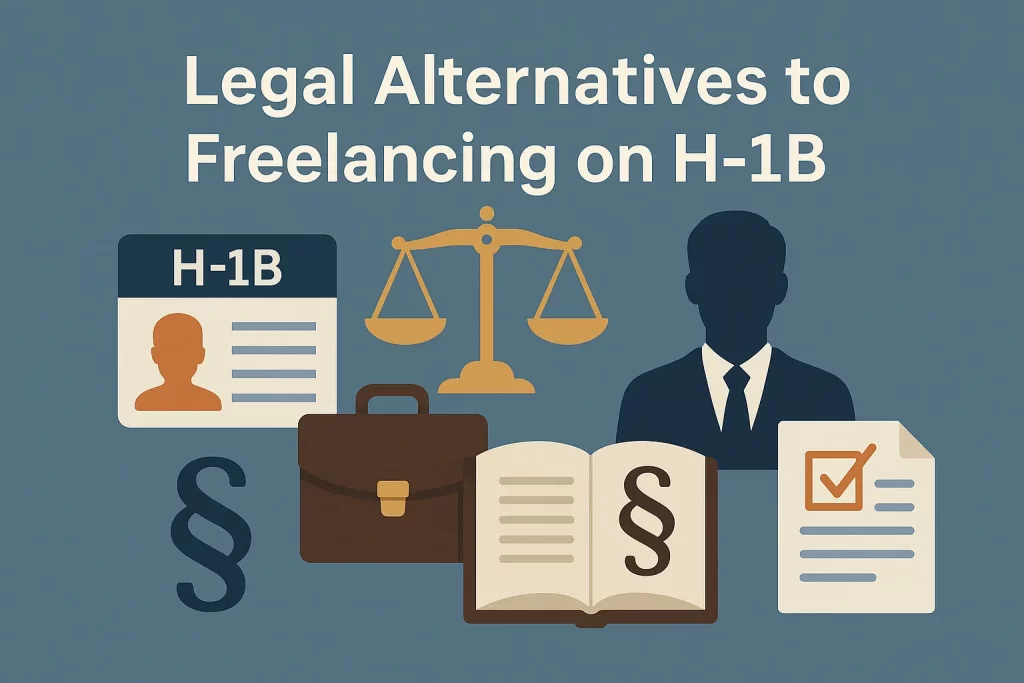
So freelancing is off the table, but that doesn’t mean you’re stuck with zero options. There are a few legal paths that can give you some flexibility, extra income, or even room to explore entrepreneurial ideas — without risking your H1B status. Let’s break them down.
Here’s the most practical alternative. Did you know you can actually work for more than one employer on H1B? It’s called concurrent H1B employment. Basically, if another company wants to hire you, they can file a separate H1B petition for you. Once approved, you can legally work for both employers. It’s not freelancing in the classic sense, but it does give you flexibility to take on new projects or jobs.
A lot of H1B holders dream of starting their own company. And yes, it’s possible — with big restrictions. You can form a company (LLC, C-Corp, whatever) and even hire employees. But you can’t actively work in or manage that company unless it sponsors you for an H1B itself. Think of yourself as the “owner on paper” but not the day-to-day worker. If you want to transition into actually working for your own business, you’d need to restructure so the company has the right employer-employee relationship with you.
Want to keep yourself busy and gain experience without pay? Volunteering can be an option, as long as it’s with a legitimate nonprofit or charitable organization, and you’re not replacing a paid role. For example, helping out at a local animal shelter or tutoring kids at a nonprofit center is fine. But offering “free” coding work to a startup that should be paying someone? That’s not volunteering — that’s unauthorized work disguised as charity.
If your spouse is on an H1B and you’re on an H4 visa with EAD (Employment Authorization Document), you’re in luck. H4 EAD holders can freelance, work as independent contractors, or even run their own businesses freely. So, if your situation allows, you could explore shifting to an H4 EAD to gain that flexibility.
It might not be “earning” right now, but investing time in certifications, networking, and building your professional brand can pay off later. Instead of freelancing, you could publish blogs, create a portfolio, or collaborate on open-source projects — things that showcase your skills without crossing into unauthorized employment.
💡 The key takeaway here? You’re not completely stuck. You just need to play smart. Look for legal options like concurrent H1Bs, explore long-term plans with other visas, or focus on growth activities that don’t violate your status. You’ll thank yourself later when your immigration record is squeaky clean and you’re ready for the next step in your journey.
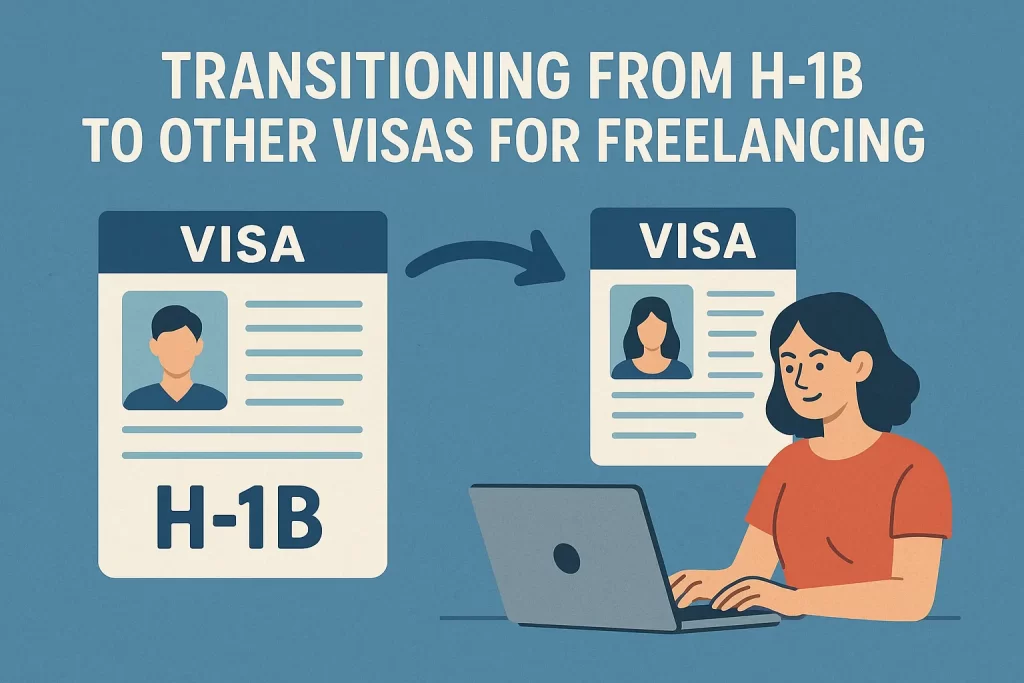
Here’s the good news: while freelancing isn’t allowed on an H1B, there are visa options that can give you that independence. Think of the H1B as a stepping stone. It gets you into the U.S. job market, but if you’re dreaming of being your own boss, you’ll probably need to move to a different visa category. Let’s go through the main ones.
If you’ve built a strong career — maybe you’re a published researcher, a developer with patents, or an artist with awards — the O-1 visa could be a game-changer. It’s for people with “extraordinary ability” in fields like science, business, or the arts. The O-1 gives you more flexibility because you can work on multiple projects, even with different employers, as long as you have a U.S. agent or company filing on your behalf. It’s not pure freelancing, but it’s much closer than the rigid H1B structure.
This one is huge for people who want independence. The EB-2 NIW is an employment-based green card, but the “national interest waiver” part means you don’t need a U.S. employer to sponsor you. Instead, you basically sponsor yourself by showing that your work benefits the U.S. economy, culture, or society. With a green card in hand, you can freelance, start a business, or work any job you want.
The ultimate ticket to freelancing is, of course, permanent residency. Once you’re a green card holder, you’re no longer tied to a specific employer. You can freelance, consult, build your own startup, or juggle multiple side gigs — whatever suits your lifestyle. That’s why many H1B holders push through the long green card process, knowing it unlocks freedom in the end.
This isn’t as common a switch, but for international students who move from H1B back to F-1 (yes, it happens sometimes), OPT gives more room to experiment with entrepreneurship. Some universities even support student founders under OPT rules.
The reality is, moving from H1B to another visa isn’t overnight. It takes paperwork, time, and sometimes luck. But if freelancing or entrepreneurship is a core dream for you, start preparing now. Build your portfolio, collect evidence of your expertise, and keep your immigration history spotless. That way, when the opportunity comes to switch, you’re ready to go.
At the end of the day, H1B isn’t forever — and if you plan right, you can step into a visa that matches your long-term goals. 🚀
Alright, let’s be real. Temptation is everywhere. Maybe your cousin back home asks you to design a website, or a friend wants to pay you for tutoring their kid in math. It feels harmless, right? But when you’re on an H1B, these little gigs can snowball into big immigration problems. So, what should you actually do if freelancing is tugging at you? Here are some practical tips.
I can’t stress this enough. Immigration law is a maze, and every situation is slightly different. A 20-minute chat with an attorney could save you from years of regret. They’ll tell you exactly what counts as “work” in your case and whether there’s a legal workaround.
If you do end up with legal concurrent H1B employment or another arrangement, keep records. Approval notices, contracts, pay stubs — all of it. When USCIS asks for proof during an extension or green card process, you’ll be glad you didn’t rely on memory.
Here’s where people get tripped up. They think, “If I don’t report it, nobody will know.” Wrong. Tax filings, bank transfers, even LinkedIn posts can give you away. If you’re doing “under the table” freelance work, you’re playing with fire 🔥. It might feel like easy money now, but one wrong move can ruin your long-term plans.
Ask yourself: is this freelance project worth risking my status? If your dream is to eventually get a green card and settle in the U.S., the answer is usually no. You’ll have far more freedom once you get permanent residency. Think long-term, not short-term.
There are safe ways to scratch that entrepreneurial itch. Create a blog, publish tutorials, or contribute to open-source projects. None of these count as unauthorized work if you’re not paid. You’ll still build a portfolio, gain visibility, and show potential future clients or employers what you can do.
If your spouse qualifies for an H4 EAD, freelancing is completely legal for them. Sometimes it makes sense to share responsibilities and let the spouse take the freelance opportunities while the H1B holder stays compliant.
Here’s the bottom line: freelancing on H1B is risky business. But with smart planning, patience, and maybe a little sacrifice, you can still prepare yourself for a future where freelancing is possible — without blowing up your current status.
So, can an H1B holder work freelance? The answer is pretty clear: not without risking your visa status. The H1B ties you to one sponsoring employer, and freelancing — whether it’s designing logos, driving for Uber, or coding for an overseas client — counts as unauthorized work. 🚫
The consequences? They’re no joke. From losing your visa status, to green card denials, to long-term immigration bans, the cost of a side hustle can be way higher than the money you make. It’s like playing poker with your future in the U.S. — and the house always wins.
But here’s the hopeful part 🌟. You’re not stuck forever. There are legal alternatives: concurrent H1B petitions, volunteering, or transitioning to visas like the O-1 or EB-2 NIW that give you more freedom. And let’s not forget — once you land a green card, freelancing and entrepreneurship are completely open to you.
If freelancing is something you truly want, think of it as a long-term goal, not a short-term hustle. Focus on keeping your record clean, building skills, and planning strategically. When the time comes to switch your status or get permanent residency, you’ll have both the freedom and the foundation to make it happen.
👉 Final advice? Don’t gamble with your immigration journey. Talk to an immigration attorney before making moves, keep your future in mind, and remember: your dreams are possible, they just require patience and planning.
✔️ Authoritative (USCIS, State Dept, IRS, DOL, AILA)
✔️ Easy for your readers to trust
✔️ Cover both H1B rules and related pathways (O-1, EAD, green card, taxes)


