Contents
What makes the E2 visa unique is its flexibility. You can build, grow, and operate a real U.S. business — and that same business can become the foundation for future eligibility under categories like EB-2 NIW, EB-1A, EB-1C, or EB-5, depending on how your company develops. Some E2 holders also qualify through employer sponsorship or marriage to a U.S. citizen.
In this article, we break down every available green card pathway for E2 holders, explain how each option works, and show you how to plan your long-term immigration strategy while maintaining your E2 status.
Whether you’re a franchise owner, a consultant, a startup founder, or a small-business investor, this guide will help you understand exactly how an E2 visa can become the first step toward permanent residency in the United States.
The E2 visa does not directly lead to a green card, and this is one of the most important distinctions applicants must understand. Unlike visas such as EB-2, EB-3, or EB-5 — which are built for permanent residence — the E2 is strictly a nonimmigrant visa category.
This means:
USCIS simply requires that you
transition into an eligible immigrant category before applying for permanent residency.
In other words, the E2 itself is temporary — but the business you build, the jobs you create, your professional achievements, and your economic impact can all support green card eligibility through several other channels.
Many E2 investors successfully obtain green cards each year through:
The key is choosing the right category based on your business model, background, and long-term goals.
Even though the E2 visa does not directly lead to permanent residency, E2 investors have multiple pathways to apply for a green card. The best option depends on your background, business structure, investment level, and long-term goals.
Here are the primary green card routes available to E2 visa holders in 2025:
This category
does not require employer sponsorship, and many E2 founders qualify based on innovation, job creation, or economic impact.
Entrepreneurs may qualify through awards, media coverage, major business achievements, or transformative contributions within their industry.
A strong option for E2 visa holders who operate a U.S. business with a qualifying foreign affiliate
If you hold an executive or managerial role and your foreign company meets eligibility rules, you may qualify under EB-1C.
Allows E2 investors to “upgrade” to a green card by investing $800,000 or $1.05 million
Funds previously invested in your E2 business may count toward the EB-5 requirement if properly documented.
Helpful when your E2 business does not yet meet EB-2 NIW or EB-5 criteria.
Other family relationships may qualify depending on category and wait times.
These options make it possible for E2 visa holders to build a path toward permanent residency — even though the E2 classification itself is temporary and nonimmigrant.
In the next sections, we will break down each option in detail, starting with the category most popular among E2 entrepreneurs: EB-2 NIW.
The EB-2 NIW is one of the most popular and accessible green card options for E2 visa holders — especially entrepreneurs, founders, consultants, and business owners whose work contributes to the U.S. economy or supports a national priority.
What makes the NIW so powerful is that it allows you to self-petition
You don’t need:
If you can show that your work benefits the United States in a meaningful way, you can qualify on your own.
Your E2 company already demonstrates:
These elements align strongly with the NIW’s three-factor test, established in the Matter of Dhanasar decision.
To qualify, you must show:
Examples for E2 entrepreneurs:
Evidence often includes:
This means the U.S. gains more from your business continuing without delays, such as:
For many E2 investors, the NIW category is the fastest and most feasible green card path.
The EB-1A Extraordinary Ability Green Card is one of the most prestigious immigration categories available — and for certain E2 entrepreneurs, it can be an excellent path to permanent residency.
While EB-1A has a high evidentiary standard, many business founders and investors underestimate how much their achievements may already qualify them. If you have built a successful E2 business, led major projects, earned recognition, or made significant contributions in your field, you may be closer to EB-1A eligibility than you think.
EB-1A is designed for individuals who are considered among the top few percent in their field. You must meet at least 3 of the 10 USCIS criteria or show one major achievement such as a nationally or internationally recognized award.
For E2 entrepreneurs, this can include:
Many E2 business owners naturally build qualifying evidence by:
Your entrepreneurial achievements, combined with your business’s measurable impact, can form a compelling EB-1A case.
This flexibility makes EB-1A ideal for E2 entrepreneurs who have built a high-impact business or personal brand.
If you have achieved significant recognition, demonstrated industry influence, or built a distinguished business, the EB-1A may be your most powerful green card option.
For E2 visa holders who operate businesses in multiple countries — or who maintain a foreign company while running a U.S. enterprise — the EB-1C Multinational Manager or Executive Green Card can be an excellent pathway to permanent residency.
This category is specifically designed for executives and high-level managers who have played a key leadership role in an international organization.
To qualify, you must demonstrate that:
This is essentially the “immigrant version” of the L1A visa — but unlike L1A, EB-1C leads directly to a green card.
Many E2 entrepreneurs qualify for EB-1C if they:
If your foreign business has been active and profitable, and your U.S. company is structured as a branch, subsidiary, or affiliate, you may already meet the foundation for EB-1C.
This is especially common when:
To qualify, your case must show:
Typical evidence includes:
This route is ideal if you:
If your E2 enterprise is part of a larger global business — or if you maintain ownership and control of a foreign company — the EB-1C category may be one of the most powerful and direct ways to transition to a U.S. green card.
For E2 investors who want a direct, investment-based path to permanent residency, the EB-5 Immigrant Investor Program is a powerful option. Unlike the E2 visa — which is temporary and requires treaty-country citizenship — EB-5 leads directly to a U.S. green card for you, your spouse, and your unmarried children under 21.
Many E2 business owners successfully “upgrade” their investment to meet EB-5 requirements, especially if their business is growing or already employs U.S. workers.
To qualify for EB-5, you must:
These jobs must be permanent positions, not independent contractors.
Yes — in many cases, the money you already invested in your E2 business can be applied toward your EB-5 investment, as long as:
This makes the EB-5 option extremely attractive for E2 founders who have already committed substantial capital.
This is ideal for:
Some E2 holders prefer a passive investment through a Regional Center
This option works well if:
If you want a clear and direct route to a green card, the EB-5 investment program is one of the most reliable options for E2 visa holders. With proper planning, your existing E2 capital may already get you part of the way there — making EB-5 a natural next step.

While many E2 entrepreneurs choose self-petitioned or investment-based green card routes, employer sponsorship is another viable pathway — especially for investors who take on professional roles within U.S. companies or decide to transition into a salaried position.
Unlike NIW or EB-1A, which allow self-petitioning, employer-sponsored green cards require a U.S. employer willing to sponsor your permanent role.
Ideal for:
Ideal for:
To apply under EB-2 or EB-3, the employer must complete the PERM Labor Certification, which proves:
This is a multi-step process involving recruitment, advertisements, and strict compliance with Department of Labor rules.
Yes — in limited and very carefully structured situations.
Your E2 business may sponsor you only if:
However, this is legally complex
Most E2 entrepreneurs pursue other green card categories instead.
Employer-sponsored green cards may be helpful if:
For many E2 investors, employer sponsorship becomes a safety net — especially if their business model shifts or they decide to transition into career-based opportunities in the U.S.
While the E2 visa itself does not directly lead to permanent residence, employer sponsorship under EB-2 or EB-3 can provide a reliable employment-based green card option for those who meet the qualifications and secure an eligible job offer.
Among all available options, the marriage-based green card is often the fastest and most straightforward route to permanent residency for E2 visa holders — especially when compared to business-based or employment-based categories.
If you are legally married to a U.S. citizen, you are immediately eligible to apply for a green card, regardless of your current visa classification.
You may apply if you are:
Marriage must be:
Yes — if you are married to a U.S. citizen, you generally qualify for Adjustment of Status (Form I-485)
This allows you to:
However, because the E2 visa does not allow dual intent, timing and legal strategy are extremely important. You must avoid actions that imply immigrant intent before filing.
If you:
You can apply for your green card through consular processing at a U.S. embassy or consulate.
E2 investors often remain in the United States for years while running their businesses, forming strong connections and relationships. Marriage to a U.S. citizen provides:
The process focuses solely on proving the authenticity of your relationship.
If you are married to a U.S. citizen, the marriage-based green card is often the most efficient, flexible, and accessible path to permanent residency — regardless of your E2 status or business operations.
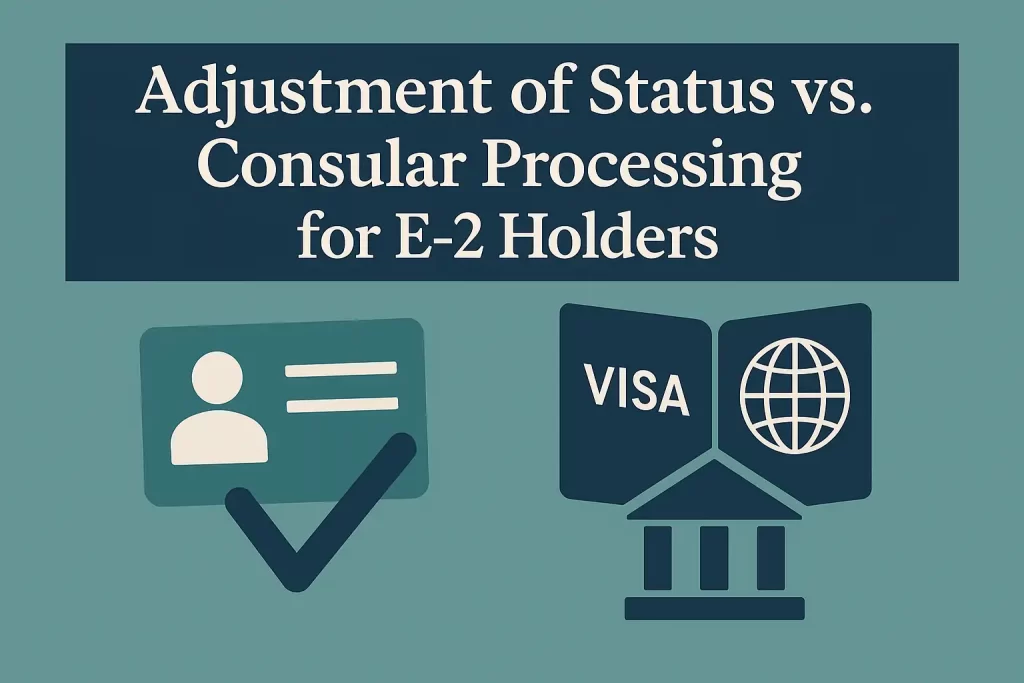
When an E2 visa holder pursues a green card, one of the most important strategic decisions is choosing between Adjustment of Status (AOS) inside the United States or Consular Processing (CP) abroad. The best option depends on your green card category, your immigration history, your current E2 status, and how USCIS interprets immigrant intent.
Adjustment of Status allows you to apply for your green card without leaving the United States. This option is typically available for E2 holders who:
Because the E2 visa does not allow dual intent
You must avoid any actions that show immigrant intent before your green card petition or AOS application is filed.
This is why legal strategy and proper documentation are essential for E2 holders transitioning from temporary intent to permanent residency.
Consular processing occurs at a U.S. embassy or consulate in your home country or country of residence.
This route is often recommended when:
Both AOS and consular processing can work for E2 visa holders — but each requires careful planning due to the E2 visa’s temporary intent. With the right immigration strategy, you can transition smoothly to permanent residency without jeopardizing your current status.

Transitioning from an E2 visa to a green card is absolutely possible — but because the E2 is a nonimmigrant visa without dual intent, the process must be handled carefully. Many applicants face delays or denials simply because they misunderstand the E2 rules or choose the wrong green card strategy.
Here are the most common mistakes E2 visa holders make — and how to avoid them.
Applicants often wait too long, hoping the visa itself will convert to a green card. By the time they seek help, they may have lost valuable years that could have been spent building NIW, EB-1A, or EB-1C qualifications.
If your goal is an entrepreneurial green card such as:
then your business must be structured from the beginning
Common errors include:
Strategic planning from day one makes your green card journey far smoother.
Filing too early can raise immigrant intent
Filing too late may leave you without enough documentary evidence or business growth to qualify.
Timing is everything — and should be planned with an attorney.
Common mistakes include:
E2 and EB-5 cases are especially sensitive to financial tracing.
Because the E2 visa requires nonimmigrant intent
This includes:
With the right legal strategy, this can be navigated smoothly.
Many investors fail to keep:
Without proper documentation, it becomes difficult to prove eligibility.
Each category has different requirements:
Choosing the wrong category leads to unnecessary denials or RFEs.
E2-to-green-card transitions are some of the most technical
A minor mistake in strategy or documentation can trigger delays, RFEs, or intent issues.
Working with an experienced immigration attorney ensures your case is planned and filed correctly.
Most mistakes E2 holders make are preventable. With the right structure, timing, documentation, and legal strategy, you can avoid pitfalls and move confidently toward permanent residency in the United States.
The answer is
yes — absolutely — but not directly through the E2 visa itself.
The E2 is a temporary, nonimmigrant classification, but it gives entrepreneurs a powerful foundation to build a life and business in the United States. From there, you can transition to permanent residency through several major categories, including:
Each pathway has different requirements, timelines, and strategies. The option that’s right for you depends on:
Your E2 visa is the beginning — not the end — of your U.S. immigration journey.
With careful planning, proper documentation, and the right legal guidance, your E2 business can absolutely become the foundation for permanent residency in the United States.
If your goal is to turn your U.S. investment into a long-term future for you and your family, there is a clear path forward — and now is the perfect time to start preparing.
Explore additional resources and related immigration topics to support your E2-to-green-card strategy:


