Contents
Unlike other employees who can move freely between states or cities, H1B workers must stay aligned with the exact job details USCIS approved. That includes the work location listed on the Labor Condition Application (LCA), the prevailing wage tied to that location, and the job duties described in the original petition. When remote work changes these factors, compliance steps — sometimes even an amendment — may be required.
With hybrid schedules, home offices, and cross-state moves becoming more common, it’s crucial to understand what USCIS considers a “valid” remote work arrangement. In this article, we break down when remote work is allowed, when an H1B amendment is required, what counts as a new worksite, and how employers can stay compliant while offering flexible work options.
Let’s dive into the rules to help you navigate H1B remote work with confidence and clarity.

Yes — H1B workers can absolutely work remotely, but only when the remote arrangement still fits within the rules laid out by USCIS and the Department of Labor. The key is making sure the remote location does not create a “material change” that requires an amendment or new LCA. Here are the main situations where remote work is allowed for H1B employees:
If the employee works from home but the home address is within the same MSA
Examples:
• The office is in San Jose, and the employee works from home in Santa Clara
• The office is in Seattle, and the employee works from home in Bellevue
In this scenario, the employer only needs to post the LCA at the home office, and no amendment is required.
The key is that the
prevailing wage and job location do not change.
This means H1B workers can temporarily work outside the approved location if the assignment is limited and the primary worksite stays the same.
This applies to:
• Trainings
• Conferences
• Client meetings
• Short-term assistance for projects
As long as it’s not permanent or long-term, this usually does not require an amendment.
If the employer files a new LCA
In some cases, this alone is enough without requiring a full amendment.
• Renovations
• Emergencies
• Weather events
• Company-wide remote days
Employees may work from home without filing anything new, as long as the change isn’t permanent.
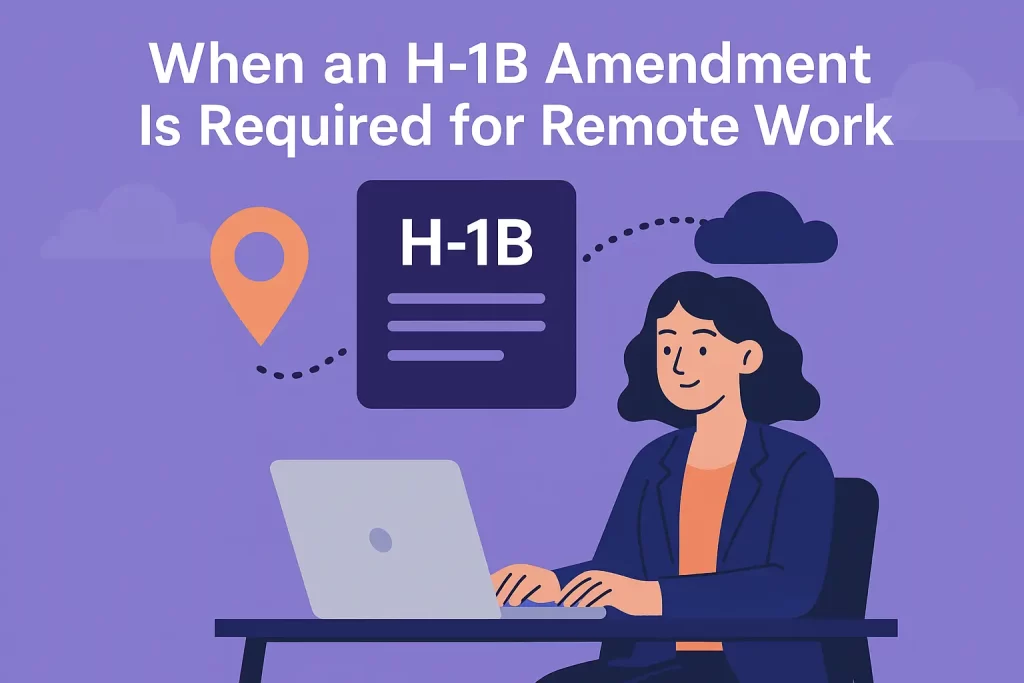
While remote work is possible for H1B employees, there are important moments when the employer must file an H1B amendment to stay compliant. This is where many people get confused — because even if the job duties stay the same, the location alone can trigger a “material change” that USCIS needs to review. Here are the most common situations where an amendment becomes mandatory:
If an H1B worker starts working remotely from a new location outside the original MSA
Example:
• Office approved in New York City
• Employee starts working long-term from Austin, Texas
Even if the duties are identical, USCIS treats this as a new worksite with a new prevailing wage — therefore requiring a new LCA and amendment.
If remote work starts as a short-term solution but becomes long-term or permanent
Once the home-office becomes the
primary place of work, an amendment is often required.
If the new remote work location has a higher wage requirement than the original site, this affects the LCA — automatically triggering the need for an amendment.
If these changes alter the:
• Job description
• Occupational category
• Required degree level
• Core daily tasks
…then an amendment is required, even if the location didn’t change.
For consulting and staffing companies, remote work can still be considered a new worksite
• The employee is assigned to a new client
• The remote location is tied to a specific project
• The LCA territory does not match the new arrangement
In these cases, USCIS treats it like any other worksite change.
• A promotion
• A new job title
• Updated job duties
• New reporting structure
When combined, USCIS sees this as a significant shift — requiring an amendment.
Not all remote work triggers an amendment. In fact, many H1B workers can enjoy flexible arrangements without needing to update USCIS — as long as the core conditions of the petition remain the same. Here are the most common situations where remote work is allowed without filing an H1B amendment:
If the home address is located within the same metro area
Example:
• Office in San Francisco
• Employee works from home in Oakland
The employer only needs to post the LCA at the home-office location.
Temporary remote work — such as attending training sessions, conferences, project visits, or client meetings — does not require an amendment because the primary worksite remains unchanged.
If the employee splits time between the office and a home nearby (within the same MSA), this is considered a normal arrangement and does not require USCIS approval.
• Renovations
• Weather
• Emergency conditions
• Company-wide remote policies
…then employees may work remotely without an amendment.
If the remote work arrangement happens at the same time as a minor internal update — like a new internal job title that does not change the role — an amendment is not needed.
Sometimes the employer files a new LCA
If the update does
not alter the job duties or occupational classification, the employer may not need a full amendment.
If the employee works remotely only while preparing for a move, waiting for office access, or finalizing travel arrangements, an amendment is generally not required.
When it comes to H1B remote work, the Labor Condition Application (LCA) plays a central role. Whether an amendment is needed or not depends heavily on how the remote work location fits into the LCA rules. Understanding these requirements helps employers maintain compliance and gives employees clarity about what’s allowed.
Here’s what you need to know about LCAs when an H1B worker goes remote:
Every H1B employee must have an LCA that accurately reflects where
This includes:
• Office locations
• Client sites
• Remote home-office locations
If the home address or remote location is not covered by the existing LCA, the employer may need to file a new one.
Even when no amendment is necessary, employers must post the LCA
This ensures transparency for:
• Other employees
• Labor authorities
• Compliance audits
Posting can be done physically or electronically, depending on company policy.
If the employee moves to a:
• New city
• New county
• New state
If the new wage is higher than the current salary, the employer must update the LCA — which may trigger an amendment.
The Department of Labor allows temporary work outside the approved area without
• The assignment is short-term
• The primary worksite stays the same
• The employee returns to the original location
This rule is designed for quick trips and occasional remote days.
If remote work becomes long-term or permanent, the home-office is considered a new worksite
This usually requires:
• A new LCA
• LCA posting at the home
• Potential amendment based on the material change
Many employers misunderstand this step — but it’s essential for staying compliant.
• Multiple client sites
• Various offices
• Hybrid remote arrangements
Each primary location must be covered by a valid LCA to avoid compliance risks.
Remote work can be a great option for H1B employees, but doing it without following USCIS and Department of Labor rules can create serious immigration risks. Many people assume that working from home is harmless, but for H1B status, every detail matters — especially your work location and job description. Here are the biggest risks when remote work is not handled correctly:
If your remote work location isn’t covered by a proper LCA or should have triggered an amendment, USCIS may determine that you are working outside the terms of your approved petition
This can lead to:
• Status violations
• Loss of work authorization
• Problems during future extensions or transfers
Even if the violation was accidental, USCIS still applies the rules strictly.
If they discover you worked remotely
without proper filings
• Delayed
• Challenged
• Or even denied
This is one of the most common hidden risks of remote work.
If the answers don’t match the information in the USCIS system — and no amendment was filed — your visa stamp can be delayed or denied.
• DOL investigations
• USCIS audits
• Penalties for incorrect LCA postings
• Restrictions on future H1B sponsorships
For companies that sponsor multiple employees, a single compliance error can create a chain reaction.
If a worker performs their job in an area with a higher prevailing wage, the employer may be required to pay back wages — sometimes thousands of dollars — for the entire period of non-compliance.
• PERM applications
• I-140 petitions
• Adjustment of Status
• Consular processing
Any mismatch in job duties, location, or wage history can raise questions in a future green card case.
If officers find the employee is working remotely without proper filings, the employer may be instructed to
stop work immediately until compliance is restored.
Offering remote or hybrid work to H1B employees is absolutely possible — but it must be handled correctly to avoid risks for both the employer and the employee. The good news is that compliance is straightforward when you follow the right steps. Here’s how employers can stay compliant while still supporting flexible work arrangements:
This helps determine:
• Whether the location matches the existing LCA
• Whether a new LCA or amendment is needed
• Whether the remote location is within the same MSA
Accurate records are essential during audits or site visits.
Before approving remote work, confirm whether the home-office address falls within the same MSA
If it does, remote work is simple and often requires only an LCA posting.
If not, additional steps are required.
• File a new LCA
• Update the worksite information
• Post the LCA at the remote location
This ensures the prevailing wage and worksite details are accurate.
• Moves the employee to a new city or state
• Changes the prevailing wage
• Creates a new permanent worksite
• Modifies the nature of the job
…then an amendment is required to keep the petition compliant.
A simple communication policy solves this, ensuring remote changes are reviewed before they happen.
• LCAs
• Posting notices
• Updated job descriptions
• Worksite records
• Amendment approval notices
Well-organized records make compliance smoother and protect against audits.
• MSA boundaries
• LCA posting requirements
• When an amendment is needed
• How remote work impacts H1B compliance
Proper training reduces mistakes dramatically.
When in doubt, consulting an immigration attorney ensures the employer stays compliant, avoids penalties, and protects the employee’s immigration status.
Remote work has become a normal part of today’s workplace, and H1B employees can benefit from the same flexibility as everyone else. However, because the H1B program is tied to very specific job conditions — including location, wage level, and job duties — remote work must be managed carefully to stay compliant.
Your work location must match what USCIS has approved — or be updated correctly.
Temporary remote work is often fine.
But long-term remote work in a different city or state, or any change affecting your job duties or wage level, may require a new LCA or even a full H1B amendment.
For employers, it ensures strong compliance and avoids penalties, audits, or work disruptions.
When handled correctly, flexibility and immigration compliance can work together smoothly.


