Contents
If you’ve achieved national or international recognition in your field — whether you’re a scientist, entrepreneur, artist, researcher, or athlete — the EB-1A visa (Extraordinary Ability) gives you the power to apply for a U.S. green card entirely on your own, without needing a job offer or employer sponsorship.
That’s right — no company paperwork, no waiting for HR approvals, no dependency on an employer’s decision. You become your own petitioner. 💪
This option is one of the biggest advantages of the EB-1A category under the EB-1 green card system, and it’s designed for individuals who have reached the very top of their professions. If your work has earned you major awards, publications, leadership roles, or consistent recognition from experts in your field, you might already qualify to self-petition for permanent residency in the U.S.
But here’s the catch — not all EB-1 categories allow this. The EB-1B (Outstanding Professors/Researchers) and EB-1C (Multinational Managers/Executives) still require employer sponsorship. Only the EB-1A Extraordinary Ability route gives you full independence to apply on your own terms.
In this guide, we’ll break down everything you need to know about self-petitioning for the EB-1, including who qualifies, what evidence you’ll need, how to file your petition, and the common mistakes that can slow down your approval. Whether you’re already working in the U.S. or planning your move from abroad, this article will help you decide if it’s the right time to take control of your green card journey — independently. 🇺🇸✨
Not everyone can file an EB-1 petition on their own — but if you fall under the EB-1A (Extraordinary Ability) category, you absolutely can. 💪
The EB-1 green card is divided into three main subcategories:
This independence makes EB-1A one of the most empowering immigration options available. You’re not tied to a single company or institution — you’re recognized for who you are and what you’ve achieved.
In the next section, we’ll explore exactly what “extraordinary ability” means under U.S. immigration law — and how you can prove you meet that high standard. 🌎
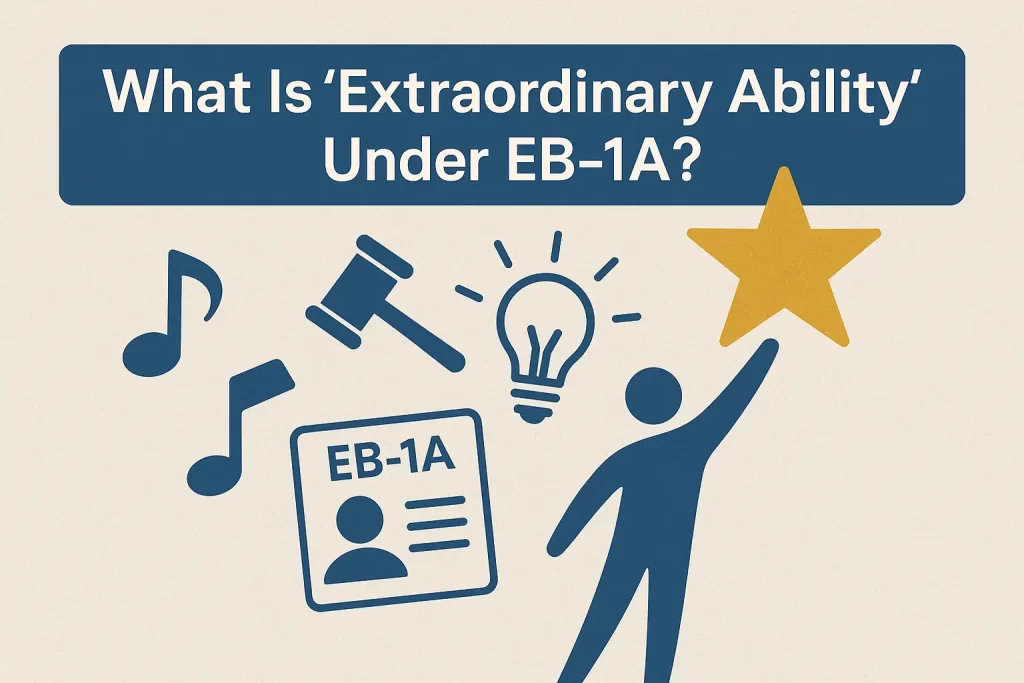
To qualify for the EB-1A self-petition, you must prove that you have extraordinary ability — meaning you’re among the small percentage of people who have reached the very top of your field. 🌟
According to U.S. Citizenship and Immigration Services (USCIS), extraordinary ability is demonstrated through sustained national or international acclaim. In simple terms, you need to show that your achievements aren’t just impressive — they’ve had a lasting impact and are recognized by experts and institutions beyond your immediate circle.
So how do you prove that? USCIS gives you two ways to demonstrate extraordinary ability:
If you’ve received a major internationally recognized award, such as a Nobel Prize, Oscar, Grammy, Olympic medal, or equivalent, that alone may be enough to qualify.
But most applicants don’t have a single “world-famous” award — and that’s okay. In that case, you’ll rely on the second path.
USCIS provides 10 categories of evidence you can use to prove your extraordinary ability. You’ll need to meet at least three, though strong petitions often go beyond that.
Here are the 10 criteria:
If you can satisfy at least three of these — and show that your recognition is ongoing — you may qualify for EB-1A self-petition.
Think of a data scientist whose research has been cited globally and featured in top journals. Or a filmmaker whose work has won awards across international festivals. Or an entrepreneur whose innovations have shaped an entire market sector.
Those are the kinds of professionals who fit the EB-1A standard — people whose success has gone beyond personal or local recognition to global influence. 🌍
In the next section, we’ll walk through exactly how to apply for EB-1A on your own — step by step.
Applying for the EB-1A on your own
Here’s a simple breakdown of how to file your
self-petition without an employer:
💡 Tip: Choose quality over quantity. Each piece should directly support one of the USCIS criteria.
This is the official Immigrant Petition for Alien Worker
Because you’re applying under
EB-1A, you’ll mark yourself as both the petitioner and the beneficiary
Submit Form I-140 with:
You can also choose Premium Processing to receive a decision within 15 calendar days.
Once your I-140 is approved, your priority date
If you were born in a country with a current visa availability (for example, most countries outside India and China), you can move directly to the next step. Otherwise, monitor the
Visa Bulletin each month until your date becomes current.
If you’re already in the U.S. on another visa, file Form I-485 (Adjustment of Status)
If you’re outside the U.S., you’ll complete
Consular Processing
This step officially transitions you from non-immigrant to permanent resident.
Keep copies of all receipts, approval notices, and correspondence from USCIS.
Staying organized can prevent unnecessary delays or requests for evidence.
Applying for EB-1A on your own means you’re in control
With the right documentation and a well-structured petition, your achievements can open the door to
U.S. permanent residency. 🇺🇸

One of the biggest reasons professionals love the EB-1A category is simple — freedom
Unlike most U.S. work visas or green cards, the
EB-1A self-petition gives you the ability to take full control of your immigration journey without waiting for a company or university to back you up.
Here’s what makes it such a powerful option:
You are both the petitioner and the beneficiary. That means you don’t have to rely on an employer’s HR department, sponsorship policies, or business plans. Whether you’re an entrepreneur, artist, or researcher, you can file based on your own achievements and future goals.
Once you receive your EB-1A green card, you can work in any field or start your own business. You’re not tied to a specific job or company — giving you total independence to shape your career as you choose.
For applicants from countries where the
Visa Bulletin is current, the entire process can move much faster than EB-2 or EB-3.
Every piece of evidence you submit — from awards to leadership roles — builds your legacy and proves that your contributions truly matter.
Once you get your green card, you’re on the path to citizenship
After five years as a permanent resident, you can apply to naturalize as a
U.S. citizen, unlocking even more opportunities and security for your future.
In short, the EB-1A self-petition isn’t just a process — it’s a statement of independence. It says you’ve built something extraordinary, and you don’t need anyone else to validate your worth.
Next, let’s look at some of the common mistakes applicants make when filing on their own — and how you can avoid them. ⚠️
So — can you apply for an EB-1 on your own
Yes, absolutely. ✅
The EB-1A (Extraordinary Ability) category is one of the few U.S. immigration options that gives you total independence. No employer, no job offer, no sponsorship — just you, your achievements, and your ability to prove that you’ve made a lasting impact in your field.
It’s a path designed for those who’ve worked hard to rise above the ordinary — scientists pushing boundaries, entrepreneurs building innovation, artists shaping culture, and professionals whose work speaks for itself.
When you file an EB-1A self-petition, you’re not just applying for a visa — you’re taking ownership of your journey. You’re saying, “I’ve earned this.” And with the right documentation, organization, and clarity, you can turn that confidence into a U.S. green card and a future filled with freedom and opportunity. 🇺🇸✨
If your dream is to build your career, business, or legacy in the United States, this may be your moment. The EB-1A gives you the platform — all you need is the proof and the courage to take the leap.
Your achievements got you here. Now, let them take you further. 🌍
For more information about the EB-1 visa, self-petition process, and related green card categories, explore the resources below:


