Contents
You’re not alone! Every year, over 1 million people successfully immigrate to the U.S. through legal and structured pathways. Whether it’s for love, opportunity, education, or safety—there’s a legal door that can open for you. But here’s the truth: U.S. immigration can feel like a maze. With so many visa types, rules, and updates, it’s easy to get overwhelmed or misled.
The good news? You don’t have to figure it out alone. This guide breaks down the easiest ways to immigrate to the United States legally, using clear steps and real-world advice. From reuniting with a U.S. citizen spouse, to securing a student visa, to even winning the green card lottery—we’ll cover the most straightforward, common, and accessible legal routes available in 2025.
Whether you’re just starting your research or ready to take action, this article will help you understand which path best fits your situation—without the legal jargon or confusion.
Let’s explore your options, cut through the red tape, and move one step closer to your American dream 🇺🇸✨
If there’s one thing that makes U.S. immigration easier—it’s family ties. Seriously, if you have a close family member who’s a U.S. citizen or green card holder, you’re already ahead of the game.
Let’s break it down: If you’re an immediate relative of a U.S. citizen—like a spouse, child under 21, or parent—you qualify for a visa category that doesn’t even have a yearly cap. That’s huge. It means your application won’t sit in line behind thousands of others waiting for a number to be available. My cousin got her green card in just under a year through her U.S. citizen husband, and let me tell you, it was way smoother than any other route she explored before.
Now, if your family relationship isn’t in the “immediate” category—say, you’re a sibling of a U.S. citizen or a married adult child—then you’ll fall under the family preference categories. These still work, but heads up: they come with longer waiting times. Some cases can take 5–15 years, especially for countries like Mexico, India, or the Philippines where the demand is high.
Here’s how it works:
The whole process can seem daunting, especially when you’re staring at endless USCIS instructions, but if your paperwork is clean and your relationship is solid, it’s one of the fastest and most reliable ways to legally move to the U.S.
Also, don’t underestimate how emotional this journey can be. One of my friends teared up just getting her case approved—it meant finally being able to live with her mom again after years apart.
Bottom line: If you’ve got family in the U.S., use that connection. It’s more than just a bond—it’s your easiest legal path to immigration.
Want to work your way into the U.S.? You totally can—if you’ve got the right skills or job offer. Employment-based immigration is one of the most respected and stable paths to legal residency, but let’s be honest—it’s also competitive and a little… paperwork-heavy.
There are five employment-based (EB) preference categories, but most people fall under the first three:
The process usually starts with a U.S. employer who’s willing to sponsor you. That means filing a PERM labor certification to prove no qualified U.S. worker is available for the job. Then, they file Form I-140, and eventually, you get to apply for a green card.
Here’s a reality check: getting that job offer isn’t always easy. I remember a friend who had to apply to 40+ companies before one agreed to sponsor her EB-2. But once she got it? Game-changer. She had job security, a clear path to permanent residency, and she didn’t have to jump through visa renewal hoops every year.
If you’re a student in the U.S. already, the F-1 visa lets you use Optional Practical Training (OPT) after graduation, which can turn into a full-time job—and eventually, a green card through H-1B or other categories. That’s what happened to one of my classmates. She interned during OPT, impressed the company, and boom—got hired and sponsored.
But it’s not all roses. There are annual caps, especially for the H-1B visa, and countries like India and China face major backlogs in the EB-2 and EB-3 categories.
✨ Pro tips:
In short, if you’ve got talent, skills, or a degree—the U.S. wants you. It might take hustle, but employment-based immigration can absolutely open the door to a legal and rewarding life in the U.S.

Want to study in the U.S. and maybe even stay after graduation? ✨ Then the student visa path might be your golden ticket. It’s not just about textbooks and lectures—it’s one of the smartest and most popular ways to get into the country legally.
There are two main types of student visas:
To get an F-1 or M-1 visa, you’ll first need to get accepted by a SEVP-certified school in the U.S. Once accepted, the school will send you a Form I-20, and you’ll use that to apply for your visa at the U.S. embassy in your country. You’ll also have to prove you can financially support yourself and plan to return home after your studies.
Here’s the fun part: Studying in the U.S. doesn’t just give you a degree. It also unlocks Optional Practical Training (OPT)—which lets you work in your field of study for up to 12 months after graduation (or up to 36 months for STEM degrees). That job can lead to an H-1B sponsorship and eventually… a green card. 🎯
A friend of mine came to California on an F-1 visa to study computer science. After graduation, she worked for a tech startup through OPT, then switched to an H-1B, and now she’s living the Silicon Valley dream with her green card in hand. All legal. All step by step.
But here’s the thing: you have to stay in status. That means enrolling full-time, not working off-campus without permission, and reporting address changes to your Designated School Official (DSO). People who forget that stuff often end up in trouble, and it’s not worth the risk.
📌 A few quick tips:
In short, if you’re hungry for knowledge and ready to work hard, a student visa isn’t just a path to education—it’s a launchpad for your life in the U.S.

Sometimes, immigration isn’t about chasing dreams—it’s about escaping danger. If you’re facing persecution, war, violence, or natural disasters, the U.S. offers humanitarian relief pathways that can provide not just safety, but also a legal way to build a new life.
Let’s start with the basics:
Each of these paths has its own set of rules, but they all lead to legal presence, and many of them can eventually lead to a green card and even U.S. citizenship.
I once volunteered with a family who fled political violence and applied for asylum at the border. It was tough—they waited over a year for their interview. But when it finally came through, they cried tears of relief. They’re now rebuilding their lives and their kids are thriving in school. It reminded me that immigration is sometimes a matter of survival.
But here’s the reality check: these applications take time. You’ll need documents, evidence, and often an attorney’s help. And yes—there are scams out there, especially targeting vulnerable people. Don’t ever pay someone promising you a “guaranteed green card.” That’s a red flag 🚩.
📎 Quick advice if you’re thinking about humanitarian relief:
This route might not be easy, but if you’re in danger, these programs exist to protect you. And they can lead to something more than just safety—they can lead to a whole new chapter.
Got capital and a bold idea? Then investing in the U.S. economy might just earn you a green card. It’s not for everyone, but if you’ve got the funds—and the vision—entrepreneur immigration can be one of the fastest and most direct legal pathways into the U.S.
The star of the show here is the EB-5 Immigrant Investor Program. It requires:
Many people opt to invest through Regional Centers, which are pre-approved organizations that pool investor money into large development projects. It’s less hands-on but still counts as active investment.
Now, if you’re more of a hands-on founder or startup builder, there’s also talk of a startup visa (though not yet law as of 2025), and programs like International Entrepreneur Parole can allow foreign founders to grow their companies in the U.S. if their startup gets U.S.-based funding and creates jobs.
One of my clients invested in a hospitality project through a regional center in Florida. Within a couple of years, she had her conditional green card, and after proving job creation, she became a permanent resident. Not only that—her kids got U.S. education and healthcare access. 🚀
But it’s not just about dropping cash and calling it a day. The EB-5 process is heavily scrutinized. You’ll need detailed financial records, lawful source of funds documentation, and a business plan that makes sense. Plus, you’ll face conditional residency for the first two years—you’ll need to prove the jobs were actually created before getting permanent status.
💡 Pro tips:
This isn’t the “easiest” path unless you’re financially prepared, but if you are? It’s one of the most direct and rewarding ways to build a life—and a business—in the United States.
What if I told you there’s a way to win a green card without a job offer, family sponsor, or massive investment? Sounds unreal, right? But it’s absolutely true—and it’s called the Diversity Visa Lottery, better known as the Green Card Lottery.
Every year, the U.S. government offers up to 55,000 permanent resident visas to people from countries with historically low immigration rates to the U.S. It’s one of the most democratic—and surprisingly simple—ways to legally immigrate. And yes, it’s completely free to apply.
To qualify, you need:
Now, the catch? It’s a lottery. Literally. You apply, and if you’re selected, you go through background checks, a visa interview, and health screenings—just like any other immigrant. But being selected means you get to skip long waitlists and go straight to a green card application.
I remember when a friend’s uncle in Nigeria applied just for fun—no expectations. A few months later? He got selected, completed his interview, and now lives in Atlanta running his own car repair business. Wild!
📝 Here’s how to stay smart:
It’s important to note: winning the lottery doesn’t guarantee a visa. You still need to meet the eligibility requirements, pass the interview, and act fast—visas are limited and processed on a first-come, first-served basis.
So if your country is eligible, apply! It takes 10 minutes and could seriously change your life. 🌍
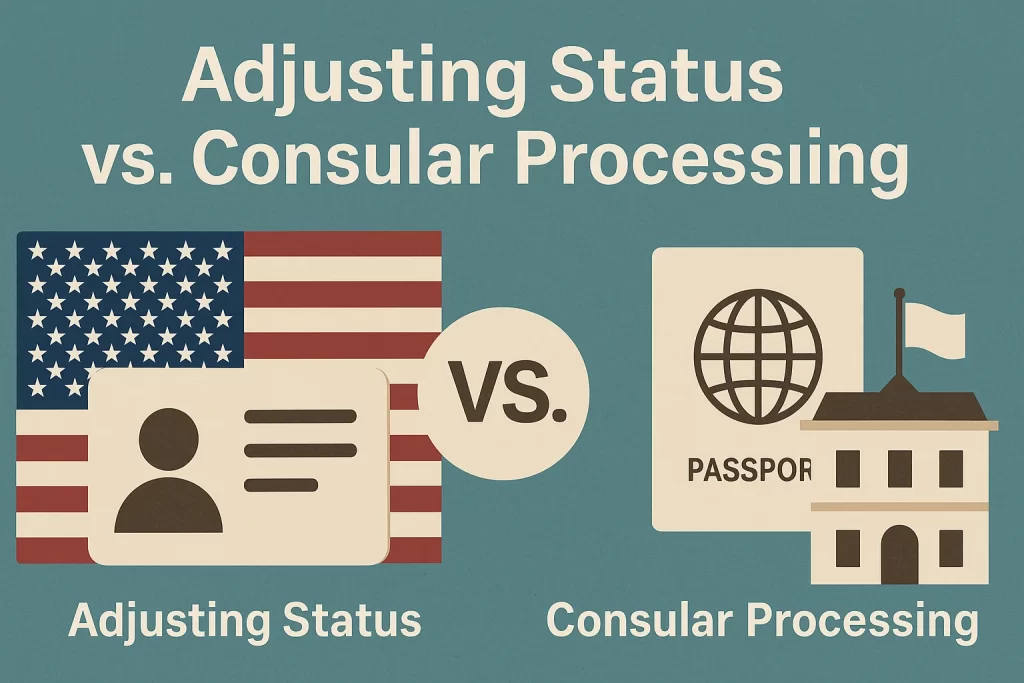
So, you’ve got an approved petition—awesome! But now comes the next big question: Where do you finish your green card process? You’ve got two main paths: adjustment of status (AOS) if you’re already in the U.S., or consular processing if you’re still abroad.
Let’s break it down:
🔄 Adjustment of Status (AOS) is for people already inside the U.S. on a valid visa. Instead of leaving and applying from your home country, you submit Form I-485 to change your status directly to permanent resident.
Here’s why people love AOS:
But it’s not always perfect. Processing times can drag on for months—sometimes over a year—and if you make a mistake in your paperwork or fall out of status, things can go sideways fast.
🛃 Consular Processing, on the other hand, means you finish your immigration process at a U.S. embassy or consulate in your home country. This is the go-to option for people outside the U.S.
Why choose consular processing?
But you do need to attend a visa interview abroad and wait for your visa to be issued. Travel expenses and the possibility of delays due to backlogs or security checks are real concerns.
I had a friend who got married in the U.S. on a tourist visa, then filed for AOS. She ended up waiting 14 months for her green card but was able to stay and work in the meantime. Meanwhile, her cousin did consular processing for a family visa in Tunisia and got approved in 8 months, but had to wait abroad and worry about embassy closures during COVID.
📌 What to consider:
In short, both paths get you to the same finish line—a green card. It’s just about choosing the route that fits your situation best.
You’ve done the research, picked your path, and you’re ready to go—but hold up! Even the most well-intentioned applicants make avoidable mistakes that can delay or completely derail their U.S. immigration journey.
Let’s make sure you’re not one of them.
✅ Here’s how to stay safe and smart:
Trust me—this stuff matters. Immigration is not just paperwork—it’s your life. And when you do it right, all that stress and waiting pays off.
Let’s be real—immigrating to the United States legally isn’t always simple. But it is possible. Whether you’re applying through family, pursuing a degree, landing a job offer, investing in your future, or seeking safety from hardship—there’s a legal path made just for you.
You’ve now seen the easiest legal ways to immigrate to the U.S. in 2025. Maybe one of them clicked for you. Maybe you’re still figuring it out. That’s okay. The key is to stay informed, be persistent, and take it step by step.
💡 Here’s your roadmap recap:
No matter where you’re starting from, the most important thing is to move forward with knowledge, clarity, and integrity. Get the right info, lean on trusted sources, and never let fear or confusion stop you.
You’re not alone on this journey. Thousands are walking this road every day—step by step, form by form, dream by dream. And you? You’re already on your way.
🚀 So go ahead—bookmark this guide, revisit it as you plan, and take that next step toward building your life in the United States, legally and confidently.
Ready to dive deeper into U.S. immigration topics? Here are some trusted links and guides that can help you on your journey:


