Contents
The process can be life-changing, but it’s not cheap. Between USCIS filing fees, medical exams, attorney costs, and document preparation, the total price can quickly add up — especially with the 2026 fee updates that may slightly raise government charges.
Every path to a Green Card comes with its own costs. Whether you’re applying through marriage, employment, or family sponsorship, your total depends on the type of petition, how many people are applying with you, and whether you’re filing inside the U.S. or at a U.S. consulate abroad.
As of 2026, most applicants should expect to spend between $1,500 and $5,000 for the full process — but some cases, especially those involving attorneys or overseas processing, can reach $7,000 or more 💰.
This guide breaks down every part of that total:
Whether you’re an individual applicant or a family planning to file together, understanding these costs upfront will help you budget confidently, avoid surprises, and take the next step toward your American dream 🌎.
Let’s start by breaking down the official USCIS filing fees for Green Card applications in 2026 — and what each of them really means.
When planning your Green Card journey in 2026, understanding the official USCIS filing fees is the first step toward budgeting wisely. These fees vary depending on your category — whether you’re applying through family sponsorship, employment, or adjusting your status while already in the U.S.
The most common form, Form I-485 (Application to Register Permanent Residence or Adjust Status), is at the core of nearly every Green Card process. As of 2026, it’s expected to cost around $1,440, based on the 2024–2025 USCIS fee adjustments. This fee covers the main application but does not include medical exams or work/travel permits.
If you’re applying from outside the U.S., you’ll instead submit a DS-260 through the Department of State, along with the Affidavit of Support (Form I-864), which adds another $120 to $325 in processing charges.
Other essential forms and their 2026 costs include:
It’s important to note that each family member applying for a Green Card must pay their own fees — so costs multiply for spouses or children included in your case.
Employers and family sponsors are usually responsible for paying the petition filing fees (I-130 or I-140), while applicants handle the adjustment or consular fees.
In total, the average Green Card filing fees in 2026 range from $1,500 to $2,500 per person, depending on category and location. While USCIS occasionally offers fee waivers for qualifying low-income applicants, most cases require full payment before your application can be processed 💳.
Once these fees are paid, the next major step — and one that can often surprise applicants — is the medical examination. Let’s look at what that includes, and how much you should expect to spend in 2026.
After submitting your Green Card application, one key requirement you can’t skip is the USCIS medical examination. This step ensures that all applicants meet the health standards for U.S. immigration — and yes, it comes with its own price tag 💉.
Every applicant must undergo a medical exam conducted by a USCIS-approved civil surgeon (for those applying inside the U.S.) or a panel physician (for applicants abroad). The doctor completes Form I-693, Report of Medical Examination and Vaccination Record, which is then sealed and submitted with your application or brought to your interview.
In 2026, the average medical exam cost is expected to range between $200 and $500 per person, depending on your state or country. However, the total can climb higher if you need additional vaccinations, blood tests, or lab work.
Here’s a breakdown of what may be included:
Some clinics may offer bundled packages that include all required tests, while others charge separately for each vaccine or lab service. If you already have an updated vaccination record, bring it to your appointment to avoid paying for repeat shots 💡.
Tip: Always compare prices among local USCIS-certified doctors — fees can differ drastically even within the same city. Some clinics also offer discounts for families applying together or students adjusting their status.
For applicants filing abroad, medical exam fees are typically similar but must be paid in local currency at the designated medical facility listed by the U.S. Embassy or Consulate. It’s best to contact the consulate ahead of time for approved clinics and payment instructions.
Though this step may feel routine, missing or outdated medical forms can delay your Green Card approval. So, schedule your exam early and ensure your Form I-693 is properly signed, sealed, and submitted before your interview.
Next, let’s look at another major factor in your total budget — the attorney and legal service fees, which can vary widely depending on your case complexity ⚖️.

Hiring an immigration attorney is optional — but for many applicants, it’s one of the smartest investments in the Green Card process. Legal fees can feel steep upfront, yet they often save you time, stress, and costly mistakes down the line 💼.
In 2026, attorney fees for Green Card applications typically range between $1,500 and $5,000, depending on the complexity of your case. Family-based petitions like a marriage Green Card usually fall on the lower end, while employment-based or multi-step filings tend to cost more due to additional paperwork and coordination.
Most immigration attorneys offer either:
A standard legal package often includes:
Although it’s possible to file without a lawyer, the immigration system can be tricky — a missing signature, incorrect filing address, or overlooked form can cause delays or rejections that cost hundreds more in re-filing fees 🕐.
Tip: Before hiring anyone, ask for a written fee agreement that details what’s included, what’s extra, and when payments are due. Always verify that your lawyer is licensed and in good standing with their state bar association or accredited by the Department of Justice (EOIR).
If full legal representation is beyond your budget, consider nonprofit legal organizations or community-based immigration clinics. They often provide low-cost or free consultations, especially for family or humanitarian cases.
Working with a qualified attorney doesn’t just make the process smoother — it ensures that your application is accurate, timely, and fully compliant with 2026’s evolving immigration rules ⚖️.
Next, let’s compare the two main filing pathways — consular processing versus adjustment of status — and how each affects your total Green Card costs 🌍.
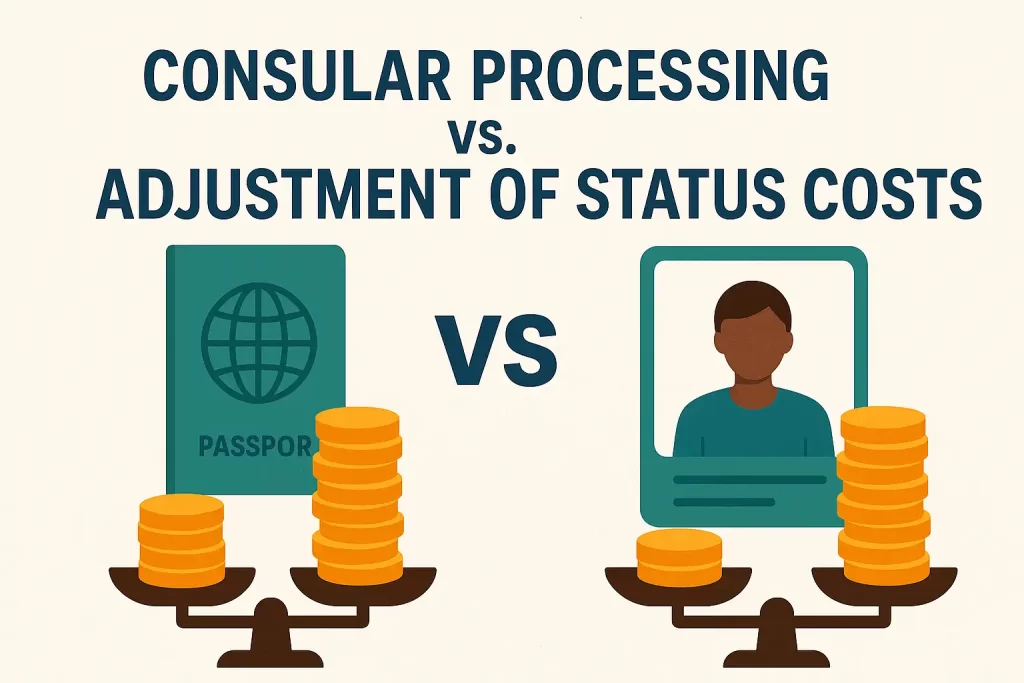
When applying for a Green Card in 2026, one of the biggest factors affecting your total cost is where you file. You’ll either apply through consular processing (outside the U.S.) or adjustment of status (inside the U.S.), and each path comes with different fees, timelines, and logistics ✈️.
Consular processing applies to applicants living abroad. In this route, your petition is approved by USCIS and then transferred to the National Visa Center (NVC) before your interview at a U.S. consulate or embassy. While it’s often faster, it includes additional international steps and fees:
In total, consular processing can range from $1,500 to $3,500 per person, depending on your location and travel costs.
Adjustment of status (AOS) applies to applicants already living legally in the U.S. under a different visa (such as an F-1 student or H-1B worker). This route allows you to apply for a Green Card without leaving the country.
Main costs for adjustment of status include:
Adjustment of status tends to cost slightly more overall — but it eliminates travel expenses, and you can usually remain in the U.S. while your case is processed 🏠.
Both options lead to the same result: lawful permanent residency. However, the right choice depends on your current visa status, location, and timeline. Applicants inside the U.S. often prefer adjustment of status for convenience, while those abroad typically go through consular processing to complete their visa interview in their home country.
Once your main filing route is chosen, there are still a few hidden costs that can catch you by surprise — let’s go over those next 💳.

Getting a Green Card is one of the most meaningful milestones in your U.S. immigration journey — but it doesn’t have to drain your savings 💳. With smart planning and attention to detail, you can cut hundreds (sometimes even thousands) of dollars off your total costs. Here’s how:
Saving money on a Green Card isn’t about cutting corners — it’s about being organized, informed, and proactive. A little preparation goes a long way toward keeping your journey smooth and affordable 🌟.
Next, let’s look ahead at what’s changing in 2026 — including expected USCIS fee updates and digital filing changes that could affect your final costs 📈.
Every few years, USCIS revises its fee schedule to reflect administrative costs, staffing needs, and technology upgrades. 2026 is shaping up to be another year of change — and anyone planning to apply for a Green Card should pay close attention to these updates 📈.
The last major adjustment came in 2024, with several forms seeing moderate increases. For 2026, USCIS is expected to propose a new round of fee revisions to support its digital modernization program. Early estimates suggest a 5–10% increase across core Green Card forms like the I-130, I-485, and I-765. These updates are designed to fund faster processing times, more online services, and improved customer support.
One of the most notable changes will likely be the expansion of online filing. More applicants will be able to file their I-485 and related forms digitally, reducing printing and courier costs 💻. While this won’t necessarily lower filing fees, it could make the overall process faster and more convenient.
Another expected shift: increased emphasis on biometric verification and case transparency. USCIS continues to invest in digital identity tools that streamline background checks and allow applicants to track their progress online. This means smoother communication — but also stricter accuracy requirements when submitting documents or personal data.
Policy experts also predict that USCIS will push for clearer cost breakdowns per form, helping applicants see exactly where their money goes. However, these updates could mean higher upfront fees for premium services, faster processing, and advanced document management.
Here’s what you can expect in 2026:
While none of these updates are confirmed yet, they point to a more digital, transparent, and secure immigration system — albeit at a slightly higher cost.
Tip: Always verify the latest fee schedule directly on the USCIS Fee Schedule page before you file. Using outdated numbers or forms is one of the most common reasons for rejection.
Up next, we’ll wrap everything together — with a clear, realistic look at the total cost of getting a Green Card in 2026, and how to plan your application with confidence 🧭.
So, how much does it cost to get a Green Card in 2026? On average, applicants should expect to spend between $1,500 and $5,000 for a standard case — but depending on your situation, that number can rise to $7,000 or more once attorney fees, medical exams, and family applications are added 💰.
While the total may seem high, your Green Card is more than just a document — it’s your gateway to permanent residency, long-term stability, and a path to U.S. citizenship 🇺🇸. For employers, it represents an investment in global talent and workforce growth.
In 2026, new USCIS fee updates and digital filing systems will make the process more efficient but slightly more expensive. Planning ahead will help you stay on budget and avoid surprises. Start by:
Remember, every case is different — a family-based Green Card will look different from an employment-based one, and consular processing has unique costs compared to adjustment of status. But no matter your path, being informed is your greatest advantage.
The Green Card journey may take time, patience, and financial preparation, but it’s a long-term investment in your future. With the right guidance, organization, and understanding of 2026’s updated requirements, your path to U.S. permanent residency can be smooth and successful 🌍✨.
If you’re planning to apply in 2026, now is the best time to start preparing your documents, checking the latest fees, and getting professional guidance.
📩 Need help navigating your case? Visit usavisalaw.com/contact to schedule a consultation with our experienced immigration attorneys and start your Green Card journey with confidence.
Official USCIS Resources:
Helpful Guides from AVLG:
Government and Supportive Resources:


