Contents
The short answer is: it depends on your background.
Both EB-1A and EB-1B fall under the first-preference employment-based immigration category, which is designed for individuals at the top of their fields. However, the qualification criteria and filing process differ significantly.
The EB-1A category targets individuals who can prove extraordinary ability in their field — scientists, entrepreneurs, artists, athletes, and professionals who’ve achieved sustained national or international acclaim. It also allows self-petitioning, meaning you can apply without a U.S. employer or job offer.
The EB-1B, on the other hand, is tailored specifically for outstanding professors and researchers who have at least three years of teaching or research experience and a permanent job offer from a U.S. university or qualified institution. Because the employer handles the petition, EB-1B can feel easier in terms of documentation and presentation — but it’s limited to the academic and research sector.
So while EB-1B might appear simpler for university-affiliated researchers, EB-1A offers greater flexibility for independent professionals who can meet a higher standard of proof.
In this guide, we’ll explain the major differences between EB-1A and EB-1B, how USCIS evaluates each, and which option might be the better fit for your goals.
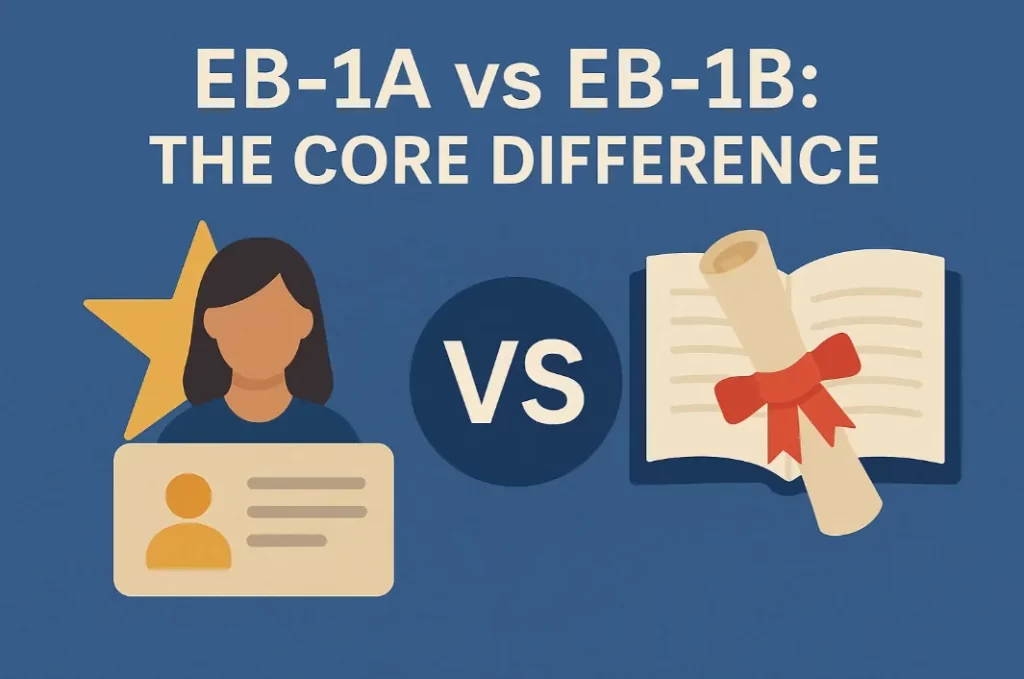
To understand whether EB-1B is easier than EB-1A, you first need to look at what separates the two. Both fall under the first-preference employment-based green card (EB-1) category — reserved for individuals who have reached the top of their fields — but the pathways and requirements differ in key ways.
The EB-1A is designed for professionals who can prove extraordinary ability in the sciences, arts, education, business, or athletics. Applicants must show national or international acclaim and evidence that they will continue to work in their field once in the U.S.
However, the trade-off is that the standard of proof is very high. You’ll need to demonstrate achievements that place you among the small percentage of individuals at the very top of your field.
Common EB-1A evidence includes:
This path offers maximum freedom and flexibility, but also requires strong documentation and clear proof of extraordinary ability — not just competence or excellence.
The EB-1B category targets professionals in academia or research. It requires employer sponsorship, meaning a U.S. university or qualifying research institution must file the petition on your behalf.
To qualify, you must:
Evidence can include:
While EB-1B applicants benefit from institutional support, the category is restricted to academic and research roles.
EB-1A offers independence
EB-1B offers
employer support and slightly lower evidentiary thresholds but applies to a narrower pool of candidates.
In short, EB-1A demands extraordinary ability, while EB-1B recognizes outstanding academic distinction.
The EB-1A Extraordinary Ability category sets one of the highest standards in the U.S. immigration system. To qualify, you must show that you belong to the small percentage of individuals who have reached the very top of your field—whether in science, business, education, arts, or athletics.
Applicants need to prove sustained national or international acclaim through documented achievements. USCIS allows two ways to do this:
USCIS officers then evaluate the totality of the evidence, deciding whether your record demonstrates the sustained acclaim required for this category.
The EB-1A also requires proof that you intend to continue working in your field after receiving your green card. This can be shown through job offers, contracts, or ongoing research and professional activities.
Because no employer or sponsor is needed, EB-1A applicants must carefully assemble and organize evidence to tell a clear story of their achievements and influence. This independence makes the category powerful—but also demanding.
Next, we’ll look at the EB-1B requirements and why some applicants find this category a more structured and collaborative route to a green card.
The EB-1B Outstanding Professors and Researchers category is part of the same first-preference EB-1 group but is specifically designed for academics and researchers who have earned international recognition for their contributions. While EB-1A focuses on extraordinary ability across all fields, EB-1B targets excellence within academia and research — and requires the backing of a U.S. employer.
To qualify for EB-1B, you must meet three main conditions:
EB-1B petitions must come directly from your sponsoring institution. The employer submits the I-140 petition along with your supporting evidence. Typically, this process involves collaboration between the applicant, the institution’s HR or international office, and their immigration counsel.
This makes EB-1B more structured and guided than EB-1A — but also less flexible, since it’s tied to a specific employer and job position. If your job ends before approval, the petition could be affected.
The EB-1B standard — “international recognition as outstanding” — is often viewed as slightly less demanding than EB-1A’s “extraordinary ability” threshold. However, the EB-1B is only available to academics and researchers with a permanent job offer in the U.S.
So, while EB-1B may seem easier for qualified professors and scientists, it’s not necessarily simpler — it’s just narrower in scope and dependent on institutional support.
In the next section, we’ll answer the central question — Is EB-1B actually easier to get than EB-1A? — by comparing eligibility flexibility, documentation standards, and overall approval trends.
This is one of the most common questions professionals and academics ask when exploring U.S. immigration options — is EB-1B actually easier than EB-1A?
The answer depends on your career background, level of independence, and type of evidence you can provide.
From a legal standpoint, EB-1B generally has a slightly lower evidentiary threshold than EB-1A because it targets a narrower group — professors and researchers with institutional backing. The EB-1A, on the other hand, demands a higher standard of proof — applicants must show extraordinary ability and sustained acclaim across their entire field, often without employer support.
Let’s break down the main differences that influence difficulty:
Verdict: EB-1B is technically easier in terms of the recognition standard, but it only applies to academic or research roles.
While EB-1B gives you the benefit of employer support, it also ties your petition to your employment — meaning if your job ends before approval, your case could be impacted.
Verdict: EB-1A offers more freedom but requires stronger evidence; EB-1B is easier procedurally if you have institutional backing.
Because the EB-1B focuses on research impact, the evidence can be more straightforward to collect if you have an established academic record.
Verdict: EB-1B documentation is more structured; EB-1A demands more diversity and narrative strength.
Recent USCIS data shows that EB-1B petitions tend to have slightly higher approval rates than EB-1A, primarily because they are filed through established employers who provide formal evidence packages. However, EB-1A approvals are growing among entrepreneurs, artists, and independent researchers who can clearly prove national or international acclaim.
Verdict: EB-1B has higher approval consistency; EB-1A has higher independence and flexibility.
In short, EB-1B can be easier
But if you’re an independent professional, innovator, or leader outside the university system,
EB-1A remains the best route — even if it’s harder to qualify.
In the next section, we’ll review approval trends and success rates to help you understand how each category performs in practice.

When comparing EB-1A and EB-1B, it’s helpful to look beyond the eligibility rules and focus on what happens in practice — approval rates, adjudication patterns, and the consistency of USCIS decisions.
The EB-1A category often attracts a wide range of professionals — from scientists and engineers to entrepreneurs, artists, and business leaders. Because of this diversity, the approval rate varies more widely.
According to recent immigration data and attorney experience, EB-1A approval rates typically range from 60% to 75%, depending on the strength of documentation and the clarity of the legal argument. The main reason for denials or Requests for Evidence (RFEs) is insufficient linkage between achievements and “sustained national or international acclaim.”
Applicants who present a well-organized petition — connecting each piece of evidence to USCIS criteria with a detailed legal brief — tend to achieve significantly higher success rates.
The EB-1B category usually shows higher and more stable approval rates, often between 80% and 90%, especially for applicants affiliated with well-known U.S. universities or research institutions.
There are several reasons for this trend:
However, EB-1B’s scope is narrower — only professors and researchers are eligible, and the applicant must maintain their employment during adjudication.
EB-1B cases, by contrast, may face RFEs about the
permanence of the position, employer eligibility, or quality of peer evaluations — issues tied more to procedural documentation than personal merit.
Statistically, EB-1B appears easier EB-1A remains the more flexible route for independent professionals, provided that your evidence is strong, consistent, and strategically presented.
Your chances of success depend less on the label of the category — and more on how well your achievements are documented and argued under USCIS standards.
Deciding between EB-1A and EB-1B often comes down to your career background, professional goals, and how much control you want over the immigration process. Both categories fall under the first employment-based preference, but they serve different applicant profiles and offer distinct advantages.
If you are an independent professional, entrepreneur, or expert whose achievements extend beyond a single employer, EB-1A may be the ideal choice. It allows you to self-petition, which means you don’t need an employer or job offer. You can apply from anywhere — even while working abroad — as long as you can prove extraordinary ability.
EB-1A is particularly beneficial if:
This flexibility makes EB-1A attractive to business leaders, creative professionals, consultants, and researchers in the private sector who want long-term autonomy.
If your career is centered in academia or research, and you already have a permanent position with a U.S. university or research institution, EB-1B may be the more efficient route.
EB-1B offers:
However, EB-1B is tied to your sponsoring employer. If your employment ends before your green card is approved, your petition may no longer be valid.
Ask yourself these three questions:
If you value independence and have wide-ranging recognition beyond a single employer, EB-1A may be worth the higher evidentiary challenge.
In the next section, we’ll wrap up with a clear conclusion summarizing the real differences between EB-1A and EB-1B, and what makes one route better suited than the other based on your professional journey.
So, is EB-1B easier than EB-1A
The answer depends entirely on
your profile, your goals, and the nature of your achievements.
If you’re a professor or researcher with a permanent position at a U.S. institution, EB-1B can indeed feel more straightforward. Its evidentiary standard — being “outstanding” rather than “extraordinary” — and its structured, employer-backed process often result in higher approval rates.
However, that comes with trade-offs: EB-1B is limited to academic and research positions, and you depend on your employer’s support to file and maintain the petition.
By contrast, EB-1A offers unmatched independence. You can self-petition, apply from anywhere in the world, and take your future into your own hands. But that flexibility comes with a higher burden of proof — you must show that your work has reached the very top of your field and gained sustained recognition across borders.
In essence:
Whichever route you pursue, success comes down to how well your achievements are documented, explained, and aligned with USCIS criteria.
A carefully prepared petition — supported by credible evidence, expert letters, and a strategic legal brief — can make either pathway a strong route to U.S. permanent residency.
If you’re unsure which category suits you best, consulting an experienced immigration attorney can help identify the strategy that fits your credentials and long-term plans.
For more resources and official guidance about the EB-1A and EB-1B immigration categories, explore these helpful links:


