Author: Hasan Abdullah, Esq.
Edited: The 18th of September 2026
The H-1B visa is not only for Indian applicants. Qualified professionals from any country may be eligible when the U.S. employer, offered position, and worker meet the H-1B requirements. There is no separate H-1B quota reserved specifically for Indian citizens.
So why is the H-1B so closely associated with India? The numbers explain much of it. According to USCIS H-1B data for FY 2024, 71% of beneficiaries of approved H-1B petitions were born in India, while about 12% were born in China. Indian professionals therefore make up a large share of the H-1B population, but nationality itself is not what determines eligibility.
American Visa Law Group works with employers and foreign professionals on H-1B visa petitions, including cap filings, transfers, extensions, amendments, cap-exempt cases, and specialty-occupation issues.
The rules also changed in 2026. For the FY 2027 cap season, DHS implemented a weighted H-1B selection process that generally gives greater selection weight to registrations connected to higher wage levels. The rule took effect on February 27, 2026. It does not give Indian applicants a nationality-based preference.
This guide explains the H-1B visa for Indians in 2026, who can qualify, how cap selection works, how to apply from India or the United States, and why India’s employment-based green card backlog is a separate issue from H-1B eligibility.
No. The H-1B visa is not restricted to Indian citizens. Qualified foreign professionals from any country may be eligible when a U.S. employer files a qualifying petition and the offered position meets the requirements for an H-1B specialty occupation.
The H-1B program is designed around the job, employer, and worker’s qualifications—not the worker’s nationality. USCIS generally looks at whether the position requires the theoretical and practical application of highly specialized knowledge and whether the worker has the education, credentials, or equivalent qualifications needed for that position.
Indian professionals make up a large share of approved H-1B beneficiaries, but that reflects participation in the program rather than an India-specific eligibility rule. Professionals from China, Canada, the United Kingdom, Mexico, South Korea, and many other countries may also qualify when the H-1B requirements are satisfied.
For employers and professionals assessing whether a particular role qualifies, USCIS focuses on the specific duties of the position, the degree or equivalent expertise normally required, and the relationship between that background and the work to be performed. A job title alone does not establish H-1B eligibility.
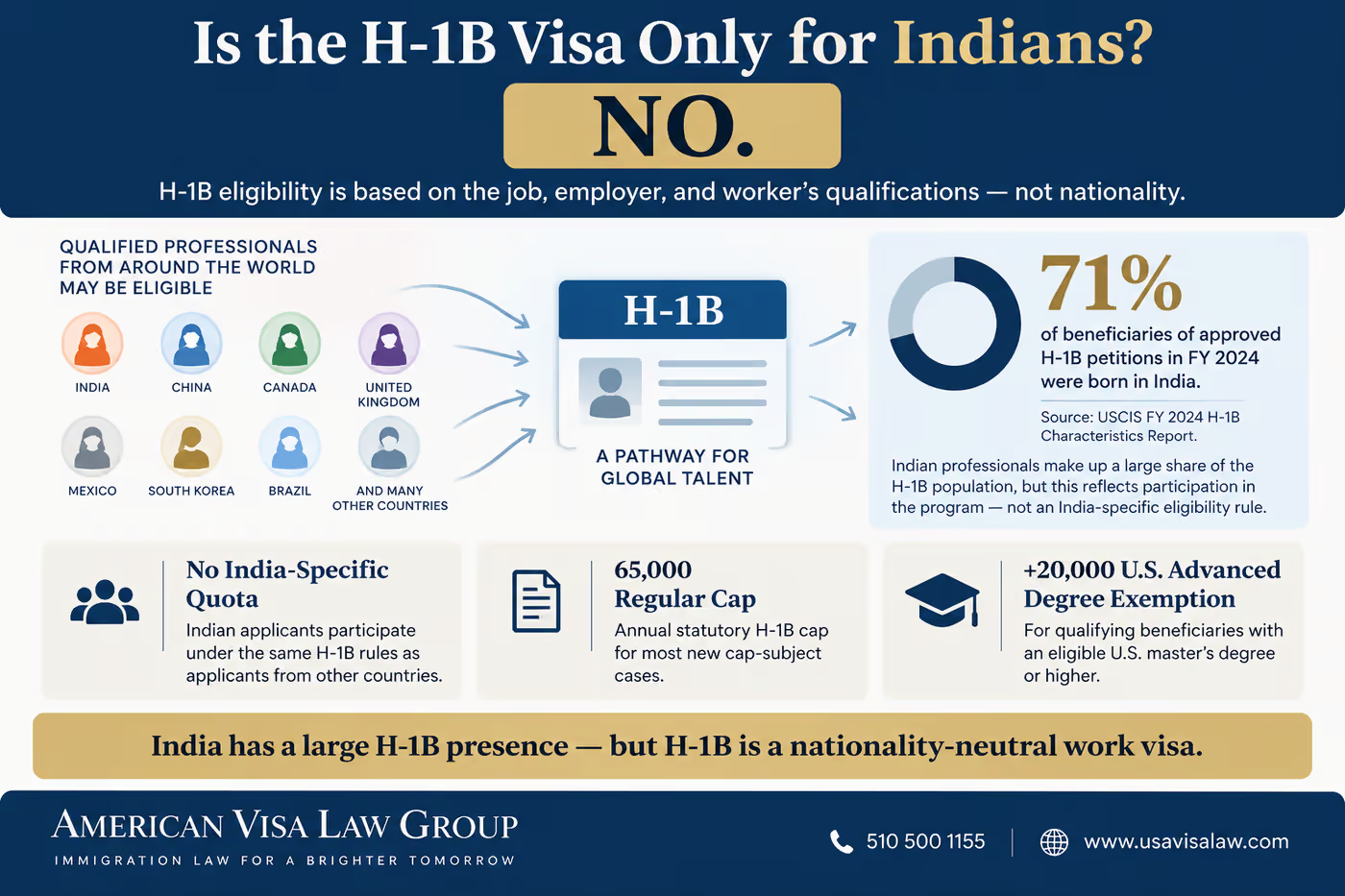
No. There is no separate H-1B quota reserved for India.
The principal H-1B numerical limit is a general annual cap of 65,000, with an additional 20,000 places available under the U.S. advanced degree exemption for qualifying beneficiaries who earned a master’s degree or higher from an eligible U.S. institution. Certain petitions are also exempt from the numerical cap, including qualifying filings by institutions of higher education and certain nonprofit or governmental research organizations. (uscis.gov)
Those numbers are not divided into separate quotas for India, China, or other countries.
This is an important distinction from the employment-based immigrant visa system, where country of chargeability can become highly significant because of annual per-country limits and Visa Bulletin backlogs. An Indian professional may therefore face a long wait in certain employment-based green card categories without there being a corresponding India-specific H-1B quota.
Applicants should also avoid confusing the regular H-1B program with the separate H-1B1 classification for certain nationals of Chile and Singapore, which exists under U.S. free trade agreements. USCIS filing guidance treats H-1B1 as a distinct category.
So the practical answer is straightforward: Indian citizenship neither creates H-1B eligibility nor gives an applicant a special H-1B allocation. Eligibility depends on the position, the employer or petitioner, the worker’s qualifications, and—when the petition is cap-subject—the applicable H-1B selection process.
Indian professionals represent a large share of the H-1B program, but that does not mean the visa is designed specifically for India.
According to the USCIS FY 2024 H-1B report, 71% of beneficiaries of approved H-1B petitions were born in India. China was the second-largest country of birth at approximately 12%. USCIS reports these figures by country of birth, so they should not be described as citizenship statistics.
Several structural factors help explain the concentration.
A substantial portion of H-1B employment is concentrated in technical occupations where Indian professionals are heavily represented.
USCIS reported that in FY 2024, 52.1% of approved H-1B petitions were for occupations in systems analysis and programming, with another 7.9% in other computer-related occupations. Engineering, higher education, healthcare, business, and other specialty occupations also appear in the H-1B data.
That occupational mix helps explain why the H-1B program is often associated with Indian software engineers, developers, data professionals, and other technology workers.
But the distinction matters: H-1B is not an IT-only visa, and Indian H-1B beneficiaries are not limited to technology occupations. The legal question is whether the offered position qualifies as a specialty occupation and whether the beneficiary has the qualifications required for that particular job.
H-1B is an employer-driven classification.
A U.S. employer or other qualifying petitioner generally identifies a specialty-occupation position and files the H-1B petition for the foreign professional. Employers use the classification across sectors where positions require specialized knowledge and qualifying educational or professional backgrounds.
As a result, the number of Indian professionals in H-1B status reflects not only the supply of skilled workers from India but also U.S. employer demand in fields where Indian professionals frequently have relevant education and experience.
Nationality itself does not create an advantage under the H-1B eligibility standard.
Another important route into H-1B begins with U.S. education.
International students may study in F-1 status and, if eligible, work temporarily through Optional Practical Training or STEM OPT. An employer may later seek H-1B status for that worker if the position and beneficiary satisfy the applicable requirements.
USCIS data shows how significant this pathway is generally. Of the 73,571 FY 2024 approved new-employment H-1B petitions requesting a change of nonimmigrant status, 71.2% reported the beneficiary’s prior status as F-1 or F-2.
That statistic is not specific to Indian students, so it should not be used to claim that 71% of Indian H-1B workers came through F-1 status. It does, however, show that the U.S. student-to-H-1B pathway is a major part of the program overall.
For Indian professionals, this can mean two common routes: being sponsored for H-1B while already in the United States after studying or working in another valid status, or being sponsored by a U.S. employer while living in India and later completing the visa process abroad.
The larger point is straightforward: Indian professionals dominate H-1B statistics because they participate heavily in occupations, education pathways, and employer-sponsored roles that use the H-1B program—not because immigration law reserves the visa for India.
An Indian professional qualifies for H-1B under the same legal standards as an applicant from any other country. The case generally needs to establish four things: the job qualifies as a specialty occupation, the worker is qualified for that job, a qualifying petitioner files the petition, and the employer obtains a certified Labor Condition Application.
Nationality does not replace any of these requirements.
The H-1B classification is intended for positions requiring the theoretical and practical application of highly specialized knowledge and at least a bachelor’s degree or equivalent in a directly related specific specialty.
The current rules do not require every employer to identify only one possible degree major. Under the H-1B modernization framework that took effect in January 2025, there must instead be a logical connection between the required degree field and the duties of the position. More than one degree field may potentially qualify when each is directly related to the work.
That change can be important for modern positions that legitimately draw from several related disciplines.
For example, a specialized technology position might reasonably accept degrees in computer science, computer engineering, or another closely related technical field when the employer can explain how those areas of study connect to the actual duties.
But an employer generally cannot make a position qualify simply by stating that “any bachelor’s degree” is required. USCIS evaluates the specific job duties and the knowledge needed to perform them. The agency’s H-1B modernization guidance explains the updated specialty-occupation framework, which became effective January 17, 2025.
The job title alone is not enough. Two employees with the same title can perform very different work, so the petition should describe what the beneficiary will actually do and why those duties require specialized education.
The beneficiary must also possess the qualifications needed to perform the specialty occupation.
In many cases, this means holding a U.S. bachelor’s or higher degree in the required specialty or a foreign degree that is equivalent to the relevant U.S. degree.
Applicants who completed their education in India may therefore need documentation showing how their academic credentials correspond to the degree requirements of the offered position. Depending on the case, professional licenses or qualifying combinations of education, specialized training, and experience may also become relevant.
The important connection is between the worker’s qualifications and the particular specialty occupation being offered.
A highly qualified professional does not automatically qualify for H-1B if their education or equivalent expertise does not support the specific position described in the petition.
Unlike EB-1A or certain EB-2 NIW cases, an H-1B beneficiary generally does not self-petition.
A U.S. employer or other qualifying petitioner files the H-1B petition with USCIS, normally using Form I-129, Petition for a Nonimmigrant Worker.
The petition must establish the qualifying position and the beneficiary’s eligibility for that employment. Current H-1B regulations also allow certain beneficiary-owned businesses to petition when the applicable requirements are satisfied, but forming or owning a company does not by itself create H-1B eligibility.
The underlying position must still qualify, and the petition must comply with the H-1B rules.
Before filing the H-1B petition with USCIS, the employer generally must obtain a certified Labor Condition Application, or LCA, from the U.S. Department of Labor.
Through the LCA, the employer makes several required attestations concerning wages and working conditions. Under Department of Labor H-1B guidance, employers submit Form ETA-9035E through the FLAG system before filing the corresponding H-1B petition.
One of the central wage requirements is that the H-1B worker generally must be paid at least the higher of the actual wage paid to similarly qualified workers at the employer or the prevailing wage for the occupation in the area of employment. The LCA also contains protections concerning working conditions and employee notice.
For Indian applicants, the practical takeaway is straightforward: being from India neither helps nor prevents H-1B eligibility. The case depends on whether the position qualifies, the worker is appropriately qualified, and the sponsoring employer properly completes the H-1B process.
Indian applicants are subject to the same H-1B cap rules as applicants from other countries. There is no separate H-1B cap for India and no fixed number of H-1B visas reserved for Indian nationals.
For most private-sector employers filing a new cap-subject H-1B petition, the annual system includes two main numerical categories:
The advanced degree exemption applies to qualifying beneficiaries who have earned a master’s degree or higher from an eligible U.S. institution of higher education. USCIS has repeatedly described the annual H-1B framework as the 65,000 regular cap plus the 20,000 U.S. advanced degree exemption.
An Indian professional with a qualifying U.S. master’s degree may therefore potentially benefit from the advanced-degree exemption, but Indian nationality itself does not provide any additional cap allocation or preference.
Not every H-1B petition is subject to the annual numerical cap.
Certain employers may file cap-exempt H-1B petitions, including qualifying institutions of higher education, related or affiliated nonprofit entities, nonprofit research organizations, and governmental research organizations. USCIS evaluates whether the employer and employment arrangement satisfy the applicable cap-exemption requirements.
This distinction can be especially important for professionals working in universities, medical or academic institutions, and research settings.
Some petitions involving workers who have already been counted against the H-1B cap may also be filed without going through a new cap selection. For example, petitions to extend H-1B status, change certain terms of employment, or move an already cap-counted H-1B worker to another qualifying employer generally do not use a new cap number.
That is why the phrase “H-1B lottery” does not describe every H-1B case.
No.
The large number of Indian H-1B beneficiaries reflects the volume of Indian professionals sponsored for qualifying U.S. jobs—not a separate India allocation.
For cap-subject cases, Indian professionals participate under the same statutory H-1B cap structure as other foreign workers. The system does not reserve a percentage of the 65,000 regular-cap numbers or 20,000 advanced-degree-exemption numbers for India.
This is also different from the employment-based green card system, where country of chargeability and per-country numerical limits can significantly affect Indian applicants. We will discuss that distinction later because it is one of the main reasons H-1B and green card statistics for India are often confused.
Applicants should also remember that being eligible for the cap does not mean a petition can automatically be filed. When USCIS receives more qualifying cap registrations than available numbers, a selection process determines which petitioners may proceed with cap-subject filings.
And in 2026, that selection process changed significantly.
For a broader explanation of those changes, AVLG’s guide to the new H-1B rules provides additional context on the evolving cap and petition framework.
The H-1B cap selection process changed significantly for the FY 2027 cap season. Instead of treating every eligible beneficiary as having the same weight in a purely random selection, DHS introduced a weighted selection process that generally gives greater selection weight to positions associated with higher wage levels.
The new rule took effect on February 27, 2026 and applies when USCIS receives more cap registrations than it expects to need to reach the annual H-1B numerical limits. (federalregister.gov)
Importantly, the change does not create a preference for Indian workers or applicants from any other country. The weighting is tied primarily to the wage level associated with the offered position.
Under the new system, USCIS generally assigns a registration a weight based on the applicable Occupational Employment and Wage Statistics, or OEWS, wage level for the occupation and area of intended employment.
The basic structure is:
This means a position associated with a higher wage level generally has a greater chance of selection than a position at a lower wage level. DHS explained that the purpose of the rule is to generally favor higher-skilled and higher-paid H-1B employment while continuing to give employers access to workers at all wage levels. (federalregister.gov)
The change should not be interpreted as a guarantee.
A Wage Level IV registration is not automatically selected, and a Wage Level I registration is not automatically rejected. The system remains a selection process when demand exceeds available H-1B numbers; the weighting changes the relative chances within that process.
USCIS also continues to use a beneficiary-centric framework. The selection process is organized around unique beneficiaries rather than simply allowing multiple registrations to multiply a person’s opportunities in the way the older registration system once permitted. Current regulations direct USCIS to conduct weighted selection among unique beneficiaries when registrations exceed the number projected to be necessary to reach the cap. (federalregister.gov)
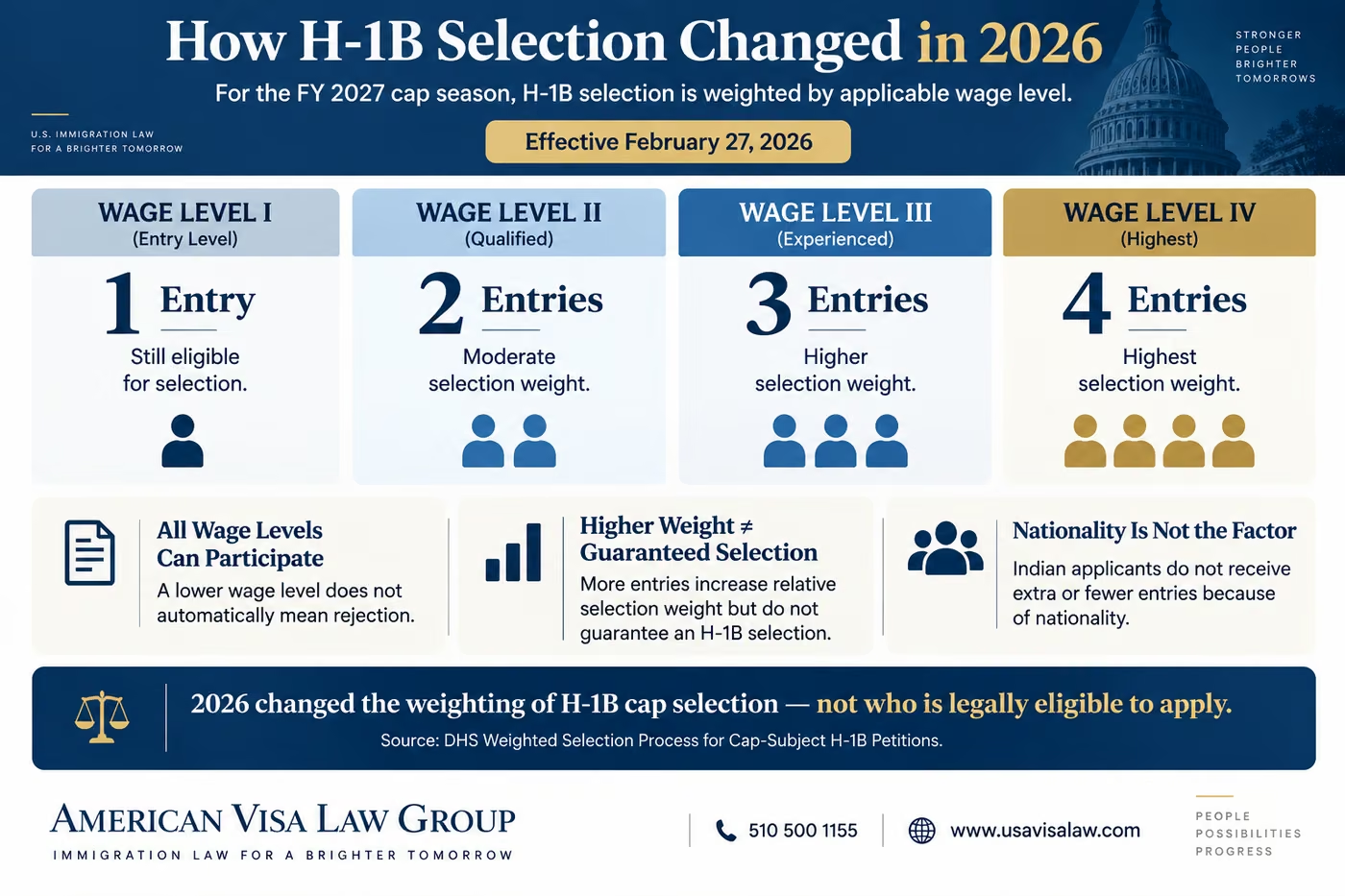
For Indian applicants, this is the key point:
The new weighted system favors certain wage levels, not nationalities.
An Indian software engineer, a Chinese researcher, a Canadian financial analyst, and a professional from another country are evaluated under the same cap-selection framework when their cases are cap-subject.
Indian professionals may still represent a large percentage of H-1B registrations and approved petitions because of their strong participation in occupations that use H-1B sponsorship. But Indian citizenship itself does not provide extra entries, reduce the number of entries, or create a separate selection category.
This is another reason not to confuse the H-1B system with the employment-based green card system, where country of chargeability can directly affect visa availability.
For a broader discussion of these policy changes, AVLG’s guide to the new H-1B rules for 2026 examines the evolving H-1B framework in more detail.
For the FY 2027 cap season, USCIS opened the initial registration period on March 4, 2026, and closed it on March 19, 2026. Employers and representatives were required to submit registrations electronically through a USCIS online account and pay a $215 registration fee for each beneficiary. USCIS stated that it intended to issue initial selection notifications by March 31, with April 1 as the earliest date for filing petitions based on registrations selected during the initial round.
Selection is only permission to move to the next stage.
A selected employer still must file the H-1B petition and establish that the offered position qualifies as a specialty occupation, that the beneficiary is qualified for the position, and that the other applicable H-1B requirements are satisfied.
Practical takeaway: The 2026 rules changed how cap-subject H-1B registrations are selected, but they did not turn H-1B into a nationality-based program. For Indian applicants, the relevant selection factor is the structure of the petition and applicable wage level—not Indian citizenship.
An Indian professional does not apply for H-1B independently in the same way someone applies for a visitor visa. In most cases, the process begins with a U.S. employer or qualifying petitioner that wants to employ the worker in a specialty occupation.
For a typical cap-subject case, the process generally follows this sequence:
Employer identifies a qualifying specialty-occupation position → Labor Condition Application → H-1B registration and selection, if required → Form I-129 petition → USCIS decision → change of status or visa processing, depending on the worker’s situation.
Before filing the H-1B petition, the employer generally must obtain a certified Labor Condition Application through the Department of Labor. The LCA contains required attestations concerning wages and working conditions and is filed through the DOL’s FLAG system.
If the position is subject to the annual H-1B cap, the employer must also participate in the applicable USCIS registration process. A selected registration allows the petitioner to move forward with the cap-subject petition; selection itself is not H-1B approval.
The employer then files Form I-129, Petition for a Nonimmigrant Worker, together with the supporting evidence showing that the position qualifies, the beneficiary is qualified, and the other H-1B requirements are met. USCIS’s current filing checklist requires cap-subject petitions to include the beneficiary confirmation number and selection notice where registration applies.
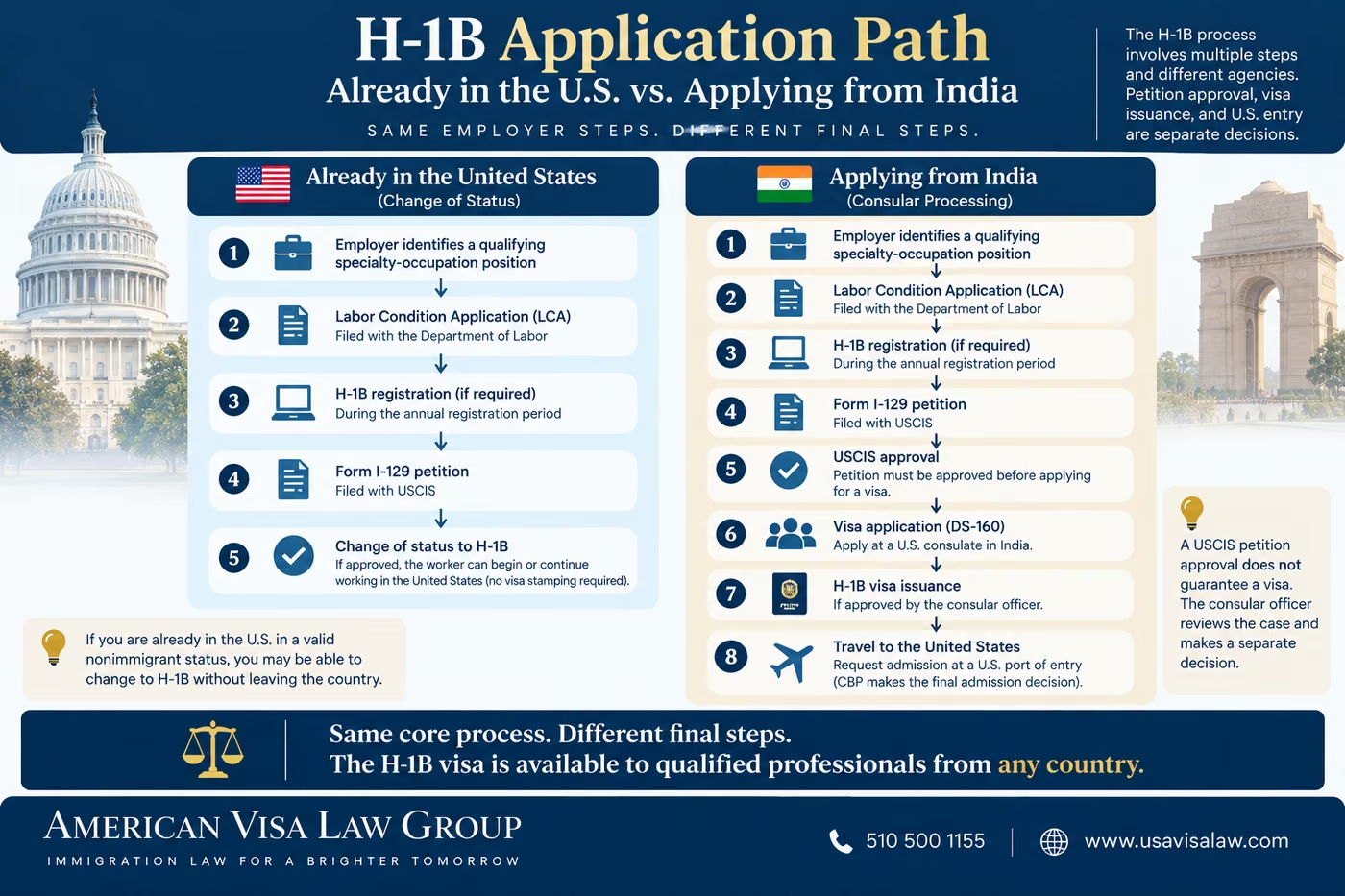
Many Indian H-1B applicants are already in the U.S. in another valid status, particularly F-1 status with OPT or STEM OPT.
Where the legal requirements are satisfied, the employer may ask USCIS to approve both the H-1B petition and a change of status to H-1B. This can allow the worker to move into H-1B status without first leaving the United States for visa issuance.
For eligible F-1 students with timely cap-subject H-1B filings requesting a change of status, the cap-gap rules may also extend F-1 status and, in qualifying cases, employment authorization while the H-1B petition is pending or until the applicable H-1B start date. USCIS includes specific cap-gap requirements in its current H-1B filing guidance.
The facts matter, however. Maintaining valid status, OPT expiration dates, travel, the requested H-1B start date, and how the petition is filed can all affect whether a change of status is available.
An Indian professional living in India can also be sponsored directly by a U.S. employer.
If USCIS approves the H-1B petition for consular processing, the approval does not by itself place the worker in H-1B status or guarantee issuance of an H-1B visa. The worker generally proceeds through the U.S. visa process before seeking admission to the United States.
The Department of State instructs petition-based temporary workers to complete the DS-160 nonimmigrant visa application, provide the petition receipt information, and follow the U.S. embassy or consulate’s instructions for scheduling and completing the visa process. A consular officer independently determines visa eligibility, and some applications may require additional administrative processing. Department of State temporary worker visa guidance explains the process in more detail.
After visa issuance, the worker may travel to a U.S. port of entry and request admission in H-1B classification.
The practical distinction is simple: an applicant already in the United States may seek a change of status if eligible, while an applicant in India generally needs petition approval followed by visa processing before traveling to begin H-1B employment in the United States.
For an Indian applicant outside the United States, an approved H-1B petition is an important step—but it is not the same as receiving an H-1B visa.
USCIS decides whether the employer’s petition qualifies for H-1B classification. The U.S. Department of State separately decides whether the worker is eligible for visa issuance at a U.S. embassy or consulate. USCIS itself notes that approval of an H-1B petition does not guarantee visa issuance or admission to the United States.
After petition approval, an applicant generally completes the DS-160 nonimmigrant visa application, follows the appointment instructions for the relevant U.S. consular post, and prepares the documents required for a petition-based temporary worker visa. The Department of State advises H-1B applicants to have the petition receipt number available and notes that petition-based workers should keep a copy of Form I-129 available when completing the DS-160.
For Indian applicants, current Department of State guidance says nonimmigrant visa applicants should generally schedule their interview in their country of nationality or residence. That makes India the natural processing location for most Indian nationals who live there, although applicants residing elsewhere may generally apply where they can demonstrate residence.
The visa process may involve an interview, document review, and—depending on the case—additional administrative processing. A consular officer can also request further evidence before deciding whether to issue the visa.
Applicants should therefore avoid treating the USCIS approval notice as the final step.
A useful way to think about the process is:
USCIS approves the H-1B petition → the Department of State decides visa issuance → CBP decides admission at the U.S. port of entry.
Each agency has a separate role.
For a more detailed explanation of appointments, documents, interview preparation, and common stamping issues, see AVLG’s H-1B visa stamping guide for 2026.
Practical takeaway: Petition approval allows an Indian professional to move forward with the visa process, but it does not guarantee that the visa will be issued or that admission to the United States will be granted.
The H-1B visa and the employment-based green card system are related, but they operate under different legal and numerical rules.
An Indian professional may qualify for H-1B under the same standards as a professional from any other country. India does not receive a separate H-1B quota, and Indian nationality by itself does not determine whether a cap-subject H-1B registration can be selected.
The green card process is different.
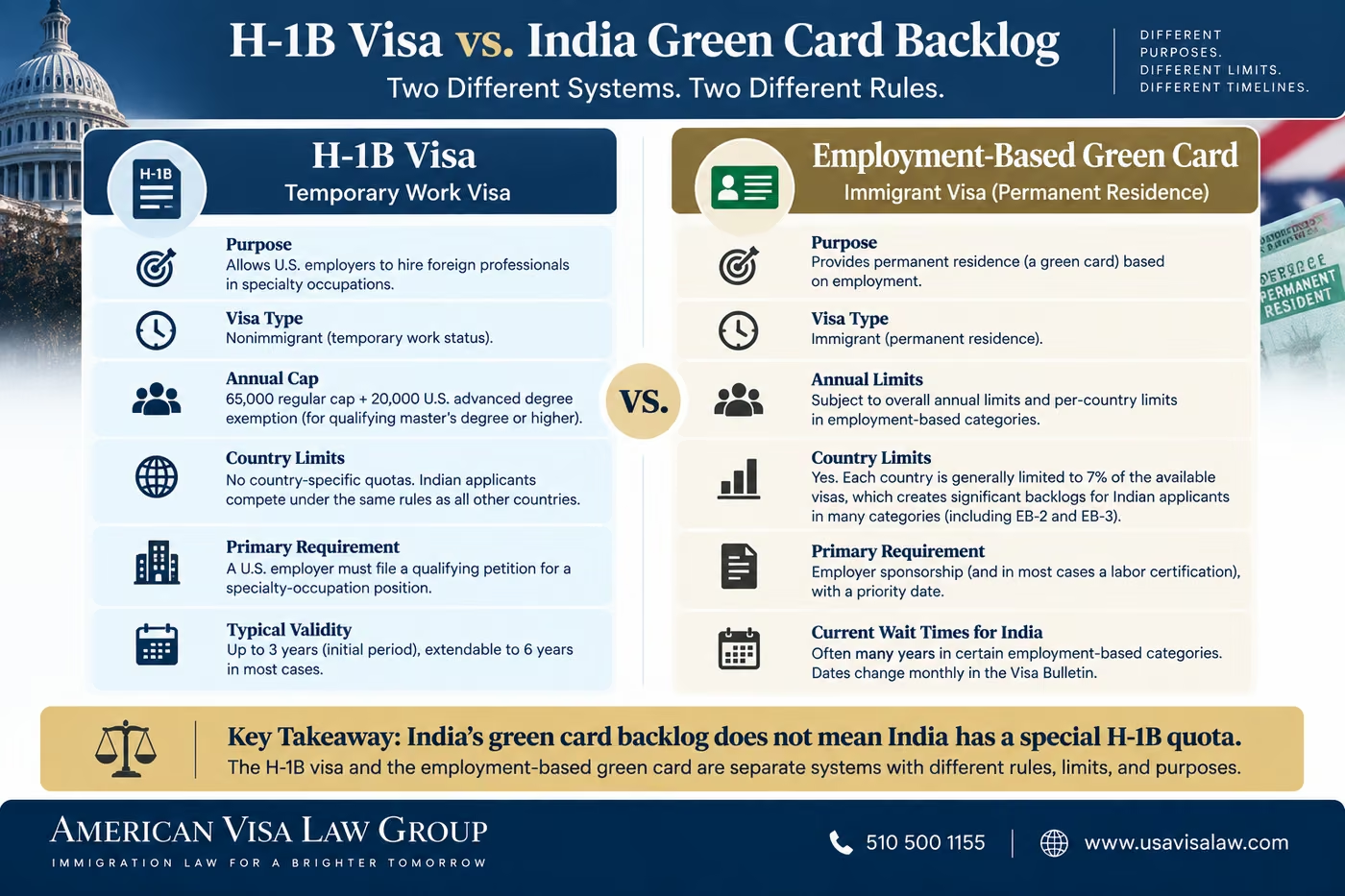
H-1B allows a qualifying professional to work temporarily in the United States for an authorized employer. It does not, by itself, grant permanent residence.
H-1B also permits dual intent, which means an H-1B worker may pursue permanent residence without that immigrant intent automatically preventing them from maintaining H-1B status. USCIS specifically recognizes that H-1B workers may be beneficiaries of immigrant petitions or take other steps toward lawful permanent residence. (uscis.gov)
For many Indian professionals, that means the H-1B period becomes the time during which an employer may begin an employment-based green card process.
But the green card case follows a separate system.
Depending on the category, an employment-based green card process may involve PERM labor certification, Form I-140, a priority date, and eventually Form I-485 adjustment of status or immigrant visa processing.
Employment-based immigrant visas are numerically limited, and the Department of State also applies per-country limits.
The September 2026 Visa Bulletin lists India as one of the oversubscribed chargeability areas. For FY 2026, the statutory per-country limit for family-sponsored and employment-based preference immigrants is generally 7% of the combined annual limits.
That is where being chargeable to India can have a major practical effect.
For example, in the September 2026 Final Action Dates chart:
Those dates do not mean that an Indian professional cannot obtain H-1B status. They show that immigrant visa availability for certain employment-based green card categories is heavily backlogged for applicants chargeable to India.
Demand for employment-based immigrant visas from India substantially exceeds the number that can be issued under the applicable numerical limits.
In May 2026, the Department of State announced that all available EB-2 immigrant visas for applicants chargeable to India had been used for FY 2026, making that category unavailable for the remainder of the fiscal year. New FY 2027 numbers become available when the fiscal year resets on October 1, 2026.
This is why an Indian H-1B worker may be legally employed in the United States for years while still waiting for an employment-based immigrant visa number to become available.
The worker’s priority date becomes especially important. USCIS explains that employment-based applicants generally must monitor the Visa Bulletin and compare their priority date with the applicable chart before they can move forward with Form I-485 when a visa number is required. (uscis.gov)
The key distinction is simple:
H-1B eligibility is based on the temporary specialty-occupation rules. India-specific green card delays arise from the separate employment-based immigrant visa system and its numerical limits.
For Indian professionals, the two processes should therefore be planned together—but they should never be treated as the same immigration issue.
No. H-1B is not limited to technology or IT jobs. The classification is available for qualifying specialty occupations across many professional fields when the position requires highly specialized knowledge and the worker has the required education or equivalent qualifications.
Technology does account for a large share of H-1B usage. According to USCIS FY 2024 H-1B data, computer-related occupations represented about 64% of approved H-1B petition beneficiaries. Architecture, engineering, education, medicine and health, mathematics and physical sciences, life sciences, management, and other professional categories also appeared in the data.
USCIS has long recognized occupations such as engineers, computer scientists, certified public accountants, college professors, and other professional roles as examples that may qualify when the actual position meets the specialty-occupation requirements.
The key point is that the job title alone does not determine H-1B eligibility.
A position must require the theoretical and practical application of highly specialized knowledge and normally require at least a bachelor’s degree or equivalent in a directly related specialty. USCIS evaluates the actual duties of the offered position, the nature of the employer’s business, and the educational background needed to perform the work.
That means an Indian professional may potentially qualify in fields such as:
At the same time, simply working in one of these industries does not automatically make a position H-1B eligible. An employer still must establish that the specific job satisfies the specialty-occupation standard.
This is why the common image of H-1B as an “Indian IT visa” is misleading. Indian technology professionals make up an important part of the program, but the H-1B classification itself is broader: it is based on qualifying specialty-occupation employment, not on nationality or membership in the technology industry.
Because Indian professionals make up such a large share of H-1B beneficiaries, several misconceptions about the program have become common. The most important distinction is that H-1B eligibility is based on the offered position, employer or petitioner, and worker’s qualifications—not Indian nationality.
False. H-1B is available to qualified foreign professionals regardless of nationality.
Indian professionals represent a large share of approved H-1B beneficiaries, particularly in computer-related occupations, but the immigration classification itself is not reserved for India. USCIS requires the petitioning employer to establish a qualifying specialty occupation and show that the beneficiary possesses the required qualifications. (uscis.gov)
False. The regular H-1B cap is not divided into country-specific allocations.
The principal annual cap includes 65,000 regular-cap numbers, plus an additional 20,000 under the U.S. advanced degree exemption. Indian applicants compete within the same cap framework as other cap-subject beneficiaries.
This is different from the employment-based green card system, where country of chargeability can substantially affect visa availability for Indian applicants.
That description is outdated for the FY 2027 cap season.
DHS implemented a weighted selection process under which unique beneficiaries are generally given more entries in the selection pool when the offered wage corresponds to a higher OEWS wage level. Wage Level IV receives four entries, Level III receives three, Level II receives two, and Level I receives one.
This does not create guaranteed selection at higher wage levels, nor does it exclude lower-wage registrations. It changes the relative weighting used when registrations exceed the number needed to reach the cap.
Most importantly for this article, nationality is not the weighting factor.
False. Technology accounts for a significant portion of H-1B employment, but the classification is available across qualifying specialty occupations.
Depending on the specific duties and educational requirements, H-1B positions can exist in engineering, medicine, accounting, research, education, architecture, finance, science, and other professional fields.
The question is not whether a job belongs to the technology industry. It is whether the specific position meets the specialty-occupation standard.
False.
For a cap-subject case, selection generally means the prospective petitioner is eligible to file the H-1B petition for that selected beneficiary during the applicable filing period. USCIS must still adjudicate Form I-129 and determine whether the position, beneficiary, petitioner, LCA, and supporting evidence satisfy the H-1B requirements. USCIS materials expressly distinguish selection from the later petition-filing and adjudication stage.
A petition can therefore still receive a Request for Evidence or be denied after cap selection.
False. H-1B is a temporary nonimmigrant classification, not permanent residence.
Many H-1B professionals later pursue employment-based green cards through categories such as EB-1, EB-2, or EB-3, but that process is legally separate and may involve PERM labor certification, Form I-140, priority dates, Visa Bulletin availability, and Form I-485 or consular processing.
For Indian professionals especially, this distinction matters because H-1B eligibility and India’s employment-based green card backlog are separate issues.
The simplest way to think about the program is this: H-1B is not an Indian visa, not an IT-only visa, and not a green card. It is an employer-driven temporary work classification with its own eligibility and selection rules.
The basic H-1B eligibility rules apply equally to Indian professionals and applicants from other countries, but several developments make 2026 an important year for H-1B planning. Applicants and employers should pay particular attention to wage level, specialty-occupation evidence, F-1 or OPT timing, visa processing, and long-term green card strategy.
For cap-subject cases, the biggest 2026 change is the new weighted H-1B selection process.
Higher OEWS wage levels generally receive greater weight in the selection process, although registrations at all wage levels may still participate. This does not mean an employer should artificially increase a wage level simply to improve selection prospects. The wage information used in the registration and petition must accurately reflect the offered position and comply with the applicable rules.
For Indian applicants, the practical point is that nationality does not determine selection—but the wage level associated with the position can now affect the registration’s relative weight.
AVLG’s guide to the new H-1B rules for 2026 discusses these changes in greater detail.
Selection is not approval.
Once selected, the employer still must establish that the position qualifies as a specialty occupation and that the beneficiary has the required educational or equivalent background.
This is particularly important for positions where several different degree fields may be accepted. Under the modernized H-1B framework, there should be a logical relationship between the qualifying degree fields and the duties of the position.
Employers should therefore pay close attention to job descriptions, degree requirements, organizational evidence, and the connection between the beneficiary’s education and the actual work rather than relying on a broad job title.
Indian students moving from F-1 status into H-1B should pay close attention to expiration dates and filing strategy.
A properly filed cap-subject H-1B petition requesting a change of status may provide eligible F-1 students with cap-gap protection, but whether employment authorization continues depends on the individual student’s circumstances and the applicable cap-gap rules.
Students should not assume that selection alone extends their status or employment authorization.
Timing can also become more complicated if the applicant travels internationally while relying on a change-of-status or cap-gap strategy. These issues should be reviewed before making travel plans.
For Indian professionals who need a new H-1B visa stamp, visa processing should be treated as a separate stage from USCIS petition approval.
Current Department of State guidance on nonimmigrant visa processing generally directs applicants to schedule visa interviews in their country of nationality or residence.
Department of State guidance also currently provides that most nonimmigrant visa applicants generally require an in-person interview, subject to limited exceptions. H-1B applicants are not broadly included among the current interview-waiver categories.
Because visa appointments, administrative processing, and travel timing can affect when a worker can return to the United States, H-1B professionals should avoid making important travel or employment plans based only on an approved Form I-797.
For more detail, see AVLG’s H-1B visa stamping guide for 2026.
For many Indian H-1B workers, the longer-term immigration issue is not obtaining H-1B status—it is managing the employment-based green card backlog.
Priority dates, PERM timing, Form I-140 strategy, job changes, H-1B extensions, and possible alternative immigrant categories can become increasingly important as the worker’s career develops.
That does not mean every H-1B worker should immediately begin a green card case. It does mean that Indian professionals should avoid treating H-1B status and permanent residence planning as completely separate decisions.
Practical takeaway: In 2026, strong H-1B planning means looking beyond registration. Wage level, specialty-occupation evidence, F-1 or OPT timing, visa stamping, international travel, and long-term permanent residence strategy can all affect the worker’s broader immigration path.
Not being selected in the H-1B cap process does not necessarily mean the end of a person’s U.S. immigration options. It does mean, however, that the employer generally cannot file that particular cap-subject H-1B petition based on an unselected registration.
What happens next depends on the worker’s current status, employer, professional background, and longer-term immigration strategy.
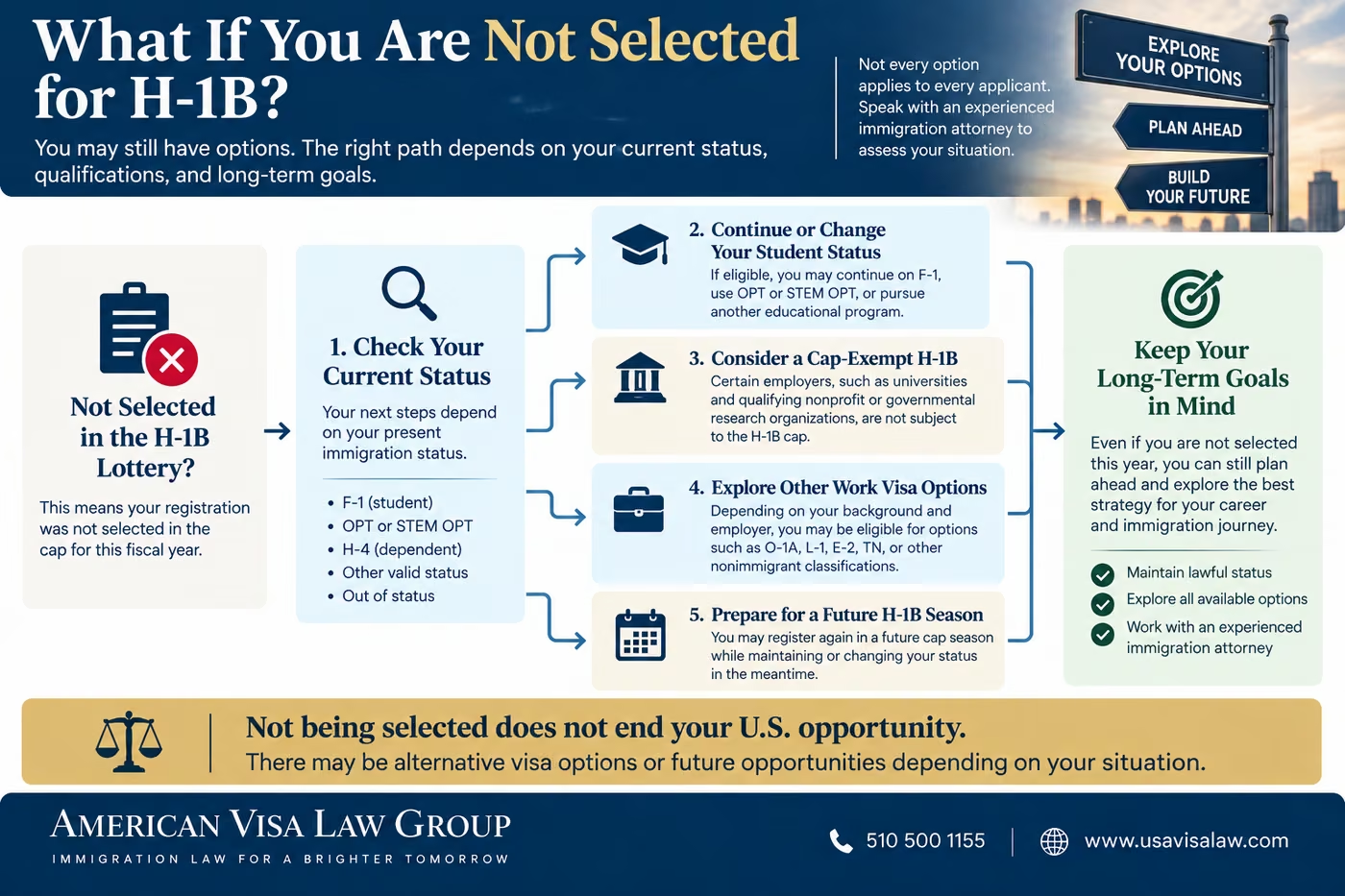
Indian students already working in the United States may be able to remain in F-1 status and continue authorized OPT or STEM OPT until their existing period of status or employment authorization expires, assuming they continue to satisfy the applicable requirements.
An important distinction is that H-1B registration alone does not create cap-gap protection. Cap-gap benefits are generally connected to a timely filed cap-subject H-1B petition requesting a change of status for an eligible F-1 student. If the registration is not selected and no H-1B petition can be filed, the student should not assume that their F-1 status or employment authorization has automatically been extended.
That makes OPT and STEM OPT expiration dates especially important when planning another H-1B cap season.
Some H-1B employment is exempt from the annual numerical cap.
Qualifying employers can include institutions of higher education, certain nonprofit entities related or affiliated with higher education institutions, nonprofit research organizations, and governmental research organizations. USCIS recognizes these statutory H-1B cap exemptions. (uscis.gov)
For a professional whose work fits an academic, medical, scientific, or research environment, a qualifying cap-exempt position may therefore provide a separate H-1B pathway that does not depend on annual cap selection.
The employer and employment arrangement still must independently satisfy the cap-exemption and H-1B requirements.
For some accomplished professionals, another nonimmigrant classification may be relevant.
An O-1A petition, for example, may be available to individuals who can demonstrate extraordinary ability in the sciences, education, business, or athletics through sustained national or international acclaim. USCIS updated its O-1A evidentiary guidance in 2025, including additional examples relevant to professionals in critical and emerging technologies. (uscis.gov)
An L-1 classification may be relevant in a different situation: where the worker has qualifying employment abroad with a multinational organization that has the required corporate relationship with a U.S. entity. USCIS generally requires qualifying employment abroad for at least one continuous year within the preceding three years, along with the other L-1 requirements. (uscis.gov)
These are not substitutes simply because an H-1B registration was unsuccessful. O-1A and L-1 each have their own eligibility standards.
Some professionals may also have potential employment-based immigrant options, including EB-1, EB-2 NIW, or employer-sponsored green card processes. But an immigrant petition does not automatically provide immediate work authorization or lawful status in the United States.
The right analysis therefore starts with the person’s current lawful status and work authorization, then considers whether a cap-exempt H-1B, another nonimmigrant classification, a future H-1B cap season, or a longer-term immigrant strategy fits the facts.
Practical takeaway: An unsuccessful H-1B cap selection closes that particular cap-subject filing opportunity, not necessarily every immigration path. The next step should be based on the worker’s actual status, qualifications, employer structure, and timing rather than treating another visa category as an automatic fallback.
Not being selected in the H-1B cap process does not necessarily mean the end of a person’s U.S. immigration options. It does mean, however, that the employer generally cannot file that particular cap-subject H-1B petition based on an unselected registration.
What happens next depends on the worker’s current status, employer, professional background, and longer-term immigration strategy.
Indian students already working in the United States may be able to remain in F-1 status and continue authorized OPT or STEM OPT until their existing period of status or employment authorization expires, assuming they continue to satisfy the applicable requirements.
An important distinction is that H-1B registration alone does not create cap-gap protection. Cap-gap benefits are generally connected to a timely filed cap-subject H-1B petition requesting a change of status for an eligible F-1 student. If the registration is not selected and no H-1B petition can be filed, the student should not assume that their F-1 status or employment authorization has automatically been extended.
That makes OPT and STEM OPT expiration dates especially important when planning another H-1B cap season.
Some H-1B employment is exempt from the annual numerical cap.
Qualifying employers can include institutions of higher education, certain nonprofit entities related or affiliated with higher education institutions, nonprofit research organizations, and governmental research organizations. USCIS recognizes these statutory H-1B cap exemptions. (uscis.gov)
For a professional whose work fits an academic, medical, scientific, or research environment, a qualifying cap-exempt position may therefore provide a separate H-1B pathway that does not depend on annual cap selection.
The employer and employment arrangement still must independently satisfy the cap-exemption and H-1B requirements.
For some accomplished professionals, another nonimmigrant classification may be relevant.
An O-1A petition, for example, may be available to individuals who can demonstrate extraordinary ability in the sciences, education, business, or athletics through sustained national or international acclaim. USCIS updated its O-1A evidentiary guidance in 2025, including additional examples relevant to professionals in critical and emerging technologies. (uscis.gov)
An L-1 classification may be relevant in a different situation: where the worker has qualifying employment abroad with a multinational organization that has the required corporate relationship with a U.S. entity. USCIS generally requires qualifying employment abroad for at least one continuous year within the preceding three years, along with the other L-1 requirements. (uscis.gov)
These are not substitutes simply because an H-1B registration was unsuccessful. O-1A and L-1 each have their own eligibility standards.
Some professionals may also have potential employment-based immigrant options, including EB-1, EB-2 NIW, or employer-sponsored green card processes. But an immigrant petition does not automatically provide immediate work authorization or lawful status in the United States.
The right analysis therefore starts with the person’s current lawful status and work authorization, then considers whether a cap-exempt H-1B, another nonimmigrant classification, a future H-1B cap season, or a longer-term immigrant strategy fits the facts.
Practical takeaway: An unsuccessful H-1B cap selection closes that particular cap-subject filing opportunity, not necessarily every immigration path. The next step should be based on the worker’s actual status, qualifications, employer structure, and timing rather than treating another visa category as an automatic fallback.
No. The H-1B classification is available to qualified foreign professionals regardless of nationality. Eligibility depends on the offered specialty-occupation position, the worker’s qualifications, the petitioning employer, and the applicable H-1B rules.
Indian professionals represent a large share of H-1B beneficiaries, but there is no rule limiting H-1B to Indian citizens.
According to USCIS FY 2024 H-1B data, 71% of beneficiaries of approved H-1B petitions were born in India.
That figure refers to beneficiaries of approved petitions by country of birth in FY 2024. It should not be interpreted as meaning that 71% of every person currently holding H-1B status is an Indian citizen.
No. India does not receive a separate H-1B allocation.
The principal annual H-1B cap is 65,000, with an additional 20,000 places under the U.S. advanced degree exemption for qualifying beneficiaries. Those numbers are not divided into India-specific or other country-specific quotas.
Potentially, yes.
H-1B eligibility is not restricted to a particular nationality. A qualifying U.S. employer or petitioner generally must file the petition, the position must meet the specialty-occupation requirements, and the beneficiary must possess the required qualifications.
For cap-subject cases, the beneficiary must also go through the applicable H-1B cap selection process before the employer can file the cap-subject petition.
No. Technology occupations account for a substantial share of H-1B employment, but H-1B can also be used for qualifying positions in engineering, healthcare, education, accounting, finance, architecture, scientific research, mathematics, and other professional fields.
The key question is whether the specific position qualifies as a specialty occupation, not whether the employer operates in the technology industry.
For the FY 2027 cap season, DHS uses a weighted selection process when eligible registrations exceed the number needed to reach the cap.
Unique beneficiaries associated with Wage Level IV receive four entries in the selection pool, Level III receives three, Level II receives two, and Level I receives one. All wage levels may still participate, but higher wage levels generally receive greater selection weight.
Indian nationality does not provide additional weight.
Yes, when the requirements are satisfied.
An employer may file an H-1B petition requesting a change of status for an eligible F-1 student already in the United States. If the case is cap-subject, the employer generally must first obtain a selected registration.
Eligible students may also qualify for cap-gap protection in certain circumstances, but selection alone does not automatically extend F-1 status or employment authorization.
Yes. A U.S. employer may sponsor a qualified Indian professional who is living in India.
The employer generally completes the H-1B petition process with USCIS first. After petition approval, the beneficiary may need to complete H-1B visa processing through the U.S. Department of State before traveling to the United States.
USCIS petition approval does not by itself guarantee visa issuance or admission at the U.S. border.
No. H-1B is a temporary nonimmigrant work classification, not permanent residence.
An H-1B worker may later pursue an employment-based green card if eligible, but that process follows separate rules involving categories such as EB-1, EB-2, or EB-3, priority dates, immigrant visa availability, and sometimes PERM labor certification.
For Indian professionals, this distinction is especially important because employment-based green card availability can be affected by significant India-specific backlogs. The Department of State Visa Bulletin is the official source for current employment-based cutoff dates.
For readers who want to explore the H-1B program in greater detail, these official government resources provide additional guidance on eligibility, cap selection, employer obligations, visa processing, and employment-based immigration.
The USCIS Characteristics of H-1B Specialty Occupation Workers, FY 2024 provides detailed government data on H-1B beneficiaries, including country of birth, occupations, education levels, wages, and petition types. It is particularly useful for understanding why professionals born in India represent such a large share of approved H-1B petitions.
The U.S. Department of Labor H-1B, H-1B1 and E-3 Specialty Workers resource explains the Labor Condition Application process, wage requirements, employer attestations, and other labor obligations connected with H-1B employment.
The DHS Weighted Selection Process for Cap-Subject H-1B Petitions provides the legal framework for the weighted H-1B selection system used for the FY 2027 cap season, including how applicable wage levels affect selection weighting.
The U.S. Department of State Temporary Worker Visas page explains the visa application process for H-1B workers applying outside the United States, including petition-based visa requirements, consular processing, and required documentation.
The September 2026 Visa Bulletin provides current employment-based immigrant visa cutoff dates and helps illustrate why the green card backlog affecting many Indian professionals is legally separate from the H-1B program.
The U.S. Department of Labor H-1B Worker Rights and Protections page explains wage protections, working-condition requirements, prohibited deductions, and other protections that apply to workers employed in H-1B status.
Together, these resources provide authoritative background on the H-1B rules discussed in this guide and help readers better understand the relationship between H-1B eligibility, annual selection, employer responsibilities, visa processing, and long-term permanent residence planning.

Hasan Abdullah, Esq. is the Founder and Managing Attorney of American Visa Law Group. His practice focuses on U.S. immigration law, including family-based immigration, employment-based immigration, adjustment of status, consular processing, waivers, PERM labor certification, NIW, EB-1, H-1B, O-1, and complex immigration strategy.
Through American Visa Law Group, Mr. Abdullah helps individuals, families, professionals, investors, and employers understand their immigration options and plan around changing government policies, USCIS procedures, and Visa Bulletin movement. His work emphasizes practical legal analysis, realistic expectations, and strategy tailored to each applicant’s immigration history and long-term goals.


