Author: Hasan Abdullah, Esq.
The July 2026 Visa Bulletin brings a difficult set of updates for many Indian green card applicants, especially those in employment-based categories. EB-2 India is unavailable, EB-5 Unreserved India is unavailable, EB-1 India has retrogressed, and EB-3 India moved only slightly forward. For Indian applicants who have already waited years in backlogged categories, these changes are more than monthly chart movements. They can affect filing strategy, pending Form I-485 cases, EAD and Advance Parole planning, job-change decisions, travel timing, and expectations for final green card approval.
The most serious development is EB-2 India becoming unavailable. In practical terms, this means immigrant visa numbers are not authorized for EB-2 India during July 2026. For applicants with pending adjustment of status applications, that does not automatically mean the case is denied. But it may mean USCIS cannot approve the green card until a visa number becomes available again. That distinction matters because many applicants confuse having a pending I-485 with being immediately eligible for final approval.
EB-1 India also requires close attention this month. The category retrogressed to October 15, 2022, which may affect applicants whose priority dates were previously closer to becoming current. EB-3 India moved forward to January 1, 2014, but the movement is limited compared with the size of the Indian employment-based backlog. For some applicants, that small movement may still matter. For many others, it is not enough to meaningfully change the broader waiting-period reality.
Indian EB-5 investors also face a major update. EB-5 Unreserved India is unavailable in July 2026, while EB-5 set-aside categories should be reviewed separately. This distinction is important because not every EB-5 case falls into the same visa availability category.
For July 2026, USCIS chart selection is also critical. Family-sponsored adjustment of status applicants may use the Dates for Filing chart, while employment-based adjustment applicants must use the Final Action Dates chart. That makes the employment-based India updates especially important because Final Action Dates are tied more closely to whether an immigrant visa number is available for approval.
This article explains what the July 2026 Visa Bulletin means for Indian applicants, with a focus on EB-1, EB-2, EB-3, EB-5, pending I-485 cases, EAD/AP planning, travel, job changes, and practical next steps. The goal is not just to summarize the dates, but to help Indian applicants understand what those dates may mean for real immigration decisions.
The July 2026 Visa Bulletin is especially important for Indian employment-based green card applicants because several major categories either moved backward, became unavailable, or advanced only slightly. For many applicants, the key issue is not simply whether a date changed. The more practical question is whether the July 2026 chart affects filing eligibility, final green card approval, EAD and Advance Parole planning, travel, or employment decisions.
For Indian applicants, the most serious update is that EB-2 India is unavailable in July 2026. This means immigrant visa numbers are not authorized for EB-2 India during the month. For applicants with pending Form I-485 applications, this does not automatically mean the case is denied, but it can prevent USCIS from approving the green card until a visa number becomes available again.
EB-1 India also retrogressed in July 2026. The Final Action Date moved back to October 15, 2022, which may affect applicants whose priority dates were previously closer to being current. EB-1 is often viewed as a more favorable employment-based category, but the July 2026 update shows that even EB-1 India can be affected by demand and visa number limits.
EB-3 India moved slightly forward to January 1, 2014. That movement may help some applicants with older priority dates, but it remains limited compared with the overall Indian employment-based backlog. Applicants should be careful not to assume that EB-3 movement automatically creates a better strategy than EB-2. The right analysis depends on the applicant’s petition history, priority date, employer support, and whether a pending adjustment case is involved.
Indian EB-5 investors also face a major update. EB-5 Unreserved India is unavailable in July 2026. However, EB-5 applicants should not stop the analysis there. EB-5 set-aside categories, including rural, high unemployment, and infrastructure categories, must be reviewed separately because visa availability may differ depending on the exact EB-5 classification.
The practical takeaway is clear: Indian applicants should review their exact category, priority date, country of chargeability, and the USCIS chart being used for July 2026 before making any immigration decision. A pending I-485, an approved I-140, or a previously current priority date does not always mean a case can move forward immediately. For July 2026, the details matter.
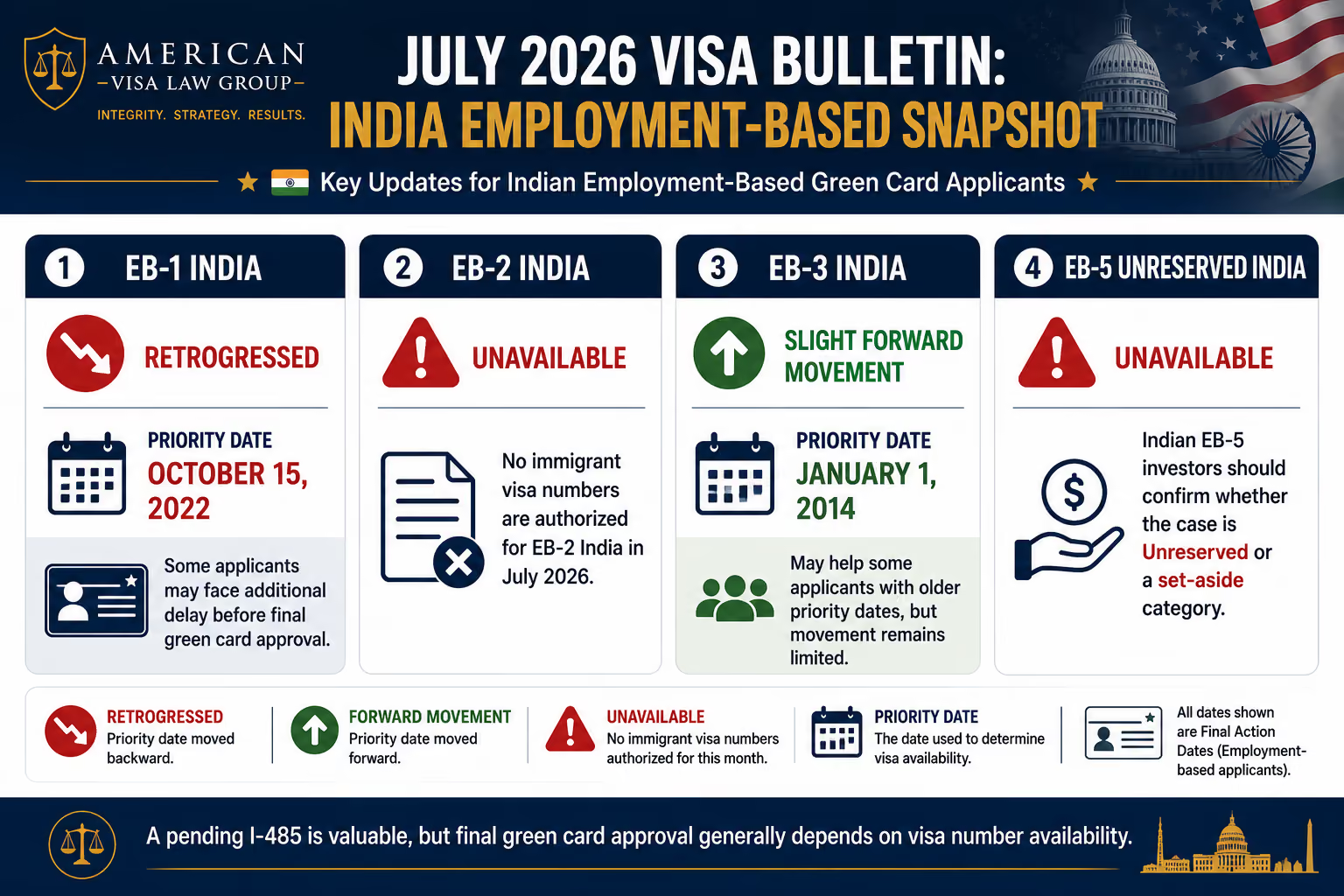
For Indian green card applicants, the July 2026 Visa Bulletin cannot be read by looking at the dates alone. The first question is which USCIS filing chart applies. This matters because the Department of State Visa Bulletin includes more than one chart, but USCIS decides each month which chart adjustment of status applicants may use when filing Form I-485 from inside the United States.
For July 2026, USCIS is allowing family-sponsored adjustment of status applicants to use the Dates for Filing chart. This may help some Indian family-based applicants if their priority date is earlier than the listed filing date and they are otherwise eligible to file. However, filing eligibility and final green card approval are not the same thing. A person may be able to file at one stage, but final approval still depends on visa number availability.
For employment-based adjustment of status applicants, USCIS is using the Final Action Dates chart in July 2026. This is especially important for Indian applicants because the most serious July 2026 changes are in employment-based categories. EB-2 India is unavailable, EB-5 Unreserved India is unavailable, and EB-1 India retrogressed under the relevant employment-based chart.
In simple terms, Final Action Dates are more closely tied to whether an immigrant visa number is available for final green card approval. If an Indian applicant’s priority date is not current under the Final Action Dates chart, USCIS generally cannot approve the Form I-485 that month, even if the case is otherwise pending and even if other parts of the application have already moved forward.
This is where many applicants make mistakes. A more favorable date in another chart does not automatically mean a person can file or receive approval. The correct chart depends on the case type, the month, and USCIS’s specific adjustment of status guidance.
For July 2026, the practical rule is straightforward: Indian family-sponsored applicants should check the family Dates for Filing chart, while Indian employment-based applicants should focus on the employment Final Action Dates chart. For EB-1, EB-2, EB-3, and EB-5 India applicants, using the correct chart is the starting point for every other decision.
EB-1 India moved backward in the July 2026 Visa Bulletin. The Final Action Date changed from December 15, 2022 to October 15, 2022, which means some Indian EB-1 applicants who were closer to becoming current may now face additional delay.
Retrogression does not mean that an applicant’s case is over. It usually means the government has moved the cut-off date backward because of visa number demand and annual limits. If an applicant’s priority date is no longer current under the applicable Final Action Dates chart, USCIS may not be able to approve the Form I-485 during that month, even if the application is already pending.
This can be frustrating for EB-1 India applicants because EB-1 is often viewed as one of the more favorable employment-based categories. But the July 2026 Visa Bulletin is a reminder that EB-1 India is still subject to demand, country limits, and visa number control. A strong petition approval does not remove the need for visa availability at the final green card stage.
Indian EB-1 applicants should pay close attention if their priority date is near late 2022. A small difference in priority date can affect whether the case is current, whether final approval is possible, and whether the applicant should prepare for a longer pending period.
For applicants with a pending Form I-485, EB-1 India retrogression may also make related planning more important. EAD renewal, Advance Parole renewal, international travel, job changes, and underlying nonimmigrant status should all be reviewed carefully when final approval may take longer than expected.
The practical takeaway is simple: EB-1 India applicants should not assume that an approved EB-1 petition automatically means the green card can be approved right away. The priority date still matters, the Final Action Date still matters, and July 2026 creates a reason to review timing before making major immigration decisions.
The most significant update for many Indian employment-based applicants is that EB-2 India is unavailable in the July 2026 Visa Bulletin. This is a major development because EB-2 has long been one of the most important green card categories for Indian professionals, including applicants with advanced degrees, exceptional ability cases, NIW petitions, and employer-sponsored PERM-based cases.
When a category is listed as unavailable, it means immigrant visa numbers are not authorized for that category during the month. This is different from a normal cut-off date. With a cut-off date, some applicants may still be current if their priority date is earlier than the listed date. But when the category is unavailable, there is no listed date to compare against for that month.
For Indian EB-2 applicants with a pending Form I-485, this does not automatically mean the case will be denied. In many situations, the adjustment application may simply remain pending until visa numbers become available again. However, USCIS generally needs an available immigrant visa number before it can approve the green card. That is why EB-2 India being unavailable can affect applicants who were hoping for final approval soon.
This update also matters for applicants who are relying on EAD and Advance Parole while their I-485 is pending. If final approval may be delayed, work authorization and travel-document planning become more important. Applicants should check expiration dates early and avoid assuming that the green card will be approved before renewal becomes necessary.
EB-2 India unavailability can also affect employment strategy. Some applicants may be thinking about job changes, AC21 portability, maintaining H-1B status, or whether an EB-3 strategy makes sense. Those questions are highly case-specific. An applicant’s priority date, I-140 history, employer support, job duties, and pending I-485 timeline can all change the analysis.
The practical takeaway is that EB-2 India applicants should treat July 2026 as a planning month, not just a waiting month. If the case is pending, review EAD, Advance Parole, travel plans, job-change timing, and underlying status. If the case is not yet pending, confirm the correct chart before assuming that filing is possible.
EB-3 India moved slightly forward in the July 2026 Visa Bulletin, with the Final Action Date advancing to January 1, 2014. For Indian applicants in the EB-3 category, this is a positive update, but it should be understood carefully. The movement is helpful for some applicants with older priority dates, but it remains limited when compared with the size and depth of the Indian employment-based backlog.
This small advancement may matter most for applicants whose priority dates are close to the new cut-off date. If an applicant’s priority date is earlier than January 1, 2014, the case may be in a better position under the July 2026 Final Action Dates chart. However, being current under the Visa Bulletin is only one part of the analysis. USCIS must still complete the required review, and the applicant must remain eligible for adjustment of status or immigrant visa processing.
The EB-3 movement may also raise questions for some Indian applicants who previously considered or pursued an EB-2 to EB-3 strategy. That issue should be handled carefully. EB-3 movement does not automatically mean EB-3 is the better option for every EB-2 applicant. The right strategy depends on the applicant’s full immigration history, approved I-140 petitions, priority date, employer support, job offer, pending I-485 status, and long-term green card goals.
For applicants with a pending I-485 based on EB-3 India, the July 2026 movement may be encouraging, but it does not remove the need for careful planning. EAD renewal, Advance Parole renewal, travel plans, and job-change decisions may still matter, especially if the case is close to the cut-off date or if future bulletins change again.
The practical takeaway is that EB-3 India movement is useful, but modest. Indian applicants should not read it as a broad solution to the backlog. It may create opportunities for some older priority dates, but each case still needs to be reviewed against the correct USCIS chart, the applicant’s priority date, and the specific employment-based petition history.
The Other Workers category for India also moved to January 1, 2014 in the July 2026 Visa Bulletin. This movement is similar to EB-3 India, but applicants should be careful not to treat the two categories as identical. Other Workers is a separate employment-based subcategory, and the correct classification can affect how the Visa Bulletin applies to a case.
This distinction matters because applicants sometimes look only at the broader EB-3 category without confirming whether their petition falls under professional/skilled workers or Other Workers. That can lead to the wrong conclusion about whether a priority date is current, whether a pending Form I-485 may move forward, or whether additional delay should be expected.
For Indian applicants in the Other Workers category, the July 2026 movement may be helpful if the priority date is earlier than the listed cut-off date. Still, the broader reality remains the same: Indian employment-based categories continue to face long backlogs, and a small forward movement does not necessarily mean a case is close to final approval.
Applicants should review the exact category listed on the underlying petition, the priority date, and the applicable Final Action Dates chart before making decisions. This is especially important for anyone with a pending I-485, upcoming EAD or Advance Parole expiration, travel plans, or employment changes under consideration.
The July 2026 Visa Bulletin also brings a major update for Indian EB-5 investors: EB-5 Unreserved India is unavailable. This means immigrant visa numbers are not authorized for Indian applicants in the EB-5 Unreserved category during July 2026.
This is an important distinction because EB-5 is not one single category for Visa Bulletin purposes. Some applicants fall under the Unreserved category, while others may fall under one of the EB-5 set-aside categories, such as rural, high unemployment, or infrastructure. Those categories may have different visa availability, so Indian EB-5 applicants should not assume that every EB-5 case is affected in the same way.
For investors with pending adjustment of status applications, EB-5 Unreserved India being unavailable may delay final green card approval. It does not automatically mean the case will be denied, but USCIS generally needs an available immigrant visa number before approving Form I-485. If the category is unavailable, the case may have to remain pending until visa numbers are available again.
This can also affect family members included as derivatives. In many EB-5 cases, the investor is not the only person waiting for permanent residence. A spouse and children may also depend on the same immigrant visa category and timing. When visa availability changes, the entire family’s planning may be affected, including travel, work authorization, school planning, and long-term status decisions.
Indian EB-5 applicants should review the exact category tied to their petition before drawing conclusions from the July 2026 bulletin. The practical question is not simply “Is EB-5 current?” The better question is: Is this case EB-5 Unreserved or a set-aside category, and what does the July 2026 chart mean for this specific petition?
For July 2026, Indian EB-5 investors should confirm their petition category, priority date, adjustment or consular processing posture, and derivative family situation. EB-5 visa availability can be highly category-specific, and the wrong assumption can lead to poor timing decisions.
Although the most serious July 2026 Visa Bulletin changes affect Indian employment-based applicants, Indian family-sponsored applicants should still review the bulletin carefully. Family-based categories can also be heavily backlogged, and the correct USCIS chart can affect whether someone may be able to file Form I-485 from inside the United States.
For July 2026, USCIS is allowing family-sponsored adjustment of status applicants to use the Dates for Filing chart. This may help some applicants file earlier if their priority date is before the listed filing date and they meet the other adjustment of status requirements. However, applicants should remember that being eligible to file and being eligible for final green card approval are not the same step.
For Indian family-sponsored applicants, the main categories to review are F1, F2A, F2B, F3, and F4. F2A, which covers spouses and children of lawful permanent residents, is current on the July 2026 filing chart. Other family categories remain backlogged, especially F4 India, which covers brothers and sisters of adult U.S. citizens.
F4 India continues to be one of the more difficult family-sponsored categories because of the long waiting period. Applicants in this category should be especially careful when reviewing the Visa Bulletin because a filing date may not mean that final approval is close. It may only mean that the case has reached a stage where filing or document submission could become possible, depending on the process being used.
The practical takeaway for Indian family-sponsored applicants is to confirm the exact family category, priority date, and chart being used for July 2026. A family petition approval by itself does not guarantee that a green card is immediately available. The Visa Bulletin still controls timing, and the difference between filing eligibility and final approval can be significant.
For Indian applicants with a pending Form I-485, the July 2026 Visa Bulletin may create concern, especially if the case is in EB-2 India, EB-1 India, or EB-5 Unreserved India. But retrogression or an unavailable category does not automatically mean the adjustment application will be denied.
In many cases, a pending I-485 can remain pending until an immigrant visa number becomes available again. The applicant may have properly filed the case when the priority date was current or when USCIS allowed filing under the applicable chart. But final approval is a separate step. USCIS generally still needs an available immigrant visa number before it can approve the green card.
This distinction is especially important for EB-2 India in July 2026 because the category is unavailable. If a case is already pending, USCIS may continue processing certain parts of the application, but final approval may have to wait. The same general issue can apply when a category retrogresses, such as EB-1 India moving backward to October 15, 2022.
A pending I-485 also creates practical responsibilities. Applicants should not focus only on the Visa Bulletin date. They should also review whether their EAD and Advance Parole are still valid, whether renewals should be filed, whether international travel is safe, and whether maintaining H-1B or another underlying status makes sense as a backup.
Job changes should also be handled carefully. Some employment-based applicants may be eligible for AC21 portability after the I-485 has been pending long enough, but the analysis depends on the job, employer, I-140 status, timing, and whether the new position is in the same or similar occupational classification. A Visa Bulletin delay can make these questions more important because the case may remain pending longer than expected.
The practical takeaway is that a pending I-485 is valuable, but it is not the same as final approval. Indian applicants affected by July 2026 retrogression or unavailability should review their documents, status, travel plans, employment situation, and family members’ dependent status before making major decisions.
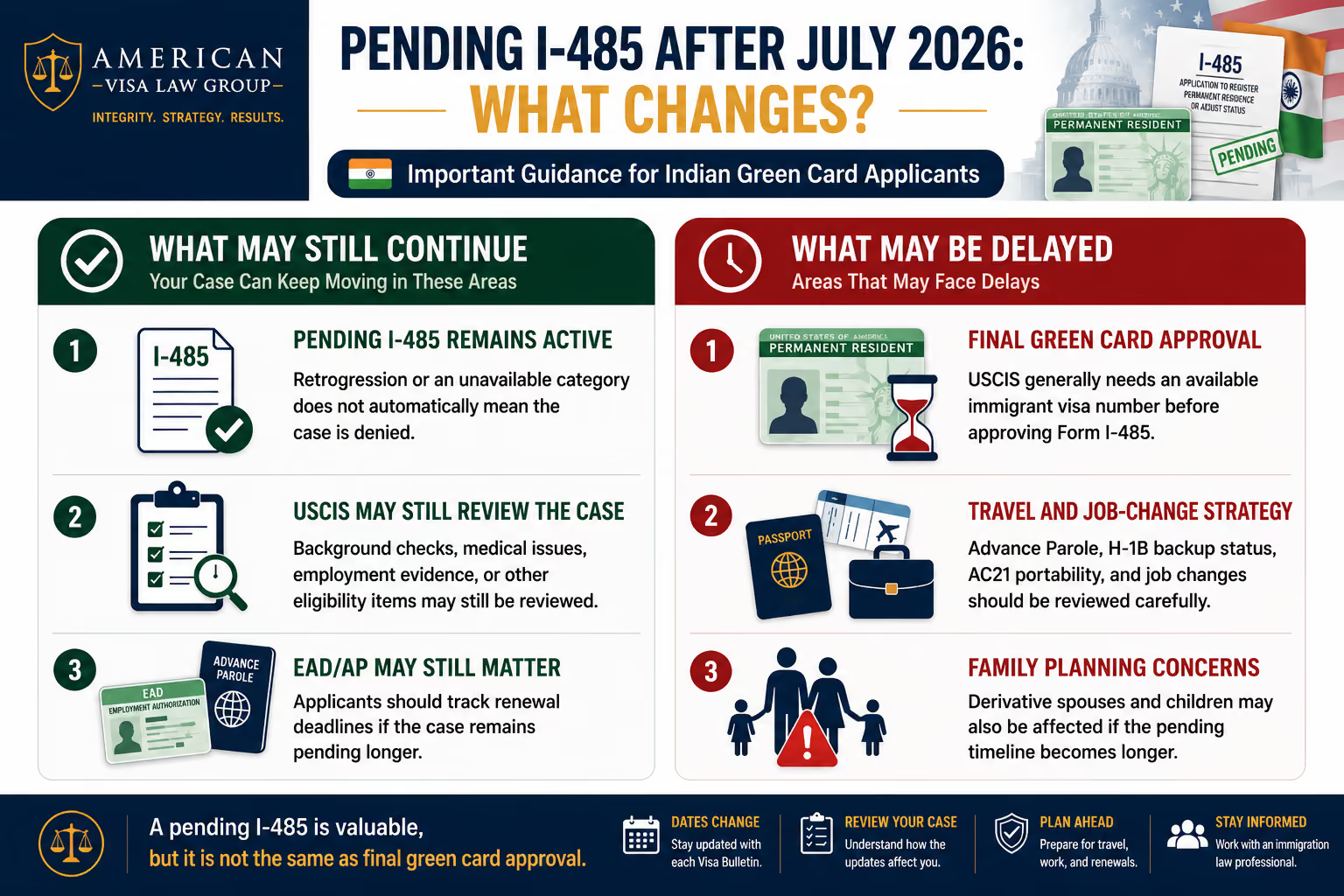
For Indian applicants affected by the July 2026 Visa Bulletin, the practical impact often shows up in everyday immigration decisions. If EB-2 India is unavailable, EB-1 India has retrogressed, or EB-5 Unreserved India is unavailable, the case may stay pending longer than expected. That makes work authorization, travel documents, job-change timing, and underlying status more important.
Applicants with a pending Form I-485 should review their Employment Authorization Document carefully. If final green card approval may be delayed, an EAD that once felt like a temporary bridge may become more important. Waiting too long to renew can create unnecessary stress, especially for applicants and dependent family members who rely on EADs for continued work authorization.
Advance Parole should also be reviewed before any international travel. A pending I-485 can create travel issues if the applicant leaves the United States without the right document or without understanding how they plan to return. Some applicants may travel using Advance Parole, while others may return in H-1B, H-4, L-1, or L-2 status if eligible. The right approach depends on the applicant’s status history, pending applications, and risk tolerance.
Job changes require the same careful approach. Indian employment-based applicants often wait many years for green card availability, and career changes may become necessary during that time. In some cases, AC21 portability may allow an applicant with a pending I-485 to move to a same or similar occupational role after the required period. But this is not automatic. The new role, job duties, employer, I-140 status, timing, and case history all matter.
Maintaining H-1B or another nonimmigrant status may also be worth considering. Some applicants rely entirely on the pending I-485, EAD, and Advance Parole. Others prefer to maintain an underlying status as a backup while waiting for the green card. There is no one-size-fits-all answer. The strategy depends on the applicant’s immigration history, employer support, travel needs, family situation, and how long the case may remain pending.
The key point is that Visa Bulletin delays are not just administrative delays. They can affect how applicants work, travel, change jobs, and protect their long-term immigration position. Indian applicants whose cases are affected by July 2026 retrogression or unavailability should review these issues before making major decisions, especially if an EAD or Advance Parole document is close to expiration or a job change is being considered.

Compared with June 2026, the July 2026 Visa Bulletin brings a much more difficult picture for many Indian employment-based applicants. The biggest changes are not minor date adjustments. EB-2 India became unavailable, EB-5 Unreserved India became unavailable, and EB-1 India moved backward. EB-3 India did move forward, but only slightly.
The June-to-July comparison shows how uneven Visa Bulletin movement can be for Indian applicants. One category may move forward slightly while another becomes unavailable. That is why applicants should avoid reading the bulletin as simply “good” or “bad.” The answer depends on the exact category, priority date, and whether the case is at the filing stage or the final approval stage.
For EB-2 India applicants, July 2026 is especially serious because there is no cut-off date to compare against. The category is unavailable. For applicants with pending Form I-485 applications, this may mean the case remains pending until visa numbers become available again. For applicants who have not yet filed, it may affect whether filing is possible under the chart USCIS is using for July 2026.
EB-1 India applicants also need to be careful. Retrogression from December 15, 2022 to October 15, 2022 may not affect every EB-1 India case, but it can matter for applicants with priority dates near late 2022. A case that looked closer to final action in June may no longer be current in July.
EB-3 India’s movement to January 1, 2014 is the one positive employment-based update for India, but it should be kept in perspective. The movement is modest, and it does not erase the long backlog. It may help some applicants with older priority dates, but it does not automatically create a better strategy for every Indian applicant.
The practical takeaway is that July 2026 requires category-by-category review. Indian applicants should compare their priority date against the correct July 2026 chart, confirm whether their case is pending or not yet filed, and review related issues such as EAD renewal, Advance Parole, travel, job changes, and maintaining underlying status.
Looking at the July 2026 Visa Bulletin compared with July 2025 helps Indian applicants understand a larger point: Visa Bulletin movement is not always steady or predictable. A category may move forward for a period of time, then slow down, retrogress, or become unavailable when demand increases or visa number limits are reached.
For Indian employment-based applicants, the year-over-year picture is mixed, but the most serious changes are in EB-2 and EB-5 Unreserved. EB-2 India is unavailable in July 2026, which is a much more difficult position than simply having a delayed cut-off date. When a category becomes unavailable, immigrant visa numbers are not authorized for that category during the month, which can affect both expectations and strategy for applicants waiting on final green card approval.
EB-5 Unreserved India also became unavailable in July 2026. This is important for Indian investors and their families because EB-5 visa availability depends on the exact EB-5 category. Applicants should not assume that all EB-5 cases are treated the same way. An Unreserved EB-5 case may face a different Visa Bulletin result than a case in a rural, high unemployment, or infrastructure set-aside category.
EB-3 India shows some forward movement compared with prior periods, but it remains heavily backlogged. The July 2026 date of January 1, 2014 may help certain applicants with older priority dates, but it does not change the broader reality for many Indian applicants still waiting years for employment-based green card availability.
EB-1 India also shows why applicants should be careful with assumptions. EB-1 is often considered a stronger or faster employment-based category, but Indian applicants are still subject to visa number demand and country limits. The July 2026 retrogression to October 15, 2022 shows that even EB-1 India can move backward when demand requires tighter visa number control.
The practical lesson from the July 2025 to July 2026 comparison is that Indian applicants should not build their immigration strategy around the hope that dates will always move forward. Priority date planning, EAD and Advance Parole renewals, H-1B backup strategy, job-change timing, and family derivative planning should all account for the possibility of retrogression or unavailability.
For many Indian applicants, the better question is not only “Did my category improve from last year?” The better question is: What does the current July 2026 chart allow me to do now, and what should I protect if my case remains pending longer than expected?
After reading the July 2026 Visa Bulletin, Indian applicants should avoid making decisions based on one date or one category alone. The Visa Bulletin is useful, but it only becomes meaningful when it is matched against the applicant’s exact immigration situation. For Indian applicants, this is especially important because the July 2026 bulletin treats EB-1, EB-2, EB-3, Other Workers, and EB-5 very differently.
The first step is to confirm the exact preference category. An applicant should know whether the case is EB-1, EB-2, EB-3, Other Workers, EB-5, or a family-sponsored category. This sounds simple, but it is not always obvious to applicants who have multiple petitions, an old PERM case, a later I-140 approval, or a possible downgrade history. The category controls which Visa Bulletin line applies.
The second step is to confirm the priority date. In many employment-based cases, the priority date comes from the PERM labor certification filing date. In other cases, such as some EB-1, NIW, or EB-5 matters, it may be tied to the immigrant petition filing date. Applicants should not rely on memory if they are close to a cut-off date. A few days or weeks can matter when the Visa Bulletin is tight.
The third step is to use the correct USCIS chart. For July 2026, family-sponsored adjustment of status applicants may use the Dates for Filing chart, while employment-based applicants must use the Final Action Dates chart. This is a key point for Indian employment-based applicants because EB-2 India and EB-5 Unreserved India are unavailable, and EB-1 India has retrogressed under the relevant employment-based chart.
Applicants with pending Form I-485 applications should also review their supporting strategy, not just the green card case itself. If final approval may be delayed, EAD and Advance Parole expiration dates become more important. Travel plans should be reviewed before leaving the United States. Job changes should be considered carefully, especially if the applicant is relying on AC21 portability or has questions about maintaining the same or similar occupational classification.
It may also be wise to review whether maintaining H-1B, H-4, L-1, or another underlying nonimmigrant status makes sense. Some applicants are comfortable relying on a pending I-485, EAD, and Advance Parole. Others may benefit from preserving an independent status while waiting through retrogression or unavailability. The right answer depends on the applicant’s immigration history, employer support, family situation, and risk tolerance.
The practical takeaway is that Indian applicants should read the July 2026 Visa Bulletin as a strategy document, not just a monthly update. The goal is to understand what the chart allows now, what it delays, and what should be protected while the case remains pending.
Visa Bulletin predictions should always be treated carefully, especially for Indian employment-based applicants. Monthly movement depends on visa number demand, annual limits, per-country limits, USCIS chart selection, and how many cases are ready for final action. A category that moves forward one month can slow down, retrogress, or become unavailable later.
For Indian applicants, the main categories to watch after July 2026 are EB-2 India, EB-1 India, EB-3 India, and EB-5 Unreserved India. EB-2 India being unavailable is the most serious concern because there is no cut-off date to compare against for July 2026. Applicants in this category should monitor future bulletins closely to see when visa numbers may become available again.
EB-1 India also deserves close attention. Although EB-1 is often seen as a stronger employment-based category, the July 2026 retrogression shows that Indian applicants are still affected by demand and visa number control. Applicants with priority dates close to October 15, 2022 should be especially careful when reviewing future Visa Bulletins.
EB-3 India is another category to monitor, but expectations should remain realistic. The July 2026 movement to January 1, 2014 is helpful for some applicants, but it does not remove the long backlog. Future movement may depend on demand, unused numbers, and how the Department of State manages employment-based visa availability near the end of the fiscal year.
October is also important because the federal fiscal year begins in October. When a new fiscal year starts, annual visa limits reset, and some categories may see new movement. That does not guarantee that India categories will advance quickly, but it is a key period for applicants to watch, especially those affected by unavailability or retrogression late in the prior fiscal year.
The practical takeaway is that Indian applicants should not make major immigration decisions based only on predictions. Future Visa Bulletins matter, but the current chart controls the immediate analysis. Applicants should keep reviewing their priority date, pending I-485 status, EAD and Advance Parole expiration dates, travel plans, and job-change timing while waiting for clearer movement.
Not every Visa Bulletin update requires legal help. Some applicants can compare their category, country of chargeability, priority date, and USCIS chart on their own. But legal guidance becomes more important when the Visa Bulletin affects a real decision, not just general planning.
For Indian employment-based applicants, July 2026 creates several situations where an attorney review may be useful. EB-2 India is unavailable, EB-5 Unreserved India is unavailable, EB-1 India has retrogressed, and EB-3 India moved only slightly forward. These changes can affect more than final approval timing. They may also affect EAD and Advance Parole renewals, travel plans, job changes, dependent family members, and whether maintaining H-1B or another nonimmigrant status makes sense.
An attorney review may be especially helpful if Form I-485 is already pending. A pending adjustment application can be valuable, but applicants still need to understand what happens if the priority date is no longer current or the category becomes unavailable. The question is not only whether the case remains pending. The more practical questions are what should be renewed, what should be preserved, and what should be avoided while waiting.
Indian applicants considering a job change should also be careful. AC21 portability may be available in some employment-based cases, but it depends on timing, I-140 status, the pending I-485, and whether the new position is in the same or similar occupational classification. A job move that seems reasonable from a career perspective can still create immigration questions if the green card case is not reviewed properly.
Travel is another area where legal review can matter. Applicants should understand whether they are traveling on Advance Parole, returning in H-1B or another status, or creating any risk to a pending application. This is especially important when a case may remain pending longer because of retrogression or visa number unavailability.
The strongest reason to speak with an immigration attorney is not fear. It is strategy. If the July 2026 Visa Bulletin affects your filing window, pending I-485, work authorization, travel document, job-change plans, or family members’ status, getting a case-specific review can help you avoid decisions based on incomplete information.
American Visa Law Group helps Indian professionals, families, investors, and employers review priority dates, adjustment of status strategy, EAD and Advance Parole planning, employment-based green card issues, and long-term immigration options.
The July 2026 Visa Bulletin is a difficult update for many Indian green card applicants, especially in employment-based categories. EB-2 India is unavailable, EB-5 Unreserved India is unavailable, EB-1 India has retrogressed, and EB-3 India moved only slightly forward. For applicants who have already spent years waiting in backlogged categories, these changes can affect more than expectations. They can affect real immigration decisions.
The most important point is that Indian applicants should not read the Visa Bulletin in isolation. The correct analysis depends on the preference category, priority date, country of chargeability, and USCIS chart being used for July 2026. For employment-based adjustment of status applicants, the Final Action Dates chart is especially important because it controls whether an immigrant visa number is available for final green card approval.
For applicants with pending Form I-485 applications, retrogression or unavailability does not automatically mean denial. But it may mean the case remains pending longer. That makes EAD renewal, Advance Parole renewal, travel planning, job-change strategy, dependent family status, and underlying nonimmigrant status more important.
Indian EB-2 applicants should be especially careful because EB-2 India is unavailable. EB-1 India applicants should review priority dates closely after retrogression. EB-3 India applicants may benefit from limited movement, but only if the priority date is early enough. Indian EB-5 investors should confirm whether their case is in the Unreserved category or a set-aside category before drawing conclusions.
The practical takeaway is simple: July 2026 is not just a month to check the chart. It is a month to review the strategy behind the case. If the July 2026 Visa Bulletin affects your Indian green card case, American Visa Law Group can help review your category, priority date, pending I-485, EAD/AP planning, travel concerns, job-change options, and next steps.
No. EB-2 India is unavailable in the July 2026 Visa Bulletin. This means immigrant visa numbers are not authorized for EB-2 India during the month. For applicants with pending Form I-485 applications, this does not automatically mean denial, but final approval may have to wait until visa numbers become available again.
“Unavailable” means that immigrant visa numbers are not authorized for that category during that month. This is different from a cut-off date. When there is a cut-off date, applicants can compare their priority date to the listed date. When a category is unavailable, there is no date to compare against for that month.
Yes. EB-1 India retrogressed to October 15, 2022. This may affect Indian EB-1 applicants whose priority dates are after that date, especially those with pending Form I-485 applications or those expecting final green card approval soon.
Yes. EB-3 India moved slightly forward to January 1, 2014. This may help some applicants with older priority dates, but the movement is still limited compared with the overall Indian employment-based backlog.
Generally, USCIS needs an available immigrant visa number before approving Form I-485. If EB-2 India is unavailable, USCIS may not be able to approve the green card during that month, even if the adjustment application is already pending.
Not necessarily. Retrogression usually does not mean that a pending Form I-485 will be denied. In many cases, the application remains pending until the applicant’s priority date becomes current again and a visa number becomes available.
Indian applicants with pending I-485 applications should review their EAD and Advance Parole expiration dates carefully. If final green card approval may be delayed because of retrogression or unavailability, keeping work authorization and travel documents current can become more important.
In many cases, maintaining H-1B or another valid nonimmigrant status may provide an additional layer of protection while the I-485 remains pending. However, this is a case-specific decision. Applicants should consider their work situation, travel plans, family members, employer support, and long-term immigration strategy.
EB-5 Unreserved India is unavailable in July 2026. Indian EB-5 applicants should confirm whether their case is in the Unreserved category or one of the EB-5 set-aside categories, such as rural, high unemployment, or infrastructure, because visa availability may differ by category.
Indian applicants should watch EB-2 India, EB-1 India, EB-3 India, EB-5 Unreserved India, and USCIS’s monthly chart selection. They should also review EAD/AP expiration dates, travel plans, job-change timing, and whether maintaining an underlying status remains part of their strategy.
URL: https://travel.state.gov/content/travel/en/legal/visa-law0/visa-bulletin/2026/visa-bulletin-for-july-2026.html
This is the official July 2026 Visa Bulletin and should be used as the primary source for Final Action Dates, Dates for Filing, India-specific category movement, and Department of State notes on visa availability.
URL: https://www.uscis.gov/green-card/green-card-processes-and-procedures/visa-availability-priority-dates/adjustment-of-status-filing-charts-from-the-visa-bulletin
This USCIS page explains which Visa Bulletin chart adjustment of status applicants may use each month, which is especially important for Indian applicants comparing Dates for Filing and Final Action Dates.
URL: https://www.uscis.gov/green-card/green-card-processes-and-procedures/visa-availability-and-priority-dates
This resource helps readers understand how priority dates, visa availability, preference categories, and country of chargeability affect green card timing.
URL: https://www.uscis.gov/i-485
This is the official USCIS page for Form I-485, the main application used by eligible applicants applying for adjustment of status from inside the United States.
URL: https://www.uscis.gov/i-765
This page is useful for applicants with pending I-485 cases who may need to understand EAD filings, renewals, and work authorization while waiting for green card availability.
URL: https://www.uscis.gov/i-131
This official USCIS page is relevant for applicants with pending adjustment of status cases who need to understand Advance Parole and travel-document issues.
URL: https://www.uscis.gov/working-in-the-united-states/how-uscis-determines-same-or-similar-occupational-classifications-for-job-portability-under-ac21
This resource is especially relevant for Indian employment-based applicants considering job changes while Form I-485 is pending.
URL: https://www.uscis.gov/working-in-the-united-states/permanent-workers/employment-based-immigration-fifth-preference-eb-5/about-the-eb-5-visa-classification
This page helps readers understand EB-5 visa classification and set-aside categories, which is important because EB-5 Unreserved India and EB-5 set-aside categories may have different Visa Bulletin treatment.
URL: https://www.usavisalaw.com/our-services
Helpful for readers who want to understand the immigration matters American Visa Law Group handles, including employment-based immigration, family immigration, adjustment of status, and immigration strategy.
URL: https://www.usavisalaw.com/immigration-attorney-cost
Useful for readers considering legal guidance and wanting transparent information about consultation fees and immigration attorney costs.
URL: https://www.usavisalaw.com/about-us/client-reviews
Supports trust and EEAT by giving readers a place to review client experiences with American Visa Law Group.
URL: https://www.usavisalaw.com/contact-us
Best used near the final call to action for readers who want to schedule a consultation or ask how the July 2026 Visa Bulletin may affect their green card case.
Hasan Abdullah, Esq. is the Founder and Managing Attorney of American Visa Law Group. His practice focuses on U.S. immigration law, including family-based immigration, employment-based immigration, adjustment of status, consular processing, waivers, PERM labor certification, NIW, EB-1, H-1B, O-1, and complex immigration strategy.
Through American Visa Law Group, Mr. Abdullah helps individuals, families, professionals, investors, and employers understand their immigration options and plan around changing government policies, USCIS procedures, and Visa Bulletin movement. His work emphasizes practical legal analysis, realistic expectations, and strategy tailored to each applicant’s immigration history and long-term goals.


