Author: Hasan Abdullah, Esq.
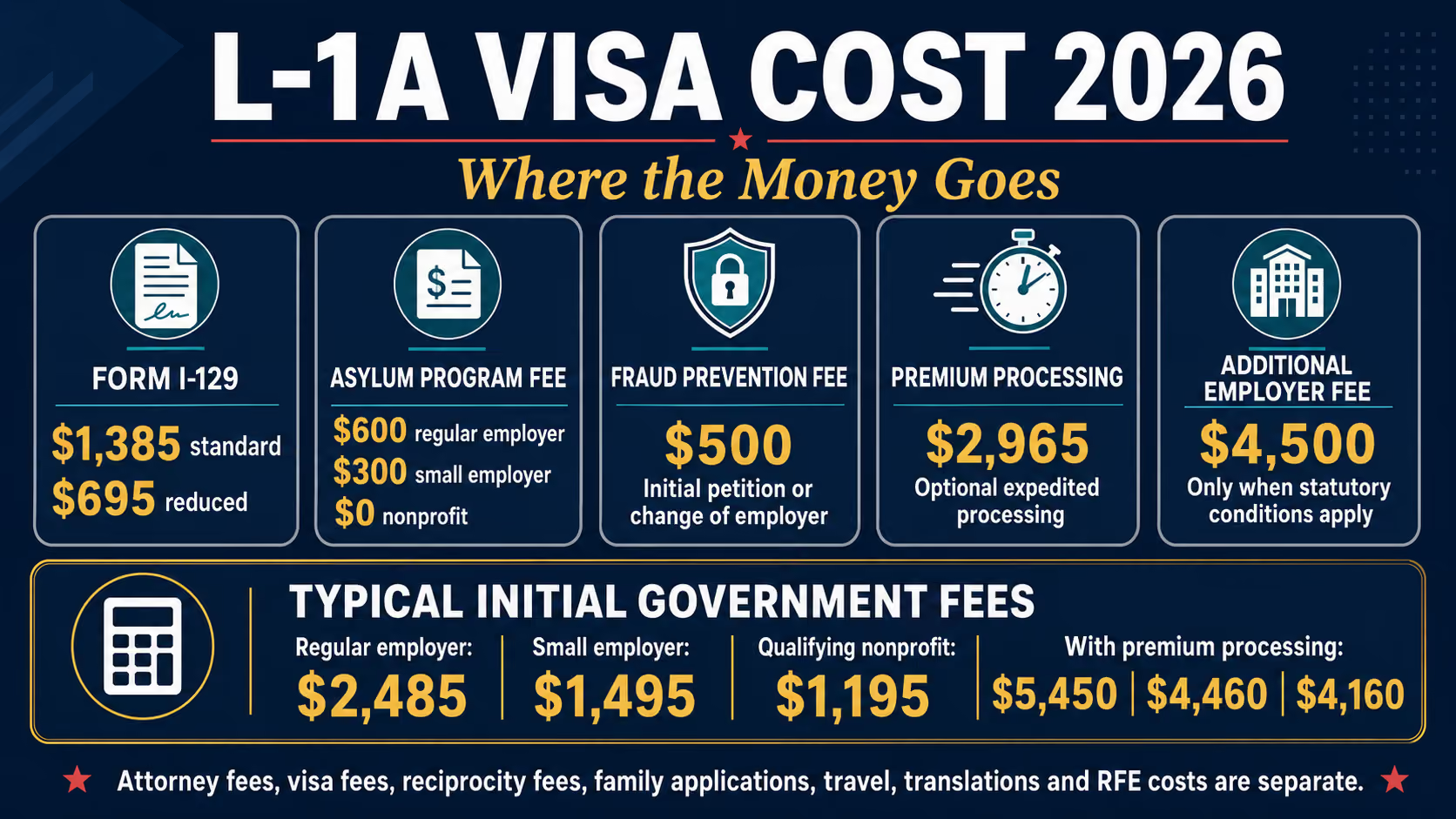
The L-1A visa cost in 2026 is not one fixed amount. For a typical initial individual petition, mandatory USCIS fees generally total $2,485 for a regular employer, $1,495 for a qualifying small employer, or $1,195 for a qualifying nonprofit. These totals include the applicable Form I-129 fee, Asylum Program Fee, and $500 Fraud Prevention and Detection Fee.
Optional premium processing adds $2,965. Certain employers must also pay an additional $4,500 fee under Public Law 114-113. Attorney fees, visa stamping, reciprocity fees, dependent applications, translations, travel, and possible Request for Evidence responses are separate.
The final cost depends on more than the number of forms being filed. An established multinational company transferring a clearly defined executive may require a different level of preparation than a new U.S. office with limited staffing, a complicated ownership structure, or a functional manager whose role must be carefully documented. Individual petitions, blanket L applications, extensions, and consular cases also produce different expense profiles.
Unlike the H-1B process, the L-1A category does not involve a lottery registration fee, an ACWIA training fee, or a Labor Condition Application. However, L-1A cases often require substantial corporate and operational evidence. The petitioner must document the qualifying relationship between the foreign and U.S. entities, the employee’s qualifying work abroad, and the executive or managerial nature of the proposed U.S. position.
This guide separates each government, legal, consular, and family-related expense so employers and transferred executives can understand what they may need to budget before filing.
For a typical initial L-1A petition, the mandatory government fees can range from $1,195 to $2,485, depending on whether the petitioner is a nonprofit, a qualifying small employer, or a larger employer. Premium processing adds $2,965, while certain L-1-dependent employers may owe an additional $4,500 fee.
The following table provides a quick overview of the main expenses:
For an initial individual L-1A petition, the most common government-fee calculations are:
With premium processing, the totals increase to $5,450 for a regular employer, $4,460 for a small employer, and $4,160 for a nonprofit.
An employer subject to the additional $4,500 Public Law 114-113 fee would generally pay $6,985 before premium processing or $9,950 with premium processing. Visa stamping, reciprocity fees, dependents, attorney fees, and document-related expenses remain separate.
American Visa Law Group’s current immigration attorney fee schedule lists a legal fee of $6,200 for an initial L-1A petition.
Using that published fee, a regular employer might budget:
These examples combine AVLG’s published legal fee with the standard government fees for a regular employer. They do not include visa stamping, reciprocity charges, dependent applications, translations, travel, business plans, or additional legal work arising from an RFE or another complication.
The correct budget therefore depends on the petitioner’s size, the nature of the corporate structure, the filing route, the number of family members, and whether faster USCIS action serves a meaningful business need.
The government cost of an L-1A petition is made up of several separate fees. The correct amount depends on the employer’s size, nonprofit status, filing history, and workforce composition. Employers should calculate each fee independently instead of assuming that every Form I-129 petition has the same price.
A filing submitted with an incorrect payment may be rejected before USCIS reviews the merits of the case. Fee eligibility should therefore be confirmed using the current USCIS fee schedule on the date of filing.
The U.S. employer begins an individual L-1A case by filing Form I-129, Petition for a Nonimmigrant Worker, with the L Classification Supplement.
The standard Form I-129 fee for an L petition is $1,385. A qualifying small employer or nonprofit pays the reduced fee of $695.
For fee purposes, a small employer generally has 25 or fewer full-time-equivalent employees in the United States. The employer must calculate its workforce under USCIS rules and provide the requested information showing that it qualifies for the reduced amount. A company should not assume it is a small employer based only on the number of people working at one location or within one business unit.
The Form I-129 fee applies to the petition itself. It does not include the Asylum Program Fee, fraud fee, premium processing, visa stamping, or attorney fees.
Employers filing Form I-129 must also address the Asylum Program Fee, even though the L-1A petition has no direct connection to an asylum application.
The amount is based on the petitioner’s size and nonprofit status:
The Asylum Program Fee is separate from the Form I-129 fee and generally applies to both initial petitions and extensions. This can create confusion for employers that previously filed L-1 petitions under the older fee structure, particularly when preparing an extension and assuming that fewer fees apply.
The $500 Fraud Prevention and Detection Fee generally applies when an employer files an initial L-1 petition for a beneficiary. It may also apply when a different qualifying employer files to obtain L-1 authorization for the worker.
A straightforward extension filed by the same petitioner for the same employee generally does not require a new fraud fee. However, corporate restructurings, changes in the petitioning entity, mergers, and transfers between related companies can complicate that analysis. The legal relationship between the old and new entities matters more than how the company informally describes the transfer.
Because the fee is tied to the nature and history of the petition, employers should review prior approval notices and complete petition copies before calculating an extension or amendment budget.
Some employers must pay an additional $4,500 fee when filing an L-1 petition. This charge is narrower than the standard filing fees and does not apply to every multinational employer.
The fee generally applies when:
This means a company can have a large international workforce without necessarily owing the additional fee. The analysis focuses on the employer’s U.S. employee count and the proportion of those employees in H-1B or L-1 status.
The Public Law 114-113 fee is currently scheduled to remain in effect through September 30, 2027. Employers close to either workforce threshold should calculate the figures carefully and retain documentation supporting the conclusion reached.
Premium processing is optional for an L-1A petition. As of March 1, 2026, the Form I-907 premium-processing fee is $2,965.
For most L-1A petitions, premium processing requires USCIS to take adjudicative action within 15 business days. That action may be an approval, denial, Request for Evidence, Notice of Intent to Deny, or investigation for fraud or misrepresentation. It is not a promise that USCIS will approve the petition within 15 business days.
If USCIS issues an RFE or NOID, the premium-processing period stops. A new premium-processing period generally begins after USCIS receives the response.
Premium processing can be valuable when a company faces a firm transfer date, operational deadline, expiring status, or urgent leadership need. It may offer less practical value when the supporting evidence is incomplete or the corporate structure has not been fully analyzed. Paying for faster review does not correct weaknesses in the petition.
The L-1A category does not use the H-1B cap registration process and does not require an H-1B lottery fee or ACWIA training fee. It also does not require a Labor Condition Application or PERM labor certification.
There is no fixed statutory minimum investment for an L-1A petition. In a new-office case, however, USCIS will still examine whether the company has sufficient premises, funding, staffing plans, and operational capacity to support an executive or managerial position within the required period. The absence of a fixed investment threshold should not be confused with the absence of a meaningful business-evidence requirement.
L-1A lawyer fees vary considerably because the legal work involves more than completing Form I-129. An attorney must evaluate the relationship between the U.S. and foreign companies, the beneficiary’s employment abroad, the proposed U.S. position, and whether the evidence supports executive or managerial capacity.
A straightforward extension for an established multinational company may require less preparation than an initial petition involving a new U.S. office, several affiliated entities, limited staffing, or a functional-manager position. For that reason, two L-1A attorney quotes may differ because they cover different work—not simply because one lawyer charges more.
American Visa Law Group’s current immigration attorney cost schedule lists the following L-1A legal fees:
These are legal fees. USCIS filing fees, premium processing, visa application fees, translations, courier charges, dependent applications, and other outside expenses are separate unless a written representation agreement expressly states otherwise.
An additional charge may also apply to an extension if the law firm did not prepare the previous petition and the employer cannot provide a complete copy. Reconstructing a prior filing requires more than collecting the approval notice. Counsel may need to rebuild the corporate history, previous job descriptions, organizational evidence, and representations made to USCIS before determining whether the new filing remains consistent.
Published fees should always be confirmed before the employer signs a legal-services agreement because the required scope may change based on the facts of the case.
L-1A cases are evidence-intensive. The petitioning employer must do more than prove that the beneficiary has a managerial or executive title. USCIS examines what the individual actually did abroad and what the individual will primarily do in the United States.
The attorney may need to analyze whether the beneficiary manages professional employees, directs an essential function, establishes organizational policy, or exercises broad decision-making authority. Duties must be described with enough detail to distinguish qualifying leadership from routine sales, production, customer service, administration, or other operational work.
Corporate eligibility requires a separate analysis. The petition must establish a qualifying relationship between the foreign and U.S. organizations, such as a parent, subsidiary, affiliate, or branch relationship. This can require reviewing incorporation records, share certificates, capitalization tables, operating agreements, ownership ledgers, annual reports, tax documents, and records showing that both entities are actively doing business.
The legal work can become more extensive when a case involves:
Organizational charts also require careful preparation. A chart with impressive titles does not establish managerial capacity by itself. USCIS may compare the chart against payroll records, employee qualifications, job descriptions, reporting relationships, and the company’s actual operations. The legal team must ensure that the different parts of the filing tell a consistent story.
Many immigration firms charge a flat fee for preparing an L-1A petition. A flat fee can make budgeting easier, but the employer must understand exactly what the quoted amount covers.
One firm’s flat fee may include eligibility analysis, petition forms, a detailed support letter, review of corporate evidence, organizational-chart guidance, filing, and routine USCIS communication. Another quote may cover only the initial petition preparation, with separate charges for consular support, dependent filings, urgent work, extensive document review, or an RFE response.
Hourly billing may be used when the required work cannot be predicted reliably. This may occur when the corporate records are incomplete, the ownership structure is disputed, a prior filing must be reconstructed, or the employer wants counsel to perform a preliminary corporate and immigration audit before deciding whether to proceed.
Before comparing L-1A attorney fees, the employer should ask whether the quote includes:
The written representation agreement should identify both the included services and foreseeable exclusions. This allows the employer to compare the real scope of each quote instead of comparing only the headline price.
The central question is not simply how much the lawyer charges. It is whether the proposed legal work addresses the evidentiary issues most likely to determine how USCIS evaluates the petition.
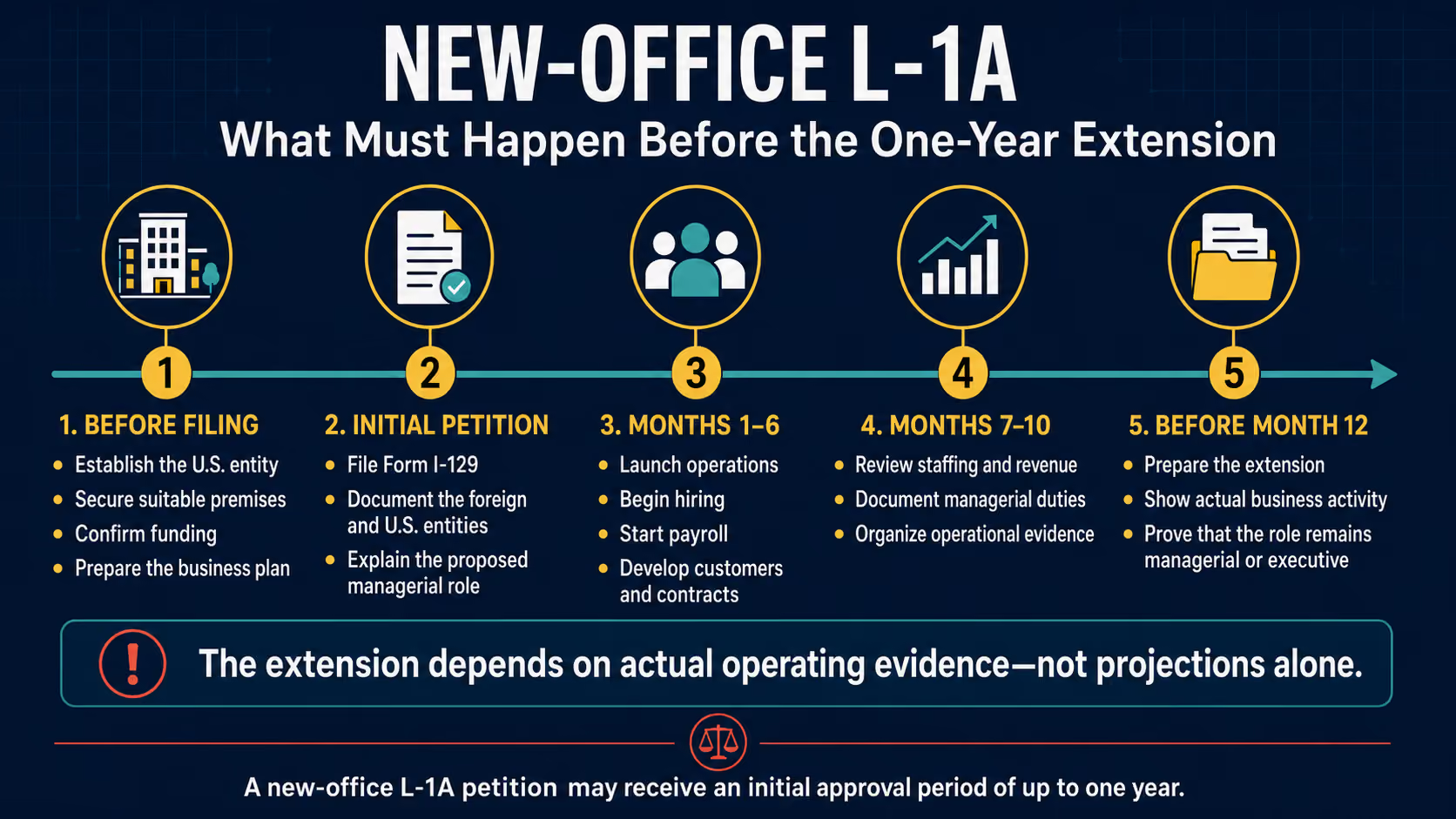
A new-office L-1A petition does not carry a separate USCIS filing fee simply because the U.S. operation is new. The employer generally pays the same Form I-129, Asylum Program, fraud-prevention, and optional premium-processing fees that apply to other initial L-1A petitions.
The practical cost can nevertheless be higher. New-office cases usually require more extensive legal analysis, corporate documentation, financial evidence, and business planning because the U.S. company does not yet have a long operational record.
For L-1 purposes, a new office generally means a U.S. organization that has been doing business for less than one year. Incorporating a company, opening a bank account, or securing an address does not necessarily establish that the company is already actively doing business. USCIS examines the organization’s actual commercial activity and ability to support the proposed transfer.
An established company can often support its L-1A petition with existing payroll records, tax returns, contracts, financial statements, organizational charts, and evidence of ongoing operations. A new office may have little or none of that history.
The petition must therefore explain how the U.S. business will develop and why transferring the executive or manager is commercially credible. Supporting evidence may include:
The proposed position deserves particular attention. During the company’s early stages, a founder or senior executive may need to participate in practical setup work. USCIS will still examine whether the operation is expected to support a primarily executive or managerial role within one year.
A job description stating that the beneficiary will “manage all operations” is usually not enough. The petition should explain who will perform sales, administration, production, customer service, accounting, and other operational functions as the company develops. It should also show how the beneficiary will direct the organization or manage an essential function rather than personally performing most of its routine work.
Business plans, accounting work, corporate formation, and operational expenses are not USCIS filing fees. They may nevertheless form a significant part of the overall new-office budget.
Potential expenses include:
An ordinary commercial business plan may not address the immigration questions USCIS is likely to examine. The plan should connect the company’s projected growth, staffing, revenue, and organizational structure to the beneficiary’s future executive or managerial role. Financial projections that are disconnected from the hiring plan or supporting records may create credibility concerns rather than strengthen the petition.
There is no fixed statutory minimum investment amount for an L-1A new-office petition. The absence of a set threshold does not mean that any level of funding will be sufficient. USCIS considers whether the capitalization is credible for the type of business, location, staffing plan, and first-year operating expenses.
A consulting company with limited physical infrastructure may require a different level of funding from a restaurant, manufacturing operation, logistics company, or retail business. The appropriate evidence depends on what the company claims it will actually do in the United States.
A new-office L-1A petition is generally approved initially for a maximum period of one year. The extension stage is therefore part of the financial planning from the beginning, not a distant issue to consider after approval.
At the one-year extension, USCIS will examine what the U.S. company actually accomplished. The employer may need to provide:
The employer should budget for a new Form I-129 filing fee, the applicable Asylum Program Fee, attorney fees, and optional premium processing. A straightforward extension by the same petitioner generally does not require another $500 fraud fee, but changes in ownership, corporate structure, or the petitioning entity may affect that conclusion.
American Visa Law Group’s published legal fee for an L-1A extension is currently $4,600. Additional work may be required if the firm did not prepare the initial petition and the employer cannot provide a complete copy of the prior filing.
The strongest new-office strategy connects the initial petition to the extension from the outset. Hiring projections, financial forecasts, and proposed job duties should be realistic enough that the company can later document meaningful progress. An ambitious plan may look attractive at filing, but unsupported projections can become a problem when USCIS compares them with the company’s actual first-year performance.
An employer can pursue an L-1A transfer through an individual petition or, if the corporate group qualifies, an approved blanket L petition. Both routes can lead to L-1A classification, but the filing process and government fees are different.
An individual petition generally requires the U.S. employer to obtain USCIS approval for the specific employee before the worker applies for an L-1A visa abroad. Under an approved blanket petition, a qualifying employee may apply for L-1 classification directly through a U.S. consulate using Form I-129S, without first obtaining an individual Form I-129 approval from USCIS.
The blanket route can be more efficient for multinational organizations that transfer employees regularly. It is not automatically less expensive in every case, and it does not reduce the legal standard the employee must satisfy.
For an individual petition, the U.S. employer files Form I-129 with the L Classification Supplement. The filing normally includes:
After USCIS approves the petition, an employee applying from outside the United States normally completes Form DS-160 and pays the $205 nonimmigrant visa application fee. A nationality-based reciprocity fee may also apply after visa approval.
The individual petition route allows USCIS to review the corporate relationship, foreign employment, and proposed U.S. position before the employee reaches the consular stage. Approval of Form I-129 does not eliminate the visa application or guarantee that the consulate will issue the visa. The consular officer still evaluates the applicant’s eligibility and admissibility.
A blanket L petition is a preapproved corporate arrangement available to certain established multinational organizations. The company must first demonstrate that its corporate group satisfies the blanket requirements. Once USCIS approves the blanket petition, qualifying executives and managers may apply for L-1A visas through a U.S. consulate by presenting Form I-129S and the required corporate and employment evidence.
For a principal applicant applying under an approved blanket petition, the government costs may include:
The $500 blanket-L fraud fee applies to the principal applicant, not to each accompanying spouse or child. L-2 family members generally pay their own $205 visa application fees and any applicable reciprocity charges.
Legal fees for a blanket-L application may cover reviewing the employer’s blanket approval, confirming that the applicant falls within the approved corporate group, preparing Form I-129S, analyzing the foreign and U.S. positions, organizing supporting evidence, and preparing the employee for the consular interview. These services may be priced separately from the legal work required to obtain or extend the company’s underlying blanket approval.
Premium processing may be relevant when the employer is asking USCIS to adjudicate the underlying blanket petition. It does not convert the employee’s later consular interview into premium processing or require the consulate to issue a visa within a USCIS deadline.
The blanket route may reduce repeated USCIS filings for a company that transfers many qualifying employees, but it shifts more of the employee-specific adjudication to the consulate. The consular officer can examine the applicant’s foreign employment, proposed duties, managerial authority, and eligibility under the blanket approval.
An approved blanket petition confirms that the corporate group meets the blanket requirements. It does not establish that every proposed transferee qualifies as an L-1A executive or manager.
For some employees, an individual USCIS petition may provide a more suitable forum for presenting a detailed or unusual managerial-capacity argument. For others, the blanket process may offer a faster and more efficient route. The employer should compare not only the filing fees but also the corporate eligibility requirements, evidentiary issues, timing needs, consular location, and strength of the employee’s role.

USCIS petition approval and visa issuance are separate stages. When an L-1A beneficiary is outside the United States, or needs a new visa for future travel, the individual generally applies through a U.S. embassy or consulate after the underlying petition is approved.
Consular costs are not included in the Form I-129 filing fee. They may include the visa application fee, a nationality-based reciprocity fee, travel, lodging, document preparation, and passport delivery. Premium processing of the USCIS petition does not expedite the consular appointment or guarantee visa issuance.
The Department of State’s nonimmigrant visa application fee for the L category is $205 per applicant. The principal L-1A applicant and each accompanying L-2 spouse or child normally pay separate application fees.
The applicant completes Form DS-160 before scheduling the visa interview. There is no separate government fee for the DS-160 itself; the $205 payment is the nonimmigrant visa application processing fee.
This fee is generally nonrefundable. It is not returned merely because the visa is refused, placed in administrative processing, or the applicant decides not to continue. Payment procedures and the period during which a fee receipt remains usable can depend on the embassy, consulate, and local appointment system.
An individual L-1A beneficiary whose employer already paid the $500 fraud fee to USCIS generally does not pay that fee again during visa stamping. The separate $500 consular fraud fee applies principally to applicants using the blanket-L process.
Some applicants must pay a visa issuance fee based on their nationality. This is commonly called a reciprocity fee.
The amount can be zero or several hundred dollars, depending on the country and visa classification. Reciprocity rules can also affect:
Unlike the standard visa application fee, a reciprocity fee is generally collected only if the visa is approved. Employers and applicants should check the Department of State’s current reciprocity schedule for the applicant’s country rather than relying on the fee paid by a colleague of another nationality.
Visa validity should not be confused with the period of authorized stay. The visa controls when the individual may travel to a U.S. port of entry and request admission. The Form I-94 issued upon admission controls how long the person is authorized to remain in the United States.
The practical cost of visa stamping can exceed the government application fee. An applicant may need to travel to another city or country for the interview, particularly when local appointment availability is limited or the applicant is working outside the country of nationality.
Possible expenses include:
Applying in a third country may create additional cost and uncertainty. A consular post may limit appointments for nonresidents, and the applicant may need to remain outside the United States while the case is reviewed. If the case is placed in administrative processing, the resulting lodging, rescheduling, and business-disruption expenses can become more significant than the visa fee itself.
Applicants should avoid making nonrefundable travel arrangements based only on an approved Form I-129 petition. Petition approval does not guarantee that the consulate will issue the visa by a particular date.
An L-1A petition filed for change of status inside the United States can be approved with a new Form I-94. If the change of status is granted, the beneficiary may begin or continue the authorized L-1A employment in accordance with the approval notice without immediately obtaining an L-1A visa stamp.
That approval does not place a visa in the beneficiary’s passport. Once the person leaves the United States, a visa application may be required before returning in L-1A status, unless an exception applies.
A petition approved for consular notification works differently. USCIS approves the employer’s petition, but the beneficiary does not obtain L-1A status merely from the approval notice. The individual must complete the consular process and then be admitted to the United States in L-1A classification.
The distinction can affect the total budget and timeline. A change-of-status case may avoid immediate visa application and travel expenses, while a consular case requires those costs at the outset. However, a person who changes status in the United States may still face the same visa-stamping expenses later when international travel becomes necessary.
Premium processing applies only to the USCIS petition. It does not accelerate visa appointment availability, the consular interview, security checks, administrative processing, or admission by U.S. Customs and Border Protection. Employers planning around a fixed transfer date should account for each stage separately.
The spouse and unmarried children under 21 of an L-1A beneficiary may qualify for L-2 status. They do not require separate Form I-129 petitions, but they may have their own visa application, change-of-status, extension, legal, travel, and document expenses.
The total family cost depends largely on whether the dependents are applying at a U.S. consulate or requesting L-2 status from inside the United States.
Each family member applying for an L-2 visa at a U.S. embassy or consulate generally pays the $205 nonimmigrant visa application fee.
For example, an L-1A principal traveling with a spouse and two children would normally pay four separate visa application fees:
The family’s combined visa application fees would be $820, before reciprocity fees, travel, lodging, photographs, courier services, or legal assistance.
Each dependent completes a separate Form DS-160. A nationality-based reciprocity fee may also apply after approval. The amount and visa validity can differ by nationality, so the family should review the current Department of State reciprocity schedule before calculating the final cost.
L-2 dependents applying under an individual L-1A approval do not pay separate Form I-129, Asylum Program, or fraud-prevention fees. Under the blanket-L process, the $500 consular fraud fee applies to the principal blanket applicant, not separately to each spouse or child.
Dependents already in the United States may use Form I-539 to request a change to L-2 status or extend an existing period of L-2 stay.
The current government filing fees are:
A paper application may include qualifying co-applicants using Form I-539A. Online filing options can be more limited when several family members are applying together, so the lowest individual filing fee does not always produce the lowest total family cost.
USCIS no longer charges a separate biometric-services fee for Form I-539. However, translation, document, courier, and attorney expenses may still apply.
Dependents commonly need to provide:
When Form I-539 is filed together with the principal’s Form I-129 petition, coordinating the applications can reduce administrative duplication. It does not eliminate the dependent filing fee.
American Visa Law Group’s published legal fee for a nonimmigrant dependent Form I-539 matter is currently $800, or $550 when filed with the principal petition, plus $100 for each additional dependent. These are attorney fees and do not include the USCIS filing fee.
A qualifying spouse admitted in L-2S status is generally employment-authorized incident to status. This means the spouse does not necessarily need to obtain a separate Employment Authorization Document before working.
An unexpired Form I-94 showing L-2S status can serve as evidence of employment authorization. L-2 children are not employment-authorized incident to status.
Some spouses may still choose to request an EAD for additional documentary evidence or because of an issue with their admission record. If Form I-765 is filed, its government filing fee and any attorney charge are additional. An EAD should not be included automatically in every L-2 family budget because it may be unnecessary for a spouse whose status and I-94 already establish work authorization.
The family should review the admission records after every entry into the United States. If a spouse’s Form I-94 does not contain the correct L-2S notation, the problem should be addressed before relying on the document for employment verification.
The cost of accompanying family members may also include:
A spouse or child’s immigration history can create separate legal issues even when the principal L-1A petition is approvable. Prior overstays, status violations, visa refusals, arrests, or inadmissibility concerns may require additional analysis and should not be treated as routine dependent processing.
For budgeting purposes, employers and families should separate the principal petition cost from the per-person dependent expenses. A legal-fee quote for the L-1A petition should not be assumed to include L-2 applications unless the written agreement says so.
An L-1A approval does not authorize employment indefinitely. Established-office petitions may be approved initially for up to three years, while new-office petitions are generally limited to one year. Later extensions are commonly granted in increments of up to two years, subject to the seven-year L-1A maximum.
An extension or amendment normally requires a new Form I-129 filing. The employer should budget for government fees, attorney fees, updated corporate evidence, and separate L-2 filings where family members also need extensions.
For a straightforward extension filed by the same employer, the government fees generally include:
The $500 Fraud Prevention and Detection Fee is generally not required for a same-petitioner extension. It may become relevant if a different qualifying employer is filing or the case is not a true continuation of the previous petition.
Based on the current fee structure, the government cost of an extension generally begins at:
Adding premium processing increases these totals by $2,965. That produces a government-fee total of $4,950 for a regular employer, $3,960 for a small employer, or $3,660 for a nonprofit.
American Visa Law Group’s current published legal fee for an L-1A extension is $4,600. Using that figure, a regular employer might budget $6,585 without premium processing or $9,550 with premium processing, before dependent filings, translations, courier expenses, or additional legal work.
An additional legal charge may apply when the firm did not prepare the previous petition and the employer cannot provide a complete copy. A prior approval notice alone may not reveal the job duties, corporate representations, organizational structure, or evidence USCIS relied on in the earlier case.
An extension is not approved automatically because USCIS approved the initial petition. The employer must show that the qualifying corporate relationship continues, the U.S. and foreign entities remain actively doing business, and the beneficiary continues to work primarily in an executive or managerial capacity.
The extension filing may require updated:
New-office extensions receive particularly close attention because USCIS can compare the original business plan with the company’s actual first-year performance. Staffing does not have to match every projection precisely, but the employer should explain meaningful differences and show how the present organization supports the claimed executive or managerial role.
For established companies, changes in staffing can also matter. If the beneficiary has fewer subordinates or has assumed more operational responsibilities, the employer may need to explain how the position continues to qualify. Reusing the original support letter without addressing the current business structure can create inconsistencies.
An amended petition may be required when a material change affects the facts supporting the existing approval. Not every business development requires an amendment, but employers should review changes before implementing them rather than waiting until the next extension.
Potentially significant changes include:
A simple office relocation does not necessarily require an amended L-1A petition. Unlike H-1B status, L-1A classification is not tied to a Labor Condition Application for a specific work location. However, a relocation combined with changes in the employing entity, business operations, staffing, or job duties may become material.
An amendment filed on Form I-129 generally carries the applicable Form I-129 and Asylum Program fees. Premium processing may be requested for an additional $2,965. Whether the fraud fee applies depends on the nature of the filing and whether a new petitioner is seeking authorization.
The legal fee for an amendment may differ from an extension fee because the attorney must determine what changed, whether the existing approval remains valid, and how the new facts affect L-1A eligibility.
An L-1A executive or manager may generally spend a maximum of seven years in L-1 status. Time previously spent in certain H or L classifications may count toward the maximum, while full days spent outside the United States may be recaptured if properly documented.
Recapture evidence may include:
An approved Form I-140 does not automatically allow an L-1A beneficiary to remain in L-1A status beyond the seven-year limit. This differs from certain H-1B extension provisions connected to the employment-based green card process.
Employers considering EB-1C or another permanent-residence strategy should account for the L-1A maximum early. Waiting until the final extension can create timing pressure if the immigrant petition, priority date, adjustment-of-status eligibility, or consular process cannot be completed before L-1A time expires.
Extension planning is therefore both a cost issue and a workforce-planning issue. The employer should evaluate government fees, legal expenses, remaining L-1A time, family status, international travel, and the long-term immigration strategy together.
The filing fee and initial attorney quote do not always represent the complete L-1A visa cost. Additional expenses can arise from an RFE, missing corporate records, foreign-language documents, business-plan preparation, changes in the company’s structure, or a later permanent-residence case.
These costs are not required in every matter. They should nevertheless be considered when building a realistic budget, particularly for new offices, smaller companies, complicated ownership arrangements, and cases where the beneficiary’s role is not clearly managerial or executive.
USCIS does not normally charge a separate government filing fee simply to respond to a Request for Evidence. An RFE can still create substantial legal and operational costs.
The attorney may need to analyze the officer’s concerns, revise the legal argument, coordinate additional evidence from several countries, prepare declarations, rebuild organizational charts, and reconcile inconsistencies in the original filing. Whether this work is included in the initial legal fee depends on the representation agreement.
Common L-1A RFE issues include:
Responding may require updated payroll records, employee qualifications, tax documents, contracts, invoices, financial statements, detailed duty descriptions, and evidence from the foreign company. Obtaining and organizing this material can involve accounting, translation, corporate, and courier expenses in addition to attorney fees.
A Notice of Intent to Deny generally requires an even more focused response because USCIS has identified a potential basis for denying the petition. A NOID may also raise credibility, eligibility, or inconsistency concerns that cannot be resolved by simply submitting more documents.
Premium processing does not prevent an RFE or NOID. It accelerates the timeframe in which USCIS takes action, which can give the employer less operational flexibility when gathering extensive evidence across multiple countries.
If a petition is denied and the employer chooses to refile, the new petition generally requires new government filing fees. The fees paid with the denied petition are not ordinarily refunded. Motions, appeals, and refilings may also create separate government and legal costs.
Foreign corporate and employment records are often central to an L-1A case. USCIS requires foreign-language documents to be accompanied by complete English translations with a certification confirming that the translation is accurate and that the translator is competent to translate.
Relevant documents may include:
Summaries of lengthy documents may not be sufficient when the omitted material affects ownership, control, employment, or business operations. Employers should determine early which records need full translation rather than discovering the issue close to a filing deadline.
Document problems can also create costs even when everything is already in English. A corporate group may use different legal names across tax records, contracts, bank statements, and immigration filings. Ownership percentages may have changed without updated records. Informal transfers of shares may not be reflected in official documents.
Resolving these issues may require assistance from foreign corporate counsel, accountants, tax professionals, or company officers. Immigration counsel can explain what must be established for the L-1A petition, but the company may need separate professionals to correct or formalize its underlying corporate records.
USCIS evaluates the beneficiary’s duties within the context of the company’s actual organization. Preparing that evidence may require more than producing a basic employee list.
A useful organizational chart should accurately show:
The chart should remain consistent with payroll records, job descriptions, tax filings, and the attorney support letter. If the company uses contractors, shared-service employees, or workers employed by related entities, the petition may need additional evidence explaining how those individuals support the beneficiary’s role.
New-office cases may also involve the cost of preparing a detailed business plan. Financial projections, hiring forecasts, market analysis, and operational milestones should be grounded in evidence rather than written solely to satisfy an immigration filing. An outside business-plan provider, accountant, or financial professional may charge separately for this work.
Other possible evidence-related expenses include:
Paying for professional documentation does not guarantee that USCIS will find the petition approvable. The value comes from presenting accurate, verifiable evidence that addresses the legal requirements.
L-1A status is temporary nonimmigrant status. It does not automatically convert into permanent residence, and the legal fee for an L-1A petition does not ordinarily include a later EB-1C green card case.
A qualifying U.S. employer may pursue EB-1C classification for a multinational executive or manager, but that process requires a separate Form I-140 petition. The employer must independently establish EB-1C eligibility, even when USCIS previously approved an L-1A petition involving similar companies and job duties.
Potential EB-1C and permanent-residence expenses include:
An earlier L-1A approval can be relevant evidence, but it does not bind USCIS to approve an EB-1C petition. The two classifications have overlapping concepts but separate requirements and adjudications.
Employers should therefore maintain two distinct budgets: one for obtaining and extending L-1A status, and another for any long-term green card strategy. Treating the entire process as one combined legal service can lead to unexpected expenses later.
The U.S. petitioning employer usually pays the costs associated with preparing and filing the Form I-129 petition, while the employee may be responsible for certain personal, consular, travel, and dependent expenses. However, L-1A cost allocation is not governed by exactly the same rules that apply to H-1B petitions.
The parties should avoid assuming that every expense must be paid by the employer or that every cost can safely be shifted to the employee. The answer may depend on the type of fee, the representation agreement, company policy, wage laws, and the circumstances of the transfer.
The L-1A petition belongs to the U.S. employer. The company files Form I-129 and must establish the qualifying corporate relationship, the employee’s qualifying foreign employment, and the proposed executive or managerial position.
Employers commonly pay:
These expenses arise primarily from the employer’s request for authorization to employ the beneficiary in L-1A status. Some government fees are expressly imposed on the petitioner, making it particularly important to identify the payer correctly and submit each fee according to USCIS instructions.
The employer may also pay visa stamping, relocation, dependent, and travel expenses as part of its global mobility policy. That is often a business or contractual decision rather than a universal immigration requirement.
The L-1A beneficiary may be responsible for personal expenses connected to the visa application and relocation, depending on the employer’s policy and applicable law.
Possible employee-paid costs include:
The employer may choose to reimburse some or all of these expenses. Larger multinational companies frequently maintain relocation policies that cover visa fees, family travel, temporary housing, and document costs, while smaller companies may cover only the principal petition.
Dependent costs deserve separate attention. An agreement stating that the employer will pay for the “L-1A case” does not necessarily include L-2 visa applications, Form I-539 filings, dependent attorney fees, or family travel. Those items should be addressed expressly.
Premium processing can serve either a business purpose or a personal purpose. An employer may request faster adjudication because the executive is needed for a project, expansion, transaction, or operational deadline. An employee may request it because of planned travel, an expiring document, or a personal scheduling concern.
The reason for requesting premium processing can influence who agrees to pay the $2,965 fee. Regardless of the arrangement, the payment should be documented, and any deduction from the employee’s compensation should be reviewed for compliance with applicable wage and employment laws.
Premium processing should not be presented to an employee as a payment for approval. It purchases faster USCIS action, which may include an RFE, NOID, or denial.
Some employers use repayment agreements when they invest substantially in immigration and relocation costs. These agreements may require an employee who leaves within a defined period to repay certain expenses.
Such provisions require careful review. A repayment term that appears valid as a contract may still create concerns under federal or state wage laws, rules governing payroll deductions, minimum-wage requirements, or restrictions on penalties that unreasonably limit an employee’s ability to leave the company.
The agreement should distinguish among:
The fact that an employer paid an immigration expense does not automatically mean the full amount can be recovered from the employee after resignation or termination.
L-1A employers should also avoid copying an H-1B reimbursement policy without legal review. The H-1B category has Labor Condition Application and required-wage rules that do not apply to L-1A petitions in the same manner. L-1A employees remain protected by generally applicable wage, contract, and employment laws, but the analysis is different.
A written cost allocation can prevent disputes and make the total budget easier to manage. Before filing, the employer and beneficiary should understand who will pay for:
The legal-services agreement should also clarify who the attorney represents and whether dependent or consular work is included. In many employment-based matters, the employer is the primary client because it is the petitioner, even though the attorney also communicates closely with the beneficiary.
A clear payment arrangement does more than prevent unexpected invoices. It helps the company separate immigration compliance costs from employee relocation benefits and ensures that the financial terms do not conflict with the legal strategy or applicable employment law.

Two L-1A attorney fee quotes may look similar while covering very different levels of legal work. One may include a complete review of the multinational corporate structure, job duties, organizational evidence, and consular process. Another may cover only Form I-129 preparation and a basic filing package.
The most useful comparison is therefore not the headline price. It is the relationship between the fee, the scope of representation, the complexity of the case, and the work excluded from the agreement.
The quote should identify whether the legal fee applies to:
These cases do not require the same amount of preparation. A fee for a straightforward extension should not be compared directly with a fee for establishing a new U.S. office. Similarly, preparing Form I-129S under an existing blanket approval is different from obtaining the company’s underlying blanket approval from USCIS.
The employer should disclose the relevant facts before relying on the quote. A price based on the assumption of a simple corporate structure may change if counsel later discovers multiple ownership layers, missing corporate records, recent restructuring, or inconsistent job descriptions.
A complete written quote should explain whether the attorney will handle:
The employer should also ask how the attorney approaches the managerial or executive capacity analysis. Completing the forms is only one part of an L-1A case. The petition must connect the beneficiary’s duties to the company’s actual staffing, hierarchy, operations, and business needs.
For a functional-manager case, the quote should reflect the work required to define the essential function, demonstrate the beneficiary’s authority over it, and show that other employees or service providers perform the function’s operational tasks.
Government filing fees are generally separate from attorney fees. The quote should also identify whether additional charges may apply for:
A low initial quote may become more expensive if common parts of the process are billed separately. Conversely, a higher quote may include work that another firm treats as an additional service.
The employer should not assume that an RFE response is included. Some firms include routine RFEs within a flat fee, while others charge based on the issue, volume of evidence, or time required. The agreement should also explain whether legal fees are refundable or credited if the employer decides not to file.
New-office cases often require work that is not part of an established-company petition. The employer should ask whether the fee includes reviewing:
Some immigration firms review a business plan prepared by the employer or an outside provider but do not draft the plan themselves. Others may coordinate with a separate business-plan company. The quote should make that distinction clear because the outside provider’s fee may be substantial.
The immigration attorney should also explain what the business plan needs to establish legally. A professionally designed document is not necessarily useful if its staffing, financial, and operational projections do not support the L-1A requirements.
L-1A experience can matter because the category involves corporate law concepts, employment evidence, organizational analysis, and detailed distinctions between managerial and operational work.
Employers can ask how the attorney approaches:
The answer should focus on analysis and evidence, not promises. No attorney can guarantee that USCIS or a consular officer will approve a petition. A guarantee may obscure the real issues that should be evaluated before filing.
Before choosing counsel, the employer should obtain clear answers to the following questions:
The written agreement should match the answers provided during the consultation. If an important service is not listed, the employer should not assume it is included.
American Visa Law Group publishes its immigration attorney fees to provide an initial point of comparison. A final quote still depends on the petition type, corporate structure, documentation, timing, and any complications identified during the case review.
The best value is not necessarily the lowest fee or the largest filing package. It is a clearly defined legal service that identifies the real eligibility issues, prepares evidence that addresses them, and gives the employer a realistic understanding of the work and costs involved.
A reliable L-1A budget should separate mandatory government fees from conditional fees, optional services, attorney fees, family expenses, and future costs. Using one estimated total without identifying these components can leave the employer unprepared for premium processing, consular applications, document preparation, or an extension.
A practical calculation is:
Total L-1A cost = government petition fees + attorney fees + consular expenses + dependent costs + evidence-related expenses + possible additional legal work.
Begin by determining whether the employee will use:
The filing route determines which agency reviews the case and when particular fees become due. An individual petition generally begins with USCIS, while an employee applying under a blanket approval may proceed directly through a U.S. consulate using Form I-129S.
Change of status can avoid immediate visa-stamping costs, but the beneficiary may still need an L-1A visa after future international travel.
A new-office petition may have the same USCIS filing fees as another initial L-1A petition, but it often carries higher preparation and evidence costs.
The budget may need to include:
The employer should also budget for the one-year extension from the beginning. USCIS will later compare the company’s actual operations with the plans and representations made in the initial petition.
The Form I-129 and Asylum Program fees depend on whether the petitioner is:
The employer should calculate its full-time-equivalent workforce under USCIS rules rather than relying on an informal headcount. The fee category affects the initial petition, extension, and amendment budget.
A regular employer may pay $1,385 for Form I-129 and $600 for the Asylum Program Fee. A qualifying small employer may pay $695 and $300, while a qualifying nonprofit may pay $695 with no Asylum Program Fee.
The $500 Fraud Prevention and Detection Fee generally applies to an initial L-1 petition for the beneficiary and certain filings involving a new petitioner.
It is generally not required for a straightforward extension filed by the same employer. However, a merger, acquisition, transfer between related companies, or change in the petitioning entity can affect the analysis.
The employer should review the complete prior petition—not only the approval notice—before treating a filing as a routine extension.
The Public Law 114-113 fee can materially change the budget. It generally applies when the petitioner:
Employers near either workforce threshold should document how the calculation was made. This is not a fee that should be added automatically to every L-1A petition.
Premium processing adds $2,965 to the petition cost. The employer should determine whether faster USCIS action is valuable enough to justify that expense.
Relevant considerations include:
Premium processing accelerates USCIS action, not necessarily final approval. It does not expedite the visa interview, administrative processing, or admission at the border. If the supporting evidence is incomplete, faster review may simply produce a faster RFE.
The legal budget should be based on a written scope of representation.
American Visa Law Group’s current published L-1A fees are:
The employer should confirm whether the fee includes consular assistance, organizational-chart preparation, business-plan review, dependents, premium-processing preparation, and an RFE response.
A separate contingency should be considered for legal work that is expressly excluded. The employer does not need to assume that an RFE will occur, but it should understand what an RFE would cost if one is issued.
For consular processing, add the $205 visa application fee for the principal applicant and each L-2 family member.
Also consider:
For example, an L-1A principal traveling with a spouse and two children would generally have $820 in visa application fees before reciprocity, travel, or legal expenses.
The employer may need outside professional assistance to prepare or obtain:
The cost depends on the company’s recordkeeping and corporate structure. A company with organized, consistent records may incur minimal additional expense. A company with missing ownership documents or conflicting entity information may need significant corporate or accounting work before the immigration petition is ready.
The initial filing is not necessarily the final L-1A expense. The longer-term budget may include:
New-office employers should plan for the one-year extension. Other L-1A employers should track the beneficiary’s remaining time within the seven-year maximum and evaluate permanent-residence strategy early.
USCIS and Department of State fees can change. The employer should verify the current amounts, required form editions, payment methods, and filing instructions immediately before submission.
The final budget should clearly show:
This approach gives the employer a usable financial plan rather than a single number that may not reflect the actual case.
Hiring an immigration lawyer is not legally required for an L-1A petition. An employer may prepare and file Form I-129 without outside counsel. The more useful question is whether the company has the legal knowledge, time, and documentation needed to present the corporate relationship and managerial or executive position accurately.
L-1A petitions are rarely decided by the forms alone. USCIS evaluates the underlying business structure, ownership and control, foreign employment, U.S. staffing, job duties, and whether the beneficiary will primarily perform qualifying leadership work. A filing can be technically complete while still failing to explain those issues persuasively.
The lawyer’s role generally begins with determining whether the proposed transfer fits the L-1A classification. This includes reviewing whether the foreign and U.S. entities have a qualifying relationship and whether the beneficiary completed the required employment abroad.
Counsel may then analyze:
The attorney also helps connect the evidence to the legal requirements. Corporate records may prove ownership without clearly proving control. An organizational chart may show job titles without establishing who performs the company’s operational work. A business plan may contain strong financial projections without explaining how the organization will support a managerial position.
Legal preparation is intended to identify and address those gaps before USCIS raises them.
Certain L-1A cases involve issues that are difficult to resolve through forms and document checklists alone.
Legal review may be especially useful when the case involves:
New-office cases present a particular challenge because the company must explain both its current startup-stage operations and how the business will support an executive or managerial position within one year. The initial petition also creates a factual record that USCIS may examine during the extension.
A lower-cost filing can become more expensive if it results in rejection, an extensive RFE, refiling, or disruption to the employee’s transfer. Government fees are generally not refunded because a petition is denied.
The longer-term record also matters. Statements made in the initial L-1A petition may later be compared with:
Differences are not automatically fatal. Businesses grow, job duties change, and corporate structures evolve. Problems arise when the company cannot explain the changes or when earlier filings contain unsupported representations.
An attorney can help maintain consistency while accurately documenting legitimate developments in the business. This may be more valuable than simply reducing the chance of a missing signature or incomplete form.
An established multinational company with an experienced in-house immigration team may already have standardized corporate records, approved blanket procedures, reliable organizational evidence, and a history of similar transfers. In that setting, the company may require limited outside assistance or use counsel primarily for legal review and unusual issues.
Even a repeat case should not be treated as a copy of an earlier petition. The beneficiary’s duties, reporting relationships, corporate records, filing fees, and immigration history must still be current.
The employer should also recognize the limits of legal representation. A lawyer cannot create qualifying employment, manufacture managerial duties, or replace missing business operations with persuasive writing. Legal counsel can identify weaknesses, recommend evidence, and present the case accurately, but cannot guarantee approval.
The value of representation depends on what the legal fee includes and whether the attorney’s work addresses the actual risks in the case.
A useful legal service should provide:
For employers uncertain about the corporate relationship, managerial structure, or new-office evidence, a case-specific consultation can clarify the expected legal work and total cost before the company commits to filing. The purpose is not to purchase a guaranteed result. It is to make a better-informed decision and prepare a petition that accurately reflects the business and the proposed transfer.
The L-1A visa cost in 2026 is a combination of government filing fees, attorney fees, consular expenses, dependent applications, and case-specific evidence costs. There is no single total that applies to every employer.
For a typical initial individual petition, mandatory USCIS fees generally total $2,485 for a regular employer, $1,495 for a qualifying small employer, or $1,195 for a qualifying nonprofit. Premium processing adds $2,965, while certain employers may also owe the additional $4,500 Public Law 114-113 fee.
The budget can increase when the case involves a new U.S. office, complicated corporate ownership, a functional-manager position, missing foreign records, L-2 dependents, consular processing, an RFE, or a later extension. A future EB-1C green card case is also a separate process with separate government and legal fees.
Before filing, employers should determine which fees apply, confirm what the attorney’s quote includes, and account for the complete immigration timeline—not only the initial petition. Government fees and form editions should always be verified immediately before submission.
American Visa Law Group advises multinational employers, executives, managers, and entrepreneurs on individual L-1A petitions, new-office cases, extensions, amendments, blanket applications, and related immigration planning. Employers seeking a case-specific assessment can schedule a consultation to review the corporate structure, proposed position, filing strategy, and expected costs.
For a typical initial individual petition, mandatory USCIS fees generally total $2,485 for a regular employer, $1,495 for a qualifying small employer, or $1,195 for a qualifying nonprofit.
These amounts do not include attorney fees, premium processing, visa stamping, reciprocity fees, dependents, translations, travel, or additional evidence-related expenses. Certain employers must also pay the $4,500 Public Law 114-113 fee.
The standard Form I-129 filing fee for an L petition is $1,385. A qualifying small employer or nonprofit pays a reduced fee of $695.
The Form I-129 payment is only one part of the government cost. The employer must separately determine whether it owes the Asylum Program Fee, $500 Fraud Prevention and Detection Fee, $4,500 additional fee, or optional premium-processing fee.
American Visa Law Group’s current published legal fees are $6,200 for an initial L-1A petition, $5,100 for certain subsequent cases, and $4,600 for an extension.
Attorney fees vary by firm and case complexity. A new-office petition, functional-manager case, complicated ownership structure, prior denial, or extensive corporate-document review may require more legal work than a straightforward extension.
Government filing fees and outside expenses are normally separate unless the representation agreement states otherwise.
The L-1A premium-processing fee is $2,965 for requests filed on or after March 1, 2026. The employer requests the service using Form I-907.
For most L-1A petitions, USCIS must take adjudicative action within 15 business days. That action may be an approval, denial, RFE, NOID, or fraud investigation. If USCIS issues an RFE or NOID, the premium-processing period stops and generally begins again after USCIS receives the response.
No. Premium processing provides faster USCIS action, not a lower legal standard or guaranteed approval.
If the petition does not adequately establish the qualifying corporate relationship, foreign employment, or executive or managerial position, USCIS can issue an RFE, NOID, or denial within the premium-processing period. Employers should make sure the petition is well supported before paying for faster review.
No. The Public Law 114-113 fee applies only to certain employers.
It generally applies when the petitioner has at least 50 employees in the United States, more than 50% of those employees hold H-1B or L-1 status, and the petition is one for which the $500 fraud fee is also required.
The fee should not be added automatically to every L-1A budget. Employers near the workforce thresholds should document how they calculated their U.S. employee count.
The $500 Fraud Prevention and Detection Fee is generally not required for a straightforward extension filed by the same petitioner for the same beneficiary.
It may apply when a different qualifying employer files the petition or when the filing is not a true continuation of the previous approval. A merger, acquisition, restructuring, or change in the petitioning entity should be reviewed before the employer excludes the fee.
A new-office petition generally uses the same USCIS fee structure as another initial L-1A petition. The government fees commonly begin at $1,195 for a qualifying nonprofit, $1,495 for a small employer, or $2,485 for a regular employer.
The total cost can be higher because the company may need a detailed business plan, financial projections, lease evidence, capitalization records, corporate documents, translations, and more extensive legal preparation.
A new-office petition is generally approved initially for no more than one year. The employer should therefore include the extension in its financial and operational planning.
There is no fixed statutory minimum investment for an L-1A new-office petition.
USCIS instead considers whether the company has sufficient funding, premises, business activity, and a credible staffing plan for the type of operation being established. The required level of capitalization depends on the business model, location, anticipated expenses, and proposed first-year operations.
The absence of a fixed investment amount does not mean that a minimally funded or inactive company will qualify.
Each L-2 family member applying at a U.S. consulate generally pays a $205 visa application fee, plus any applicable reciprocity, travel, or courier expenses.
Inside the United States, Form I-539 currently costs $470 for a paper filing or $420 for an eligible online filing. Attorney fees, translations, and additional dependent applications may increase the family’s total cost.
Qualifying spouses admitted in L-2S status are generally employment-authorized incident to status, so a separate EAD should not be treated as a mandatory expense in every case.
The petitioning employer commonly pays the Form I-129-related government fees and attorney fees for preparing the employer’s petition. The employee may pay personal visa application, reciprocity, passport, travel, and dependent expenses, depending on company policy and applicable law.
Payment responsibilities should be documented before filing. Employers should also obtain legal review before using payroll deductions or repayment agreements because wage and employment laws may restrict how immigration expenses can be recovered from an employee.
Government filing fees are generally not refunded simply because USCIS denies the petition or a consulate refuses the visa. The agencies charge the fees to process and adjudicate the filing, not to produce a favorable decision.
Attorney-fee refund policies depend on the written representation agreement. If the employer decides to refile, appeal, or file a motion after denial, new government and legal fees may apply.
Not necessarily. The L-1A process does not have an H-1B registration fee, ACWIA training fee, or Labor Condition Application. However, the Form I-129 fee for an L petition is higher, and L-1A cases may require substantial corporate, organizational, and managerial-capacity evidence.
The less expensive option depends on the employer, employee, filing history, legal complexity, and applicable fees. More importantly, the categories have different eligibility requirements. Cost alone cannot determine which classification is appropriate.
Normally, no. An L-1A petition and an EB-1C immigrant petition are separate legal matters.
A later EB-1C case may involve Form I-140 filing fees, an additional Asylum Program Fee, optional premium processing, attorney fees, and adjustment-of-status or consular-processing expenses. A spouse and children may also have separate permanent-residence costs.
An approved L-1A petition can provide relevant background evidence, but it does not automatically result in EB-1C approval or eliminate the cost of the green card process.

Hasan Abdullah, Esq. is the Founder and Managing Attorney of American Visa Law Group. His practice focuses on U.S. immigration law, including family-based immigration, employment-based immigration, adjustment of status, consular processing, waivers, PERM labor certification, NIW, EB-1, H-1B, O-1, and complex immigration strategy.
Through American Visa Law Group, Mr. Abdullah helps individuals, families, professionals, investors, and employers understand their immigration options and plan around changing government policies, USCIS procedures, and Visa Bulletin movement. His work emphasizes practical legal analysis, realistic expectations, and strategy tailored to each applicant’s immigration history and long-term goals.


