Contents
So, what exactly is the I-130? In simple terms, it’s the first step toward reuniting families under U.S. immigration law. By filing this petition, a U.S. citizen or lawful permanent resident tells USCIS: “This person is my family — and I want them to live here with me.” 🇺🇸
But as with most immigration processes, the I-130 can be confusing. The rules differ depending on your relationship — whether you’re petitioning for a spouse, parent, child, or sibling. Add in the updated 2025 USCIS filing procedures, new digital tools, and changing visa timelines, and it’s easy to feel lost. 😅
Here’s the good news: once you understand the steps, it all starts to make sense. This guide walks you through every part of the I-130 process — from eligibility and documentation to approval and next steps. You’ll learn who can file, what to include, how long it takes, and what to expect after submission.
Whether you’re helping your spouse start a new life in the U.S., sponsoring your parents to join you, or beginning the process for a child abroad, this article is here to make it simple, clear, and stress-free.
Because at the end of the day, the I-130 isn’t just paperwork — it’s a symbol of love, commitment, and the hope of family reunion. 🌍💫
🧭 What Is the I-130 Petition for Family Sponsorship?
If you’ve ever tried to bring a family member to the United States, you’ve probably heard about the I-130 Petition for Alien Relative. It’s the foundation — the first official step to help a loved one become a permanent resident. 🇺🇸
In simple terms, the I-130 is a form that proves two key things:
When you file this petition, you’re essentially telling USCIS (U.S. Citizenship and Immigration Services), “I have a qualifying family relationship with this person, and I want to help them immigrate legally.” Once it’s approved, your family member can begin the process of applying for a Green Card — either through consular processing abroad or adjustment of status if they’re already in the U.S.
But not all family relationships are treated the same. The U.S. government divides family sponsorship into two main categories:
Understanding which category your relationship falls under is crucial — it determines how long you’ll wait and when your loved one can move forward in the process.
In 2025, USCIS continues to modernize the I-130 system, with expanded online filing options and digital case tracking tools that make it easier to monitor your petition in real time. No more mailing delays or wondering if your paperwork got lost. 📬
So, in short — the I-130 petition is your formal way of saying to the U.S. government, “We’re family.” And once it’s approved, your loved one’s journey to a Green Card officially begins. 💫
Next up: we’ll look at who exactly can be sponsored

When it comes to family sponsorship, one of the biggest questions people have is: “Can I actually petition for this family member?” 🤔 The answer depends on your immigration status and your relationship with the person you’re sponsoring.
Let’s break it down clearly.
💙 If You’re a U.S. Citizen, You Can File for:
💚 If You’re a Lawful Permanent Resident (Green Card Holder), You Can File for:
⚠️ Who You Cannot Sponsor Through I-130:
✨ Pro Tip: Always double-check your relationship category before filing. Filing under the wrong category (for example, marking a married child as unmarried) can cause your petition to be denied or delayed for months.
Ultimately, the I-130 petition is about proving real family ties. Whether it’s a spouse waiting overseas or parents you haven’t seen in years, this form opens the door for your loved ones to join you in the United States — legally and permanently. ❤️
Next up, let’s go step by step through how to file Form I-130 in 2025 — from choosing between paper and online submission to organizing your evidence for faster approval. 📝✈️
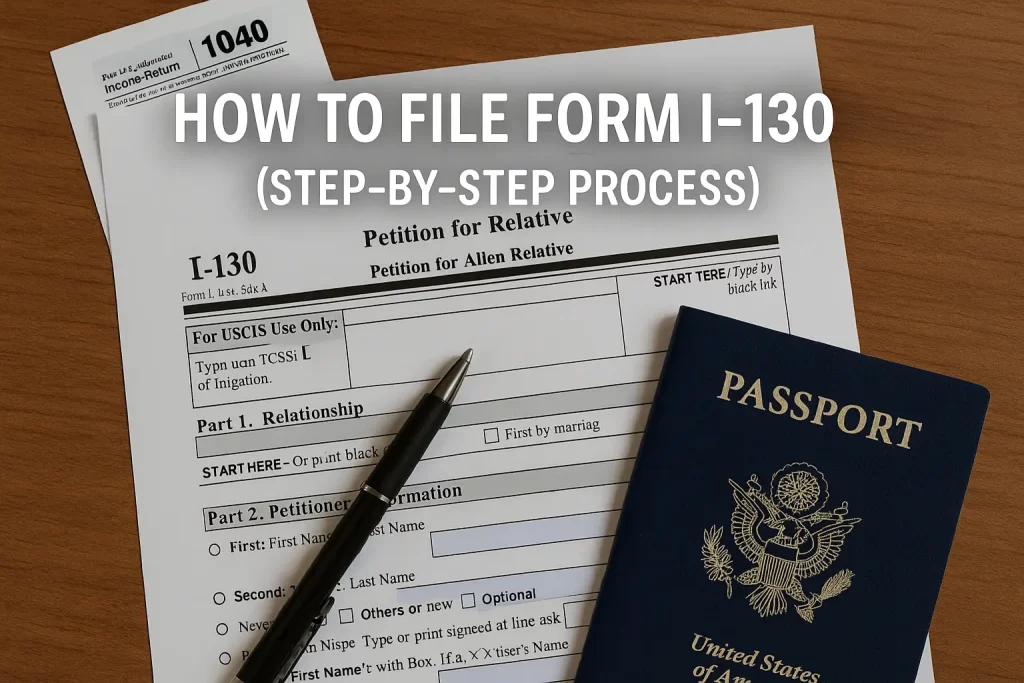
Filing the I-130 Petition for Family Sponsorship may seem intimidating at first — but once you understand the steps, it’s really about staying organized and following instructions carefully. Think of it as building a bridge between you and your loved one’s future in the U.S. 🌉
Here’s how to get it right, step by step:
In 2025, USCIS offers two ways to file your I-130:
💡 Pro tip: If you file online, double-check that all documents are uploaded clearly and labeled properly. Missing files are one of the most common causes of initial rejections.
You’ll need to complete:
As of 2025, the filing fee is $535, but always verify the latest fee on the official USCIS website, as it may change. Payments can be made online via credit card or through a check or money order if filing by mail.
Depending on the type of relationship, examples include:
🖇️ Make sure all documents in a foreign language are translated into English and certified by a qualified translator.
Once everything is ready, submit your form and supporting documents either:
After submission, you’ll receive a Receipt Notice (Form I-797C) confirming that USCIS has received your petition. Keep this document safe — it contains your case number, which you’ll need to track progress.
After submission, you can check your status online anytime using your receipt number
If USCIS needs more information, they’ll send an
RFE (Request for Evidence). Don’t panic — it’s common. Respond as soon as possible, providing exactly what’s asked for.
🕰️ Most I-130 cases take several months to process, but timelines vary based on your relationship type and USCIS service center workload.
✨ Pro Tip: Make digital and physical copies of everything you submit — forms, evidence, translations, even mailing receipts. If you ever need to reference something or respond to an RFE, you’ll thank yourself later.
Once your I-130 is officially filed, the waiting game begins — but you’re one big step closer to reuniting with your loved one. 💌
Next, let’s go over what supporting documents you’ll need to make your petition as strong and complete as possible. 📁
📁 Supporting Documents for I-130 Approval
When it comes to the I-130 petition, documentation is everything. 🗂️ Think of your supporting documents as the “proof” that gives USCIS confidence your relationship is real and legitimate. Submitting the right evidence upfront can make your case move faster and help you avoid frustrating delays or RFEs (Requests for Evidence).
Let’s go through what you’ll need depending on your relationship type.
📝 Tip: USCIS looks for consistency. Make sure dates, addresses, and names match across all documents.
You’ll also need to show that you have the legal right to sponsor your family member. Include one of the following:
Thanks to the new USCIS digital platform, petitioners can now upload documents directly through their online account. This eliminates mailing delays and makes it easier to track what’s been received. You can also preview uploaded files to ensure they’re clear before submission — no more guessing whether your scans are legible!
✨ Pro Tip: Submit all your supporting documents together when you file. Incomplete applications are the #1 reason I-130 petitions get delayed or rejected.
Once you’ve submitted all your documents, the hard part begins — waiting for USCIS to process your case. But don’t worry, in the next section we’ll break down how long the I-130 process takes in 2025 and how you can track your timeline like a pro. ⏳
Here’s the question everyone wants answered — how long does it take? Unfortunately, there’s no single timeline that fits everyone. The I-130 processing time depends on your relationship, your filing method, and the USCIS service center handling your case. Still, by 2025, we can spot some patterns and improvements that make the wait a little easier to predict.
As of 2025, the average processing times are:
These times can shift depending on USCIS workload and any policy changes. Always double-check current estimates at uscis.gov/processing-times.
USCIS has several service centers — like Texas (TSC), Nebraska (NSC), California (CSC), Vermont (VSC), and the National Benefits Center (NBC) — and each one moves at its own pace. Your receipt notice will show which center is handling your case.
💡 Pro Tip: If your case has been pending longer than the average time posted for your service center, you can submit a case inquiry online to request an update.
Processing time isn’t the only factor. Your visa category also determines when your relative can actually move forward in the immigration process.
Here’s how it works:
The Visa Bulletin, published monthly by the Department of State, shows which cases are ready to move forward based on your country and category.
Unlike employment-based petitions, the I-130 doesn’t offer premium processing. However, you can request expedited processing in rare circumstances — for example, urgent humanitarian reasons or severe family separation. You’ll need to provide solid evidence and a detailed explanation when making this request.
USCIS continues to digitize family-based petitions in 2025. The online filing system now sends instant receipt notices, digital case updates, and estimated completion windows — a big improvement from the old paper-based process.
Many petitioners also report that online filings get faster responses to RFEs and status updates, which means less uncertainty and better transparency.
✨ Pro Tip: Stay proactive during the wait. Set a reminder to check the Visa Bulletin monthly and log into your myUSCIS account regularly for status changes. You can even opt into email or text notifications so you never miss an update.
Waiting is the hardest part — but the good news is, once your I-130 is approved, you’re finally moving into the next phase of the process. In the next section, we’ll walk through what happens after your I-130 is approved and what to expect whether your loved one is inside or outside the U.S. 📨
⚖️ What Happens After I-130 Approval?
So you’ve received that long-awaited I-130 approval notice — congrats! 🎉 It’s a major milestone, but it’s not the end of the road. What happens next depends on where your family member is living and which visa category they fall under. Let’s walk through what comes after the I-130 is approved and how to make sure the next step goes smoothly.
After approval, your case moves from USCIS to the National Visa Center (NVC), which is managed by the U.S. Department of State. The NVC will:
Your relative will complete the DS-260 Immigrant Visa Application online and submit civil documents like birth certificates, police records, and passport pages. You, the petitioner, will complete Form I-864 (Affidavit of Support) to show that you can financially support your family member once they arrive. 💵
After all documents are reviewed and approved, the NVC schedules an interview at the U.S. consulate. If everything goes well, your relative receives their immigrant visa — and they can finally travel to the U.S. as a permanent resident. ✈️
If your family member is already in the U.S. on a valid visa, they may be eligible to file Form I-485 (Application to Register Permanent Residence or Adjust Status) after the I-130 approval — or in some cases, at the same time.
Here’s how it works:
When the I-485 is filed, your family member can also apply for:
After the interview (if required) and final review, they’ll receive their Green Card in the mail — a truly life-changing moment. 💚
For preference categories (like siblings or married children), the I-130 approval doesn’t mean an immediate visa. It just means USCIS has recognized the family relationship. Your case will remain with the NVC, waiting for your priority date
It’s important to keep your address and contact details updated with the NVC — they’ll reach out when your turn comes.
You can track your I-130 status on USCIS.gov and your NVC case status on nvc.state.gov. Always note your case number and keep every email or letter you receive.
💡 Pro Tip: Once your petition is approved, don’t let it sit idle. Keep an eye on Visa Bulletin changes — sometimes a single month can open or close filing opportunities, especially for high-demand countries.
The approval of your I-130 marks the end of one chapter and the beginning of another — the part where your loved one’s dream of living in the U.S. becomes tangible. 🇺🇸
But before that dream comes true, it’s vital to avoid mistakes that could delay or derail your progress. In the next section, we’ll cover the most common reasons I-130 petitions get denied — and how to make sure yours doesn’t. 🚫

There’s nothing more discouraging than waiting months for your petition only to receive a denial notice from USCIS. 😞 The good news? Most I-130 denials are preventable — they happen because of avoidable errors or missing information. Let’s look at the most common reasons and how to make sure your case stays on track.
Examples:
Provide strong, consistent evidence. For spousal cases, go beyond the basics — include joint financial records, travel history, and affidavits from people who know your relationship well. For parent-child or sibling petitions, make sure all birth certificates clearly show the same parents.
Even a small typo can create big problems. Forgetting to sign a form, entering the wrong date of birth, or skipping a section can lead to rejection or delays.
Review your form carefully before submission — and if you’re filing online, use the built-in “preview” feature to catch mistakes. Make sure every field is complete, all names are spelled exactly as on official documents, and that the form is signed (digitally or on paper, depending on filing method).
For spousal petitions, USCIS takes extra precautions to ensure the marriage isn’t solely for immigration benefits. If your documents or interviews raise doubts, your case could be denied.
Be genuine and transparent. Provide proof that your relationship is ongoing and real — joint finances, shared photos over time, travel together, or messages showing continued communication.
Sometimes, petitions are denied simply because they were sent to the wrong lockbox or filed using an outdated version of the form.
Always download the latest version of Form I-130 directly from
USCIS.gov and check the correct filing address for your location and relationship type. If you’re filing online, the system automatically ensures you’re using the current version.
It sounds simple, but missing or incorrect payments are a leading cause of rejection — especially for paper filers.
If filing online, pay via USCIS’ secure payment system to avoid errors. For mailed applications, double-check the check or money order amount and make it payable to U.S. Department of Homeland Security — not abbreviations like “DHS.”
Sometimes USCIS asks for additional proof. Ignoring or missing the RFE deadline results in an automatic denial.
Check your USCIS account and email regularly for updates. If you receive an RFE, respond quickly and completely. Send exactly what’s requested — nothing less, nothing more.
Only U.S. citizens and lawful permanent residents can file Form I-130. Sometimes petitions are denied because the petitioner doesn’t have sufficient proof of status.
Always include a clear copy of your U.S. passport, citizenship certificate, birth certificate, or Green Card.
✨ Pro Tip: If your petition is denied, don’t lose hope. You may have the option to appeal the decision or refile with stronger evidence. In some cases, a denial doesn’t mean the relationship was invalid — just that the documentation wasn’t convincing enough the first time.
Avoiding these mistakes from the start saves you months of frustration. And once your petition is strong and organized, the rest of the process — from NVC to Green Card — will move much more smoothly.
Up next, let’s go through practical tips for a smooth I-130 experience, so you can stay confident and proactive every step of the way. 🌟
💡 Tips for a Smooth I-130 Petition Experience
Filing the I-130 is more than just paperwork — it’s about preparation, precision, and patience. 🕊️ Even a small detail can make a big difference in how smoothly your case moves through the system. Here are practical tips to help you stay one step ahead and make your I-130 process as stress-free as possible.
Before you even start the form, gather everything you’ll need: identification, proof of status, relationship evidence, and translations. Having everything ready avoids delays and helps you spot missing documents before they become a problem.
💡 Create a labeled digital folder — for example:
This will make it much easier when USCIS asks for a copy or when you later move to the NVC or I-485 stage.
The online system in 2025 is faster, more transparent, and less prone to errors than mailing. You can:
You’ll also get notifications when USCIS takes action on your case — so no more guessing or waiting for mail.
Never send your only copy of a document. Scan or photograph every form, translation, and supporting record. Keep digital backups stored securely in the cloud or an external drive.
If USCIS ever requests additional evidence or you need to refile, you’ll have everything ready at your fingertips.
Minor mistakes can trigger major setbacks. Review names, dates, and addresses carefully — and make sure they match your official records exactly.
Tip: Use the same spelling and format across all documents (for example, “St.” vs. “Street” or “Avenue” vs. “Ave”). Consistency matters more than you think.
Don’t just “set it and forget it.” Check your USCIS account or case status page every few weeks. USCIS can send updates or requests at any time, and you’ll want to act quickly.
You can even sign up for email or text alerts so you’re notified as soon as there’s movement on your case.
Make sure the person you’re sponsoring knows what to expect — especially if they’re abroad. Keep them informed about required documents, interview steps, and approximate timelines. Many delays happen because beneficiaries miss NVC or consular deadlines.
Processing times and rules can shift quickly. USCIS sometimes updates filing locations, form editions, or digital processes mid-year. Following immigration law updates or subscribing to alerts from your attorney’s office helps you stay compliant and prepared.
It’s natural to feel anxious during the wait, but patience and persistence are key. Most cases move forward without issue — they just take time. If your case is stuck far beyond normal processing times, contact USCIS through an online inquiry or your local congressional office for help.
Approach your petition as a team effort — you, your family member, and (if possible) a trusted immigration attorney. The more complete, organized, and honest your case is, the faster and smoother it will move toward approval.
Up next, we’ll look at 2025 USCIS updates and policy changes — including new online filing tools, fee adjustments, and process improvements that could impact your case this year. 🖥️🇺🇸
The U.S. immigration landscape never stands still — and 2025 is no exception. 📆 USCIS has continued modernizing its systems to make the I-130 process faster, more transparent, and easier for families around the world. Here’s what’s new this year and how it could affect your petition.
USCIS has been steadily shifting away from paper-based processing. In 2025, nearly all I-130 family petitions can now be filed and tracked online through a secure myUSCIS account.
That means:
💡 Tip: Always use high-quality PDFs or scans when uploading your documents. Blurry or incomplete files can still cause slowdowns even in a digital system.
USCIS introduced a new fee structure in early 2025 to cover system upgrades. The I-130 base fee remains affordable compared to other immigration petitions, but payment methods are now fully digital — you can pay by credit card, debit card, or ACH transfer directly online.
If filing by mail, USCIS now encourages using Form G-1450 (Credit Card Authorization) instead of checks for faster processing.
The new digital platform includes a feature that categorizes your evidence by type — for example, “Proof of Relationship,” “Identity Documents,” and “Proof of Petitioner Status.” This helps USCIS officers review files more efficiently and reduces RFEs for misplaced or unclear evidence.
Petitioners can now see estimated completion timelines inside their online accounts. While not exact, these projections help families plan ahead and reduce uncertainty. You’ll also receive automatic updates whenever your case moves between stages (like from USCIS to NVC).
USCIS has strengthened its expedited review options for cases involving urgent humanitarian situations, family separation, or vulnerable dependents. While still rare, these requests are now reviewed faster through a dedicated humanitarian team.
A big improvement this year is better data synchronization between USCIS and the National Visa Center (NVC). Once your I-130 is approved, case information now transfers automatically, reducing the lag time between approval and NVC case creation.
In past years, this could take weeks — now, in many cases, it happens within days. ⚡
The 2025 edition of Form I-130 includes clearer instructions about:
USCIS also added new checklist prompts to help ensure petitions are complete before submission.
USCIS reaffirmed its 2025 goal: to reduce family-based visa backlogs and reunite families faster. With increased staffing, better technology, and digital workflow improvements, processing times for many I-130 categories are expected to shorten slightly this year.
💡 Pro Tip: Always check the “Newsroom” section on the USCIS website before filing. That’s where official announcements about fee changes, filing addresses, or form revisions are posted — often before they circulate elsewhere online.
The immigration system may still take time, but 2025’s updates are making it smoother, smarter, and more predictable than ever before.
Next, we’ll wrap it all up with a final reflection — a reminder of why the I-130 isn’t just a form, but a bridge connecting families across borders. 🌈💌
At its core, the I-130 Petition for Family Sponsorship is about love, connection, and commitment. ❤️ It’s the legal bridge that reunites parents with children, spouses with partners, and siblings who’ve waited years to finally be in the same place — not just in heart, but in home.
Filing Form I-130 can feel like a long and technical process, filled with documents, fees, and waiting. But when you take a step back, every signature and scanned page represents something deeper — the desire to build a life together. 🌍
In 2025, the path to family reunification is evolving for the better. USCIS is moving faster, systems are more transparent, and the filing process is easier than ever to manage online. Whether you’re a U.S. citizen bringing your spouse home or a Green Card holder helping your child join you, you now have clearer tools and better guidance to make that dream a reality.
Still, the real key to success isn’t just understanding forms — it’s patience, preparation, and persistence. Stay organized, stay informed, and don’t lose sight of why you started this journey. Because at the end of every approved petition is a reunion, a hug at the airport, a home finally full again. 🕊️
The I-130 isn’t just paperwork — it’s a promise. A promise that across oceans, time zones, and years apart, family still finds its way back together. 💫
https://www.usavisalaw.com/immigration-blog
https://www.usavisalaw.com/family-immigration
https://travel.state.gov/visa-bulletin
Contact our team at:
https://www.usavisalaw.com/contact


