Author: Hasan Abdullah, Esq.
Edited: September, 2026
Your U.S. visa number, also called the visa foil number, is the red alphanumeric identifier printed near the bottom-right corner of the visa inside your passport. It identifies that particular visa issuance and is different from your passport number, visa control number, A-Number, and I-94 number.
That distinction matters because a U.S. visa contains several numbers that can look similar, and immigration forms may ask for a specific one. Using the wrong identifier can create unnecessary confusion when completing visa or immigration paperwork.
Whether you hold a B1/B2 visitor visa, F-1 student visa, H-1B work visa, or another classification, the basic identification method is generally the same. American Visa Law Group assists individuals, families, professionals, and employers with a range of U.S. visa and immigration matters.
This guide explains where to find your U.S. visa number, what it looks like, and how to distinguish it from other immigration document numbers.
A U.S. visa number is an identifier assigned to a specific visa issued by the U.S. Department of State. It is commonly called the visa foil number and appears on the visa placed inside the traveler’s passport.
According to USCIS SAVE guidance on immigration identifiers, the visa number is the red identifier printed near the bottom-right of the visa. Current USCIS guidance describes it as an eight-character number, while other SAVE materials note that some visa numbers may contain seven or eight alphanumeric characters. For that reason, the safest approach is to copy the number exactly as it appears on the visa. (USCIS)
The visa number identifies the particular visa document, not the traveler permanently. It is different from identifiers such as a passport number, visa control number, A-Number, or I-94 admission number.
Yes. In this context, visa number and visa foil number refer to the same identifier. USCIS uses both terms for the number printed on a U.S. visa. (USCIS)
If a form specifically asks for a visa number or visa foil number, it generally refers to this identifier. However, the broader phrase “document number” can refer to different immigration documents, so applicants should follow the instructions for the particular form they are completing rather than assume every document-number field means the visa number.
A U.S. visa number is usually printed in red and may contain seven or eight alphanumeric characters. Depending on the visa, it may consist entirely of numbers or include a letter.
For example, a fictional visa number might look like:
12345678
A1234567
USCIS SAVE guidance confirms that the visa number—also called the visa foil number—is the red identifier printed near the bottom-right of the visa document. (USCIS)
The exact format can vary, so do not rely only on the number of characters. Copy the visa number exactly as it appears on your visa, including any letters.
Avoid adding spaces, omitting characters, or trying to reconstruct an unclear number from memory. If a government form asks for a visa number or visa foil number, use the identifier printed on the visa itself.
USCIS SAVE guidance on visa numbers and immigration identifiers
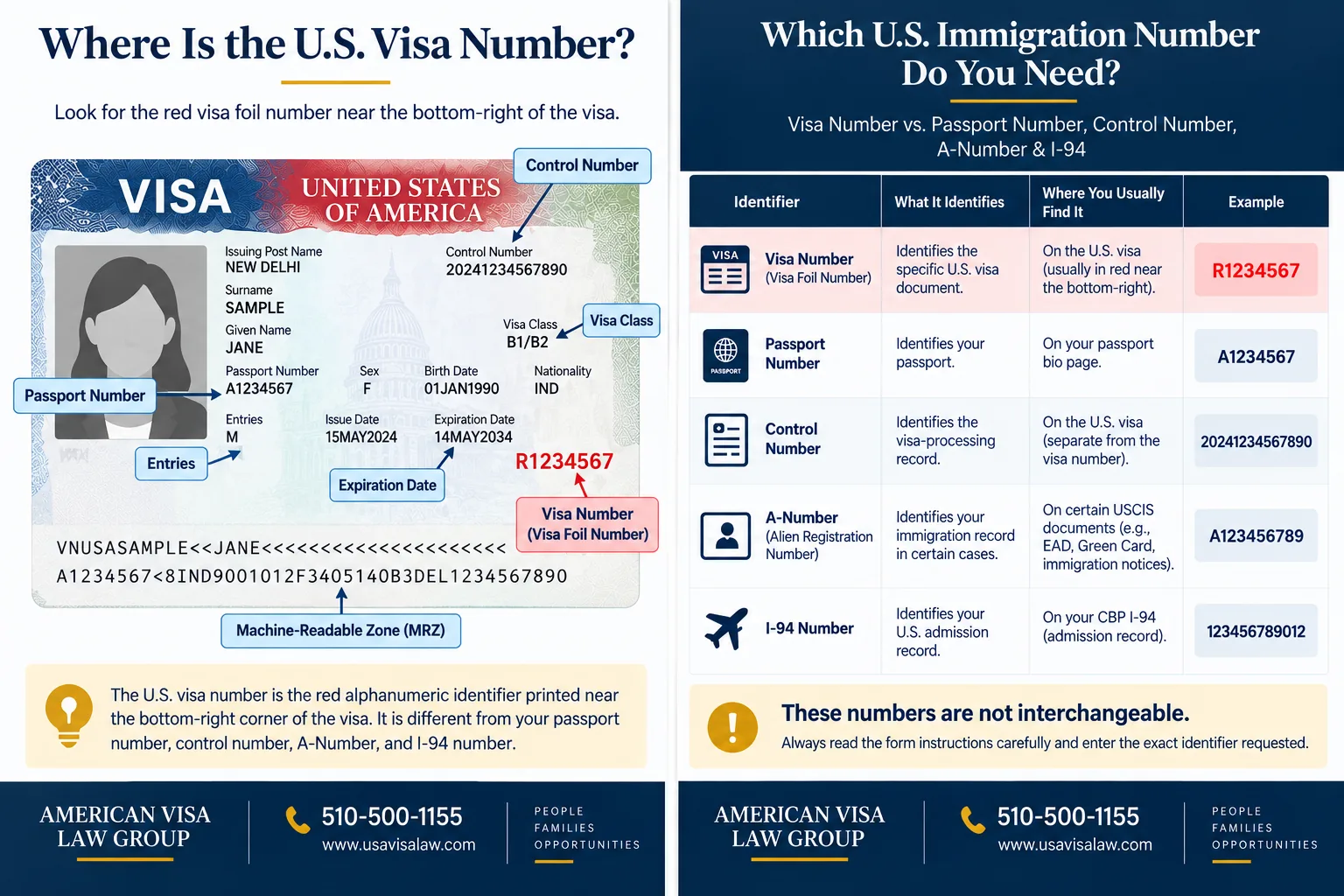
On a B1/B2 visa, the visa number is the same visa foil number used on other modern U.S. visas. It is generally printed in red near the bottom-right corner of the visa inside the passport.
The B1/B2 label identifies the visa class, not the visa number itself. A combined B1/B2 visa is a visitor visa used for qualifying temporary business or tourism purposes, according to the U.S. Department of State. (Travel.state.gov)
If a form asks for the B1 B2 visa foil number, it is generally asking for the red visa number—not the passport number or the control number printed elsewhere on the visa.
USCIS SAVE guidance identifies the visa number, also called the visa foil number, as the red number printed at the bottom-right of a U.S. visa. (USCIS)
For more information about visitor visas, see AVLG’s B-1/B-2 visitor visa guidance.
A U.S. visa contains several different identifiers, and they are not interchangeable. The visa number identifies the visa document itself, while other numbers may identify your passport, immigration record, admission to the United States, or a particular USCIS case. USCIS SAVE guidance on immigration identifiers explains how several of these document numbers are used across U.S. immigration records.
Your passport number identifies the passport issued by your country, while your U.S. visa number identifies the visa issued by the U.S. Department of State and placed inside that passport.
If an immigration or visa form asks for both numbers, enter each one in the field specifically designated for it.
The visa control number is different from the visa number. A U.S. visa may display a separate control number in another part of the document, while the visa foil number is the red identifier near the lower-right portion of the visa.
The U.S. Department of State’s visa guidance provides official information about U.S. visa documents and the information associated with them.
If a form asks specifically for your visa number or visa foil number, do not enter the control number.
An A-Number, or Alien Registration Number, is a separate identifier associated with certain immigration records maintained by the Department of Homeland Security. It does not identify a particular visa foil.
For a detailed explanation of that identifier, see AVLG’s guide to the Alien Registration Number (A-Number).
Your I-94 number relates to your admission to the United States, not to the visa itself. After entering the country, many travelers can retrieve their official admission record through the CBP I-94 system.
The visa number identifies the visa used for travel, while the I-94 record documents the terms of admission after entry.
The simplest rule is: read the form carefully and enter the exact identifier it requests rather than choosing whichever number on your immigration documents looks most important.
.webp)
The visa number is only one of several fields printed on a U.S. visa. Knowing what the other fields mean can help you avoid confusing the visa foil number with your passport number, control number, visa class, or expiration date.
The U.S. Department of State’s guidance on visa validity explains several of these fields, including the number of entries and the difference between visa validity and authorized stay. (Travel.state.gov)
The Department of State confirms that “M” under Entries means multiple entries, while a specific number limits the visa to that number of uses to seek admission. (Travel.state.gov)
One field causes particular confusion: the expiration date. It tells you about the period during which the visa may be used to seek admission; it does not by itself determine how long you are authorized to remain in the United States after entry. (Travel.state.gov)
The expiration date on your U.S. visa does not determine how long you are allowed to remain in the United States after entry.
A visa allows you to travel to a U.S. port of entry and request admission. According to the U.S. Department of State’s guidance on visa expiration, U.S. Customs and Border Protection decides whether to admit a traveler and determines the authorized period of stay. (Travel.state.gov)
For many nonimmigrants, that period is reflected in the Form I-94 admission record. The record may show a specific “admit until” date or, for certain classifications, D/S, meaning duration of status. Travelers can review their admission information through the official CBP I-94 system.
A visa can therefore expire while you are lawfully present in the United States. If you were properly admitted for a period extending beyond the visa’s expiration date, the expiration of the visa alone does not end that authorized stay. (Travel.state.gov)
The distinction is simple:
Visa expiration date: generally determines how long the visa may be used to seek admission.
I-94 or admission record: generally reflects how long you are authorized to remain after entry.
Because overstaying an authorized period can have significant immigration consequences, travelers should not use the visa expiration date alone to calculate when they must leave the United States.
You may need your U.S. visa number when a government form or immigration process asks for information about a current or previously issued U.S. visa.
Common situations include completing a new visa application, providing details about prior U.S. travel, responding to an immigration form that requests previous visa information, or documenting an earlier visa issuance. For example, applicants completing the DS-160 Online Nonimmigrant Visa Application may be asked for information about previous U.S. visas.
The key is to follow the wording of the specific form. If it asks for a visa number or visa foil number, enter the number printed on that visa. Do not substitute your passport number, A-Number, control number, or I-94 number unless the form specifically requests one of those identifiers.
If you have held more than one U.S. visa, use the number from the visa the form is asking about. If it requests your most recent U.S. visa, use the number from your latest visa issuance.
The safest approach is simple: identify the exact visa referenced by the form and copy the number directly from that document.
If you cannot clearly identify your U.S. visa number, do not guess. The best source is the original visa document or a clear copy of it.
Start by checking the passport that contains the visa and look for the red visa foil number near the lower-right portion of the document. If the visa is in an older passport, make sure you are looking at the correct visa issuance, especially if you have received more than one U.S. visa over time.
If the passport has been lost, stolen, or damaged, check whether you have a secure scan, photograph, or copy of the visa in your records. If a form asks for prior visa information and you no longer have the document, review the instructions for that specific form rather than substituting another identifier.
If the visa itself appears to contain incorrect information, the U.S. Department of State advises visa holders to contact the U.S. embassy or consulate that issued the visa.
If the problem is instead that you entered the wrong visa number on an immigration or visa form, the correction process depends on the specific application and where it is in the process. Do not alter the visa itself or submit conflicting information without first checking the applicable instructions.
The safest rule is simple: verify the number from the actual visa whenever possible and avoid reconstructing it from memory.
Most errors happen because a U.S. visa contains several different identifiers that can look equally important. The simplest way to avoid problems is to match the wording on the form with the correct number on the document.
Common mistakes include:
If you are unsure which identifier a government form is requesting, review the form instructions before submitting it. The USCIS SAVE program and the official CBP I-94 system are useful government references for understanding common immigration document identifiers and admission records.
A U.S. visa number, also called the visa foil number, is the red identifier printed near the lower-right portion of the visa inside your passport.
It is different from your:
The same general rule applies across visa classes, including B1/B2, F-1, H-1B, and other U.S. visas.
When a government form asks for a visa number or visa foil number, copy the identifier directly from the relevant visa and enter it exactly as printed.
Also remember that a visa’s expiration date does not determine how long you may remain in the United States, and in green card cases, the phrase “visa number available” can refer to immigrant visa availability rather than the number printed on a visa.
The U.S. visa number, also called the visa foil number, is generally printed in red near the bottom-right corner of the visa inside your passport.
Yes. On most modern U.S. visas, the red alphanumeric identifier near the lower-right portion of the visa is the visa number.
No. Your passport number identifies the passport issued by your country, while the visa number identifies the specific U.S. visa placed inside that passport.
No. The control number is a separate identifier printed elsewhere on the visa. If a form asks for a visa number or visa foil number, do not enter the control number.
No. An A-Number, or Alien Registration Number, identifies an individual in certain U.S. immigration records. It is different from the visa foil number printed on a visa. For more detail, see AVLG’s guide to the Alien Registration Number (A-Number).
Yes. On a B1/B2 visitor visa, the visa foil number and visa number refer to the same identifier. The B1/B2 label identifies the visa class; it does not change what the visa number is.
Generally, yes. A newly issued visa will usually have its own visa number because the identifier relates to that particular visa issuance.
Do not guess. Check the original visa, a clear scan, or another secure copy. If the visa itself appears incorrect, contact the U.S. embassy or consulate that issued the visa for guidance.
For official guidance on U.S. visa documents, visa validity, admission records, and immigration identifiers, these government resources are useful references:

Hasan Abdullah, Esq. is the Founder and Managing Attorney of American Visa Law Group. His practice focuses on U.S. immigration law, including family-based immigration, employment-based immigration, adjustment of status, consular processing, waivers, PERM labor certification, NIW, EB-1, H-1B, O-1, and complex immigration strategy.
Through American Visa Law Group, Mr. Abdullah helps individuals, families, professionals, investors, and employers understand their immigration options and plan around changing government policies, USCIS procedures, and Visa Bulletin movement. His work emphasizes practical legal analysis, realistic expectations, and strategy tailored to each applicant’s immigration history and long-term goals.


