American visa law group

US Visa Options for Entrepreneurs and Startup Founders

We publish vlog/blog posts with accompanying articles covering a variety of immigration topics. They are classified by the following subjects: News, General, Waivers, Family Based, U-Visa, VAWA, Asylum, EB1/NIW, PERM/I140, EB4, EB5, Visitors (B1/B2/VWP), E2, F1, H1B, L1, and TN Visas. Click on the title on any of the articles to read the full blog post:

US Visa Options for Entrepreneurs and Startup Founders

So, you’ve got the vision, the drive, and maybe even the capital—but how do you bring your entrepreneurial dream to life in the United States?

You’re not alone in wondering this. Every year, thousands of ambitious founders around the world set their sights on the U.S., drawn by its innovation-driven economy and thriving startup ecosystems like Silicon Valley, New York, and Austin. In fact, over 40% of Fortune 500 companies were founded by immigrants or their children—a powerful reminder that the American dream is very much alive, especially for those with big ideas.

But before you can pitch to VCs or open that Brooklyn café, there’s a critical first step: getting the right visa. And here’s the tricky part—there isn’t just one “entrepreneur visa” in the U.S. legal system. Instead, there’s a maze of visa categories, each with its own rules, timelines, and quirks. E-2? L-1? EB-5? It’s enough to make your head spin.

Don’t worry. This guide breaks it all down for you—plain and simple. Whether you’re an investor from a treaty country, a startup founder with VC backing, or an established business owner expanding into the U.S. market, you’ll find your path here. We’ll cover eligibility, pros and cons, and strategies to increase your odds of success.

Let’s get you closer to launching your business in the land of opportunity. 🚀

Perfect! Here’s the first section of the article:
🌎 Why the U.S. Attracts Global Entrepreneurs

Why the U.S. Attracts Global Entrepreneurs (1)


Let’s be real—there’s a reason the U.S. shows up on every entrepreneur’s radar. It’s not just about the big market size or the prestige of “making it” in America (though those help!). It’s about the unique combination of opportunity, innovation, and support that makes launching a business in the U.S. feel like hitting the startup jackpot.

When I first considered moving my small tech consulting firm to the States, I was overwhelmed. I thought, “What does the U.S. really offer that I can’t find somewhere else?” Turns out, a lot. And here’s why that matters to you:

  • Innovation Hubs That Spark Growth
    Think Silicon Valley, Austin, Boston—these aren’t just buzzwords. They’re ecosystems packed with accelerators, co-working spaces, tech meetups, and investor networks that are constantly looking for the next big thing. If you’re in biotech, fintech, SaaS—really, anything—there’s a niche and support structure for you.
  • Access to Capital
    The U.S. is the global epicenter of venture capital. Whether you’re bootstrapping or raising a million-dollar round, chances are you’ll find a funding option that fits. And here’s the kicker: American investors are often willing to take risks—if you show them a strong vision and the hustle to back it up.
  • Top Talent on Tap
    Let’s say you need an AI specialist, a brilliant graphic designer, and a legal team that understands startups. In the U.S., you can build that dream team faster than almost anywhere else. Between the university pipelines and gig economy, you’re spoiled for choice.
  • Legal & IP Protection
    When you’re pouring your soul into building a product, the last thing you want is someone swiping your code or idea. U.S. intellectual property laws are robust, and courts generally support business owners defending their patents or trademarks. It’s a safety net most countries don’t offer with this level of enforcement.
  • Immigrant Success Stories Everywhere
    From Elon Musk (South Africa) to Hamdi Ulukaya (Turkey, founder of Chobani), the U.S. has seen immigrant entrepreneurs change entire industries. There’s something inspiring about being in a place where your background isn’t a limitation—it’s part of your edge.

Of course, it’s not perfect. The bureaucracy is very real, and you’ll face your fair share of paperwork, visa confusion, and cultural adjustment. But if you’re the kind of person who dreams big and takes risks? The U.S. gives you the playing field, the tools, and the audience to make it happen.


🛂 E-2 Visa – For Treaty Country Entrepreneurs

20250619 1719 Visa for Entrepreneurs simple compose 01jy4fqwd8f4c8p6xhefpyx2p5

Alright, let’s talk about one of the most popular (and honestly underrated) visa options for foreign entrepreneurs: the E-2 Treaty Investor Visa. If your home country has a treaty of commerce and navigation with the United States, this might be your golden ticket to launching a business on U.S. soil.

I had a friend from Tunisia—super sharp guy, ran a small organic food brand—who used the E-2 to open a storefront in California. He didn’t need millions, just a solid plan, a decent investment, and the guts to go for it. Within a year, he was turning profit and hiring staff. That’s the kind of story the E-2 can make possible.

🔑 Key Features of the E-2 Visa:

  • Investment-Based
    You must “substantially” invest in a U.S. business. There’s no official minimum, but in practice, you’re looking at $100,000+ as a ballpark for credibility. The business must be active—not just a shell or holding company.
  • Ownership & Control
    You need to own at least 50% of the business, or otherwise demonstrate operational control. No passive investors allowed here—USCIS wants to see that you’re hands-on and running the show.
  • Renewable (but Temporary)
    The E-2 doesn’t offer a direct path to a green card, but it can be renewed indefinitely as long as your business stays active and compliant. Some entrepreneurs live in the U.S. for decades on this visa alone.
  • Spouses Can Work
    This is a huge plus! If your spouse joins you on a derivative E-2 visa, they can apply for work authorization and take up employment in any field—not just your business.
  • Children Can Study
    Your kids (under 21) can go to U.S. schools and universities while you operate your business. It’s a lifestyle opportunity as much as a business one.

🚩 Watch Out For:

  • You can’t apply for this visa if your country doesn’t have a qualifying treaty with the U.S. (Check the list on the U.S. Department of State website.)
  • No direct transition to a green card—so long-term immigration goals might require a different plan.
  • The term “substantial investment” is vague and often case-specific. USCIS wants to see real risk and real commitment.

💡 Pro Tip:

Prepare a strong business plan. This isn’t optional—it’s the heart of your application. It should detail your investment, marketing strategy, hiring projections, and financials for at least five years. If possible, include evidence of contracts, leases, and even early revenue. Immigration officers want to know you’re serious.


🌐 L-1 Visa – For Business Owners Expanding to the U.S.

If you’re already running a business in your home country and dreaming of opening a U.S. branch, the L-1 visa could be your ideal pathway. It’s kind of like a business-class ticket for international expansion—especially if you plan on sticking around long enough to get permanent residency later on.

I remember a client from Morocco who had a small IT firm with 15 employees. He used the L-1A to transfer himself as an executive to a new office in Chicago. Within a year, he was hiring locally, scaling operations, and applying for his EB-1C green card. It was a grind, sure—but the roadmap was clear, and it worked.

🔑 What is the L-1 Visa?

The L-1 is a nonimmigrant intracompany transferee visa that allows you to relocate to the U.S. to manage a new or existing office for your foreign business.

There are two flavors:

  • L-1A: For executives and managers (valid up to 7 years)
  • L-1B: For employees with specialized knowledge (valid up to 5 years)

For entrepreneurs, L-1A is the more relevant one.

🧩 Basic Eligibility:

  • Your foreign business must continue operating and have a qualifying relationship with the U.S. entity (like parent, branch, affiliate, or subsidiary).
  • You must have worked for the business for at least 1 continuous year in the past 3 years in an executive or managerial capacity.
  • The U.S. office can be newly established, but it must show plans for growth and a genuine need for a manager or executive.

📈 Why Entrepreneurs Love It:

  • Path to Green Card: The L-1A can lead to a green card under the EB-1C category, often without needing labor certification.
  • No Investment Threshold: Unlike E-2 or EB-5, there’s no required dollar amount. The focus is more on the operational structure and job creation.
  • Family Benefits: Like the E-2, your spouse can apply for work authorization and your kids can attend school in the U.S.

🚧 Challenges to Watch For:

  • Bureaucracy is no joke. You’ll need to submit a detailed business plan, org charts, lease agreements, payroll documents, and more.
  • If opening a new office, the initial visa is usually granted for 1 year, with the expectation that you’ll prove growth to renew.
  • Immigration officers scrutinize L-1s more now than in the past—especially for smaller businesses—so don’t skimp on documentation.

💡 Pro Tip:

Use this visa strategically. If your long-term goal is permanent residency, the L-1A to EB-1C route is one of the few employer-sponsored options that bypasses the lengthy PERM process. Just make sure your foreign and U.S. operations are clearly linked and sufficiently staffed—especially at the executive level.


🚀 International Entrepreneur Rule (IER)

Now here’s a wildcard that not many people know about—but it could be a game-changer if you’re a startup founder with serious potential. The International Entrepreneur Rule, or IER, isn’t technically a visa, but it does allow you to live and work in the U.S. while building your startup. Think of it as a special permission slip from Uncle Sam if your business is promising enough to boost the American economy.

Let me tell you, I almost didn’t believe this one was real until I helped a fintech founder apply. He had about $300,000 in U.S. venture capital backing, a team of three, and a killer MVP. No E-2 eligibility, no L-1 structure—but boom, IER gave him a foothold.

🔍 What is the IER?

It’s a parole program, not a visa, launched by USCIS to allow foreign startup founders temporary stay in the U.S. if their company shows significant public benefit—usually through funding, innovation, or job creation.

✅ Basic Eligibility:

  • You must own at least 10% of the startup and play a central role in its operations.
  • The startup must be less than 5 years old and based in the U.S.
  • The business must have received at least $250,000 in qualified U.S. investment OR $100,000 in U.S. government grants or awards.
  • If you don’t hit those exact numbers, you can still qualify by showing other compelling evidence of the startup’s potential.

⏳ How Long Can You Stay?

  • Initial parole is granted for 2.5 years.
  • You can apply for a one-time extension of another 2.5 years—but only if your startup continues to show strong growth, funding, or job creation.
  • Maximum stay = 5 years total.

🧠 Pros of the IER:

  • You don’t need a treaty country, a huge investment, or an existing business abroad.
  • It’s founder-friendly, designed for early-stage innovation.
  • Your spouse can apply for a work permit.
  • It’s perfect for startups with backing but no clear visa option.

⚠️ Cons to Consider:

  • It’s not a visa, so it doesn’t lead directly to a green card.
  • You’re technically a parolee, not a legal nonimmigrant.
  • USCIS has been inconsistent in processing these—approvals take time and aren’t guaranteed.
  • You can’t switch from IER to most visas without leaving the country and reapplying.

💡 Pro Tip:

Have a clean cap table and strong documentation. Investors should be U.S.-based and have a track record of funding startups. Also, consider pairing IER with a future strategy for transitioning to an EB-2 NIW or another long-term visa if you’re serious about staying in the U.S.
 

💼 EB-2 NIW – National Interest Waiver for Entrepreneurs

EB 2 NIW National Interest Waiver for Entrepreneurs (1)

If you’re a mission-driven founder building something impactful—think clean energy, healthcare innovation, or agri-tech—then the EB-2 NIW (National Interest Waiver) might be your golden path to a U.S. green card. No employer sponsorship. No lottery. Just you, your business, and a compelling case that what you’re doing matters to America.

I once worked with a biotech entrepreneur who developed low-cost diagnostic tools for rural clinics. He didn’t have a ton of U.S. funding, but his work clearly addressed public health challenges. The EB-2 NIW let him apply for a green card without needing a job offer. It’s that kind of flexibility that makes this visa so powerful—especially if you’ve got a project with purpose.

🧠 What is the EB-2 NIW?

The EB-2 is an employment-based immigrant visa category for individuals with advanced degrees or exceptional ability.

The NIW part means you can waive the job offer and labor certification requirement by proving your work benefits the U.S. as a whole.

Perfect for solo founders, researchers, or innovators solving big problems.

✅ Key Requirements:

You must meet both EB-2 and NIW criteria.

For EB-2, you’ll need:

  • An advanced degree (Master’s or higher) OR
  • Exceptional ability in your field (e.g., documented expertise and recognition)

For the NIW waiver, you must show:

  1. Your work has substantial merit and national importance
  2. You are well positioned to advance the work
  3. It would benefit the U.S. to waive the job offer requirement

💎 Why Entrepreneurs Choose This Route:

  • No employer needed: You don’t need to be sponsored or hired.
  • Path to a green card: Unlike E-2 or IER, this leads directly to permanent residency.
  • Flexibility: Works well for entrepreneurs, independent contractors, consultants, and founders.
  • Powerful for innovators: Especially if your business supports underserved communities, scientific progress, economic growth, or national policy goals.

🚩 Drawbacks to Keep in Mind:

  • It’s not quick: Processing can take 12–18 months (or longer).
  • You’ll need to prepare a rock-solid petition with letters of recommendation, media coverage, business plans, and proof of success.
  • If you’re early-stage or pre-revenue, it’s harder—but not impossible. You’ll need to argue on potential.

💡 Pro Tip:

You don’t have to be famous—but you do need to build your credibility. Publish articles, get invited to speak, win awards, or show traction. Even if your startup is young, show how it’s different and how you’re the right person to lead it. U.S. immigration wants to bet on people who look like they’ll change something.
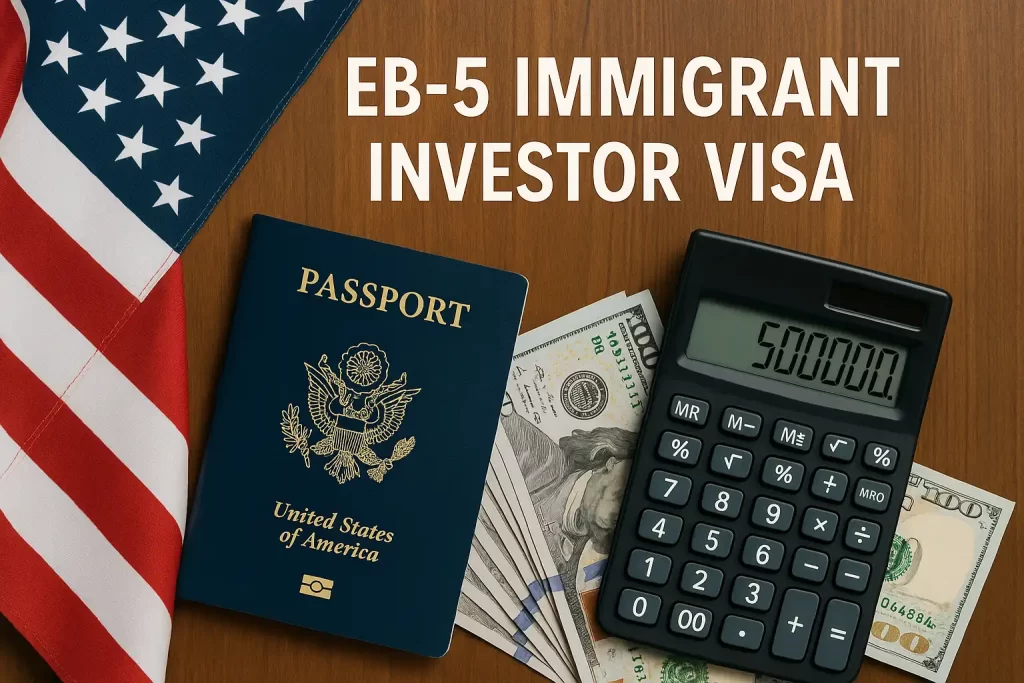
 

📈 EB-5 Immigrant Investor Visa

EB 5 Immigrant Investor Visa (1)

If you’re an entrepreneur with substantial capital and a dream of living in the U.S. long-term, the EB-5 Immigrant Investor Visa might be your express lane to a green card—not just for you, but for your spouse and children too. It’s the most direct investment-to-residency path out there.

I once consulted with a Lebanese restaurateur who had already run several successful businesses in the Gulf. He used EB-5 to invest in his own U.S. franchise and move his whole family to Florida. It wasn’t easy or cheap—but for him, it was absolutely worth it.

💰 What is the EB-5 Visa?

The EB-5 is a U.S. immigration program that grants permanent residency (green card) to foreign nationals who invest a specific amount in a U.S.-based commercial enterprise and create at least 10 full-time jobs for American workers.

💵 Investment Amounts:

  • $800,000 in a Targeted Employment Area (TEA) – rural or high-unemployment regions
  • $1,050,000 in a non-TEA location (typically urban or higher-income areas)

This can be done via:

  • Direct Investment (you control the business)
  • Regional Center Projects (you invest in a pre-approved project and take a more passive role)

🎯 Requirements:

  • Investment must be at risk (no guaranteed returns)
  • The business must be for-profit and create at least 10 full-time U.S. jobs
  • Funds must be lawfully sourced (you’ll need solid financial records to prove it)
  • You must actively engage in the business if it’s a direct investment

🌟 Why It’s a Powerful Option:

  • Direct path to green card: Permanent residency without needing a U.S. employer or sponsor.
  • Family coverage: Spouse and unmarried children under 21 get green cards too.
  • Freedom to live anywhere: You don’t have to reside in the state where your business is located.
  • Option to start your own business: Unlike some other visas, you don’t need a pre-existing company abroad.

⚠️ Challenges to Know:

  • It’s costly—between legal fees, investment capital, and admin costs, you may need over $900,000–$1.2 million ready to go.
  • Processing delays are common. Some countries (like China or India) face long visa backlogs.
  • You’ll need extensive documentation to prove the legal origin of your investment funds.

💡 Pro Tip:

Consider working with an immigration attorney and licensed EB-5 specialist early on. A strong investment strategy, clean documentation trail, and careful business selection can make or break your case. And if you’re not ready to launch a business from scratch, Regional Centers are a lower-risk option—but read the fine print before you invest.

 

❓Which Visa Is Right for You? A Quick Comparison

Which Visa Is Right for You A Quick Comparison (1)


Let’s be honest: with all these acronyms—E-2, L-1, EB-5, IER—it’s easy to get overwhelmed. But choosing the right U.S. entrepreneur visa doesn’t have to be a guessing game. The best option depends on you: your nationality, investment capacity, business stage, and long-term goals.

When I was helping a startup duo from Egypt, one had funding from a U.S. accelerator, and the other had family capital. They each qualified for different visas (IER and E-2), but they made it work—by choosing what fit their role and resources best. You can do the same.

🧾 At-a-Glance Comparison Table:

Visa Type Investment Required Leads to Green Card Ideal For Nationality Restrictions Processing Time
E-2 ~$100,000+ ❌ (Not directly) Small business owners or franchisees Yes (Treaty countries only) 2–4 months
L-1A Varies (no set minimum) ✅ (via EB-1C) Business owners expanding to the U.S. None 1–6 months (premium option available)
IER $250k VC OR $100k U.S. grant ❌ (Parole status) Early-stage, VC-backed startup founders None 6–12+ months
EB-2 NIW None (but strong evidence required) Visionary founders with impactful work None 12–18+ months
EB-5 $800K–$1.05M High-net-worth entrepreneurs or passive investors None 24+ months (can vary)

🧠 How to Choose:

  • Don’t have a lot to invest yet? Try IER or EB-2 NIW if your business has social or economic impact.
  • Own a business abroad and want to expand? L-1A is made for you.
  • Coming from a treaty country and want a flexible visa? E-2 is a solid fit—but no direct green card path.
  • Want to invest and get a green card? EB-5 is the most straightforward—but also the most expensive.

💡 Pro Tips:

  • Think of your immigration strategy as a roadmap, not a one-stop shop. Many entrepreneurs start on an E-2 or L-1 and later apply for a green card.
  • Consider family needs too. Do you need your spouse to work? Want your kids in U.S. schools?
  • Some founders even layer strategies—start with IER while building an EB-2 NIW petition on the side.

📋 Key Steps to Prepare a Strong Visa Application

Key Steps to Prepara a Strong Visa Application (1)


Let’s get one thing straight: even if you’re the next Elon Musk, a sloppy visa application can still get denied. U.S. immigration doesn’t just want a good idea—they want paperwork, structure, and proof that you know what you’re doing.

I learned this the hard way helping a founder who had everything—traction, funding, even a U.S. office—but forgot to include a detailed business plan. The petition was delayed 6 months. Don’t let that be you.

Here’s how to stack the odds in your favor.

🧠 1. Build a Bulletproof Business Plan

  • Whether you’re applying for an E-2, L-1, or even making a case for EB-2 NIW, a business plan is your foundation.
  • Include: mission, market analysis, 5-year financial projections, staffing plan, and U.S. job creation estimates.
  • Keep it visually clean and professionally formatted. Think of it like a visa résumé.

📂 2. Organize Your Financial Documentation

  • USCIS wants proof your funds are legally sourced and at risk.
  • Gather: bank statements, investment contracts, asset sales records, tax filings, and if needed, loan documentation.
  • For EB-5 especially, you’ll need a full money trail—no shortcuts here.

🏢 3. Prepare Corporate and Legal Paperwork

  • Articles of incorporation, lease agreements, proof of office setup, EIN number, business licenses—these show your U.S. operation is real.
  • For L-1, include both foreign and U.S. company org charts, payroll, tax filings, and proof of shared ownership/control.

📬 4. Craft a Strong Cover Letter or Petition Letter

  • This letter tells the story: who you are, what your business does, and why you qualify.
  • Include citations of exhibits (like “See Exhibit A for financials”) and align them to visa criteria.
  • If you’re working with a lawyer, they’ll often write this—but be involved. Your voice matters.

👥 5. Get Support Letters (If Applicable)

  • For EB-2 NIW or IER, letters of recommendation can be powerful. Aim for 3–5 from industry peers, professors, or business partners who can vouch for your impact.
  • Make sure letters speak to specific achievements, not just general praise.

📸 6. Triple Check Forms and Deadlines

  • Always use the latest forms from uscis.gov.
  • Double-check every page for signatures, typos, and fees. Sounds basic, but even one box left blank can delay your case by months.

💡 Pro Tip:

Use a Dropbox or Google Drive folder to keep everything in one place—and share it with your legal team. The more organized you are, the smoother it goes. Think of your visa application like a pitch to investors: clear, confident, and backed by numbers.

🔁 Alternatives and Long-Term Strategies

alternatives longterm strategy

Maybe you’re not quite ready to jump into the visa maze—or maybe you’re already in the U.S. and wondering what’s next. The good news? There are workarounds, stepping stones, and long-game strategies that can help you stay legally and build your entrepreneurial journey at the same time.

One of my clients was here on an F-1 student visa, launched a successful app during OPT (Optional Practical Training), then transitioned into a long-term status through EB-2 NIW. It wasn’t fast, but it was smart—and totally doable.

Let’s explore the routes beyond the “usual suspects.”

🧑‍🎓 1. F-1 Visa with OPT or STEM OPT

  • Many international students in the U.S. start businesses during OPT (12-month post-grad work period) or STEM OPT (24-month extension).
  • You can start a business, but you must work for your own company as an employee, not just as a founder.
  • You’ll need a proper employment offer letter and E-Verify enrollment.

🧳 2. H-1B Visa via Your Own Startup

  • Yes, your startup can sponsor you for an H-1B, but it’s tricky.
  • You must prove an employer-employee relationship, meaning someone (a board, investor, co-founder) has the authority to fire you.
  • Not ideal for solo founders, but a creative solution for structured startups.

📤 3. Start Abroad, Then Apply for L-1 or E-2

  • Launch your startup in your home country first, show traction, then apply for L-1A to open a U.S. office.
  • Or qualify for E-2 if your country has a treaty. Start small, scale smart.

🇺🇸 4. Green Card via EB-2 NIW or EB-5

  • Already covered earlier, but keep in mind: even if you start on IER, F-1, or E-2, you can later pivot to a green card strategy.
  • Many entrepreneurs build up evidence over 1–2 years before applying under EB-2 NIW or investing through EB-5.

🌍 5. Digital Nomad or Remote Work (Short-Term)

  • While the U.S. doesn’t offer a dedicated digital nomad visa, you can legally work for a foreign company while visiting on B-1/B-2—but you can’t work for a U.S. entity.
  • Some founders use this time to network, fundraise, attend accelerators, then apply for a proper visa from abroad.

💡 Pro Tip:

Start planning your immigration strategy as early as possible—ideally before launching your business. Too many entrepreneurs wing it, then realize their visa doesn’t allow for work or equity ownership. Work with an immigration expert who understands startup life, not just standard cases.


🧾 Conclusion: Choose the Visa That Moves Your Vision Forward

Starting a business in the U.S. isn’t just about chasing the American Dream—it’s about building something real, something lasting. And the visa you choose? That’s your launchpad. From the flexible E-2 to the investment-heavy EB-5, from the mission-driven EB-2 NIW to the fast-paced International Entrepreneur Rule, there’s a path for almost every kind of founder. The key is matching your goals, resources, and vision to the right immigration strategy.

Maybe you’re early-stage with a scrappy MVP. Maybe you’re running a profitable company overseas. Or maybe you’ve got a game-changing idea and the funding to back it. Wherever you’re starting from, there’s a route—if you plan smart, stay organized, and commit to the process.

Remember: U.S. immigration can be slow, sometimes frustrating, and almost always paperwork-heavy. But it rewards persistence, preparation, and clear purpose. And if you’ve read this far, chances are you’ve got all three.

So go ahead—refine that business plan, talk to a good immigration attorney, and take the next step. The future you’re building deserves a solid foundation.

Your dream is valid. Your hustle is real. And the right visa can get you there. 🇺🇸


🔍 Further Reading: Explore More on American Entrepreneur Visas

USCIS: Entrepreneur Visa Options Overview

Official resource page outlining various U.S. visa options for entrepreneurs and business investors.
👉 https://www.uscis.gov/working-in-the-united-states/permanent-workers/employment-based-immigration-second-preference-eb-2

USCIS: E-2 Treaty Investors

Detailed information on E-2 visa eligibility, required investments, and treaty countries.
👉 https://www.uscis.gov/e-2

USCIS: L-1 Intracompany Transferee Visas

Learn how business owners can expand into the U.S. and transfer executives or managers.
👉 https://www.uscis.gov/l-1

USCIS: International Entrepreneur Parole (IER)

Everything you need to know about the IER program for startup founders with significant funding.
👉 https://www.uscis.gov/humanitarian/humanitarian-parole/international-entrepreneur-parole

USCIS Policy Manual: EB-2 NIW for Entrepreneurs

Guidance on self-petitioning for a green card under the National Interest Waiver category.
👉 https://www.uscis.gov/policy-manual/volume-6-part-f-chapter-5

USCIS: EB-5 Immigrant Investor Program

Official explanation of the EB-5 investor visa, investment amounts, and job creation rules.
👉 https://www.uscis.gov/eb-5

U.S. Department of State: Treaty Countries for E-2 Visa

Check if your country is eligible for E-2 status.
👉 https://travel.state.gov/content/travel/en/us-visas/visa-information-resources/fees/treaty.html

Study in the States: OPT, STEM OPT & Starting a Business

For student entrepreneurs considering launching a startup after graduation.
👉 https://studyinthestates.dhs.gov/

AILA (American Immigration Lawyers Association): Entrepreneur Pathways

Resources and analysis for attorneys and founders on entrepreneur-friendly immigration policy.
👉 https://www.aila.org/advo-media/issues/all/entrepreneur-visa-options

National Law Review: Comparing E-2, L-1, EB-5 and IER

Legal insights on which entrepreneur visa is best for your business goals.
👉 https://www.natlawreview.com/article/which-us-entrepreneur-visa-right-you-e-2-l-1-or-ier


Schedule your consultation.
Take the first step towards resolving your legal matters with a personalized consultation.
Thank you! Your submission has been received!
Oops! Something went wrong while submitting the form.
Ready to take the next step?

Schedule your consultation today.