Author: Hasan Abdullah, Esq.
The EB-1A immigrant visa category is designed for individuals who can demonstrate extraordinary ability in the sciences, arts, education, business, or athletics. Unlike many employment-based green card categories, EB-1A does not require a permanent job offer or PERM labor certification, and qualified applicants may file the immigrant petition on their own behalf. For accomplished professionals considering this path, understanding the EB-1A requirements is therefore less about fitting a particular job and more about proving a sustained record of recognition and achievement.
American Visa Law Group works with researchers, entrepreneurs, executives, physicians, engineers, artists, and other accomplished professionals pursuing EB-1A extraordinary ability classification. One of the most important points applicants should understand at the beginning is that EB-1A is not simply a checklist where meeting three criteria guarantees approval.
USCIS generally allows an applicant to establish the initial evidentiary threshold in one of two ways: by showing a major, internationally recognized one-time achievement, or by providing evidence that satisfies at least three of the 10 regulatory EB-1A criteria. Those criteria cover achievements such as nationally or internationally recognized awards, selective memberships, published material about the applicant, judging the work of others, original contributions of major significance, scholarly authorship, leading or critical roles, and high compensation.
But satisfying that first step is only part of the analysis. USCIS then reviews the evidence as a whole to determine whether it demonstrates sustained national or international acclaim and whether the applicant has risen to the small percentage at the very top of the field. This final merits review is why the quality, context, and significance of the evidence can matter just as much as the number of criteria claimed.
This guide explains the EB-1A requirements for 2026, breaks down all 10 criteria, shows the types of evidence that may support each one, and explains how USCIS evaluates an EB-1A petition beyond the initial three-criteria threshold. It also covers comparable evidence, common weaknesses, profession-specific examples, and the practical factors applicants should examine before deciding whether EB-1A fits their immigration strategy.
To qualify for EB-1A classification, an applicant must demonstrate extraordinary ability in the sciences, arts, education, business, or athletics through sustained national or international acclaim. The applicant must also intend to continue working in the United States in the area of extraordinary ability, and that work must prospectively substantially benefit the United States.
At the evidentiary stage, this generally means showing either a qualifying one-time achievement of major international recognition or satisfying at least three of the 10 regulatory criteria. But those criteria are not the entire EB-1A standard. USCIS ultimately considers whether the complete record demonstrates the level of sustained acclaim required for this highly selective immigrant classification.
Under the EB-1A regulations, extraordinary ability means a level of expertise indicating that the individual is among the small percentage who have risen to the very top of the field of endeavor. That makes the analysis broader than whether a person is talented, successful, highly educated, or respected by colleagues. The evidence must show recognition at a level consistent with the EB-1A standard.
The word “sustained” also matters. USCIS is not simply looking for a single impressive moment in an otherwise ordinary professional record. Unless an applicant relies on a qualifying major internationally recognized one-time achievement, the petition generally needs to show that recognition has been maintained over time and that the applicant's achievements have been recognized within the relevant field.
This is why context can be as important as the underlying accomplishment. A publication, award, leadership position, patent, media appearance, or high salary may help establish one of the regulatory criteria, but USCIS may still examine what that evidence actually says about the applicant's standing in the field. At the final merits stage, the evidence is considered together rather than as ten isolated boxes.
For example, an applicant may establish authorship of scholarly articles and participation as a peer reviewer. Those facts can be important. The larger EB-1A question, however, is whether the record as a whole demonstrates the sustained recognition and level of distinction required for extraordinary ability. That distinction between meeting individual criteria and proving extraordinary ability overall is central to building a strong EB-1A petition.
EB-1A applicants do not need a permanent U.S. job offer, and the classification permits self-petitioning. That flexibility is one of the important differences between EB-1A and many other employment-based green card routes.
However, no job offer does not mean no future-work requirement.
The applicant must provide evidence showing an intention to continue working in the United States in the area in which the extraordinary ability was established. USCIS guidance indicates that this may be demonstrated through evidence such as prospective employment, contracts, letters describing future work, or the applicant's own detailed statement explaining planned professional activity in the United States.
The proposed work does not necessarily have to duplicate the applicant's past job title. The more important question is whether there is a credible connection between the field in which the applicant earned acclaim and the work they intend to pursue
To prove extraordinary ability for EB-1A, an applicant generally must show either a major, internationally recognized one-time achievement or evidence satisfying at least three of the 10 regulatory criteria. Meeting that initial threshold allows USCIS to move to the next stage of the analysis, where the agency evaluates the entire record to determine whether the applicant has sustained national or international acclaim and has risen to the very top of the field.
This two-step structure is central to understanding the EB-1A requirements. An applicant may technically satisfy three evidentiary categories and still face questions about whether the overall record demonstrates extraordinary ability at the level required by law. USCIS explains this framework in its extraordinary ability guidance, which addresses both the individual evidentiary criteria and the final merits determination.
The first route is based on a one-time achievement: a major, internationally recognized award.
This is a very high standard. USCIS is looking for an achievement whose international prestige and significance are sufficiently established that it can independently demonstrate extraordinary ability. The regulations are often associated with awards at the level of a Nobel Prize, although the legal standard is not limited to one specific award or profession.
The key issue is not simply whether an award sounds prestigious. The evidence should establish the award's significance, the reputation of the organization granting it, the level of competition, the selection process, and the degree of international recognition attached to the achievement.
Most EB-1A applicants do not qualify through this route. Instead, they rely on the regulatory criteria discussed below.
If the applicant does not have a qualifying one-time achievement, USCIS may consider evidence under the 10 EB-1A criteria established by regulation.
These criteria address different forms of professional recognition, including nationally or internationally recognized awards, selective memberships, published material about the applicant, judging the work of others, original contributions of major significance, scholarly authorship, artistic exhibitions, leading or critical roles, high compensation, and commercial success in the performing arts.
The applicant generally needs to satisfy at least three of the applicable criteria. In some occupations, where the listed criteria do not readily apply, USCIS may also consider properly supported comparable evidence.
The three-criteria threshold should be understood as an initial evidentiary requirement, not as a scoring system. There is no rule that says an applicant with four criteria automatically has a stronger case than an applicant with three, or that claiming six criteria guarantees approval. What matters is whether the evidence actually satisfies the language of each claimed criterion and, ultimately, what the complete record demonstrates about the applicant's professional standing.
This is why evidence development should be selective. A petition is usually stronger when it focuses on well-supported criteria rather than stretching ordinary accomplishments to fit additional categories.
Applicants who want an initial review of how their background may fit these standards can also use AVLG's free EB-1A case evaluation to provide information about awards, publications, judging, original contributions, leadership, compensation, and other potential evidence.
One of the most common misunderstandings about EB-1A is the idea that proving three criteria means the case is finished.
It does not.
After determining whether the applicant has presented a qualifying one-time achievement or satisfied at least three criteria, USCIS performs a final merits determination. At this stage, the agency looks at the evidence collectively and asks whether it establishes sustained national or international acclaim and shows that the applicant belongs to the small percentage who have risen to the very top of the field. USCIS decisions continue to apply this two-step analysis.
That distinction can materially change how an EB-1A petition should be prepared.
For example, an applicant may document scholarly publications, peer-review activity, and a leadership role. Those accomplishments may support individual criteria. But the final merits analysis goes further: How influential are the publications? Why was the applicant selected to judge others? How significant was the leadership role? Has the applicant received meaningful independent recognition? Do these achievements, considered together, demonstrate sustained acclaim?
The strongest EB-1A petitions therefore do more than accumulate documents. They connect the evidence to a coherent argument showing recognition, significance, and standing within the field.
That broader analysis is also why comparing yourself mechanically with famous EB-1A recipients and “Einstein Visa” examples can be misleading. Public fame is not the legal test, and another person's career does not reveal what evidence was actually submitted in their immigration case. What matters is whether the applicant's own record satisfies the regulatory criteria and supports the overall extraordinary-ability standard.
For applicants who do not have a qualifying major internationally recognized one-time achievement, the most common path to satisfying the initial EB-1A evidentiary requirement is to establish at least three of the 10 criteria listed in the regulations.
Each criterion has its own legal requirements. USCIS does not simply ask whether an applicant has an award, publication, leadership position, or other impressive credential. The agency examines whether the evidence actually meets the language of the particular criterion being claimed.
The strength of the documentation also matters. An award certificate may prove that an applicant received an award, for example, but it may say very little about how selective or prestigious that award is. Strong EB-1A evidence therefore usually establishes both the accomplishment itself and the context that gives that accomplishment significance.
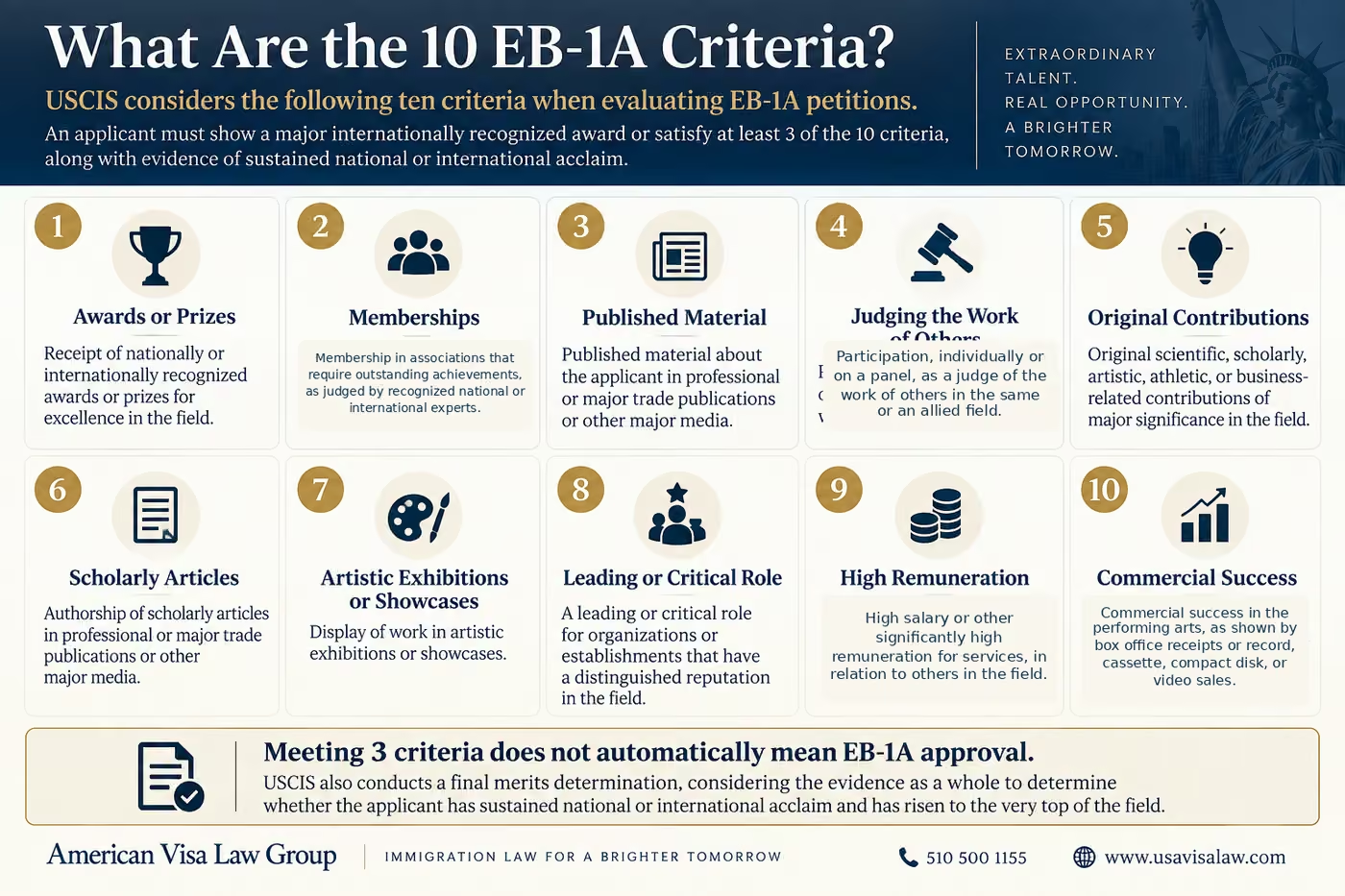
The first EB-1A criterion covers evidence that the applicant has received lesser nationally or internationally recognized prizes or awards for excellence in the field of endeavor.
The word “lesser” is important. This criterion is different from the separate one-time-achievement route involving a major internationally recognized award. An applicant does not need a Nobel Prize, Olympic medal, or similarly famous honor to satisfy this individual criterion. The award must, however, be recognized at the national or international level and must have been granted for excellence in the applicant's field.
USCIS may consider several factors when evaluating an award, including the criteria used to grant it, its national or international significance, the number of recipients, and any restrictions on who was eligible to compete. USCIS guidance on extraordinary ability evidence Recent USCIS decisions likewise emphasize that receiving an award is not enough by itself; the applicant must also establish that the award is nationally or internationally recognized for excellence in the relevant field.
For example, evidence supporting this criterion might include the award certificate together with documentation explaining the selection process, eligibility requirements, number and quality of competitors, reputation of the awarding organization, prior recipients, independent media coverage, or other evidence showing how the award is regarded within the field.
An internal company award, participation certificate, local honor, or recognition given primarily for completing a program may be meaningful professionally without necessarily meeting this EB-1A criterion. The central question is not simply “Did the applicant win something?” It is “Does the evidence show that this prize or award is nationally or internationally recognized as an award for excellence in the applicant's field?”
USCIS has also clarified an important point for applicants whose achievements were earned as part of a team: team awards can count. In its October 2024 policy update, USCIS confirmed that it may consider a person's receipt of a team award under this criterion.
That does not mean every award received by a company, research group, athletic team, or project automatically satisfies the requirement. The petition should still establish that the applicant was actually a recipient of the award and that the award itself carries the necessary national or international recognition.
This distinction can be particularly important for researchers, engineers, founders, athletes, filmmakers, and professionals whose most significant achievements were collaborative. The fact that an accomplishment involved a team does not necessarily weaken the evidence, but the documentation should make the applicant's connection to the recognized achievement clear.
Practical takeaway: An award is strongest for EB-1A purposes when the petition can independently document what the applicant won, why it was awarded, how selective it was, and why the award is recognized beyond the organization or event that issued it.
The second EB-1A criterion covers membership in associations in the applicant’s field that require outstanding achievements of their members, as judged by recognized national or international experts.
This criterion is narrower than it may first appear. Simply belonging to a respected professional organization does not automatically satisfy the EB-1A requirement. USCIS looks closely at the actual admission standards for the applicant’s specific membership category and who makes the decision to admit members.
Under current USCIS guidance for EB-1A extraordinary ability petitions, the key question is whether membership is granted because the individual has demonstrated outstanding achievements that are evaluated by recognized experts in the field. Recent USCIS decisions continue to apply that distinction.
For example, a professional association may be internationally known and highly respected, but if ordinary membership is available to anyone who holds a particular degree, works in the profession, pays annual dues, or has a certain number of years of experience, that membership will generally not establish this criterion by itself.
USCIS has specifically identified requirements such as education level, professional experience, payment of membership fees, or simply working in the field as factors that may show that admission is not based on outstanding achievement.
The distinction becomes especially important when an organization offers several membership levels. A general or associate membership may not qualify, while a highly selective fellowship, elected membership, or other advanced category within the same organization potentially could.
In that situation, the petition should establish exactly which membership level the applicant holds and what was required to obtain it.
Useful evidence may include the association’s bylaws, constitution, membership rules, official admission criteria, nomination procedures, selection committee information, or documentation showing that recognized experts evaluate candidates based on distinguished professional accomplishments.
The reputation of the association can support the overall context, but reputation alone is not the legal test. In a 2025 decision, for example, USCIS explained that the applicant needed to show not only membership in the relevant organizations, but also that the organizations required outstanding achievements and that those achievements were evaluated by recognized national or international experts. Membership categories based principally on working in the profession and paying dues were insufficient.
There is also an important difference between an organization being selective and it requiring outstanding achievement. A private club or industry organization may have limited membership, recommendations, interviews, or a long waiting list. Those facts may demonstrate exclusivity, but they do not necessarily establish that admission is based on extraordinary professional accomplishments judged by recognized experts. USCIS has rejected that type of argument where the underlying admission requirements did not establish the regulatory standard.
At the same time, this criterion can be powerful when membership is genuinely tied to competitive accomplishment. USCIS has recognized situations in which access to an association or professional group depended on significant competitive rankings or demonstrated excellence within the field.
Practical takeaway: For EB-1A purposes, do not focus only on the name or prestige of the organization. The stronger evidence answers three questions clearly: What did the applicant have to achieve to become a member? Who evaluated those achievements? And were those evaluators recognized national or international experts in the field?
The third EB-1A criterion covers published material about the applicant in professional publications, major trade publications, or other major media, relating to the applicant’s work in the field.
This criterion can be valuable for professionals who have received meaningful independent media attention, but it is often misunderstood. A simple mention, company press release, directory listing, or article primarily about the applicant’s employer will not necessarily satisfy the requirement.
USCIS generally looks at two separate questions: Is the published material actually about the applicant and their work? And does the publication qualify as a professional publication, major trade publication, or other major media?
The USCIS Policy Manual guidance on extraordinary ability evidence explains that material may qualify when it substantially discusses the person’s work and mentions the person in connection with that work. USCIS then evaluates the publication itself, considering factors such as its intended audience and, where relevant, its circulation, readership, or viewership.
That distinction matters because the prestige of the individual being discussed and the credibility of the publication are separate issues.
A detailed profile in a respected industry publication may be strong evidence because it establishes both meaningful coverage of the applicant and the relevance of the publication to the field. By contrast, an article that briefly names the applicant while primarily discussing a company, product, event, or another individual may be much weaker.
Evidence supporting this criterion may include the published article itself, the publication’s masthead or media information, circulation or readership data, audience demographics, independent information about the publication’s reputation, and evidence establishing that the article concerns the applicant’s work in the claimed field.
The regulations also require the evidence to include the title, date, and author of the published material, together with any necessary translation. USCIS decisions continue to apply those requirements when evaluating this criterion.
Yes. Qualifying published material does not have to appear in a traditional printed newspaper or magazine.
Professional and major online publications can potentially satisfy the criterion. The more important issue is whether the source qualifies as a professional publication, major trade publication, or major media outlet and whether the material itself sufficiently concerns the applicant and their work.
For an online publication, evidence of reach can therefore become particularly useful. Depending on the source, this may include readership statistics, audience information, industry prominence, geographic reach, or independent evidence establishing the publication’s significance.
Simply showing that an article is publicly accessible online is generally not enough to establish that the website constitutes major media.
Interviews and professional profiles can be particularly useful when they contain substantive discussion of the applicant’s achievements, expertise, projects, research, leadership, or influence in the field.
There is also an important 2024 USCIS clarification here.
USCIS removed prior policy language suggesting that published material had to independently demonstrate the value of the applicant’s work or contributions in order to satisfy this criterion. USCIS explained that such a requirement went beyond the plain language of the regulation. The criterion instead focuses on whether there is qualifying published material about the person relating to their work in the field.
That clarification does not eliminate the other requirements. The material still has to concern the applicant and relate to their work, and the publication must still qualify under the regulatory standard.
It also means that applicants should avoid treating this criterion as a general collection of every online reference to their name. Ten brief mentions in minor websites are not necessarily stronger than one or two substantial pieces in credible professional or major media publications.
The quality and context of the coverage matter.
A strong submission should therefore establish what the article says about the applicant, why the publication itself qualifies, and how the coverage relates to the field in which extraordinary ability is claimed.
Practical takeaway: Media evidence is strongest when the coverage is substantive, independently published, clearly tied to the applicant’s professional work, and supported by objective evidence showing that the publication qualifies as professional, major trade, or major media.
The fourth EB-1A criterion covers evidence that the applicant has participated, either individually or as part of a panel, as a judge of the work of others in the same or an allied field of specialization.
This criterion commonly appears in EB-1A petitions involving researchers, academics, physicians, engineers, technology professionals, artists, entrepreneurs, and other specialists whose expertise has led them to evaluate the work of their peers.
Qualifying activities can include peer reviewing manuscripts for academic journals, evaluating papers submitted to professional conferences, serving on grant-review panels, judging industry competitions, reviewing research proposals, participating on expert selection committees, or evaluating the work of other professionals in a comparable setting.
USCIS specifically recognizes activities such as peer reviewing papers submitted to scholarly journals or conferences as examples that may satisfy the judging criterion. The central issue, however, is actual participation. A person who receives an invitation to review a manuscript but never completes the review has not necessarily demonstrated that they served as a judge. (uscis.gov)
That difference can have a major impact on the evidence submitted with an EB-1A petition.
An invitation email may show that a journal or organization considered the applicant qualified to participate. But stronger evidence will also document that the applicant accepted and completed the judging activity. This could include confirmation emails, completed-review records, reviewer dashboards, certificates, letters from journal editors or conference organizers, panel rosters, or other records showing that the applicant actually evaluated another person's work.
For researchers and academics, peer review is one of the most common ways this criterion is claimed.
A journal may invite a researcher to evaluate whether another scholar's manuscript is suitable for publication. Similarly, conferences may ask experts to assess submitted abstracts, research papers, or presentations.
These activities can satisfy the regulatory criterion when the evidence shows actual participation. USCIS decisions have accepted evidence such as communications from journals requesting reviews combined with confirmation that the reviews were completed. (uscis.gov)
Applicants should therefore preserve more than just the original invitation. Documentation showing the name of the journal or conference, the date of the review, the subject matter, and confirmation that the evaluation was completed can make the evidence substantially clearer.
The applicant should also be careful not to overstate routine professional responsibilities. Serving as a reviewer may satisfy the individual evidentiary criterion, but that does not automatically prove that the person has risen to the very top of the field.
That distinction becomes especially important during the final merits determination.
USCIS has previously explained that peer review can be a routine part of academic and scientific publishing. An applicant may therefore establish the judging criterion while USCIS separately considers the frequency, selectivity, reputation, and significance of those judging activities when evaluating the overall extraordinary-ability claim. (uscis.gov)
For example, repeated invitations to review for respected journals, service on an editorial board, judging highly competitive professional awards, or selection for specialized expert panels may provide stronger context during final merits review than an isolated review assignment.
The analysis should remain evidence-specific. There is no fixed number of peer reviews that automatically establishes extraordinary ability.
The criterion is not limited to academic peer review.
A technology professional might judge startup or engineering competitions. An artist could serve on a jury selecting other artists' work. A business executive might evaluate entries in a recognized industry award program. A physician could participate in professional research or grant-review panels.
What matters is whether the applicant was actually evaluating the work of other people in the same or an allied field, rather than simply attending an event, mentoring colleagues, supervising ordinary employees, or participating in a professional organization.
The documentation should therefore explain the judging process itself: who was being evaluated, why the applicant was selected, what standards were applied, and what role the applicant played in reaching an evaluation or decision.
This context becomes particularly valuable where the title of the activity, such as “mentor,” “advisor,” “committee member,” or “expert”—does not by itself prove that the applicant was serving as a judge.
Practical takeaway: For this EB-1A criterion, an invitation is only the beginning. Strong evidence shows that the applicant was selected because of relevant expertise, actually evaluated the work of others, and can document the judging activity through independent records. The prestige, frequency, and selectivity of that judging experience may then become relevant again when USCIS evaluates the petition as a whole.
The sixth EB-1A criterion covers evidence of the applicant’s authorship of scholarly articles in the field, published in professional or major trade publications or other major media.
For researchers and academics, this is one of the more recognizable EB-1A criteria. But publication alone does not necessarily satisfy it. USCIS generally looks at two questions: Is the work actually a scholarly article in the applicant’s field, and was it published in a qualifying professional, major trade, or major media publication?
Under USCIS Policy Manual guidance on extraordinary ability evidence, scholarly articles in academic settings generally report on original research, experimentation, or philosophical discourse and are written by researchers or other experts in the field. They commonly undergo peer review and often contain references, footnotes, endnotes, or bibliographies. Outside traditional academia, a scholarly article may instead be written for people with advanced knowledge of the particular field.
That distinction means an applicant should not assume that every article, blog post, opinion piece, interview, or trade publication automatically qualifies as scholarly authorship.
USCIS has examined this issue directly. In one decision, the agency questioned whether op-eds and an interview could satisfy the criterion because the evidence did not establish that the pieces were scholarly in nature, and being the subject of an interview did not itself establish authorship.
The focus is therefore on the nature of the article, the applicant’s authorship, and the publication in which it appeared.
In an academic or research setting, journal articles presenting original research are the clearest examples. Depending on the field, qualifying evidence might include peer-reviewed research papers, scientific studies, technical research articles, or other substantive publications directed toward experts.
Scholarly authorship is not necessarily limited to university researchers. USCIS guidance also recognizes that outside academia, an article can be scholarly when it is written for “learned” persons—meaning readers with substantial knowledge or expertise in the relevant field.
That makes the intended audience particularly important.
For example, an article written by a specialized financial professional for other experts in banking may warrant a different analysis from a general consumer article explaining basic financial concepts. Similarly, a detailed technical publication written for engineers may be more consistent with scholarly authorship than marketing content describing a company's products.
A 2024 USCIS decision illustrates the distinction. The agency found that a financial-industry publication qualified as a professional or major trade publication because it was directed toward banking and insurance professionals. However, the applicant’s particular article did not qualify as scholarly because it contained little research or substantive analysis and appeared primarily designed to market the employer’s services.
The prestige of the publication therefore does not, by itself, turn every article published there into a scholarly article.
Yes. An applicant does not necessarily have to be the sole or first author.
USCIS decisions have recognized co-authored scholarly articles when the evidence establishes the applicant’s authorship and shows that the publications otherwise meet the regulatory requirements. In a 2024 decision, for example, USCIS found that an applicant had satisfied the criterion based on evidence showing his co-authorship of multiple scholarly articles published in professional journals.
The petition should still clearly identify the applicant as an author and document the article itself, its publication, and the nature of the journal or other outlet.
Useful evidence may include complete copies of published articles, journal records, publisher confirmations, DOI information, database listings, publication dates, and documentation describing the journal’s peer-review process and intended audience.
In another 2024 decision, USCIS accepted evidence that included full copies of articles, publisher letters verifying publication dates and authorship or co-authorship, Google Scholar verification, and evidence showing that the journals were peer reviewed.
The lesson is straightforward: do not make USCIS reconstruct the publication record from a CV alone. A résumé listing ten papers is not the same as documentary evidence establishing authorship of qualifying scholarly articles.
There is no fixed number of scholarly articles in the regulation that automatically satisfies this criterion.
The regulatory requirement focuses on whether the applicant has authored qualifying scholarly articles in the field and whether those articles appeared in professional or major trade publications or other major media. The criterion does not establish a universal rule such as five papers, ten papers, or a particular citation count.
That is important because publication patterns vary substantially by profession and discipline.
A researcher in a field where papers regularly have dozens of co-authors and frequent publication cycles should not necessarily be evaluated in the same practical context as an expert in a specialized field where significant scholarly work is published less frequently.
The better approach is to document the qualifying publications clearly rather than rely on an arbitrary numerical target.
Not necessarily.
Authorship and citation impact are related but legally distinct issues.
For this particular criterion, the central question is whether the applicant authored qualifying scholarly articles in qualifying publications. USCIS has found applicants to satisfy the authorship criterion based on the publications themselves without establishing that a particular citation threshold was required.
Citation evidence can become important elsewhere in the EB-1A analysis.
As discussed under the original contributions of major significance criterion, unusually influential citation activity may help demonstrate that other researchers have relied on or recognized the applicant’s work. Citation evidence can also become relevant during the final merits determination, where USCIS evaluates the applicant’s accomplishments collectively rather than merely counting satisfied criteria.
A 2024 AAO decision illustrates this broader use of publication and citation evidence. In assessing final merits, USCIS considered an economist’s lengthy publication history together with hundreds of citations, awards, media coverage, judging activity, original contributions, and leading roles when evaluating whether his acclaim had been sustained over time.
This is why an EB-1A petition should avoid collapsing two different arguments into one:
Publishing scholarly work can establish the authorship criterion. The influence and reception of that work can help demonstrate why the applicant’s overall record is extraordinary.
Practical takeaway: Strong evidence for this criterion should establish authorship, scholarly character, relevance to the applicant’s field, and publication in a qualifying professional or major trade publication or other major media. There is no universal publication or citation number that guarantees EB-1A eligibility, and citation impact should be analyzed separately when evaluating the significance of the applicant’s work and the petition as a whole.
The seventh EB-1A criterion covers evidence that the applicant’s work has been displayed in the field at artistic exhibitions or showcases.
This criterion is most naturally associated with visual artists, designers, photographers, sculptors, filmmakers, and other creative professionals whose work is presented publicly through galleries, exhibitions, showcases, festivals, or similar artistic venues.
USCIS generally evaluates two basic questions: Was the applicant’s own work displayed, and was it displayed at an artistic exhibition or showcase?
That second question is especially important.
In an October 2024 policy clarification, USCIS explained that although the ordinary dictionary definition of an “exhibition” can include many types of public displays, the EB-1A regulation specifically uses the modifier “artistic.” USCIS therefore treats Criterion #7 as requiring an artistic exhibition or showcase. Non-artistic exhibitions may instead be considered only through a properly supported claim of comparable evidence under the EB-1A rules.
This distinction prevents the criterion from becoming a catch-all for conferences, trade shows, professional presentations, or public appearances.
For example, a researcher who presents a scientific poster at an academic conference does not automatically satisfy the artistic exhibition criterion simply because the research was publicly displayed. Similarly, speaking at an industry event, participating in a workshop, or appearing at a professional conference does not by itself transform the event into an artistic showcase. USCIS decisions have specifically rejected attempts to treat ordinary professional presentations as displays at artistic exhibitions.
For an artist, by contrast, evidence might include photographs or catalogs from gallery exhibitions, museum programs, festival listings, official exhibition webpages, invitations, curator statements, or documentation showing that the applicant’s work was selected and publicly displayed.
The evidence should make clear that the work on display actually belonged to the applicant. Merely attending an exhibition, participating in an event, or appearing in photographs at a venue is not the same as showing that the applicant’s artistic work was exhibited.
USCIS has also recognized that an artistic exhibition or showcase does not necessarily have to occur in a physical gallery. In a 2024 decision, the agency accepted evidence showing that an artist’s work was displayed on qualifying art-gallery websites, noting that USCIS policy permits artistic exhibition venues to be virtual or otherwise.
That can be particularly relevant for contemporary artists and creative professionals whose work is displayed through curated online exhibitions or other recognized digital platforms.
The stronger evidence usually establishes both sides of the criterion: the applicant’s work was genuinely exhibited, and the venue or event was artistic in nature. Documentation about the reputation, selectivity, or prominence of the exhibition may also become useful during the final merits analysis, where USCIS evaluates the significance of the applicant’s achievements as a whole.
Applicants in fields such as technology, science, business, or athletics sometimes try to use trade shows, conferences, product demonstrations, competitions, or professional presentations under this criterion.
Current USCIS guidance makes clear that those activities do not automatically satisfy Criterion #7 merely because something was publicly displayed. The exhibition or showcase itself must be artistic in nature.
However, EB-1A regulations permit comparable evidence when the listed regulatory criteria do not readily apply to a particular occupation. That does not mean an applicant can simply relabel an unsuccessful Criterion #7 argument as comparable evidence. The petition must explain why the regulatory criterion does not readily apply to the occupation and why the proposed evidence is genuinely comparable to the type of recognition contemplated by the regulation.
That distinction becomes important for professionals in newer or nontraditional fields, where public displays of significant work may occur in ways that look very different from an art-gallery exhibition.
Practical takeaway: Criterion #7 is specifically about artistic displays of the applicant’s own work. Gallery exhibitions, curated showcases, and qualifying virtual artistic exhibitions can potentially satisfy the criterion. Conferences, trade shows, presentations, or other non-artistic displays generally require a different legal theory and may need to be analyzed as comparable evidence rather than forced into this category.
The eighth EB-1A criterion covers evidence that the applicant has performed in a leading or critical role for organizations or establishments that have a distinguished reputation.
This criterion can be especially important for executives, entrepreneurs, researchers, physicians, engineers, technology professionals, and other applicants whose strongest evidence comes from the impact they have had within prominent organizations.
USCIS effectively applies a two-part analysis. First, the applicant must establish that the role was leading or critical. Second, the organization, establishment, or qualifying division or department must have a distinguished reputation. Both elements need to be supported.
Under USCIS guidance on EB-1A extraordinary ability evidence, a leading role generally means that the person served as a leader within the organization or a qualifying part of it. A critical role focuses instead on whether the person contributed in a way that was significantly important to the outcome of the organization's activities.
The distinction matters because a role can be critical without being senior in the organizational hierarchy.
A leading role is generally easier to understand from organizational structure. Evidence may show that the applicant headed a department, directed an important business unit, served in a senior executive position, founded and led an organization, supervised important operations, or otherwise occupied a leadership position.
An organizational chart can be especially useful because it shows where the applicant actually stood within the relevant structure.
But a title alone is not enough.
Calling someone “Vice President,” “Director,” “Chief Scientist,” or “Head of Engineering” does not automatically establish that the person performed a qualifying leading role. USCIS may look beyond the title to the applicant’s actual responsibilities, authority, decision-making power, and position within the organizational hierarchy. USCIS decisions have specifically emphasized that while a title can support a leading-role claim, the duties associated with that position must also demonstrate genuine leadership.
A critical role is different.
Here, the applicant does not necessarily need to occupy a high-ranking position. Instead, the evidence should show that the person’s performance was of significant importance to the outcome of the organization’s—or qualifying division's—activities.
For example, an engineer might hold a relatively ordinary title but be responsible for technology essential to a major product. A researcher might lead a scientific program central to an institution's work. A physician may oversee a specialized clinical program. A business professional might develop systems or strategies that materially affect an important division.
The focus is therefore on impact, not title.
USCIS has described a critical role as one in which the applicant contributed in a way that was of significant importance to the outcome of the relevant organization's activities. Recent USCIS decisions continue to distinguish this impact-based analysis from simply holding a senior-sounding position.
Yes. The analysis is not necessarily limited to an applicant's importance to an entire multinational corporation or university.
USCIS guidance permits consideration of a leading or critical role for a division or department of an organization or establishment. This can be particularly important for applicants working within very large institutions where no single employee, other than top corporate leadership, would realistically be “critical” to the entire organization.
For example, a researcher may direct a distinguished laboratory within a major university. An executive may lead a significant business division within a global company. An engineer might be central to a specialized product organization rather than to the corporation as a whole.
The petition should identify the relevant organizational unit precisely and show why the applicant's role was leading or critical to that unit, rather than making overly broad claims about influence on the entire company.
USCIS decisions have applied this approach by examining roles within qualifying organizations, divisions, and departments rather than demanding evidence that every applicant controlled an entire enterprise.
Establishing the applicant's role is only half of the criterion.
The organization or establishment must also have a distinguished reputation. USCIS describes “distinguished” as being marked by eminence, distinction, or excellence.
This is another area where applicants sometimes rely too heavily on assumptions.
Working for a recognizable company does not eliminate the need to document its reputation. Conversely, an organization does not necessarily need to be a household-name multinational corporation to qualify. The relevant question is whether objective evidence demonstrates that the organization, or qualifying division or department, has achieved distinction in its particular field.
USCIS may consider factors such as the organization's scale, longevity, customer base, relevant media coverage, significant funding, industry standing, awards, achievements, or other evidence demonstrating its reputation.
Depending on the organization, useful evidence might include independent media coverage, industry rankings, major awards, recognized clients or customers, significant funding, market position, revenue information, institutional accomplishments, or other objective indications of prominence.
A few positive online reviews or broad statements from employees that a company is “one of the best” may not be enough. In a 2024 case, USCIS found that an applicant had demonstrated both a leading and critical role in a dental clinic but had not sufficiently established the clinic's distinguished reputation because the record lacked stronger evidence concerning matters such as its size, customer base, and meaningful media or industry recognition.
That decision illustrates an important point: strong evidence of the applicant's role cannot compensate for weak evidence about the organization itself.
Strong documentation usually combines evidence of the applicant's position with evidence of actual impact.
This may include organizational charts, detailed employment letters, internal records, project documentation, contracts, performance metrics, company reports, press coverage, or other records demonstrating what the applicant was responsible for and why those responsibilities mattered.
Letters from senior executives, founders, department heads, clients, or other knowledgeable individuals can also be useful when they provide specific information.
For example, a persuasive letter might explain that the applicant developed a system central to a major product, directed a team responsible for a significant share of company operations, led expansion into a new market, or solved a technical problem that materially affected the organization's activities.
By contrast, a letter stating only that the applicant was “essential,” “outstanding,” or “indispensable” provides a conclusion without explaining why.
USCIS decisions illustrate the difference. In one case involving an oil and gas professional, detailed descriptions of the applicant’s duties, credible supporting letters, and evidence documenting the organization's reputation were sufficient to establish qualifying leading or critical roles.
The stronger evidence therefore explains what the applicant did, why the work mattered, and what identifiable impact resulted from that role.
Entrepreneurs should be particularly careful with this criterion.
Being the founder, owner, CEO, or co-founder of a company may make it relatively straightforward to establish a leading role, but it does not automatically establish the entire criterion.
The company must still have a distinguished reputation.
A founder of a very early-stage business may unquestionably lead the organization while still lacking sufficient evidence that the organization itself has achieved the level of distinction contemplated by the EB-1A regulation. Funding, revenue, customers, major partnerships, awards, independent media coverage, industry recognition, or significant market accomplishments may therefore become important depending on the facts.
The same distinction applies to applicants working for startups. A critical technical or executive role in a startup can potentially qualify, but the petition should document both the applicant's impact and the company's standing.
Practical takeaway: Criterion #8 is not simply about having an impressive title or working for a famous company. Strong evidence establishes both sides of the test: the applicant genuinely performed a leading or materially important role, and the organization, establishment, division, or department had a distinguished reputation. The best documentation explains the applicant's concrete impact rather than asking USCIS to infer importance from a résumé or job title.
The ninth EB-1A criterion covers evidence that the applicant has commanded a high salary or other significantly high remuneration for services in relation to others in the field.
The comparison language is critical. USCIS is not simply asking whether the applicant earns what most people would consider a large amount of money. The issue is whether the compensation is high relative to comparable professionals doing similar work.
USCIS guidance allows applicants to use comparative wage or remuneration data, including geographically and position-appropriate compensation surveys, to establish that relationship. USCIS Policy Manual guidance for extraordinary ability petitions
That means a $200,000 salary could be unusually high for one profession and relatively ordinary for another. Geography matters as well. Compensation for the same position can differ substantially between San Francisco, New York, a smaller U.S. market, and another country.
The strongest evidence therefore establishes two things clearly: what the applicant actually earns or has been offered, and what similarly situated professionals typically earn.
Evidence of the applicant's compensation may include employment contracts, offer letters, pay statements, tax records, compensation statements, bonus documentation, or other reliable financial records.
USCIS also recognizes that the phrase “has commanded” does not necessarily mean the applicant must already have received the compensation. A credible contract or job offer showing prospective compensation may potentially establish the ability to command a high salary.
The compensation evidence then needs an appropriate benchmark.
For U.S.-based positions, government data can be particularly useful. The Bureau of Labor Statistics Occupational Employment and Wage Statistics data provides wage information by occupation and, in many cases, by geographic area. The program currently publishes wage estimates for hundreds of occupations across national, state, metropolitan, and nonmetropolitan markets.
Private compensation surveys, credible industry reports, recruiter data, and other occupational salary sources may also be useful when they provide a meaningful comparison.
The key is comparability.
A senior machine-learning engineer should generally not be compared with the average salary of all “computer professionals.” A specialized executive should not necessarily be compared with every management occupation. The benchmark should reflect the applicant's actual profession, seniority, work, and relevant geographic market as closely as the available evidence allows.
Not necessarily.
Showing that an applicant earns more than the average worker in an occupation does not automatically prove that the salary is high in relation to others in the field.
In one USCIS decision involving an executive chef, the record showed compensation above the local average. USCIS nevertheless explained that evidence of an average salary alone did not necessarily demonstrate that the applicant's compensation was “high,” as opposed to merely above average, relative to similarly employed workers.
This is why stronger evidence often includes salary percentiles or other distributions that show where the applicant actually falls relative to comparable professionals.
But applicants should also avoid replacing the regulation with an invented numerical rule. There is no universal EB-1A requirement stating that every applicant must earn above a particular percentile or a particular dollar amount.
In a 2024 decision involving a data center and network engineer, USCIS specifically addressed the appropriate comparative occupation and geographic evidence rather than applying a rigid universal salary threshold.
The legal question remains whether the applicant has commanded high salary or significantly high remuneration in relation to others in the field.
Potentially, yes.
The regulation is not limited to base salary. It expressly refers to a high salary or other significantly high remuneration for services. Depending on the compensation structure, bonuses, incentive compensation, stock-based compensation, commissions, or other forms of remuneration may therefore be relevant.
This can be particularly important for executives, founders, finance professionals, technology employees, sales professionals, and others whose total compensation may differ substantially from their base salary.
The comparison, however, has to remain meaningful.
If an applicant relies on total compensation that includes stock or bonuses but compares that figure with salary data measuring only base wages, USCIS may question whether the two figures are actually comparable. The petition should identify what each compensation figure includes and, where possible, compare like with like.
USCIS decisions also demonstrate the importance of consistent financial documentation. In one case involving compensation that included salary and stock-related income, inconsistencies among employer records, tax documents, and the claimed remuneration weakened the applicant's evidence.
For this reason, adding every possible form of compensation is not necessarily helpful if the figures cannot be clearly documented and compared.
Applicants earning compensation abroad should generally be compared with appropriate professionals in the relevant foreign labor market, rather than simply converting their income into U.S. dollars and comparing it with American salaries.
This is an important point for multinational executives, international entrepreneurs, researchers, technology professionals, athletes, and other EB-1A applicants working outside the United States.
USCIS has expressly evaluated foreign applicants using wage statistics or comparable evidence relevant to their actual work locations.
Currency conversion alone can produce a misleading comparison because compensation levels, cost structures, and labor markets differ substantially between countries.
The stronger approach is to establish what comparable professionals earn in the applicant's country, city, industry, and position whenever reliable data is available.
Founders present another special issue.
A startup founder may own valuable equity while receiving a relatively modest salary. Conversely, a founder may receive distributions or other income because of ownership rather than as compensation for services.
Those distinctions matter because Criterion #9 focuses on salary or remuneration received for the applicant's services.
Ownership value, fundraising totals, company valuation, or business revenue should therefore not automatically be treated as personal compensation. If equity, bonuses, distributions, or other remuneration are being relied upon, the petition should clearly establish what the applicant personally received or credibly contracted to receive for their services.
Other entrepreneurial achievements may be much stronger under different EB-1A criteria, such as original contributions of major significance or a leading or critical role for a distinguished organization.
Trying to force every financial accomplishment into the high-salary criterion can weaken an otherwise well-supported petition.
Practical takeaway: A high salary claim is strongest when it establishes a clean comparison: the applicant's documented compensation, an appropriate group of comparable professionals, and reliable evidence showing that the applicant's remuneration is genuinely high relative to that group. The dollar amount alone rarely tells the full story.
The tenth EB-1A criterion covers commercial success in the performing arts, as shown by box office receipts or record, cassette, compact disk, or video sales.
Unlike some of the broader EB-1A criteria, this one is specifically directed at the performing arts. It can be relevant to actors, musicians, singers, performers, and other professionals whose work generates measurable commercial audience demand.
The key issue is not simply whether the applicant participated in a commercially successful production. USCIS focuses on the volume of sales or box office receipts and whether that evidence demonstrates the applicant’s commercial success relative to others engaged in similar pursuits.
For example, evidence might include documented box office receipts, record or video sales, ticket sales, or other reliable commercial-performance records connected to the applicant’s work. The evidence should allow USCIS to evaluate the scale of that success rather than merely establish that a film, album, concert, or other production existed.
This distinction can be important for performers who worked on a successful project involving many participants. USCIS has found that appearing in a successful film, television program, or theatrical production does not automatically establish the individual performer’s commercial success. The record should connect the applicant to the commercial performance being claimed and, where relevant, demonstrate how that success compares with others in the field.
Similarly, media exposure, professional demand, contractual fees, or evidence that a production company generated revenue do not necessarily substitute for the type of commercial-success evidence contemplated by this criterion. In a 2024 decision, USCIS rejected an argument based largely on service contracts, demand for the applicant’s work, and media exposure because the evidence did not establish the required commercial success through sales or comparable performance measures.
The criterion should also not be confused with the separate high salary or remuneration criterion. An artist may be highly paid without demonstrating commercial success through sales or box office performance, just as a commercially successful production does not automatically prove that every participant commanded unusually high compensation. USCIS has expressly treated these as distinct concepts.
For applicants outside the performing arts, ordinary business revenue, product sales, company growth, or professional income generally should not be forced into Criterion #10. Those accomplishments may be more relevant to another EB-1A criterion, such as original contributions of major significance, a leading or critical role, or high remuneration.
Practical takeaway: Strong evidence under Criterion #10 shows measurable commercial success in the performing arts, credible documentation of sales or box office performance, and a clear connection between that success and the applicant’s own work.
The 10 EB-1A criteria measure different forms of professional recognition, influence, and achievement. An applicant who does not have a qualifying major internationally recognized one-time achievement generally must satisfy at least three of these criteria, but USCIS will still evaluate the entire record in the final merits determination.
The table below summarizes what each criterion focuses on and the types of evidence that may support it.
USCIS evaluates these criteria under its extraordinary ability evidentiary framework. The table is therefore best treated as a screening tool, not as a formula for predicting approval.
A strong EB-1A petition does more than identify three categories that appear to fit. It documents why the evidence meets each claimed criterion and why the record, viewed as a whole, demonstrates sustained national or international acclaim.
Meeting at least three of the 10 EB-1A criteria is an important threshold, but it does not automatically establish eligibility for an extraordinary ability green card. USCIS uses a two-step analysis: it first determines whether the evidence satisfies the regulatory criteria and then evaluates the petition as a whole through a final merits determination.
This second stage is where USCIS asks the broader question: Does the complete record show sustained national or international acclaim, recognition of the applicant’s achievements in the field, and a level of expertise placing the applicant among the small percentage who have risen to the very top of the field?
That distinction changes how a strong EB-1A petition should be approached. The goal is not simply to accumulate three qualifying categories. The evidence needs to tell a convincing, well-documented story about the applicant’s professional standing.
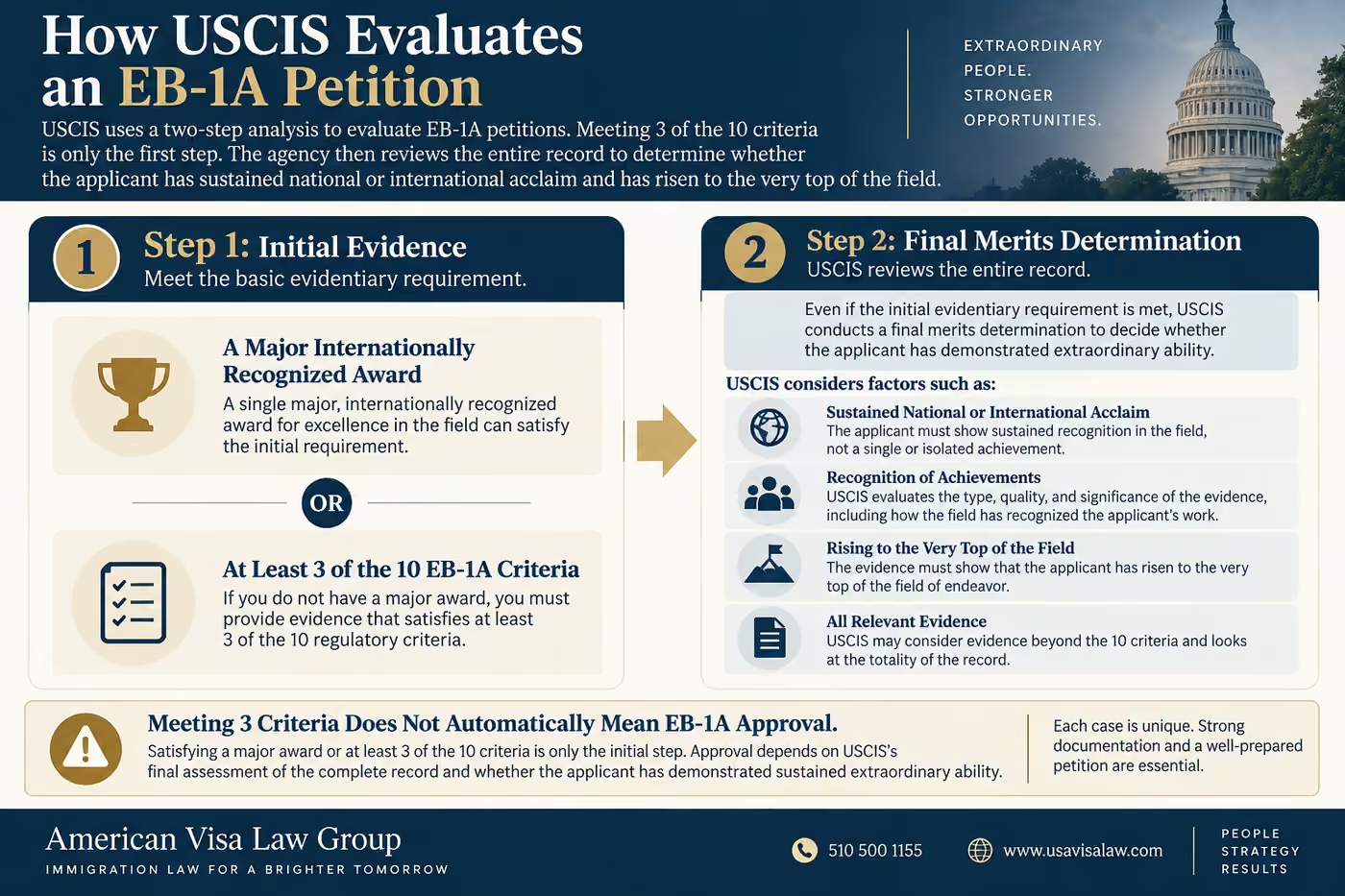
At the first stage, USCIS examines each criterion individually.
If the applicant does not have a qualifying major internationally recognized one-time achievement, the petition generally must establish at least three of the 10 regulatory criteria. USCIS determines whether the evidence submitted under each claimed category actually satisfies the requirements of that criterion.
For example, an applicant claiming the judging criterion must show actual participation in judging the work of others. An applicant relying on a leading or critical role must establish both the importance of the role and the distinguished reputation of the relevant organization, establishment, division, or department.
At this stage, the question is primarily whether the evidence fits the regulatory categories, not yet whether the applicant's entire career proves extraordinary ability.
USCIS decisions have emphasized this distinction. Once the required initial evidence has been established, USCIS must proceed to the final merits determination rather than treating the individual criteria themselves as the complete extraordinary-ability analysis.
At the second stage, USCIS considers the petition in its entirety.
The agency weighs the totality of the evidence to determine whether the applicant has demonstrated sustained national or international acclaim, whether the applicant’s achievements have been recognized in the field, and whether the record indicates that the individual belongs to the small percentage who have risen to the very top of the field.
This means the same evidence used to establish an individual criterion can take on a different significance during final merits review.
Consider an applicant who establishes three criteria through scholarly authorship, judging, and a leading role. Those accomplishments may be enough to pass Step 1. During final merits, however, USCIS may examine broader questions:
How influential is the applicant’s published work? How frequently and under what circumstances was the applicant selected to judge others? How significant was the applicant’s leadership role? Is there independent recognition of those accomplishments? Has that recognition been sustained over time?
The analysis is therefore qualitative as well as evidentiary.
USCIS has also made clear that potentially relevant evidence should be considered during final merits even when that evidence does not independently fit one of the 10 regulatory categories. In a 2024 decision, the Administrative Appeals Office emphasized that approval or denial depends on the type and quality of the evidence, and that USCIS should consider potentially relevant evidence across the record.
Because of the final merits analysis, claiming more EB-1A criteria does not necessarily produce a stronger case.
An applicant who credibly establishes three criteria with substantial evidence of sustained recognition may have a very different record from someone who attempts to claim six criteria using evidence that only marginally fits each category.
The regulations do not create a points system in which each additional criterion automatically increases the likelihood of approval.
In practice, a stronger strategy is often to identify the applicant’s most persuasive accomplishments, document those accomplishments carefully, and show how the evidence connects across the petition. Publications may reinforce evidence of original contributions. Independent media coverage may provide context for awards or leadership. Judging activity may demonstrate that other professionals recognize the applicant’s expertise. These forms of evidence can reinforce one another when USCIS examines the record as a whole.
The timing of the evidence can matter as well because the statutory standard requires sustained acclaim. In a 2025 decision, USCIS found that evidence concentrated primarily in a short period shortly before filing did not, on the record presented, sufficiently establish sustained national or international acclaim.
That does not create a fixed number of years that every applicant must document. Instead, it illustrates why an EB-1A petition should show the development and recognition of the applicant’s career in context rather than simply presenting a collection of recent credentials.
The final merits determination is ultimately where USCIS connects the individual pieces of evidence to the statutory standard. Meeting three criteria gets an applicant through the initial evidentiary analysis; the complete record must still demonstrate extraordinary ability at the level required for EB-1A classification.
For applicants trying to determine whether their evidence works together at that level, an EB-1A case assessment can be more useful than simply counting how many criteria appear to apply.
The EB-1A regulations recognize that the 10 evidentiary criteria do not fit every profession equally well. When one or more of those criteria do not readily apply to the applicant’s occupation, the applicant may submit comparable evidence to demonstrate extraordinary ability.
This flexibility can be important for professionals working in fields where achievement and recognition are measured differently from traditional academic, artistic, or corporate careers. However, comparable evidence is not a general substitute for the 10 criteria and should not be treated as an easier way to qualify.
Under the USCIS Policy Manual guidance on comparable evidence, USCIS considers two questions: whether the normal regulatory criterion readily applies to the applicant’s occupation and, if it does not, whether the alternative evidence is genuinely comparable to the evidence contemplated by that criterion.
An applicant does not have to prove that a criterion is completely impossible to apply. USCIS has clarified that comparable evidence may be considered when a criterion is not easily applicable to the person’s job or profession. A detailed, specific, and credible explanation from the petitioner may help establish why a particular criterion does not readily fit the occupation.
For example, certain professionals may work in fields where scholarly publication is not a normal measure of distinction, where artistic exhibitions have no meaningful equivalent, or where industry recognition occurs through different professional mechanisms.
In that situation, the petition should do more than submit alternative evidence. It should explain the connection:
Why does the ordinary criterion not readily apply, and why is the proposed evidence comparable to the type of distinction that criterion is designed to measure?
That explanation is often as important as the evidence itself.
Comparable evidence cannot generally be used merely because an applicant has difficulty satisfying one of the regular EB-1A criteria.
USCIS has repeatedly distinguished between a criterion that does not readily apply to the occupation and a criterion that applies but the applicant simply lacks sufficient qualifying evidence. Where the normal criteria readily apply, comparable evidence is generally not available simply to lower the evidentiary burden.
For example, an applicant cannot ordinarily argue that recommendation letters should replace the awards criterion simply because the applicant has not received qualifying awards. Similarly, an applicant cannot avoid the requirements of the scholarly-authorship criterion merely because their existing publications do not qualify.
The alternative evidence must actually be comparable in significance and purpose to the regulatory evidence it is intended to replace.
USCIS also cautions that generalized assertions or unsupported expert letters are not automatically comparable evidence. The petition should demonstrate why the evidence reflects a level of recognition or achievement comparable to the regulatory criterion.
This makes the comparable-evidence provision particularly fact-specific. It can provide meaningful flexibility for unconventional or emerging professions, but it does not change the overall EB-1A standard.
Even when comparable evidence is accepted at the initial evidentiary stage, USCIS still conducts the final merits determination and evaluates whether the entire record demonstrates sustained national or international acclaim and extraordinary ability at the required level.
Practical takeaway: Comparable evidence works best when the petition can clearly show why a normal EB-1A criterion does not readily fit the occupation, what alternative evidence is being offered, and why that evidence measures a comparable level of professional achievement or recognition. It should not be used simply to compensate for weak evidence under a criterion that already applies.
The EB-1A requirements are the same across the sciences, arts, education, business, and athletics, but the evidence used to prove extraordinary ability can look very different from one profession to another.
A research scientist may rely heavily on publications, citations, peer review, and original contributions. A startup founder may have little scholarly evidence but substantial proof of business impact, media recognition, leadership, awards, or unusually high compensation. An artist may build a case around exhibitions, press coverage, awards, and commercial success.
USCIS evaluates the evidence within the context of the applicant’s field rather than expecting every profession to produce the same type of record. Its extraordinary-ability guidance also recognizes that the significance of particular evidence depends on the occupation and the circumstances in which the achievement occurred. USCIS guidance on extraordinary ability evidence
The examples below are therefore illustrative, not separate EB-1A requirements.
Researchers often have several forms of evidence that fit naturally within the EB-1A framework.
Scholarly publications may support the authorship criterion, while peer-review activity can establish judging the work of others. Research that has been cited, independently adopted, incorporated into later studies, commercialized, or otherwise influential may also support an argument that the applicant made original contributions of major significance.
Awards, selective fellowships, invited judging, leadership of important research programs, and independent media coverage can further strengthen the record.
Citation evidence can be particularly useful, but raw numbers should be interpreted carefully. Citation practices vary substantially across scientific disciplines. A stronger presentation explains not simply how many citations an applicant has received, but what those citations indicate about the influence of the work within the relevant field.
The strongest researcher cases often show a relationship between several categories of evidence: the applicant published important work, other researchers relied on it, recognized journals selected the applicant to review the work of peers, and independent experts can explain the significance of those contributions.
Engineering and technology cases frequently require a different approach because important achievements do not always appear in academic publications.
Relevant evidence may include patents, technical innovations, widely implemented systems, industry awards, judging activities, media coverage, leadership roles, or documentation showing that other organizations adopted the applicant’s technology or methodology.
A patent can help establish originality, but—as discussed earlier—it does not automatically prove major significance. Evidence showing licensing, commercial deployment, substantial adoption, measurable technical impact, or use by other professionals can make the contribution considerably more persuasive.
For professionals working at major technology companies, the leading or critical role criterion may also be important. The analysis should focus on what the applicant actually contributed rather than relying primarily on the prestige of the employer or the seniority of the job title.
An engineer who was central to the development of a significant product or infrastructure system may have a stronger critical-role argument than someone with a more senior title whose individual impact is difficult to document.
Entrepreneurial EB-1A cases can be strong, but they require careful separation between company success and the founder’s individual extraordinary ability.
Evidence may include recognized business awards, significant independent media coverage, original business or technological contributions, judging startup competitions, selective professional memberships, unusually high remuneration, and a leading or critical role in a distinguished company.
Funding can also provide useful context, but raising venture capital does not automatically establish an EB-1A criterion. The same is true of company valuation, revenue, customer growth, or an acquisition. Those facts may be significant, but the petition should explain what they demonstrate about the applicant’s individual achievements and recognition.
For example, substantial outside investment may help establish the prominence of a company and provide context for a founder’s role. Independent coverage identifying the founder’s innovation, industry influence, or achievements may support other criteria more directly.
The goal is to avoid turning the petition into a company pitch deck. EB-1A eligibility belongs to the individual, not the startup.
Physicians may qualify through a combination of clinical, academic, research, and leadership achievements.
Relevant evidence can include medical research, scholarly publications, citation impact, peer review, leadership of distinguished clinical or research programs, recognized medical awards, original treatment or research contributions, and professional media coverage.
A physician's clinical success alone does not necessarily demonstrate extraordinary ability. Treating a large number of patients, performing difficult procedures, or holding an important hospital position may be impressive but should be tied to the specific EB-1A criteria being claimed.
For example, a new clinical technique may support the contributions criterion if there is evidence that it affected practice beyond the physician’s own patients or institution. Leadership of a specialized department may support the leading-or-critical-role criterion if both the role and the distinguished reputation of the institution or department are properly documented.
Artists and other creative professionals may rely on evidence that looks very different from a research-based EB-1A petition.
Relevant evidence can include nationally or internationally recognized awards, substantive media coverage, artistic exhibitions or showcases, leading or critical roles in distinguished productions or organizations, and—where applicable—commercial success in the performing arts.
The reputation and selectivity of the venue can become important context. Showing artwork somewhere is not necessarily equivalent to selection for a prominent curated exhibition. Similarly, appearing in a production is different from establishing that the applicant played a leading or critical role in its success.
USCIS clarified in 2024 that the exhibition criterion itself specifically concerns artistic exhibitions or showcases; non-artistic exhibitions must be analyzed differently and may potentially be considered as comparable evidence when the regulatory requirements for comparable evidence are met.
Athletes may rely on competitive awards, rankings, media recognition, selective memberships, judging activity, commercial success where relevant, or evidence of leading and critical roles with distinguished teams or organizations.
The level of competition matters. A championship, ranking, or award should be documented in enough context for USCIS to understand the geographic scope, quality of competition, selection process, and significance within the sport.
Athletes who later move into coaching, management, commentary, or another related role should also pay attention to how the proposed U.S. work relates to the area in which extraordinary ability was established. EB-1A does not require a permanent job offer, but applicants must still demonstrate an intention to continue working in their area of expertise.
Across all of these professions, the strongest strategy is not to ask, “How many EB-1A criteria can I claim?” It is to identify the accomplishments that best demonstrate sustained recognition, document them with objective evidence, and show how they fit together under the extraordinary-ability standard.
Many EB-1A petitions involve applicants with genuinely strong professional records. The difficulty is often not the absence of accomplishments, but the way those accomplishments are documented and connected to the legal standard.
USCIS does not evaluate an EB-1A petition as a résumé competition. Each claimed criterion must be supported by evidence that satisfies its specific requirements, and the complete record must ultimately demonstrate sustained national or international acclaim. The USCIS extraordinary ability framework therefore makes both evidence selection and evidence context important.
This is probably the most important mistake to avoid.
Meeting three of the 10 criteria generally satisfies the initial evidentiary threshold, but USCIS still conducts a final merits determination. At that stage, the agency evaluates whether the totality of the evidence shows that the applicant has sustained national or international acclaim and belongs to the small percentage at the very top of the field.
USCIS decisions illustrate this distinction clearly. In one 2024 case, the applicant established three criteria, judging, scholarly authorship, and a leading or critical role—but USCIS still concluded at final merits that the overall record did not establish the required sustained acclaim.
For that reason, the question should not be only, “Can I identify three criteria?” It should also be, “What does this evidence collectively say about my standing in the field?”
EB-1A cases can become overloaded with evidence showing that the applicant was active in the profession without demonstrating why that activity reflects extraordinary ability.
Attending conferences, belonging to professional organizations, participating in important projects, publishing articles, or working for respected companies can all be professionally valuable. But none of those facts necessarily establishes an EB-1A criterion by itself.
The evidence must connect the activity to the legal requirement being claimed.
For example, an invitation to peer review is different from proof that the applicant actually completed the review. Membership in a professional association is different from membership requiring outstanding achievements. Working for a famous company is different from performing a leading or critical role within it.
The distinction is between participation in a field and recognized distinction within that field.
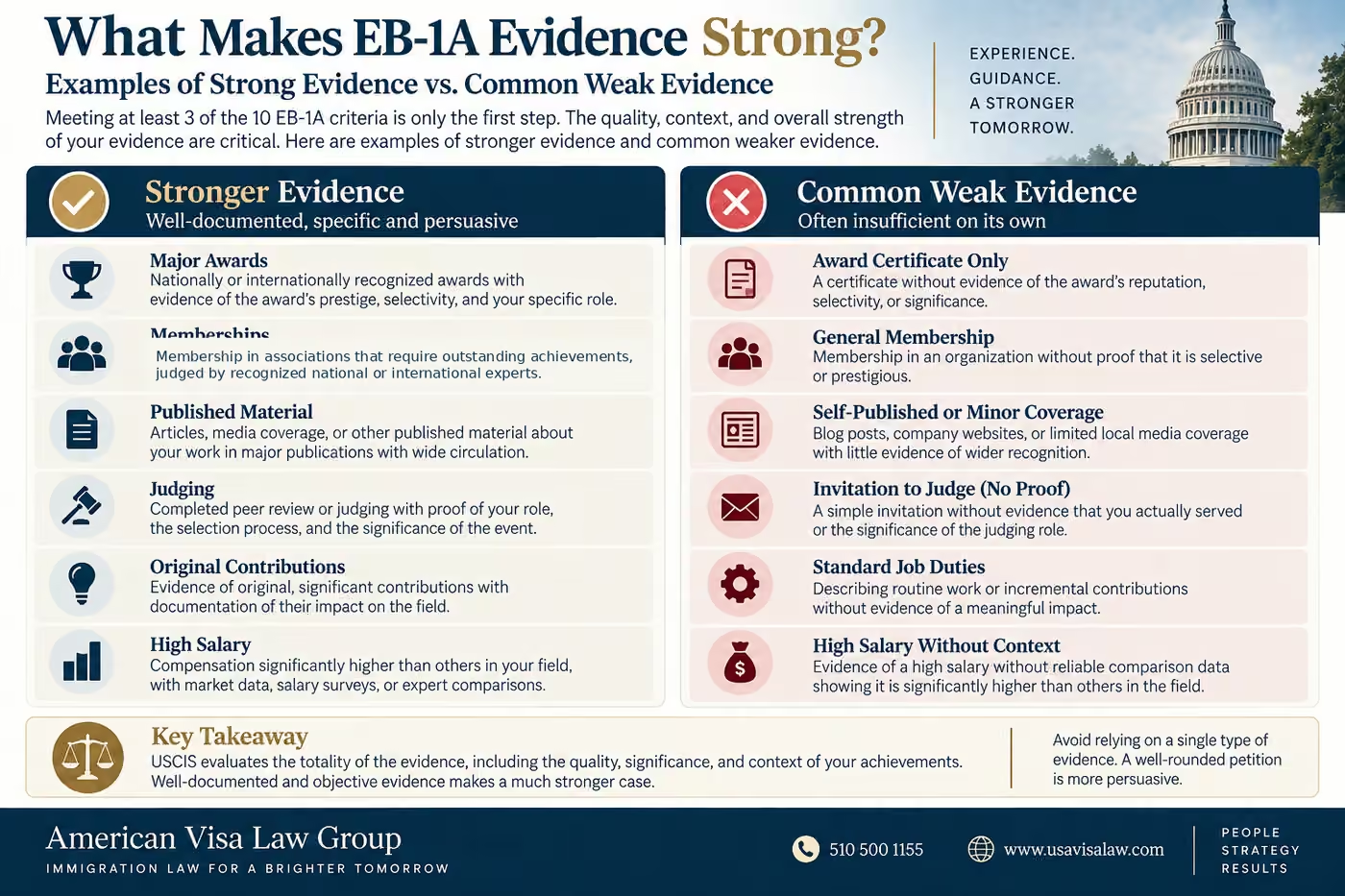
Expert letters can provide important context, especially when an applicant’s work is highly specialized. But letters are usually most persuasive when they explain facts rather than simply offer praise.
Statements describing an applicant as “exceptional,” “groundbreaking,” or “one of the best” carry limited value if they are not supported by specific examples and objective documentation.
For original contributions, for example, USCIS has explained that detailed expert letters can help establish significance, particularly when they are supported by corroborating evidence. USCIS has also rejected conclusory letters that describe contributions as important without adequately explaining their impact on the field.
A stronger letter identifies the contribution, explains why it matters, describes how the writer knows of its impact, and points to independent evidence supporting that conclusion.
An award certificate proves that the applicant received an award. It does not necessarily prove that the award is nationally or internationally recognized for excellence.
A stronger submission documents the selection criteria, number and quality of competitors, reputation of the awarding organization, geographic scope, prior recipients, and independent recognition of the award.
This same principle appears throughout EB-1A adjudication: the accomplishment and the significance of the accomplishment often require separate evidence.
Titles such as CEO, Vice President, Director, Principal Engineer, or Head of Research may sound impressive, but USCIS looks beyond titles.
For a leading role, the evidence should show that the applicant actually functioned as a leader. For a critical role, the evidence should demonstrate that the applicant’s performance was significantly important to the outcome of the organization’s activities.
USCIS’s current EB-1A RFE guidance specifically notes that the applicant’s performance—not merely the title—determines whether a role was critical.
The organization, division, or department must also have a distinguished reputation. Strong evidence of the applicant’s role cannot compensate for failing to establish that second element.
Innovation does not automatically equal major significance.
A patent may establish originality. A research paper may introduce a new idea. A business professional may develop a new process. But Criterion #5 requires evidence showing that the contribution was of major significance in the field.
USCIS has repeatedly distinguished between originality and significance. Evidence that work was patented, funded, or published may prove that something new was created, but stronger evidence of major significance can include substantial citations, widespread commentary, licensing, commercialization, independent adoption, or other documented influence.
Similarly, work that produced major benefits for one employer may not automatically establish impact on the broader field. USCIS has rejected contribution claims where the evidence primarily demonstrated value to the employer rather than wider significance.
A large salary figure alone does not establish the high-remuneration criterion.
The comparison should involve professionals who are genuinely comparable to the applicant in occupation, seniority, market, and geography. Comparing a specialized executive with all management workers—or comparing compensation in one country with U.S. salaries—can produce a misleading result.
The same care is needed when total compensation includes bonuses, stock, commissions, or other remuneration. The applicant should avoid comparing total compensation with a benchmark measuring only base salary unless the difference is clearly addressed.
Perhaps the most strategic mistake is treating the petition as a collection of unrelated exhibits.
A strong EB-1A record should show how the evidence reinforces itself.
Publications may establish scholarly authorship. Citation evidence may show that those publications influenced the field. Peer-review invitations may demonstrate that other experts recognize the applicant’s expertise. A critical role may show that a distinguished organization relied on that expertise. Independent media coverage may provide another form of outside recognition.
Together, those facts can tell a much stronger story than each item does alone.
Practical takeaway: EB-1A evidence is strongest when every document has a clear purpose. The goal is not to submit the most exhibits or claim the most criteria. It is to build a well-supported record showing what the applicant achieved, why those achievements matter, how others recognized them, and why the record demonstrates sustained extraordinary ability.
Yes. EB-1A applicants can self-petition and do not need a U.S. employer to sponsor the immigrant petition. They also do not need a permanent job offer or a PERM labor certification from the U.S. Department of Labor.
This flexibility is one of the major differences between EB-1A and many traditional employment-based green card categories. USCIS confirms that individuals with extraordinary ability may self-petition for EB-1 classification without a job offer or Department of Labor certification.
The applicant normally begins the immigrant petition process by filing Form I-140, Immigrant Petition for Alien Workers. Because EB-1A permits self-petitioning, the applicant can be both the person seeking classification and the petitioner filing the case.
This can be particularly useful for researchers, entrepreneurs, independent professionals, artists, consultants, and other applicants whose careers are not tied to a single permanent employer.
However, self-petitioning does not mean the applicant can qualify without showing future professional plans in the United States.
EB-1A applicants must still provide clear evidence that they intend to continue working in their area of extraordinary ability. USCIS specifically notes that extraordinary-ability applicants may change employers or become self-employed because a job offer is not required, but they must continue to demonstrate an intention to work in their area of expertise.
Depending on the circumstances, evidence of future work may include employment offers, contracts, letters from prospective employers or clients, planned projects, business activities, or a detailed statement explaining how the applicant intends to continue working in the field.
For an entrepreneur, that could involve continuing to develop or operate a business related to the area in which extraordinary ability was established. A researcher might plan to continue research through a university, private company, or independent venture. An artist may show upcoming projects, contracts, performances, exhibitions, or other professional plans.
The key is maintaining a credible connection between the field in which the applicant established extraordinary ability and the work they intend to pursue in the United States.
This is also different from simply being free to change jobs. EB-1A's lack of a specific employer sponsor gives applicants considerable professional flexibility, but the underlying extraordinary-ability classification remains connected to the applicant’s field of expertise.
Applicants considering several employment-based options can review AVLG’s immigration services to understand how EB-1A fits alongside other potential immigration strategies.
Practical takeaway: EB-1A does not require employer sponsorship, a permanent job offer, or PERM labor certification. An applicant can file Form I-140 as a self-petitioner, but must still establish an intention to continue working in the United States in the area of extraordinary ability.
Applicants considering EB-1A often also encounter the O-1A and EB-2 National Interest Waiver (NIW) classifications. Although all three can be relevant to highly accomplished professionals, they serve different immigration purposes and apply different legal standards.
.avif)
EB-1A and EB-2 NIW are immigrant classifications that can support permanent residence. O-1A, by contrast, is a temporary nonimmigrant classification for individuals of extraordinary ability in the sciences, education, business, or athletics.
O-1A and EB-1A share several concepts, including extraordinary ability, sustained acclaim, awards, published material, judging, original contributions, scholarly authorship, important organizational roles, and high remuneration.
For O-1A applicants in the sciences, education, business, or athletics, USCIS generally considers evidence of a major internationally recognized award or at least three of eight evidentiary categories, followed by an evaluation of the record as a whole. USCIS defines extraordinary ability in these O-1A fields as a level of expertise indicating that the individual is among the small percentage who have risen to the very top of the field. (uscis.gov)
That overlap means an established O-1A record may contain evidence that is also relevant to an EB-1A petition.
But the two classifications are not interchangeable.
O-1A is a nonimmigrant classification tied to temporary work in the United States, and the beneficiary does not file the petition independently. A qualifying U.S. employer or agent generally files Form I-129 on the beneficiary's behalf. EB-1A, by contrast, is an immigrant classification and permits the individual to self-petition.
An approved O-1A therefore does not automatically mean USCIS will approve a later EB-1A petition. The EB-1A filing must independently establish all applicable immigrant-classification requirements based on its own evidentiary record.
For someone already in O-1A status, however, the evidence developed over time—additional judging, influential publications, major contributions, awards, leadership, media recognition, or other accomplishments—may become relevant when assessing whether the person has developed a sufficiently strong EB-1A record.
EB-1A and EB-2 NIW are both employment-based immigrant routes that can permit self-petitioning without PERM labor certification, but their legal frameworks are fundamentally different.
An EB-1A applicant must establish extraordinary ability through sustained national or international acclaim and show that their achievements have been recognized in the field.
For an EB-2 National Interest Waiver, the analysis begins somewhere else entirely.
The applicant must first qualify for the underlying EB-2 classification as either an advanced-degree professional or a person of exceptional ability. USCIS then separately determines whether waiving the ordinary job-offer and labor-certification requirements is justified in the national interest. USCIS emphasized this sequence again in its January 2025 guidance on EB-2 National Interest Waivers. (uscis.gov)
Under the framework established in Matter of Dhanasar, the NIW applicant must demonstrate that:
USCIS continues to apply those three factors in NIW adjudications. (uscis.gov)
The distinction is important.
EB-1A is primarily an extraordinary-ability analysis centered on the applicant’s sustained acclaim and standing in the field. NIW is centered on the applicant’s EB-2 qualification, proposed endeavor, ability to advance that endeavor, and the national-interest justification for waiving the normal employment requirements.
Some accomplished professionals may have evidence relevant to both classifications. A researcher, for example, could have influential publications and judging activity that support an EB-1A case while also proposing nationally important research that may be relevant to an NIW analysis.
But those same facts must be connected to the different legal elements of each classification rather than simply reused under the assumption that the standards are equivalent.
For applicants comparing several employment-based options, the more useful question is not which category has the shortest checklist. It is which legal framework most closely matches the applicant’s existing evidence, career history, proposed U.S. work, and broader immigration strategy.
Establishing that an applicant meets the EB-1A requirements is only the first part of obtaining permanent residence. The next steps generally involve filing the immigrant petition, obtaining approval of the EB-1A classification, and then completing either adjustment of status in the United States or immigrant visa processing abroad.
The exact sequence depends on the applicant’s location, immigration status, visa availability, and whether the immigrant petition and permanent residence application can be filed at the same time.
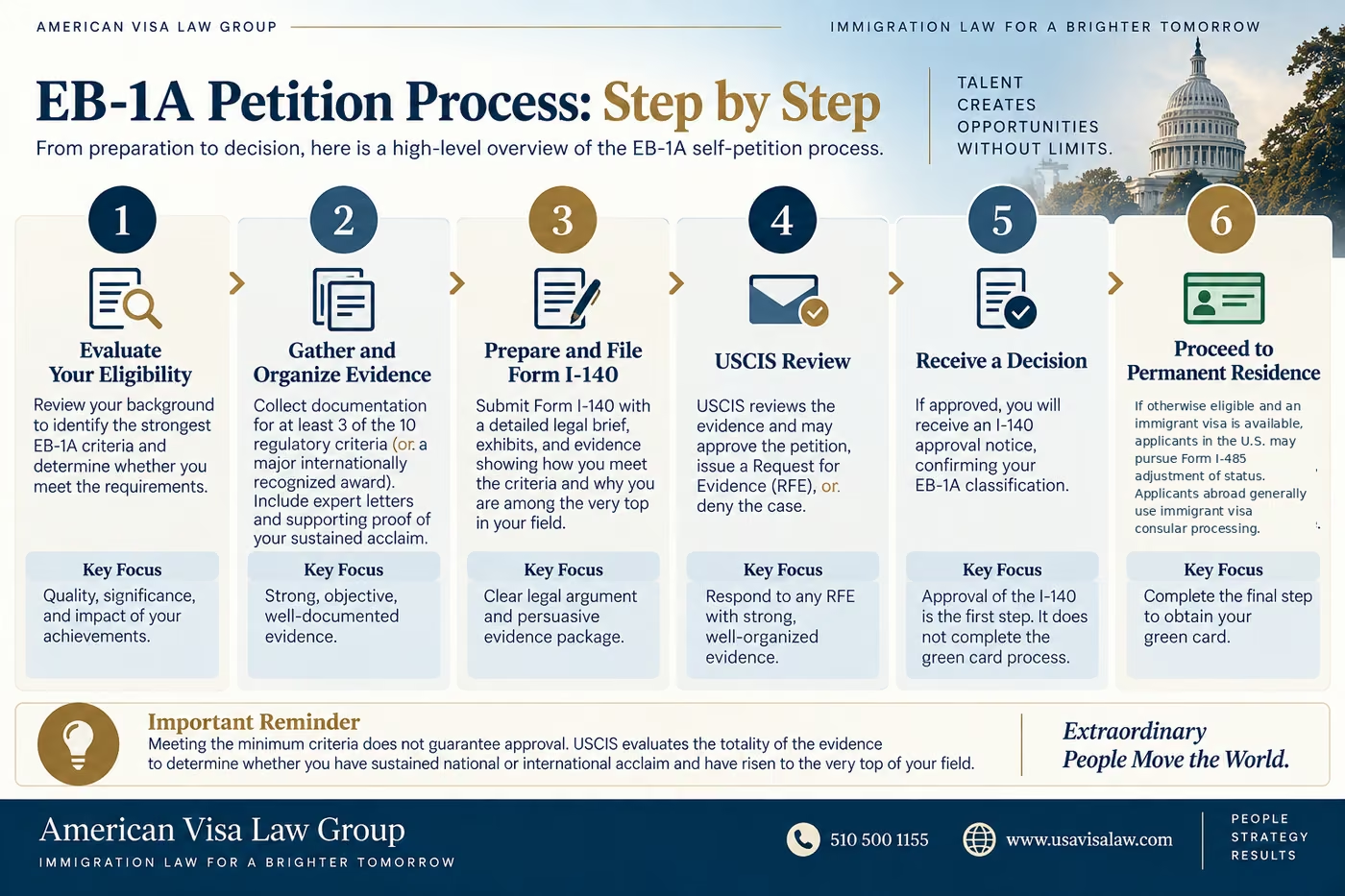
An EB-1A case begins with Form I-140, Immigrant Petition for Alien Workers. Because EB-1A permits self-petitioning, the applicant does not need a U.S. employer to file the petition.
The I-140 filing is where the applicant presents the evidence supporting extraordinary ability, the regulatory criteria being claimed, the final-merits argument, and the intention to continue working in the area of extraordinary ability in the United States.
An approved I-140 establishes eligibility for the underlying employment-based immigrant classification, but I-140 approval by itself does not grant lawful permanent resident status.
Applicants can review the current filing requirements directly through USCIS Form I-140 guidance.
Premium processing is available for qualifying Form I-140 filings, including EB-1A petitions. An applicant requesting premium processing files Form I-907, Request for Premium Processing Service, together with the applicable fee or after the underlying petition has already been filed.
Premium processing accelerates USCIS action on the petition; it does not guarantee approval. USCIS may approve the petition, deny it, issue a Request for Evidence, issue a Notice of Intent to Deny, or take another qualifying adjudicative action within the applicable premium-processing period.
Current requirements and fees should be checked before filing because USCIS filing procedures and fees can change. USCIS Form I-907 premium processing information
After, or in some cases while, the I-140 is being adjudicated, the applicant must complete the permanent residence stage.
An applicant who is physically present in the United States and otherwise eligible to adjust status may file Form I-485, Application to Register Permanent Residence or Adjust Status, once an immigrant visa is available. When a visa is immediately available, USCIS rules can permit an employment-based applicant to file Form I-485 together with Form I-140, while the I-140 remains pending, or after the I-140 is approved.
Applicants completing the process outside the United States generally proceed through consular processing after approval of the immigrant petition and when an immigrant visa number is available.
These two routes ultimately pursue the same result—lawful permanent residence—but involve different procedures, eligibility considerations, and government agencies.
EB-1A is part of the employment-based first preference, or EB-1, category. Although an applicant may qualify for EB-1A, an immigrant visa must still be available before permanent residence can be granted.
Visa availability is governed by the monthly U.S. Department of State Visa Bulletin and can differ by country of chargeability.
As of the September 2026 Visa Bulletin, the EB-1 Final Action Date is current for most countries. China-mainland born applicants have a Final Action Date of July 1, 2023, while India has a Final Action Date of October 15, 2022. The Department of State also warned that high EB-1 demand for India could potentially cause the category to become unavailable before the end of fiscal year 2026 if the applicable numerical limit is reached.
Those dates can move forward, remain unchanged, retrogress, or become unavailable, so applicants should check the applicable Visa Bulletin rather than relying on a date from an older article.
The distinction is important: an approved EB-1A petition confirms the immigrant classification, while visa availability and the applicant’s eligibility for adjustment of status or consular processing determine when the green card stage can move forward.
Yes. USCIS can issue a Request for Evidence (RFE) in an EB-1A case when the initial filing does not contain enough evidence to establish eligibility or when the adjudicator needs additional documentation or explanation before making a decision.
An RFE does not necessarily mean that USCIS has decided to deny the petition. It gives the petitioner an opportunity to address specific deficiencies identified by the officer. What matters is how precisely the response addresses those concerns.
USCIS’s own EB-1A Request for Evidence template instructs petitioners to respond to the specific insufficiencies identified in the request and explains that simply meeting the minimum regulatory criteria does not, by itself, establish eligibility for extraordinary ability classification.
An RFE may focus on one or more of the individual criteria claimed in the petition.
For example, USCIS might question whether an award is genuinely nationally or internationally recognized, whether a professional membership actually requires outstanding achievement, whether media coverage qualifies as major media, or whether an applicant truly performed a critical role for a distinguished organization.
The agency may also accept that certain criteria have been satisfied while raising concerns about the final merits determination.
That distinction is important. An applicant could potentially establish three regulatory criteria and still receive scrutiny over whether the totality of the evidence demonstrates sustained national or international acclaim and placement among the small percentage at the very top of the field.
USCIS decisions show both situations. In one case, an RFE initially challenged all of the applicant’s claimed criteria. After additional proceedings, USCIS ultimately accepted three criteria, judging, scholarly authorship, and a leading or critical role, but separately evaluated whether the record satisfied the final-merits standard.
An RFE can therefore raise questions such as:
One of the most important strategic points in responding to an EB-1A RFE is that more evidence is not automatically better evidence.
If USCIS questions whether an award has national recognition, adding several more copies of the award certificate does not resolve the problem. The response needs evidence addressing the award’s reputation, selection standards, competitive scope, or other factors relevant to the officer’s concern.
If USCIS questions whether an original contribution has major significance, another general recommendation letter describing the applicant as talented may add little. More useful evidence might establish adoption of the work, independent reliance on it, citation impact, commercialization, licensing, or detailed expert analysis explaining its significance.
USCIS’s RFE template specifically states that a response should address the identified insufficiencies and explain how the evidence establishes the required level of expertise.
The same principle applies when USCIS raises a final-merits concern. The response should explain how the evidence works collectively, rather than simply repeating that the applicant met three or more criteria.
Responding to an RFE does not always mean that every weakness must be solved with newly created evidence.
In EB-1A adjudication, USCIS must evaluate the relevant evidence in the record, and additional letters, explanations, or documentation may help clarify the significance of evidence that already existed when the petition was filed. In a 2024 decision involving original contributions, the Administrative Appeals Office specifically rejected an overly restrictive treatment of expert letters and emphasized that detailed expert evidence could provide valuable context about the significance of the applicant’s work.
There is still an important limitation: the applicant generally must have been eligible for the requested classification at the time of filing. An RFE response should not be treated as an opportunity to build an entirely new EB-1A career after filing. Rather, it should address USCIS’s concerns with evidence and explanation demonstrating that the eligibility requirements were satisfied when required.
Practical takeaway: An EB-1A RFE should be treated as a targeted evidentiary problem, not a request to send USCIS everything available. A strong response identifies exactly what USCIS found insufficient, addresses that issue with relevant documentation and legal analysis, and shows how the complete record satisfies both the claimed criteria and the overall extraordinary-ability standard.
A useful EB-1A self-assessment should go beyond asking whether three criteria appear to fit. The stronger question is whether the applicant has objective, well-documented evidence of sustained recognition and professional distinction that remains persuasive when the record is viewed as a whole.
USCIS applies that broader analysis during the final merits determination. Even after the initial evidentiary threshold is satisfied, the agency considers the type and quality of the evidence and whether the total record demonstrates sustained national or international acclaim and recognition placing the applicant among the small percentage at the very top of the field.
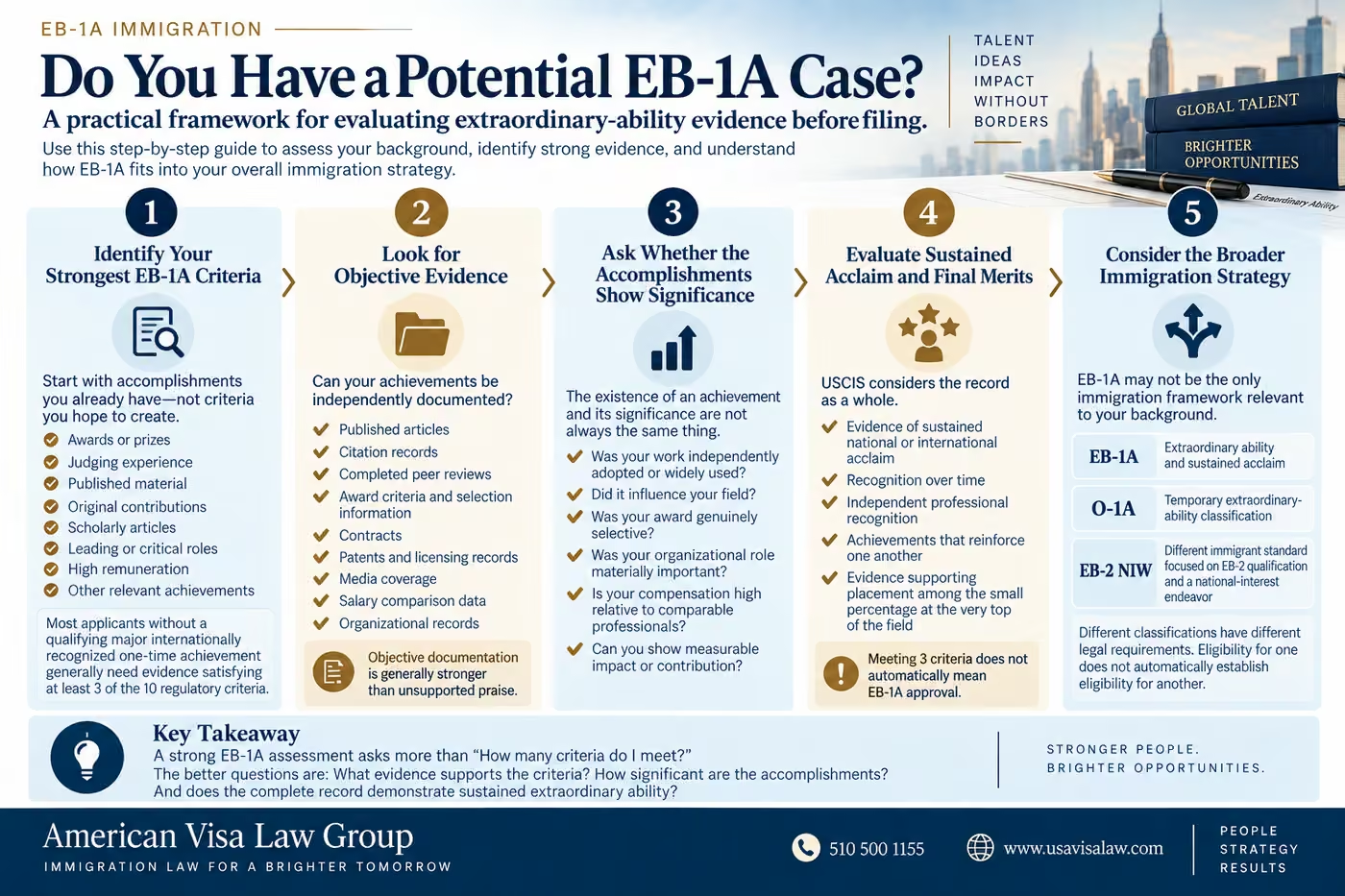
Start by identifying the criteria that are supported by existing accomplishments—not the criteria that might be possible to manufacture or develop quickly.
For example, a researcher may already have a strong publication and peer-review record. An engineer may have documented original contributions and a critical role in significant projects. An entrepreneur may have strong media coverage, business awards, industry recognition, and leadership evidence.
The goal is not to force the profile into as many of the 10 criteria as possible. It is to identify the categories where the evidence is naturally strong and where the underlying accomplishments are significant enough to contribute to the overall extraordinary-ability argument.
An applicant who credibly satisfies three or four criteria with substantial evidence may have a more coherent record than someone who claims seven criteria using marginal evidence.
The strongest EB-1A profiles usually contain evidence that can be independently verified.
This may include published articles, citation records, peer-review activity, contracts, patents, licensing records, awards, salary data, organizational records, media coverage, rankings, or documentation showing that other professionals have adopted or relied on the applicant’s work.
Expert recommendation letters can help explain why technical or specialized accomplishments matter, but they are most useful when they are tied to objective facts.
For example, a letter stating that an applicant is “one of the best professionals in the industry” provides a conclusion. A stronger record may show that the applicant developed technology adopted by several organizations, received independent industry recognition, was selected to judge other experts, and received compensation significantly above comparable professionals.
Those facts allow USCIS to evaluate the claim rather than simply accept someone else’s opinion.
EB-1A requires sustained national or international acclaim, so the timing and development of the applicant’s record can matter.
A collection of achievements earned within a very short period immediately before filing may raise a different question than a career showing recognition, influence, and achievement over time. USCIS does not impose a universal number of years that an applicant must demonstrate, but “sustained” acclaim means the recognition must have been maintained rather than appearing only as an isolated moment.
A useful self-assessment therefore considers the trajectory of the applicant’s career.
Are the strongest achievements concentrated in one brief period? Has the applicant continued to publish, lead, judge, innovate, perform, or receive independent recognition? Is there evidence that others in the field have continued to rely on or recognize the applicant’s work?
These questions help distinguish a promising résumé from a record that may support the higher EB-1A standard.
The final question is whether the evidence tells a coherent story of extraordinary ability.
USCIS considers potentially relevant evidence during final merits even when that evidence does not fit neatly within one of the 10 regulatory criteria. What matters is what the complete record shows about the applicant’s professional standing.
This is where connections between different accomplishments become important.
A researcher’s publications may be more persuasive when they have attracted substantial independent citations and led journals to select that researcher as a reviewer. A technology professional’s original contribution may carry greater weight when it was adopted by other organizations and led to independent recognition. A founder’s leadership role may become more significant when the company achieved recognized industry distinction and the founder personally received media coverage or awards.
The evidence should reinforce the same broader conclusion rather than appear as unrelated achievements assembled solely to satisfy separate criteria.
A person can have a strong professional record without EB-1A necessarily being the only relevant immigration option.
Depending on the applicant’s accomplishments, proposed U.S. work, current immigration status, and long-term goals, categories such as O-1A or EB-2 NIW may also warrant consideration. Those classifications use different legal standards, so the analysis should focus on how the applicant’s actual evidence fits each framework rather than assuming one category automatically leads to another.
For applicants who want a more structured review, American Visa Law Group’s free EB-1A case evaluation asks about awards, publications, original contributions, judging activity, memberships, leadership, compensation, and other evidence relevant to the EB-1A analysis. AVLG notes that the evaluation is preliminary and does not guarantee eligibility or approval.
Practical takeaway: A meaningful EB-1A assessment should answer three questions: Which criteria are strongly supported? What objective evidence demonstrates the significance of those achievements? And does the complete record show sustained recognition at the level required for extraordinary ability? Counting criteria is only the starting point.
An EB-1A petition should be evaluated on more than whether the applicant appears to meet three of the 10 criteria. A useful preliminary checklist should cover both the initial evidentiary requirements and the broader extraordinary-ability standard USCIS applies to the record as a whole.
Before filing, consider whether the case can document the following:
This checklist is useful for identifying potential strengths and gaps, but it should not be treated as a points system.
An applicant may appear to satisfy three criteria and still have weaknesses in the final merits analysis. Conversely, a well-documented petition can become substantially stronger when the evidence across different criteria reinforces the same broader conclusion: that the applicant has achieved sustained recognition and distinction at the level required for EB-1A classification.
Bottom line: The strongest EB-1A cases do not merely check boxes. They show, through objective and well-organized evidence, why the applicant’s achievements are significant, how the field has recognized those achievements, and why that recognition reflects sustained extraordinary ability.
If the applicant does not have a qualifying major internationally recognized one-time achievement, they generally must provide evidence satisfying at least three of the 10 EB-1A criteria.
That is the initial evidentiary threshold. USCIS then evaluates the complete record to determine whether the applicant has sustained national or international acclaim and has risen to the very top of the field.
No. Meeting three criteria does not automatically result in EB-1A approval.
USCIS uses a two-step analysis. First, it determines whether the applicant has a qualifying major international achievement or satisfies at least three regulatory criteria. It then conducts a final merits determination, considering the evidence as a whole.
This means an applicant can establish three criteria but still fail to demonstrate the overall level of extraordinary ability required for EB-1A classification. USCIS explains this broader analysis in its extraordinary ability guidance.
No. A Nobel Prize or similarly famous international award is not required.
A major internationally recognized award can independently satisfy the initial evidentiary requirement, but most applicants instead seek to establish at least three of the 10 regulatory criteria.
Those criteria recognize many other forms of achievement, including awards, judging, scholarly publications, original contributions, media coverage, leadership roles, and high remuneration.
The ultimate issue is whether those accomplishments, considered together, establish sustained extraordinary ability.
There is no fixed USCIS citation requirement for EB-1A.
Citation evidence can be particularly useful for researchers because it may help show that other experts have relied on or recognized the applicant’s work. But citation patterns differ substantially between disciplines, and USCIS does not establish a universal number that guarantees qualification.
The significance of the citation record should therefore be evaluated within the applicant’s particular field and alongside other evidence of influence and recognition.
Yes. Publications are not mandatory for every EB-1A applicant.
Scholarly authorship is only one of the 10 regulatory criteria. Entrepreneurs, executives, athletes, artists, technology professionals, and others may have strong cases based on different combinations of evidence, such as awards, media coverage, judging, original contributions, critical roles, high remuneration, or artistic and commercial achievements.
The relevant evidence depends heavily on the profession and the applicant’s actual career record.
Yes. Awards are also only one possible EB-1A criterion.
An applicant without qualifying prizes may potentially rely on other evidence, such as judging the work of others, original contributions of major significance, scholarly authorship, published material about the applicant, a leading or critical role, or high remuneration.
Not having awards therefore does not automatically prevent someone from qualifying. The broader question is whether the applicant can establish the required criteria and demonstrate extraordinary ability during final merits review.
Yes. Entrepreneurs can potentially qualify for EB-1A when their personal achievements satisfy the extraordinary-ability standard.
Relevant evidence may include recognized business or technology awards, significant independent media coverage, original contributions with broader industry impact, judging activities, leading or critical roles, selective memberships, or unusually high remuneration.
The key distinction is between the success of the business and the achievements of the individual founder. Funding, company valuation, revenue, or customer growth may provide useful context, but they do not automatically establish the founder’s personal EB-1A eligibility.
EB-1A permits self-petitioning. A U.S. employer does not have to sponsor the applicant, and a permanent job offer is not required.
The applicant generally files Form I-140 on their own behalf and must demonstrate an intention to continue working in the United States in the area in which extraordinary ability was established. USCIS confirms that extraordinary-ability applicants may self-petition without a job offer or labor certification.
The absence of an employer sponsor gives EB-1A applicants considerable professional flexibility, but it does not eliminate the requirement to show credible future work in the field.
No. EB-1A does not require PERM labor certification.
This distinguishes EB-1A from employment-based categories in which an employer may first need to complete the Department of Labor permanent labor certification process before filing an immigrant petition.
Because EB-1A permits self-petitioning and does not require PERM, the case focuses primarily on the applicant’s extraordinary ability, supporting evidence, continued work in the field, and satisfaction of the other statutory requirements.
Applicants who are unsure whether their professional record meets these standards can use American Visa Law Group’s EB-1A case evaluation to organize the evidence potentially relevant to an extraordinary-ability petition.
EB-1A cases are highly evidence-specific. Two applicants working in the same profession may have very different cases depending on the quality of their accomplishments, how those achievements are documented, the recognition they have received, and whether the complete record demonstrates sustained national or international acclaim.
That is why an EB-1A assessment should go beyond simply counting how many of the 10 criteria appear to apply.
A stronger analysis looks at which criteria are genuinely supported, where the evidence may be vulnerable to USCIS scrutiny, whether independent documentation supports the applicant’s claims, and how the record is likely to be evaluated during the final merits determination.
For some applicants, the existing evidence may already support a well-developed EB-1A strategy. Others may discover that certain accomplishments need stronger documentation, that another criterion is more persuasive than initially expected, or that a different employment-based option should also be considered.
American Visa Law Group assists professionals, researchers, entrepreneurs, executives, artists, and other accomplished individuals with extraordinary-ability and employment-based immigration matters. Applicants who want an initial review of their background can complete the firm’s free EB-1A case evaluation or contact American Visa Law Group to discuss their immigration options.
The central question in an EB-1A case is not simply whether an applicant can identify three qualifying criteria. It is whether the evidence, viewed as a whole, demonstrates the level of sustained recognition and professional distinction required for extraordinary ability classification.
A carefully prepared petition should make that conclusion clear through the evidence, not ask USCIS to infer it.
For official guidance on EB-1A requirements, extraordinary ability evidence, USCIS adjudication standards, Form I-140 filing, premium processing, and the green card stage, these resources are especially useful.
USCIS Policy Manual guidance on extraordinary ability explains the EB-1A evidentiary framework, including the 10 regulatory criteria, comparable evidence, sustained national or international acclaim, and the final merits determination.
USCIS guidance on Employment-Based First Preference EB-1 provides an official overview of the EB-1 category, including extraordinary ability, self-petitioning, the major-award or three-criteria framework, and the general eligibility requirements.
USCIS extraordinary ability criteria clarification explains important policy clarifications involving awards, memberships, published material, team awards, and artistic exhibitions, including when non-artistic exhibitions may instead be considered as comparable evidence.
USCIS Form I-140, Immigrant Petition for Alien Workers provides current filing information, instructions, editions, and procedural guidance for the immigrant petition used in EB-1A cases.
USCIS Form I-907, Request for Premium Processing Service provides current information on requesting premium processing for eligible petitions. USCIS explains that premium processing requires the agency to take a qualifying adjudicative action within the applicable timeframe, which can include approval, denial, an RFE, or a Notice of Intent to Deny.
U.S. Department of State Visa Bulletin provides the monthly employment-based Final Action Dates and Dates for Filing used to determine immigrant visa availability for the permanent residence stage. The EB-1 category can be current for some countries while remaining subject to cutoff dates for others.
These official sources are useful because an EB-1A case involves more than the 10 criteria alone. USCIS provides the substantive extraordinary-ability standard, evaluates Form I-140 petitions, and administers premium processing, while the Department of State Visa Bulletin becomes important when determining immigrant visa availability for adjustment of status or consular processing.

Hasan Abdullah, Esq. is the Founder and Managing Attorney of American Visa Law Group. His practice focuses on U.S. immigration law, including family-based immigration, employment-based immigration, adjustment of status, consular processing, waivers, PERM labor certification, NIW, EB-1, H-1B, O-1, and complex immigration strategy.
Through American Visa Law Group, Mr. Abdullah helps individuals, families, professionals, investors, and employers understand their immigration options and plan around changing government policies, USCIS procedures, and Visa Bulletin movement. His work emphasizes practical legal analysis, realistic expectations, and strategy tailored to each applicant’s immigration history and long-term goals.


