Author: Hasan Abdullah, Esq.
Many people search for famous EB-1A recipients because the EB-1A extraordinary ability category is often called the “Einstein visa.” This nickname can make it sound as though EB-1A is reserved for Nobel Prize winners, Olympic athletes, world-famous scientists, or celebrities. In reality, public fame is not the legal standard.
Famous examples can help illustrate the achievements and recognition that may support an EB-1A petition. However, USCIS is not simply asking whether the public knows an applicant’s name. The evidence must demonstrate sustained national or international acclaim and show that the person has risen to the top of their field.
USCIS evaluates both the individual evidentiary criteria and the strength of the petition as a whole. As explained in the USCIS Policy Manual, satisfying three criteria does not automatically guarantee approval. The complete record must establish extraordinary ability through credible and persuasive evidence.
There is also no complete public government list of EB-1A recipients. Online lists may include people who received another EB-1 classification, O-1 status, or a different immigration benefit. Famous names should therefore be treated as learning examples—not guaranteed templates.
This article examines well-known “Einstein visa” recipients and explains what their cases may teach about recognition, professional impact, and building a strong EB-1A profile. The key takeaway is simple: EB-1A is not only about fame. It is about whether the evidence proves sustained acclaim and exceptional standing within the applicant’s field.
The “Einstein visa” is an unofficial nickname for the EB-1A extraordinaryability category. It reflects the category’s high standard and the idea that applicants must demonstrate exceptional achievement in their field.
However, the nickname can be misleading. EB-1A is not limited to scientists, Nobel Prize winners, celebrities, or people who are famous worldwide.
The category covers extraordinary ability in the sciences, arts, education, business, and athletics. Researchers, entrepreneurs, artists, executives, athletes, physicians, engineers, and other professionals may qualify if they can provide the necessary evidence.
USCIS does not require applicants to prove that they are geniuses or household names. Instead, they must demonstrate sustained national or international acclaim and show that they have risen to the top of their field.
Relevant evidence may include:
USCIS first reviews the applicable EB-1A evidentiary criteria and then evaluates the petition as a whole.
The “Einstein visa” nickname describes the category’s demanding standard, but EB-1A is not reserved only for world-famous applicants. Accomplished professionals may qualify when their evidence clearly demonstrates sustained recognition and exceptional standing in their field.
There is no complete official public list of EB-1A recipients. USCIS maintains individual immigration records and provides formal procedures for requesting certain files through the Freedom of Information Act and Privacy Act.
Many online articles name famous people who may be associated with the “Einstein visa.” However, unless the person, their attorney, a government source, or a reliable public report confirms the immigration category, it can be difficult to know whether they received EB-1A specifically.
Some public figures may have qualified under EB-1A or another EB-1 classification. Others may have received O-1 status, employer sponsorship, family-based immigration, or another benefit. These distinctions matter because each immigration pathway has different requirements.
Famous examples should therefore be treated as general learning tools rather than confirmed case studies unless the source clearly identifies the person’s immigration category. A public figure’s career may illustrate strong professional recognition, but it does not reveal the complete petition, the evidence submitted, or how USCIS evaluated the case.
For this reason, the more useful question is not simply who may have received EB-1A. It is what evidence can help demonstrate extraordinary ability and sustained recognition within a particular field.
I
When people talk about famous EB-1A recipients, they are often thinking about public figures whose immigration history became part of media coverage or public debate. These examples can be useful, but they should be handled carefully because the full immigration file is usually not public.
One of the most commonly discussed examples is Melania Trump, whose green card has often been described in media discussions as connected to the EB-1 or “Einstein visa” category. Her example is frequently mentioned because it challenged the public assumption that EB-1A is only for scientists, inventors, or Nobel Prize winners. It also shows why the nickname “Einstein visa” can be misleading.
The EB-1A category can apply beyond science. It may apply to people in the arts, athletics, business, education, and other fields if the evidence is strong enough. For that reason, public discussions of models, artists, athletes, entertainers, founders, researchers, and other high-achieving professionals can help readers understand how broad the category may be.
Still, famous examples should not be treated as simple templates. A public biography does not show what evidence was submitted to USCIS. It does not show the legal argument, expert letters, media evidence, awards, contracts, judging roles, original contributions, or other documents that may have supported the case.
That is why applicants should be careful when reading online lists of famous EB-1A recipients. Some names may be accurate. Others may involve a different EB-1 category, an O-1 visa, family-based immigration, employer sponsorship, or another immigration route.
The better lesson is this: EB-1A is not about copying a famous person’s career. It is about proving that the applicant has sustained recognition and strong evidence of extraordinary ability within their own field.
Famous EB-1A examples can be useful, but applicants should not try to copy a celebrity’s career. Their real value is showing what professional recognition and meaningful impact may look like in different fields.
One important lesson is that public fame is not the legal standard. Under the federal EB-1A regulations, applicants must demonstrate sustained national or international acclaim and show that they have risen to the top of their field.
A person may be famous online but have weak evidence under the EB-1A criteria. Another person may not be widely known to the public but may have an exceptional reputation within a specialized field such as research, engineering, medicine, business, athletics, or the arts.
Evidence may also look different depending on the profession:
The central lesson is that EB-1A is evidence-driven. Applicants should focus less on whether they resemble a famous recipient and more on whether their own record presents a clear story of achievement, recognition, and impact.
As explained in the USCIS extraordinary-ability guidance, officers do not evaluate documents in isolation. They review the evidence individually and then consider whether the complete record demonstrates extraordinary ability.
Awards, publications, media coverage, judging roles, leadership positions, high compensation, and original contributions should therefore work together. Each piece of evidence should help explain why the applicant stands out and why their achievements matter within the field.
For most applicants, the goal is not to prove celebrity status. It is to prove extraordinary ability through credible, organized, and field-specific evidence.
The EB-1A category is not based on reputation alone. It is based on evidence.
USCIS looks at whether the applicant can show extraordinary ability in the sciences, arts, education, business, or athletics. The applicant must also show sustained national or international acclaim and recognition for achievements in the field.
In many cases, this starts with the evidence categories. An applicant may qualify by showing a major internationally recognized award, or by submitting evidence that meets several of the listed EB-1A criteria. These criteria may include awards, published material about the applicant, judging the work of others, original contributions, scholarly articles, leading or critical roles, high salary, artistic exhibitions, or commercial success in the performing arts.
But meeting the minimum number of criteria is not always the end of the analysis.
USCIS may still look at the total record and ask whether the evidence actually shows that the applicant is among the small percentage who have risen to the top of the field. This is often where EB-1A cases become more difficult. A person may have strong credentials, but USCIS may still question whether those credentials show extraordinary ability at the required level.
That is why EB-1A is not just a document collection exercise. The petition needs a clear legal strategy. The evidence should explain what the applicant has accomplished, why those achievements matter, how the field recognized them, and why the applicant stands out compared to others in the same field.
For applicants, this means famous examples can only teach so much. The real question is whether the applicant’s own evidence can satisfy the EB-1A requirements and support a persuasive final review of the case.
One of the biggest misunderstandings about EB-1A is that the applicant must be famous to the general public. That is not true.
The EB-1A category is demanding, but it is not limited to celebrities, Nobel Prize winners, Olympic medalists, or people whose names are widely known outside their field. Many strong applicants are not household names. They may be researchers, entrepreneurs, physicians, engineers, artists, executives, athletes, designers, or other professionals who have built serious recognition within a specific field.
This distinction matters because USCIS is usually not asking whether the average person has heard of the applicant. USCIS is asking whether the evidence shows extraordinary ability and sustained recognition in the applicant’s area of expertise.
For example, a researcher may not be famous to the public, but may have important publications, citations, peer review experience, conference recognition, or original contributions that affected the field. An entrepreneur may not be a celebrity, but may have built a company, led a major product, received significant press, raised funding, won industry awards, or played a critical role in a recognized organization.
The same idea can apply to artists, performers, coaches, physicians, business professionals, and other high-achieving applicants. The evidence may look different from one field to another, but the goal is the same: to show that the applicant stands out within the field in a way that is supported by objective proof.
This is why the “Einstein visa” nickname can be misleading. It may make some qualified applicants assume EB-1A is impossible for them. It may also make other applicants think fame alone is enough. Both assumptions can be wrong.
A better way to think about EB-1A is this: the applicant does not need to be famous everywhere, but the evidence should show meaningful recognition in the field where they claim extraordinary ability.
Famous EB-1A recipients can make the category sound mysterious, but most EB-1A cases are built around specific types of evidence. The goal is to show that the applicant has been recognized for extraordinary ability in their field.
One common evidence category is awards and prizes. Awards can help, but not every award carries the same weight. USCIS may look at how selective the award is, who gives it, whether it is recognized in the field, and whether it shows more than ordinary professional achievement.
Published material about the applicant can also be important. This may include articles, interviews, profiles, or media coverage discussing the applicant’s work. Stronger media evidence usually comes from independent and reputable sources, not paid promotional content or short mentions with little substance.
Another category is judging the work of others. This can include reviewing papers, judging competitions, evaluating grants, serving on expert panels, or reviewing the work of other professionals in the field. The key is to show that the applicant was trusted to evaluate others because of their expertise.
Original contributions can be one of the most important parts of an EB-1A case. USCIS may want to see that the applicant’s work had real significance beyond their own job or company. This could involve research impact, business innovation, technical development, artistic influence, industry adoption, or other evidence showing that the work mattered in the field.
For researchers, scholars, and some professionals, authorship of scholarly articles or important publications may help. However, USCIS may look beyond the number of publications and consider the quality, relevance, citations, and influence of the work.
A leading or critical role can also support an EB-1A case. This may apply when the applicant played an important role for a distinguished company, institution, project, team, or organization. The evidence should explain why the role was important and how the applicant contributed to the organization’s success.
High salary or other significant compensation may also be relevant. But the comparison matters. The evidence should usually show that the applicant earned significantly more than others in similar roles, locations, or fields.
For artists, performers, and creative professionals, evidence may include exhibitions, showcases, commercial success, critical reviews, press coverage, awards, or other proof that the work received meaningful recognition.
The main point is that EB-1A evidence should not be viewed as a checklist only. A strong petition usually explains how the evidence fits together and why it proves the applicant stands out in the field.
Famous EB-1A examples can be interesting, but they can also create the wrong impression.
A public figure’s career may look impressive from the outside, but the public usually does not see the actual immigration petition. We do not know which evidence was submitted, how the case was organized, what legal arguments were made, or how USCIS evaluated the record.
This matters because EB-1A is not approved based on a headline or a public reputation alone. The petition must show documented evidence of extraordinary ability. That evidence may include awards, media coverage, judging experience, original contributions, publications, leadership roles, high compensation, or other proof depending on the applicant’s field.
Another problem is that online lists can sometimes mix different immigration categories together. A person may be described online as an “Einstein visa” recipient, but the actual immigration path may have involved EB-1A, EB-1B, EB-1C, O-1, family-based immigration, employer sponsorship, or another route entirely.
That is why applicants should be careful about comparing themselves too closely to famous names. A celebrity, athlete, model, founder, or researcher may have a very different evidence profile, different field, and different immigration history.
The better approach is to focus on the lesson behind the example. What type of recognition did the person appear to have? Was there independent media coverage? Were there awards, critical roles, original contributions, or field-level impact? Did the achievements show sustained recognition over time?
Famous examples can help explain what extraordinary ability may look like, but they should not be treated as a formula. A strong EB-1A case depends on the applicant’s own evidence, field, achievements, and legal strategy.
Famous EB-1A examples can be helpful, but the most important lessons are not about fame. They are about evidence, positioning, and how the applicant’s achievements are explained.
A regular applicant may not be famous to the general public, but that does not automatically mean the person is unqualified. Many strong EB-1A applicants are known mainly within their professional field. They may be researchers, entrepreneurs, physicians, engineers, artists, designers, business professionals, athletes, or other specialists whose work has been recognized by people who understand that field.
One lesson is that the field must be clearly defined. USCIS needs to understand where the applicant claims extraordinary ability. A broad field can make the case feel unclear. A very narrow field can make the recognition seem less meaningful. The petition should explain the applicant’s area of expertise in a way that is accurate, credible, and supported by the evidence.
Another lesson is that recognition should come from outside the applicant’s own circle. Employer letters can help, but independent evidence is often stronger. This may include media coverage, citations, awards, judging roles, professional memberships, expert letters, commercial impact, conference roles, or other proof that people outside the applicant’s employer or immediate network recognize the work.
Applicants should also focus on why their achievements matter. It is not enough to say that someone worked hard, held an important job, or completed impressive projects. The stronger question is what impact the work had in the field. Did it influence others? Was it adopted, cited, awarded, published, reviewed, funded, used, or recognized in a meaningful way?
Famous recipients can also remind applicants that presentation matters. A strong EB-1A case usually tells a clear story. The evidence should not feel like a random pile of documents. It should show a pattern of achievement, recognition, and continued work in the field.
For regular applicants, the goal is not to look like a celebrity. The goal is to show that their own record, in their own field, supports a serious claim of extraordinary ability.
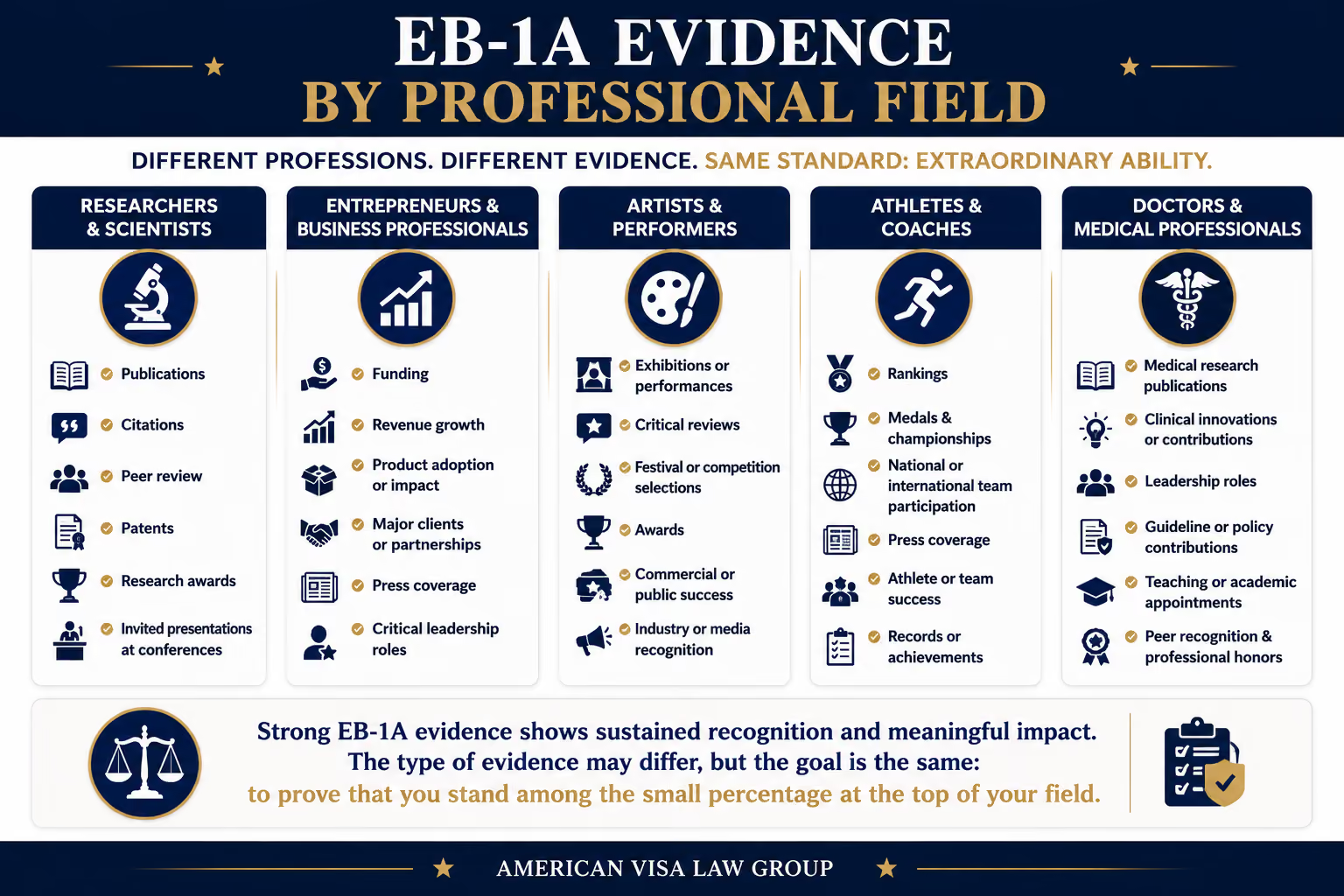
EB-1A evidence can look very different depending on the applicant’s field. This is one reason famous examples can be both helpful and confusing. A strong researcher, entrepreneur, artist, athlete, or physician may all qualify in different ways, but the evidence should still point to the same basic idea: recognized achievement in the field.
For researchers and scientists, EB-1A evidence may include peer-reviewed publications, citation history, conference presentations, invited talks, research awards, patents, grants, peer review work, and expert letters explaining the significance of the applicant’s contributions.
The focus should not only be on the number of publications. USCIS may also look at whether the work influenced other researchers, contributed to the field, solved an important problem, or received recognition from independent experts.
For entrepreneurs and business professionals, EB-1A evidence may include company growth, funding, revenue, major clients, media coverage, industry awards, product adoption, leadership roles, or proof that the applicant played a critical role in a recognized organization.
An entrepreneur does not automatically qualify just because they started a company. The evidence should show why the business achievement is significant and how the applicant’s work stands out in the industry.
For artists, performers, designers, and creative professionals, evidence may include exhibitions, performances, critical reviews, press coverage, awards, commercial success, festival selections, important collaborations, or work displayed in recognized venues.
In these cases, USCIS may want to understand both the quality of the work and the level of recognition it received. Independent reviews, notable publications, recognized institutions, and strong documentation can make a difference.
For athletes and coaches, EB-1A evidence may include rankings, medals, championships, national team participation, press coverage, awards, coaching achievements, elite competition results, or proof of influence in the sport.
For coaches, the evidence may focus not only on personal athletic history, but also on the success of athletes trained, leadership roles, team impact, and recognition from sports organizations.
For doctors and medical professionals, EB-1A evidence may include published research, clinical innovation, leadership roles, teaching, awards, peer recognition, invited presentations, guideline contributions, patents, or evidence that their work improved medical practice.
A strong medical career alone may not be enough. The case should explain what makes the applicant’s work unusually significant within medicine, research, public health, or a specialized clinical field.
Across all fields, the strongest EB-1A cases usually do more than list achievements. They explain why those achievements matter, who recognized them, and how they show the applicant stands out within the field.
Many EB-1A applicants are accomplished. They may have strong education, respected employers, important projects, publications, awards, or leadership experience. But EB-1A usually requires more than being impressive.
The key question is whether the evidence shows recognition at a high level within the field.
This is where many applicants misunderstand the category. A strong resume is not always the same as a strong EB-1A case. USCIS may want to see evidence that the applicant’s work has been recognized beyond a normal job role, beyond internal company success, and beyond ordinary professional growth.
A useful way to evaluate the profile is to ask a few practical questions. Has the applicant received independent recognition? Has the work been covered, cited, awarded, adopted, reviewed, or used by others? Has the applicant judged the work of peers? Has the applicant made contributions that experts in the field can explain as important? Has the applicant played a leading or critical role for a distinguished organization or project?
The strength of an EB-1A case often depends on how clearly the evidence answers those questions.
It is also important to look at consistency. A case may be stronger when the same story appears across different types of evidence. For example, awards, media coverage, expert letters, publications, and leadership roles may all point to the same area of expertise and the same field impact.
A weaker case may have scattered achievements that look impressive individually, but do not clearly show sustained acclaim or a high level of recognition in one defined field.
Applicants should also be careful about filing too early. Sometimes a person has the beginning of a strong profile, but not enough independent evidence yet. In that situation, the better strategy may be to build more evidence before filing, or to consider whether another immigration option may be more appropriate.
A careful EB-1A review should look beyond whether the applicant has done good work. It should ask whether the evidence can show extraordinary ability under the USCIS standard and whether the full record is strong enough for final review.
Famous EB-1A examples can be helpful, but they can also lead applicants in the wrong direction if they are misunderstood.
One mistake is assuming that only celebrities qualify. EB-1A is a high standard, but it is not limited to people who are famous to the general public. Many strong applicants are recognized mainly within their field, not by the general public.
Another mistake is assuming that fame alone is enough. A person may have public visibility, press coverage, or social media attention, but USCIS still looks for evidence that fits the legal standard. The petition should show sustained recognition, field-level achievement, and a strong connection between the applicant’s work and their claimed area of extraordinary ability.
Applicants should also avoid copying another person’s profile. A famous recipient may have had awards, contracts, expert letters, media coverage, or industry recognition that are not visible from the outside. The public story is not the same as the immigration petition.
Another common mistake is relying on weak media coverage. Paid articles, short mentions, promotional interviews, or low-authority publications may not carry the same weight as independent coverage that discusses the applicant’s work in a meaningful way.
It is also risky to treat EB-1A like a simple checklist. Meeting several evidence categories does not automatically mean the case is ready. USCIS may still review the full record and decide whether the evidence shows extraordinary ability overall.
Some applicants also confuse EB-1A with other immigration options, such as O-1, EB-1B, EB-1C, NIW, or employer-sponsored green card categories. Evidence that may help in one category may not be enough for another.
The safer approach is to use famous examples as inspiration, not as a formula. Every EB-1A case should be built around the applicant’s own field, evidence, achievements, and long-term strategy.

You do not need to be famous to the general public to apply for EB-1A.
That is one of the most important points for applicants to understand. The EB-1A category is not limited to celebrities, public figures, or people whose names are widely known outside their profession. Many strong applicants are recognized mainly within a specific field, industry, academic area, artistic discipline, business sector, or professional community.
The better question is not whether you are famous. The better question is whether your evidence can show extraordinary ability and sustained recognition in your field.
For example, a researcher may not be known by the public, but may have influential publications, citations, peer review work, grants, awards, or original contributions. An entrepreneur may not be a celebrity, but may have strong evidence of business impact, media coverage, funding, revenue, product adoption, or leadership in a recognized company. An artist, athlete, physician, engineer, or executive may also have a strong case if the evidence shows meaningful recognition and field-level achievement.
At the same time, applicants should be realistic. EB-1A is a high standard. A strong job title, advanced degree, good salary, respected employer, or long career does not automatically mean the person qualifies. USCIS looks for evidence that the applicant stands out beyond ordinary professional success.
Some applicants may be strong EB-1A candidates now. Others may need more time to build evidence. Some may be better suited for another immigration option, such as EB-2 NIW, O-1, EB-1B, PERM, or another employment-based strategy.
This is why a careful review matters. A good EB-1A assessment should look at the applicant’s field, achievements, recognition, evidence quality, and possible weaknesses. It should also consider whether the case is ready to file or whether the applicant would benefit from strengthening the profile first.
The main takeaway is simple: do not assume EB-1A is impossible just because you are not famous. But also do not assume that being accomplished is enough. The strength of the case depends on the evidence.
Famous EB-1A recipients can make the “Einstein visa” easier to understand. They can show that extraordinary ability may appear in many fields, including science, business, athletics, arts, entertainment, medicine, and entrepreneurship.
But famous examples should not distract from the real issue.
EB-1A cases are not won because an applicant resembles a famous person. They are built on evidence. USCIS looks at the applicant’s achievements, recognition, field impact, and whether the full record supports extraordinary ability under the legal standard.
For some applicants, the biggest mistake is assuming they cannot qualify because they are not famous. For others, the mistake is assuming they qualify simply because they are successful, visible, or accomplished. Both views can be too simplistic.
The better approach is to review the evidence carefully. Does the applicant have independent recognition? Do the achievements matter in the field? Is there proof of sustained acclaim? Does the record show more than ordinary professional success? Can the evidence support a strong final merits review?
The EB-1A category is demanding, but it is not reserved only for household names. A strong applicant may be well known in a specialized field, even if the general public has never heard of them.
Famous EB-1A examples may be interesting, but evidence wins cases. The strongest petitions usually tell a clear, credible story about why the applicant stands out and why their work has been recognized at a high level.
There is no complete official public list of EB-1A recipients because immigration records are generally private. Some public figures are commonly discussed in connection with the EB-1A or “Einstein visa,” but readers should be careful unless the source clearly confirms the exact immigration category.
Yes, EB-1A is often informally called the “Einstein visa.” The nickname comes from the idea that the category is for people with extraordinary ability. However, the phrase can be misleading because EB-1A is not only for scientists or geniuses. It can apply to people in sciences, arts, education, business, and athletics.
No. You do not need to be famous to the general public to qualify for EB-1A. The stronger question is whether you have evidence of extraordinary ability and sustained recognition within your field.
Yes, artists, models, performers, designers, and other creative professionals may qualify if they can provide strong evidence of recognized achievement. This may include major media coverage, awards, exhibitions, commercial success, critical reviews, or other proof of recognition in the field.
Yes, entrepreneurs may qualify for EB-1A if they can show strong evidence of extraordinary ability in business. This may include company growth, funding, revenue, major press, industry awards, product impact, leadership roles, or other evidence showing significant recognition and influence.
EB-1A is often considered more demanding than O-1 because EB-1A is an immigrant visa category that can lead to a green card. Both categories involve extraordinary ability, but EB-1A usually requires a strong showing of sustained acclaim and overall field-level achievement.
No. Meeting three evidence categories does not automatically guarantee approval. USCIS may still review the total record and decide whether the applicant has shown extraordinary ability at the required level.
Yes. EB-1A allows self-petitioning, which means an employer sponsor is not required. This is one reason EB-1A can be attractive for qualified applicants who want more control over their immigration process.
A common mistake is treating EB-1A like a checklist. Strong cases usually need more than scattered evidence. The petition should explain why the applicant’s achievements matter, how the field recognized them, and why the full record supports extraordinary ability.
Possibly. Being successful is not always enough, but being famous is not required. The right question is whether your evidence shows sustained recognition, field-level impact, and achievements that stand out beyond ordinary professional success.
Review the official eligibility requirements, qualifying fields, evidence categories, and self petition rules for extraordinary ability applicants.
Learn how USCIS evaluates individual evidence categories and determines whether the complete record demonstrates extraordinary ability.
Read the federal regulation defining extraordinary ability and listing the types of evidence that may support a petition.
Explore USCIS guidance clarifying how awards, memberships, published material, exhibitions, and leading or critical roles may be evaluated.
Understand how immigration records may be requested and why there is no simple public government list of individual extraordinary ability recipients.
Compare the O extraordinary ability classification with the immigrant extraordinary ability category and understand why the two pathways should not be confused.

Hasan Abdullah, Esq. is the Founder and Managing Attorney of American Visa Law Group. His practice focuses on U.S. immigration law, including family-based immigration, employment-based immigration, adjustment of status, consular processing, waivers, PERM labor certification, NIW, EB-1, H-1B, O-1, and complex immigration strategy.
Through American Visa Law Group, Mr. Abdullah helps individuals, families, professionals, investors, and employers understand their immigration options and plan around changing government policies, USCIS procedures, and Visa Bulletin movement. His work emphasizes practical legal analysis, realistic expectations, and strategy tailored to each applicant’s immigration history and long-term goals.


