Author: Hasan Abdullah, Esq.
Last updated: The 20th of November, 2026.
The EB1A criteria are ten regulatory categories of evidence used to demonstrate extraordinary ability in the sciences, arts, education, business, or athletics. Under 8 CFR § 204.5(h), applicants must provide evidence of a qualifying major internationally recognized one-time achievement or satisfy at least three of the ten evidentiary criteria. These criteria recognize accomplishments such as nationally or internationally recognized awards, judging the work of others, original contributions of major significance, scholarly publications, and leading or critical roles within distinguished organizations.
However, meeting three EB1A criteria does not automatically establish eligibility. USCIS also evaluates the evidence as a whole to determine whether the applicant has demonstrated sustained national or international acclaim and recognition as someone among the small percentage at the very top of their field. A published research paper, professional award, or leadership position may satisfy an individual criterion, but the broader significance of those achievements remains important. Developing a persuasive EB-1A extraordinary ability petition therefore requires more than collecting documents. It requires demonstrating how the evidence satisfies specific regulatory standards and supports the applicant's overall standing in their profession.
This guide examines all ten EB1A criteria, explains the documentation that may support each requirement, and identifies common evidentiary weaknesses that can undermine an otherwise promising petition. It also addresses how USCIS conducts the final merits determination and when comparable evidence may be appropriate. For a broader explanation of eligibility and the immigration process, see our guide to EB-1A requirements and filing considerations.
The 10 EB1A criteria are evidentiary categories established under 8 CFR § 204.5(h)(3) to evaluate extraordinary ability in the sciences, arts, education, business, or athletics. Applicants who do not have a qualifying major internationally recognized one-time achievement must demonstrate that their accomplishments satisfy at least three of these criteria.
Each criterion recognizes a different form of professional achievement, from awards and scholarly authorship to original contributions, judging activities, and leadership within distinguished organizations. However, the quality and relevance of the supporting documentation matter. Evidence must establish the particular requirements of the criterion being claimed, not merely demonstrate that an applicant has enjoyed professional success.
The following table summarizes all ten USCIS criteria, examples of relevant documentation, and common evidentiary weaknesses.
These categories are not interchangeable, and USCIS does not evaluate them through a numerical points system. A petitioner may satisfy several criteria using different types of professional accomplishments, but the evidence must independently establish the requirements of each claimed category. The same underlying achievement may be relevant to more than one criterion when it genuinely satisfies each standard.
Importantly, meeting three criteria is an evidentiary threshold, not a guarantee of EB-1A approval. USCIS subsequently considers the complete record to determine whether the applicant has demonstrated sustained national or international acclaim and the level of extraordinary ability required by law.
Understanding this distinction is essential when selecting which achievements to emphasize. A petition supported by clearly documented, independently verifiable accomplishments may present a stronger case than one relying on numerous exhibits that do not adequately establish the applicable legal standards.

Understanding the EB1A criteria requires examining more than the accomplishments listed on an applicant's résumé. Each regulatory category has specific evidentiary requirements, and USCIS evaluates whether the documentation establishes those requirements. The following sections explain what each criterion means, which evidence may support it, and the weaknesses applicants should consider when preparing their petitions.
The first EB1A criterion requires evidence that the applicant has received nationally or internationally recognized prizes or awards for excellence in their field. These awards do not need to carry the prestige of a Nobel Prize or another major internationally recognized honor. However, their significance must extend beyond ordinary participation, internal recognition, or routine professional achievement.
USCIS considers factors such as the award's selection standards, the reputation of the awarding organization, the number of recipients, and the award's recognition within the relevant professional field. A competitive research award, industry distinction, or professional achievement prize may provide qualifying evidence when its national or international recognition can be established.
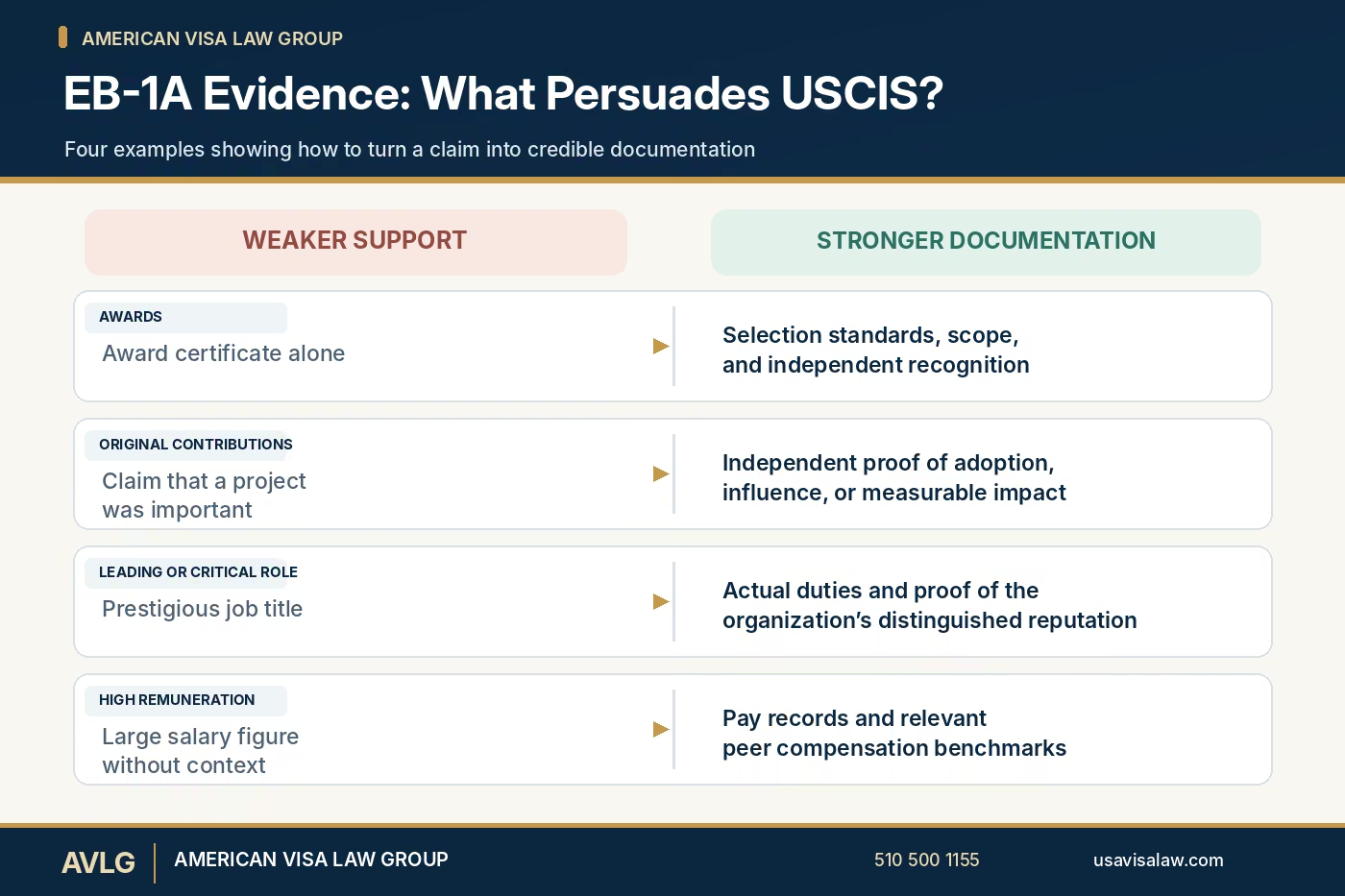
The award certificate alone may not be sufficient. A persuasive evidence package should explain why the distinction matters. Supporting documentation may include official selection criteria, information about the judging process, independent coverage of the award, and evidence demonstrating its reputation within the profession.
Importantly, awards are not necessarily limited to individual competitions. USCIS has clarified that qualifying team awards may also be considered when the applicant can establish that they were among the actual recipients. Documentation identifying the individual as an award recipient may therefore be important when recognition was granted to a group rather than a single professional.
A common weakness is assuming that an award qualifies simply because it was issued by a respected institution. The relevant question is whether the particular award recognizes excellence in the applicant's field and has the required national or international standing.
The USCIS Policy Manual's extraordinary ability guidance provides additional direction on evaluating qualifying prizes and awards. Ultimately, the strength of this criterion depends not only on proving that an award was received, but also on establishing the professional recognition it represents.
The second EB1A criterion recognizes membership in professional associations that require outstanding achievements, as judged by recognized national or international experts in the relevant field. Under 8 CFR § 204.5(h)(3)(ii), simply belonging to a prestigious organization is insufficient. The applicant must demonstrate that admission to the association, or the specific membership level held, depends on exceptional professional accomplishments evaluated by qualified experts.
This distinction is particularly important for scientists, researchers, engineers, and other professionals who belong to established industry organizations. Many associations offer general memberships based on professional qualifications, educational credentials, years of experience, or payment of annual dues. Such requirements do not ordinarily establish the outstanding achievements necessary for this criterion.
However, selective membership categories, such as certain fellowships or honorary distinctions, may qualify when admission requires a documented evaluation of outstanding accomplishments by recognized experts. USCIS also considers qualifying past memberships, meaning applicants are not necessarily required to maintain current membership if they can establish that the earlier selection satisfied the regulatory standard.
Strong supporting evidence should establish both the applicant's membership and the organization's selection requirements. Relevant documentation may include official membership bylaws, nomination procedures, admission criteria, selection committee records, and evidence of the professional standing of the experts responsible for evaluating candidates.
A common weakness is submitting a membership certificate without explaining how admission was earned. Even when an association enjoys substantial international recognition, USCIS must be able to determine whether the applicant's particular membership was awarded based on outstanding achievements rather than routine professional eligibility.
The USCIS Policy Manual's extraordinary ability guidance provides further clarification on membership requirements and the evaluation of different membership categories. A persuasive petition should therefore establish not only that the applicant belongs to a respected professional organization, but that their admission reflects the level of achievement required by the regulation.
The third EB1A criterion recognizes published material about an applicant and their work in the field of extraordinary ability. Under 8 CFR § 204.5(h)(3)(iii), qualifying coverage must appear in professional publications, major trade publications, or other major media. The evidence must also identify the material's title, date, author, and any necessary translation.
This criterion is distinct from authorship of scholarly articles. A researcher who publishes a study may satisfy the separate scholarly authorship criterion, but the publication itself does not automatically establish that qualifying material has been published about the researcher. Relevant evidence may instead include independent news coverage, professional profiles, industry interviews, or articles discussing the applicant's research, innovations, or other professional accomplishments.
Importantly, USCIS does not require the applicant to be the sole subject of the publication. Coverage discussing a broader scientific discovery, industry development, or team achievement may qualify when it substantially discusses the applicant's work and sufficiently connects the individual to that work. USCIS has also clarified that published material does not need to independently demonstrate the value of the applicant's contributions to satisfy this particular criterion.
A strong evidence package should establish both the relevance of the coverage and the standing of the publication. Supporting documentation may include complete articles, publication details, readership or circulation information, and evidence identifying the intended professional audience. Qualifying coverage may also include certain audio or video materials supported by appropriate transcripts.
A common weakness is submitting publicity without demonstrating that the source qualifies as a professional publication, major trade publication, or other major media. Similarly, an article that briefly mentions an applicant without meaningfully addressing their work may not satisfy the regulatory standard.
The USCIS Policy Manual on extraordinary ability explains how officers evaluate published material, including publication credibility and the relationship between the coverage and the applicant's professional achievements.
Ultimately, the objective is to demonstrate qualifying published recognition of the applicant and their work, supported by credible documentation establishing the nature and reach of the publication.
The fourth EB1A criterion requires evidence that the applicant has participated, individually or as part of a panel, in judging the work of others in the same or an allied field of specialization. Under 8 CFR § 204.5(h)(3)(iv), this criterion recognizes professional evaluation responsibilities that demonstrate an applicant has been entrusted with assessing the work of other individuals in their field.
Qualifying activities may include reviewing manuscripts for scholarly journals, evaluating research proposals, serving on professional award committees, judging industry competitions, or assessing submissions for technical and academic conferences. The relevant consideration is whether the applicant actually evaluated the work of others in an appropriate professional capacity.
An invitation to serve as a judge or reviewer is not sufficient by itself. USCIS expects evidence that the applicant completed the judging activity. For example, a researcher who received an invitation to peer-review a manuscript should provide documentation confirming that the review was performed, rather than relying exclusively on the invitation email.
Strong supporting evidence may include journal review confirmations, completed evaluation records, official judging appointments, correspondence from organizers, and documentation identifying the nature of the work evaluated. Where confidentiality restrictions apply, records confirming participation may help establish the activity without disclosing protected material.
A common weakness is treating ordinary supervisory responsibilities, informal professional feedback, or participation in a committee as automatically qualifying judging experience. The evidence should establish that the applicant evaluated the work of others in the same or an allied field, rather than merely holding a position involving general oversight.
Although completed judging activities may satisfy this individual criterion, their significance within the applicant's professional record can also be considered during the final merits determination. The nature of the reviewing responsibility, the professional context, and the applicant's broader recognition may therefore remain relevant to the overall EB-1A assessment.
For this reason, a persuasive petition should document both the applicant's actual judging participation and the professional circumstances in which that responsibility was performed.
The fifth EB1A criterion requires evidence of original scientific, scholarly, artistic, athletic, or business-related contributions of major significance in the field. Under 8 CFR § 204.5(h)(3)(v), applicants must establish two distinct elements: that their work represents an original contribution and that the contribution has achieved major significance within the relevant professional field.
This distinction is particularly important for researchers, engineers, entrepreneurs, and technology professionals. Developing an innovative product, publishing original research, obtaining a patent, or introducing a new business process may demonstrate originality. However, these accomplishments do not automatically establish major significance. USCIS examines whether the contribution has meaningfully influenced the field, rather than merely benefiting the applicant or their employer.
Strong supporting evidence may include independent adoption of a technology, influential research citations, commercial licensing, documented industry implementation, or recognition from established experts. For example, a software engineer whose technical innovation has been adopted by multiple independent organizations may be able to demonstrate significance through implementation records, technical documentation, and credible evidence explaining the innovation's influence.
Expert recommendation letters can strengthen this criterion, but their substance matters more than their number. A persuasive letter should identify the specific contribution, explain its significance to the field, and provide a factual basis for the expert's assessment. Independent records supporting those statements can make the evidence more compelling.
A common weakness is relying on patents, publications, commercial achievements, or letters of praise without establishing why the underlying work represents a contribution of major significance. USCIS does not impose a universal citation count, revenue threshold, or adoption percentage for this criterion. The appropriate evidence depends on the nature of the contribution and the standards of the relevant field.
For a more detailed discussion of evidence strategies, see our guide to proving original contributions of major significance for EB1A. The USCIS Policy Manual's extraordinary ability guidance also explains how original contributions are evaluated.
Ultimately, the strongest evidence connects an applicant's original achievement to its demonstrable significance within the field, providing USCIS with a clear explanation of both what was accomplished and why it matters.
The sixth EB1A criterion recognizes applicants who have authored scholarly articles in their field, published in professional or major trade publications or other major media. Under 8 CFR § 204.5(h)(3)(vi), USCIS evaluates both the scholarly nature of the applicant's work and whether the publication meets the applicable regulatory standard.
This criterion is particularly relevant to researchers, scientists, academics, engineers, and other professionals whose work contributes to specialized knowledge. Scholarly articles generally involve original research, experimentation, technical analysis, or informed academic discourse intended for an audience with expertise in the subject. Peer-reviewed journal articles are common examples, although publication in a peer-reviewed journal is not an absolute requirement for satisfying the criterion.
Strong supporting evidence should establish authorship, the scholarly character of the article, and the nature of the publication. Applicants may submit copies of published articles, journal records, publication metadata, documentation confirming their authorship, and information about the publication's intended audience or professional standing. For co-authored research, the evidence should clearly identify the applicant as an author.
An important distinction exists between satisfying the scholarly authorship criterion and demonstrating the broader impact of published research. The regulation does not establish a minimum number of articles, citations, or journal impact factors for this criterion. Citation records and independent recognition may nevertheless strengthen the overall petition by demonstrating the influence of the applicant's research during the final merits determination.
For a more detailed examination of how research citations are evaluated, see our guide to how many citations are needed for EB1A.
A common evidentiary weakness is assuming that every published article qualifies as scholarly work. General blog posts, promotional articles, and ordinary professional commentary do not automatically satisfy this requirement. USCIS must be able to determine that the submitted material meets the scholarly standard and appeared in an appropriate publication.
Ultimately, this criterion focuses on establishing qualifying scholarly authorship. The significance and influence of that work may become especially important when USCIS evaluates the applicant's sustained recognition and overall extraordinary ability.
The seventh EB1A criterion requires evidence that the applicant's work has been displayed at artistic exhibitions or showcases. Under 8 CFR § 204.5(h)(3)(vii), this criterion primarily applies to professionals whose achievements involve artistic creation, including visual artists, designers, photographers, sculptors, and others working in qualifying artistic fields.
USCIS examines whether the applicant's own work was displayed and whether the event qualifies as an artistic exhibition or showcase. Relevant examples may include gallery exhibitions, curated art installations, photography showcases, and other organized presentations of artistic work. The applicant does not necessarily need to have organized the exhibition or been its sole featured artist, provided the evidence establishes that their work was displayed.
Strong supporting evidence should connect the applicant's artistic work to the exhibition. Documentation may include exhibition catalogs, official programs, gallery records, photographs identifying the displayed work, organizer confirmations, and information about the venue or event. Independent coverage may provide additional context about the exhibition's recognition and professional significance.
A common weakness is assuming that any public presentation of professional work satisfies this criterion. Technical demonstrations, business conferences, scientific poster presentations, and product exhibitions do not automatically qualify as artistic exhibitions. USCIS clarified in its October 2024 policy guidance that non-artistic exhibitions may be considered as comparable evidence when the regulatory requirements for comparable evidence are satisfied.
Another important distinction concerns the exhibition's prestige. The regulatory criterion focuses on whether the applicant's work was displayed at an artistic exhibition or showcase, rather than imposing a separate requirement that every exhibition be internationally renowned. Nevertheless, the exhibition's professional significance may remain relevant when USCIS evaluates the complete petition during the final merits determination.
Applicants should therefore document the nature of the exhibition, their participation, and the artistic work displayed while distinguishing evidence that satisfies this individual criterion from evidence supporting their broader claim of sustained national or international acclaim.
The eighth EB1A criterion requires evidence that the applicant has performed in a leading or critical role for an organization or establishment with a distinguished reputation. Under 8 CFR § 204.5(h)(3)(viii), applicants must demonstrate both the significance of their professional responsibilities and the distinguished standing of the organization, establishment, or relevant division or department.
USCIS distinguishes between leading and critical roles. A leading role generally involves a position of leadership within an organization or qualifying division, while a critical role is evaluated according to the importance of the applicant's contributions to the organization's activities or outcomes. A prestigious job title alone does not establish either requirement. USCIS examines the actual responsibilities performed and their significance to the organization.
This criterion may be relevant to executives, researchers, engineers, entrepreneurs, and other professionals whose work has played an important role within established institutions or distinguished businesses. For example, a technology professional responsible for developing a system central to an organization's operations may present evidence of a critical role, even without holding a senior executive title. However, the petition must establish the significance of that responsibility through credible documentation rather than relying on job descriptions alone.
Strong supporting evidence may include organizational charts, detailed employment records, project documentation, measurable outcomes, and letters from individuals with direct knowledge of the applicant's responsibilities. Evidence of the organization's distinguished reputation may include independent industry recognition, significant achievements, reputable media coverage, or other objective indicators of professional standing.
For startup founders and professionals working in emerging companies, USCIS may consider relevant funding, industry recognition, and organizational achievements when evaluating distinguished reputation. The company's size or age is not automatically decisive.
A common weakness is demonstrating that an applicant held an important position without adequately establishing the organization's distinguished reputation, or proving that an employer is well known without showing why the applicant's role was leading or critical.
For a more detailed analysis, see our guide to EB1A leading or critical role requirements and RFE response strategies. The USCIS Policy Manual on extraordinary ability also provides guidance on evaluating these responsibilities.
Ultimately, the strongest evidence connects the applicant's actual contributions to a clearly established leading or critical role while independently demonstrating the distinguished reputation of the organization or qualifying division.
The ninth EB1A criterion requires evidence that the applicant has commanded a high salary or other significantly high remuneration for services compared with others in their field. Under 8 CFR § 204.5(h)(3)(ix), the central consideration is not how much an individual earns in absolute terms, but whether their compensation is demonstrably high relative to comparable professionals.
This criterion may be particularly relevant to senior executives, technology professionals, specialized researchers, entrepreneurs, and other individuals whose expertise commands substantial compensation. However, a salary that appears impressive in one occupation or geographic market may be ordinary in another. USCIS therefore considers the context of the applicant's field, position, and relevant compensation market when evaluating comparative evidence.
Strong supporting evidence should establish both the applicant's actual remuneration and its significance relative to others in the field. Documentation may include employment contracts, pay statements, tax records, compensation agreements, and reliable industry salary surveys. Where applicable, bonuses, equity compensation, or other forms of remuneration may also be relevant, provided their value and connection to the applicant's services can be adequately documented.
The reliability of comparative data is especially important. Salary benchmarks should reflect appropriate professional roles, geographic markets, compensation periods, and relevant experience levels. Comparing a specialized executive's compensation with an overly broad national average, for example, may produce a misleading picture of their relative earnings.
A common weakness is assuming that compensation above the 90th percentile automatically satisfies the criterion. USCIS does not establish a universal salary amount or fixed percentile threshold for EB1A eligibility. The evidence must demonstrate that the applicant's remuneration is high in relation to others in the relevant field, based on credible and appropriately matched comparisons.
The USCIS Policy Manual on extraordinary ability provides additional guidance on evaluating salary and remuneration evidence.
Ultimately, this criterion requires more than proof of substantial earnings. A persuasive petition should establish why the applicant's compensation is comparatively exceptional within the relevant professional context, while recognizing that USCIS will also consider the overall record during the final merits determination.
The tenth EB1A criterion requires evidence of commercial success in the performing arts, demonstrated through box office receipts, record sales, or comparable commercial performance records. Under 8 CFR § 204.5(h)(3)(x), this criterion focuses on measurable commercial achievements associated with an applicant's work in the performing arts, rather than professional recognition or critical acclaim alone.
This criterion is particularly relevant to musicians, actors, performers, and other professionals whose artistic work generates measurable commercial results. Qualifying evidence may include substantial ticket sales, box office revenue, music recording sales, or reliable industry documentation demonstrating commercial performance. The central question is whether those results establish meaningful commercial success relative to others engaged in similar professional activities.
Strong supporting evidence should demonstrate both the commercial results and their connection to the applicant. Relevant documentation may include verified box office reports, recording sales certifications, distributor statements, financial records, and independent industry publications. Comparative data can help establish why the reported sales or receipts represent significant commercial success within the relevant market.
For example, a performing artist whose recordings have achieved substantial verified sales may strengthen their petition by documenting those figures alongside reliable industry comparisons. Similarly, an actor associated with a commercially successful production should establish the connection between the production's financial performance and their own claimed achievements, rather than assuming the production's success automatically establishes the criterion.
A common evidentiary weakness is relying on publicity, social media popularity, award nominations, or participation in commercially released productions without documenting actual commercial success. Although these accomplishments may support other EB1A criteria or the broader assessment of professional recognition, they do not necessarily satisfy the specific commercial-success standard.
The USCIS Policy Manual on extraordinary ability explains that this criterion focuses on sales volume and box office receipts as measures of commercial success. USCIS does not establish a universal revenue or sales threshold; the significance of the evidence must be evaluated within the relevant performing arts field.
Ultimately, a persuasive petition should demonstrate measurable commercial achievements through reliable documentation while establishing their significance within the applicant's profession. As with the other EB1A criteria, satisfying this individual evidentiary requirement does not eliminate the need to establish extraordinary ability during the final merits determination.
USCIS evaluates EB1A petitions through a two-step evidentiary review. First, the agency determines whether the applicant has submitted evidence satisfying the applicable regulatory criteria. It then examines the complete record to determine whether the applicant has demonstrated the sustained national or international acclaim required for extraordinary ability classification.
Meeting three EB1A criteria is not equivalent to establishing extraordinary ability. The first stage determines whether the evidence satisfies specific regulatory requirements; the second evaluates whether those achievements, considered together, establish the applicant's standing among the small percentage at the very top of their field.
During the initial review, USCIS determines whether the applicant has documented a qualifying major internationally recognized one-time achievement or satisfied at least three of the ten regulatory criteria under 8 CFR § 204.5(h)(3).
Officers evaluate the evidence against the actual requirements of each claimed criterion. For example, scholarly authorship requires evidence of qualifying publications, while judging requires documentation of participation in evaluating others' work. USCIS should not impose the overall extraordinary ability standard as an additional requirement at this initial stage.
The distinction matters because an applicant may satisfy a criterion without demonstrating that the underlying achievement independently establishes widespread professional recognition. The significance of that achievement may become more important during the second stage.
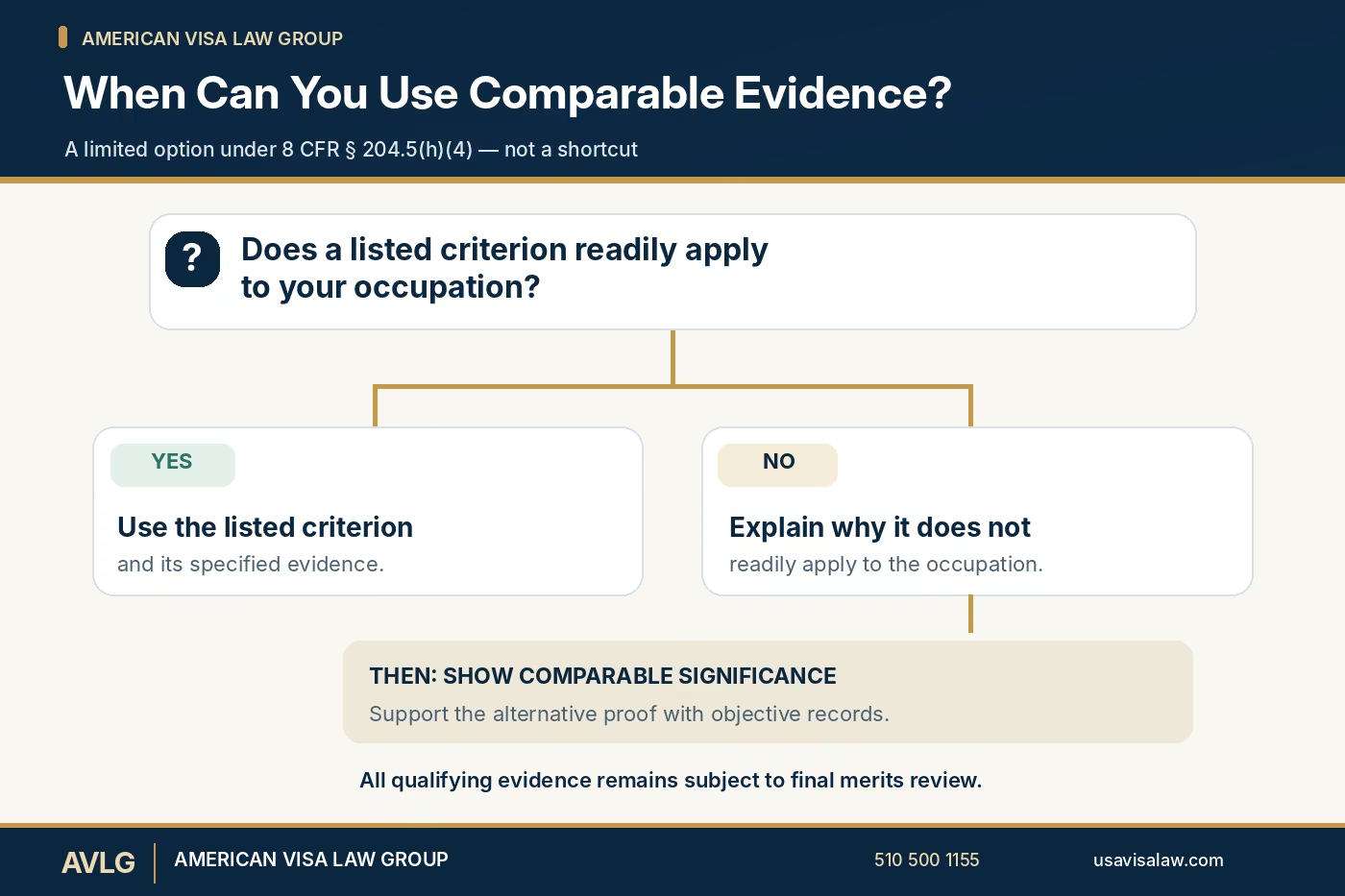
Where appropriate, USCIS may also consider comparable evidence when particular regulatory criteria do not readily apply to the applicant's occupation.
Once the initial evidentiary threshold is satisfied, USCIS conducts a final merits determination, evaluating the totality of the evidence under the applicable legal standard.
At this stage, officers assess whether the record establishes sustained national or international acclaim, recognition of the applicant's achievements within the field, and extraordinary ability consistent with having risen to the small percentage at the very top of that field.
Consider a researcher who establishes scholarly authorship, participation in peer review, and a qualifying leading role. Those accomplishments may satisfy three individual criteria. During final merits review, however, USCIS may examine the influence of the research, the professional significance of the judging responsibilities, and the importance of the leadership role within the broader record of recognition.
The analysis therefore goes beyond counting qualifying achievements. USCIS considers the quality, significance, and collective weight of the evidence, including whether the applicant's recognition has been sustained rather than limited to isolated accomplishments.
For a more detailed examination, see our guide to EB1A final merits determination, sustained acclaim, and RFE considerations.
A persuasive EB1A petition should address both stages from the outset, connecting the evidence supporting individual criteria to the broader legal standard for extraordinary ability.
USCIS allows applicants to submit comparable evidence for EB1A when one or more of the ten regulatory evidentiary criteria do not readily apply to their occupation. Under 8 CFR § 204.5(h)(4), this provision recognizes that extraordinary ability may be demonstrated differently across professional fields, particularly when conventional forms of recognition are not customary within a particular occupation.
However, comparable evidence is not simply an alternative for applicants who cannot satisfy a criterion. The petitioner must explain why the specific regulatory standard does not readily apply to their occupation and demonstrate that the proposed evidence is comparable in significance to the evidence ordinarily required.
For example, a technology professional whose work is primarily demonstrated through major industry presentations rather than scholarly publications may be able to submit evidence of presentations at significant trade shows, provided the circumstances justify using comparable evidence. Similarly, an entrepreneur whose compensation is primarily reflected in valuable equity holdings rather than a traditional salary may present evidence of those holdings when the high-salary criterion does not readily apply to their position.
The strength of a comparable evidence claim depends on establishing both its relevance and its significance. Supporting documentation should explain the professional context, why the conventional criterion is not readily applicable, and how the alternative evidence demonstrates a comparable level of achievement. Simply describing an accomplishment as exceptional does not establish that it satisfies the applicable standard.
The USCIS Policy Manual's guidance on comparable evidence emphasizes that this flexibility does not eliminate the requirement to demonstrate extraordinary ability. Comparable evidence must still contribute to satisfying the applicable evidentiary threshold, and the complete record remains subject to the final merits determination.
For applicants whose achievements fall outside traditional academic or professional recognition structures, carefully documented comparable evidence may provide an important way to demonstrate qualifying accomplishments without misrepresenting the regulatory requirements.
A strong EB1A evidence portfolio does more than demonstrate that an applicant satisfies three regulatory criteria. It presents a coherent record of professional achievements, independent recognition, and sustained impact that supports the broader extraordinary ability standard. The objective is not to submit the greatest possible number of documents, but to establish why the applicant's accomplishments are significant within their field.
The first step is to evaluate existing achievements against the ten EB1A criteria and identify which categories have the strongest documentary support. A researcher may have substantial evidence of scholarly authorship, judging activities, and original contributions, while an entrepreneur may have stronger evidence of a leading or critical role, significant business contributions, and high remuneration. The appropriate strategy depends on the individual's actual professional record, not assumptions about which criteria are easiest to satisfy.
Independent, verifiable evidence is particularly valuable when demonstrating professional significance. Awards should be supported by information about their selection standards and recognition. Original contributions may require documentation showing adoption, influence, or measurable impact beyond the applicant's immediate workplace. Leadership claims should establish the importance of the applicant's responsibilities and the distinguished reputation of the organization involved.
Expert recommendation letters can provide meaningful context, particularly when the significance of specialized work is difficult to understand from technical documents alone. However, generalized praise carries less evidentiary value than a detailed explanation identifying the applicant's contributions, their importance to the field, and the factual basis for the expert's conclusions. Whenever possible, these assessments should be supported by independent records.
Evidence organization also matters. Each claimed criterion should be supported by clearly identified exhibits, reliable dates, and explanations connecting the documentation to the applicable regulatory standard. Inconsistencies between employment records, publication dates, compensation documents, or professional accomplishments should be addressed rather than overlooked.
Applicants who are still developing their professional records may benefit from a longer-term strategy focused on genuine achievements and independently documented recognition. Our guide on how to build an EB-1A profile within one year explains how professionals can assess existing evidence, identify meaningful gaps, and strengthen their documentation over time.
Ultimately, the strongest EB1A petitions connect individual accomplishments to a consistent pattern of professional recognition. The evidence should explain not only what the applicant has achieved, but why those achievements demonstrate extraordinary ability and sustained acclaim within the field. This distinction is central to both satisfying the regulatory criteria and presenting a persuasive case during USCIS's final merits determination.
No. Applicants do not need to satisfy all ten EB1A criteria. Under 8 CFR § 204.5(h)(3), the evidentiary requirement can be met through a qualifying major internationally recognized one-time achievement or evidence satisfying at least three of the ten regulatory criteria. However, USCIS also evaluates the complete record to determine whether the applicant has demonstrated sustained national or international acclaim and extraordinary ability. Meeting the minimum evidentiary threshold does not guarantee approval.
Not necessarily. Satisfying three criteria allows an applicant to meet the initial evidentiary threshold, but USCIS must also conduct a final merits determination. This involves evaluating the significance of the applicant's achievements, the evidence of professional recognition, and whether the complete record demonstrates that the individual belongs to the small percentage at the very top of their field. An applicant may therefore satisfy three criteria without ultimately establishing eligibility for EB-1A classification.
Yes. Winning an award is not mandatory when an applicant can satisfy at least three other qualifying evidentiary criteria and demonstrate extraordinary ability through the complete record. For example, a researcher may present evidence of scholarly authorship, participation in judging others' work, and original contributions of major significance. The petition must establish the specific requirements of each claimed criterion and demonstrate sustained acclaim during the final merits review.
Software engineers may qualify through several EB1A criteria, depending on their professional achievements. Potential evidence includes documented technological contributions of major significance, judging technical work, qualifying professional publications, leading or critical roles for distinguished organizations, and significantly high remuneration relative to others in the field. Patents, open-source projects, and widely adopted technologies may also provide relevant supporting evidence, but their significance must be established. Employment at a well-known technology company or possessing advanced technical skills does not independently establish EB-1A eligibility.
USCIS does not establish a minimum citation count for EB1A eligibility. Citations may help demonstrate the influence of scholarly research, particularly when evaluating original contributions of major significance and the applicant's broader professional recognition. Their evidentiary weight depends on the field, publication history, citation context, and other relevant factors. A high citation count does not guarantee approval, while a relatively modest count does not automatically prevent eligibility. For further analysis, see our guide to how many citations are needed for EB1A.
Recommendation letters can provide important evidence, particularly when explaining original contributions, professional influence, or leading and critical responsibilities. However, their effectiveness depends on the writer's knowledge of the applicant's work, the specificity of the analysis, and the factual support provided. Detailed expert testimony may help establish the significance of specialized achievements, while independent documentation can strengthen the overall evidentiary record. Generic letters stating that an applicant is exceptional, without explaining why their achievements satisfy a particular standard, are generally less persuasive.
Yes, but only under specific circumstances. Under 8 CFR § 204.5(h)(4), comparable evidence may be submitted when one or more regulatory evidentiary criteria do not readily apply to the applicant's occupation. The petitioner must explain why the particular criterion is not readily applicable and establish how the alternative evidence is comparable to the required evidence. Comparable evidence is not a general substitute for weak documentation, and the complete petition remains subject to USCIS's final merits determination.
A successful EB1A petition requires more than demonstrating professional accomplishments or satisfying three evidentiary criteria. The evidence must establish how those achievements meet the applicable regulatory standards and, when considered together, demonstrate the sustained national or international acclaim required for extraordinary ability classification.
Before filing, applicants should carefully assess the strength of each claimed criterion, the reliability of supporting documentation, and whether their professional recognition extends beyond routine achievements within their occupation. Awards, publications, judging activities, original contributions, and leadership roles may provide valuable evidence, but their significance must be established within the context of the applicant's field.
The strongest EB1A strategy is built around credible, well-documented achievements rather than the number of criteria claimed. Identifying evidentiary weaknesses before submission can help applicants develop a clearer petition strategy and avoid relying on accomplishments that do not satisfy USCIS requirements.
At American Visa Law Group, our immigration attorneys assist professionals, researchers, entrepreneurs, and other accomplished individuals in evaluating eligibility and developing evidence-based EB-1A petition strategies.
If you are considering an extraordinary ability petition, request an EB-1A case evaluation with American Visa Law Group to better understand how your professional achievements may align with USCIS requirements.
This article provides general educational information and does not constitute individualized legal advice or establish an attorney-client relationship.
For a deeper understanding of EB1A eligibility, evidentiary requirements, and USCIS adjudication standards, the following authoritative resources provide additional legal and procedural guidance.
For additional guidance on preparing a persuasive EB1A petition, the following articles examine important aspects of the extraordinary ability classification.

Hasan Abdullah, Esq. is the Founder and Managing Attorney of American Visa Law Group. His practice focuses on U.S. immigration law, including family-based immigration, employment-based immigration, adjustment of status, consular processing, waivers, PERM labor certification, NIW, EB-1, H-1B, O-1, and complex immigration strategy.
Through American Visa Law Group, Mr. Abdullah helps individuals, families, professionals, investors, and employers understand their immigration options and plan around changing government policies, USCIS procedures, and Visa Bulletin movement. His work emphasizes practical legal analysis, realistic expectations, and strategy tailored to each applicant’s immigration history and long-term goals.


