Author: Hasan Abdullah, Esq.
Edited: September 9th, 2026
The “Einstein visa” is an informal nickname commonly used for the EB-1A extraordinary ability immigrant classification, a U.S. green card category for individuals who can demonstrate sustained national or international acclaim in their field. It has become especially well known because several prominent scientists, artists, athletes, entrepreneurs, and other high-achieving professionals have been publicly reported as recipients.
There is no complete official public list of Einstein visa recipients, so any reliable roundup must distinguish between confirmed public reporting and unsupported internet claims. This article focuses on publicly reported examples while also explaining what those cases can, and cannot, teach prospective applicants.
Importantly, EB-1A is not reserved for celebrities or Nobel Prize winners. Eligibility depends on the evidence and the legal standard, not name recognition alone. Applicants considering this category can review AVLG’s EB-1A extraordinary ability requirements and legal guidance for a deeper overview of the classification. (usavisalaw.com)
There is no complete official public list of Einstein visa recipients, because individual immigration files are not published as a searchable government directory. For that reason, a reliable list should focus on publicly reported EB-1 or EB-1A cases rather than repeat names that appear on unsourced websites.
One of the best-known publicly reported examples is Melania Trump, who was reported by The Washington Post to have received permanent residence in 2001 through the EB-1 extraordinary ability category. The newspaper’s reporting on her EB-1 “Einstein visa” case is one of the clearest publicly available sources documenting a high-profile use of the category. That distinction matters because the term “Einstein visa” is informal. In current immigration practice, it is generally associated with the USCIS EB-1 extraordinary ability classification, but EB-1 also includes separate classifications for outstanding professors and researchers and certain multinational managers and executives.
As we review famous examples, the important question is not whether an applicant is a celebrity. It is whether the evidence can satisfy the legal standard for extraordinary ability, sustained acclaim, and recognition at the top of the field.
The “Einstein visa” is an informal nickname for the EB-1A extraordinary ability immigrant classification. It is part of the employment-based first-preference, or EB-1, category and is intended for individuals who have demonstrated extraordinary ability in the sciences, arts, education, business, or athletics.
Under, an EB-1A applicant must show sustained national or international acclaim and that their achievements have been recognized in their field. The regulatory standard describes extraordinary ability as expertise indicating that the person is among the small percentage who have risen to the very top of the field. (USCIS)
Unlike many employment-based green card categories, EB-1A does not require a permanent job offer or PERM labor certification. A qualifying individual may file the immigrant petition on their own behalf, although they must intend to continue working in their area of extraordinary ability in the United States.
Applicants can qualify by showing a major internationally recognized award or, more commonly, by satisfying at least three of the specified evidentiary criteria and then demonstrating through the overall record that they meet the EB-1A standard. USCIS evaluates the evidence as a whole rather than treating three checked boxes as an automatic approval.
For a detailed breakdown of the category, see AVLG’s EB-1A extraordinary ability requirements and evidence guidance.
“Einstein visa” is a popular nickname, not an official USCIS visa category. The name reflects the category’s demanding extraordinary-ability standard, but applicants do not need to be world-famous scientists, or resemble Albert Einstein’s career, to qualify. Eligibility depends on the individual’s field, accomplishments, and supporting evidence.
Yes. In modern U.S. immigration discussions, the term “Einstein visa” generally refers to the EB-1A extraordinary ability classification. “Einstein visa” is only a nickname; EB-1A is the actual immigration classification used by USCIS.
EB-1A is one part of the broader employment-based first-preference category. The USCIS EB-1 classification includes three distinct paths: extraordinary ability, outstanding professors and researchers, and certain multinational managers or executives. (USCIS)
The nickname “Einstein visa” is most closely associated with EB-1A, not with every person who receives permanent residence through the broader EB-1 category.
That distinction is especially important when reviewing lists of famous recipients. A public source may report that someone received an EB-1 green card without clearly establishing whether the case was specifically EB-1A, EB-1B, or EB-1C. For this reason, claims about famous Einstein visa recipients should be based on credible reporting that identifies the underlying classification rather than assuming every high-achieving EB-1 recipient had an EB-1A case.
No. There is no complete official public list of Einstein visa recipients or EB-1A green card holders.
USCIS maintains individual immigration records, including A-Files and benefit-request records, but those records are not published as a searchable public directory of EB-1A recipients. USCIS privacy materials explain that immigration records are maintained in agency systems tied to individual cases and identifiers rather than released as a public recipient database. (USCIS)
That means lists of famous “Einstein visa” recipients should be treated carefully. Some individuals have publicly discussed their immigration histories, while others have been identified through credible reporting, biographies, interviews, court records, or other public sources. In many cases, however, online lists repeat claims without clearly documenting whether the person actually received EB-1A, another EB-1 classification, or a different immigration benefit.
For this reason, the most accurate terminology is:
rather than implying that a list is complete or officially confirmed by USCIS.
The examples below should be included only where there is credible public reporting or another reliable source identifying the person’s immigration category.
Where a source reports only that someone received an EB-1 green card, without confirming the specific EB-1A classification, that distinction should be stated rather than assumed.
This approach protects the accuracy of the article while still answering what readers searching for a list of Einstein visa recipients actually want to know.
There is no complete public USCIS database identifying every EB-1A recipient. The examples below are based on credible public reporting about individuals associated with the EB-1 extraordinary ability category. Where a source identifies only the broader EB-1 category rather than EB-1A specifically, that distinction should be preserved.
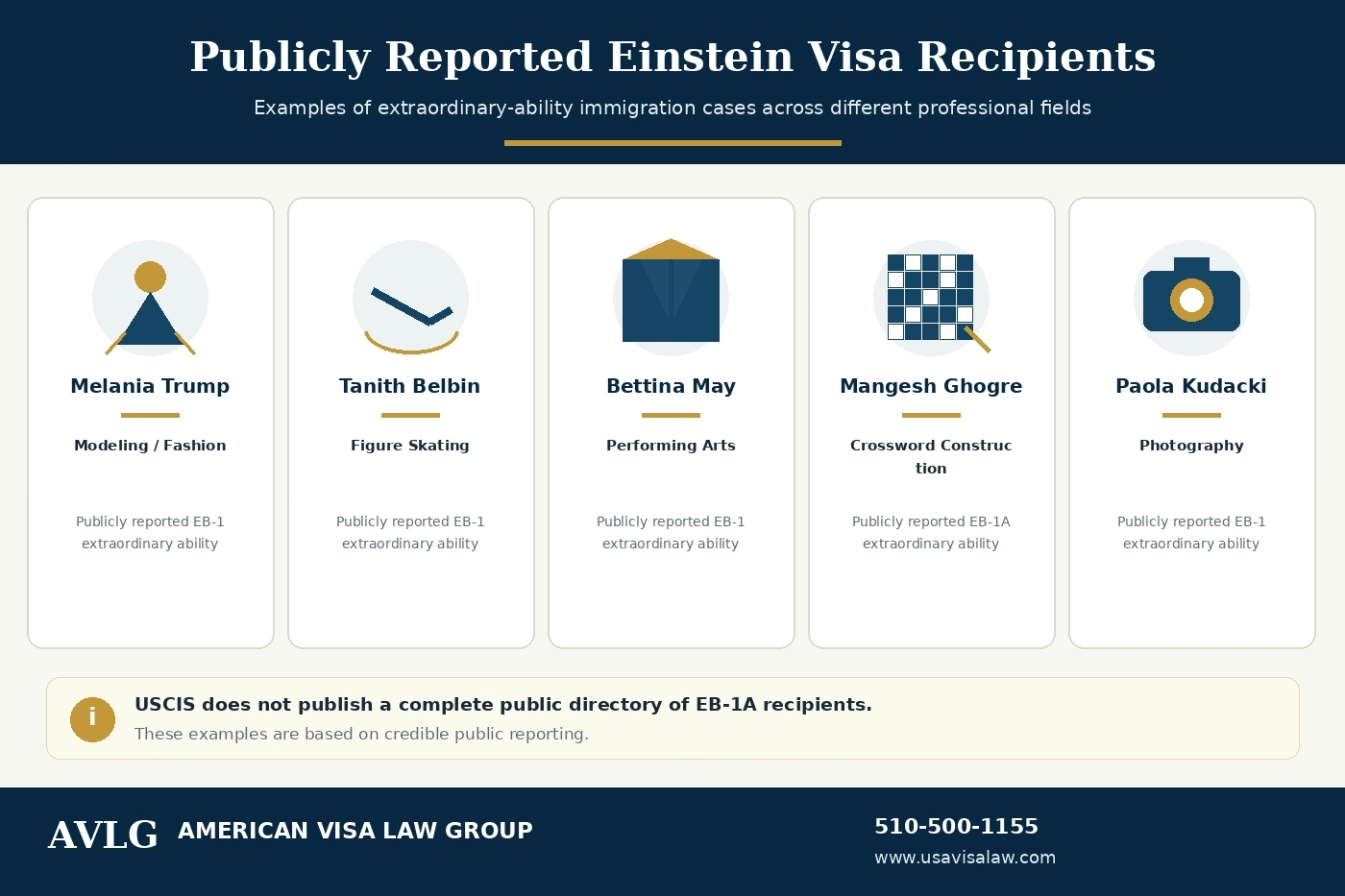
Melania Trump is one of the most widely reported recipients associated with the so-called Einstein visa. The Washington Post reported that she received permanent residence in 2001 through the EB-1 extraordinary ability category while working as a model.
Her case is frequently discussed because it illustrates an important point: extraordinary ability is not limited to scientists or academics. The EB-1A category can apply across the sciences, arts, education, business, and athletics.
Olympic ice dancer Tanith Belbin was publicly reported as receiving an EB-1 visa based on extraordinary ability. Reporting about Belbin’s immigration history described her EB-1 approval before she later became a U.S. citizen.
Her case illustrates how elite athletic achievement and recognition can potentially support an extraordinary-ability immigration case.
Performer and photographer Bettina May has publicly discussed obtaining extraordinary-ability immigration status. In an interview about her immigration experience, May described moving from O-1 status to an EB-1 extraordinary ability green card.
Her example shows that EB-1A is not limited to traditional academic or scientific fields. Artists and performers may rely on different types of evidence, including media recognition, distinguished engagements, and professional acclaim.
Crossword constructor Mangesh Ghogre provides one of the more unusual publicly reported EB-1A examples. The New Yorker reported that Ghogre obtained U.S. permanent residence through an EB-1A “Einstein” visa based on his work in crossword construction.
His case demonstrates that extraordinary ability can exist within a highly specialized field. An applicant does not need to work in a conventional STEM profession or be a household name.
Photographer Paola Kudacki has also been publicly associated with an EB-1 extraordinary-ability case. A published case description concerning her EB-1 approval as a photographer referenced her work with major publications, brands, and prominent subjects.
Her example illustrates how recognition, high-profile work, distinguished clients, and professional reputation may contribute to an extraordinary-ability record in a creative field.
These cases show that extraordinary ability can be demonstrated across very different professions. But famous recipients should be treated as examples, not approval templates.
The better question is not whether an applicant is as famous as someone on this list. It is whether their own evidence can satisfy the EB-1A legal requirements and USCIS’s overall extraordinary-ability standard.
Famous Einstein visa recipients are useful examples, but they should not be treated as templates for approval. USCIS does not decide EB-1A cases by asking whether an applicant resembles a celebrity, athlete, scientist, or entrepreneur who previously qualified. The focus is on the applicant’s own evidence and whether it demonstrates the level of extraordinary ability required by the category.
One lesson from publicly reported cases is that EB-1A can apply across very different fields. The USCIS EB-1 extraordinary ability classification covers the sciences, arts, education, business, and athletics. That means the strongest evidence will often look different depending on the profession.
For example:
What matters is not simply collecting impressive achievements. USCIS evaluates whether the evidence satisfies the applicable criteria and whether the record as a whole demonstrates sustained acclaim and recognition at the top of the field.
Applicants should therefore use famous EB-1A cases for context, not comparison. The better question is whether their own record can satisfy the EB-1A extraordinary ability requirements with strong, well-documented evidence.
No. You do not have to be famous to qualify for an Einstein visa, or EB-1A. Celebrity status is not one of the legal requirements.
USCIS focuses instead on whether the applicant can show sustained national or international acclaim and recognition placing them among the small percentage who have risen to the top of their field. The official USCIS Policy Manual on extraordinary ability explains how officers evaluate both the initial evidence and the record as a whole. (USCIS)
An applicant may qualify by showing either a major internationally recognized award or, more commonly, evidence satisfying at least three of the regulatory criteria. But meeting three criteria is only the first part of the analysis. USCIS then considers whether the totality of the evidence actually demonstrates the required level of extraordinary ability and sustained acclaim. (USCIS)
Public recognition can be helpful evidence, but fame and EB-1A eligibility are not the same thing.
A researcher may have strong citation impact and original contributions without being publicly famous. An entrepreneur may be recognized within a specialized industry rather than by the general public. An artist or athlete may have significant acclaim within a professional field without being a household name.
That is why prospective applicants should focus less on whether they resemble famous Einstein visa recipients and more on whether their evidence can satisfy the EB-1A extraordinary ability standard.
The next step is understanding the specific EB-1A criteria USCIS uses to evaluate that evidence.
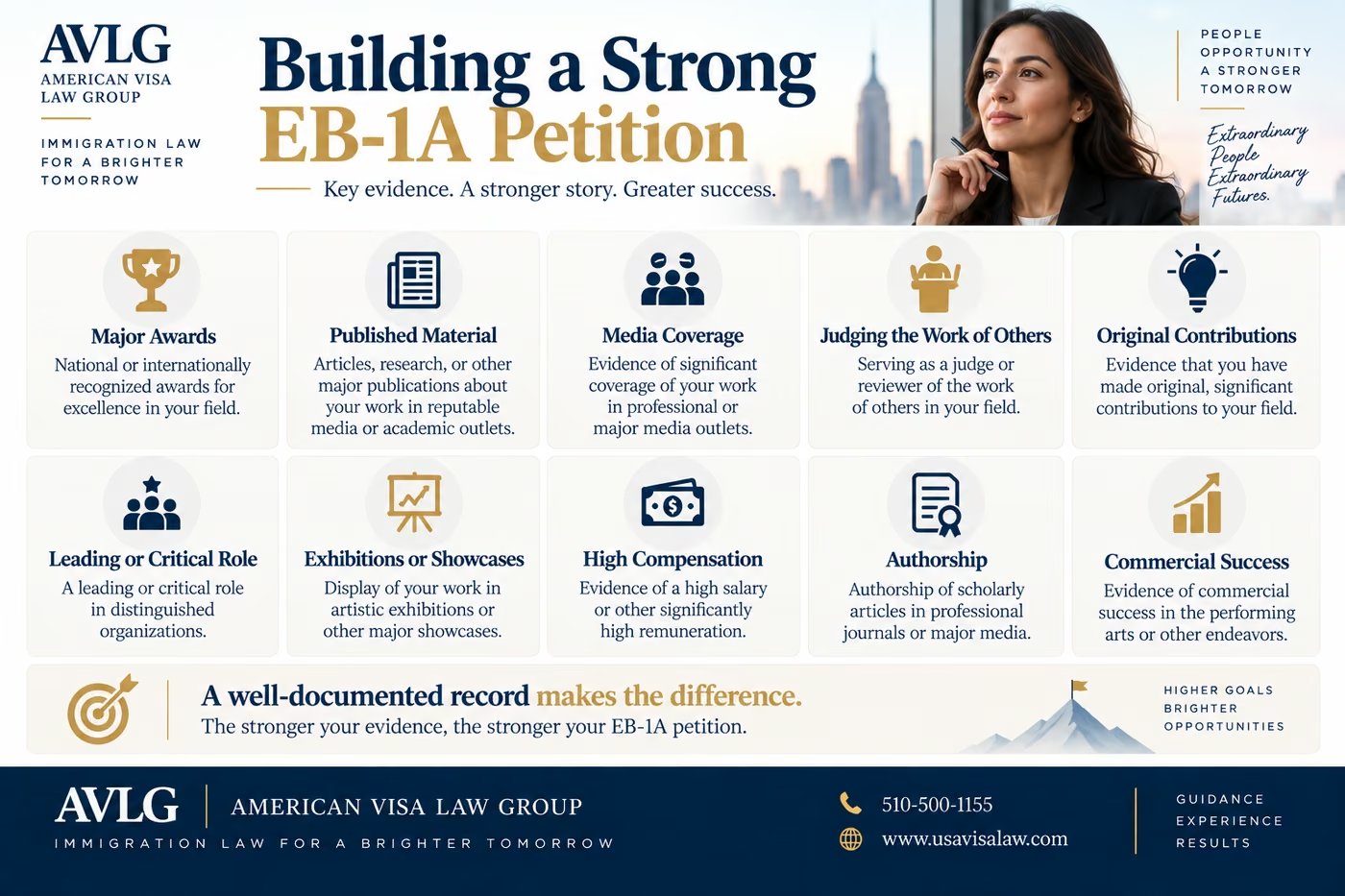
Most Einstein visa applicants qualify by showing evidence that meets at least three of the 10 EB-1A regulatory criteria. USCIS then evaluates the record as a whole to determine whether the applicant has demonstrated sustained national or international acclaim and recognition at the top of the field.
The USCIS Policy Manual on extraordinary ability explains how officers evaluate each type of evidence and the overall merits of an EB-1A petition. USCIS has also clarified that qualifying evidence can vary depending on the applicant’s profession and circumstances. (USCIS)
Applicants who cannot readily use one of the listed criteria may, in certain circumstances, submit comparable evidence if a particular criterion does not readily apply to their occupation.
Importantly, satisfying three criteria does not automatically result in EB-1A approval. The evidence must first meet the specific regulatory requirements, and USCIS then considers whether the petition as a whole demonstrates the level of acclaim required for extraordinary ability.
For example, having published articles does not necessarily establish extraordinary ability by itself. Likewise, serving as a judge, receiving an award, or holding a senior position may satisfy a criterion only if the supporting evidence meets the applicable legal standard.
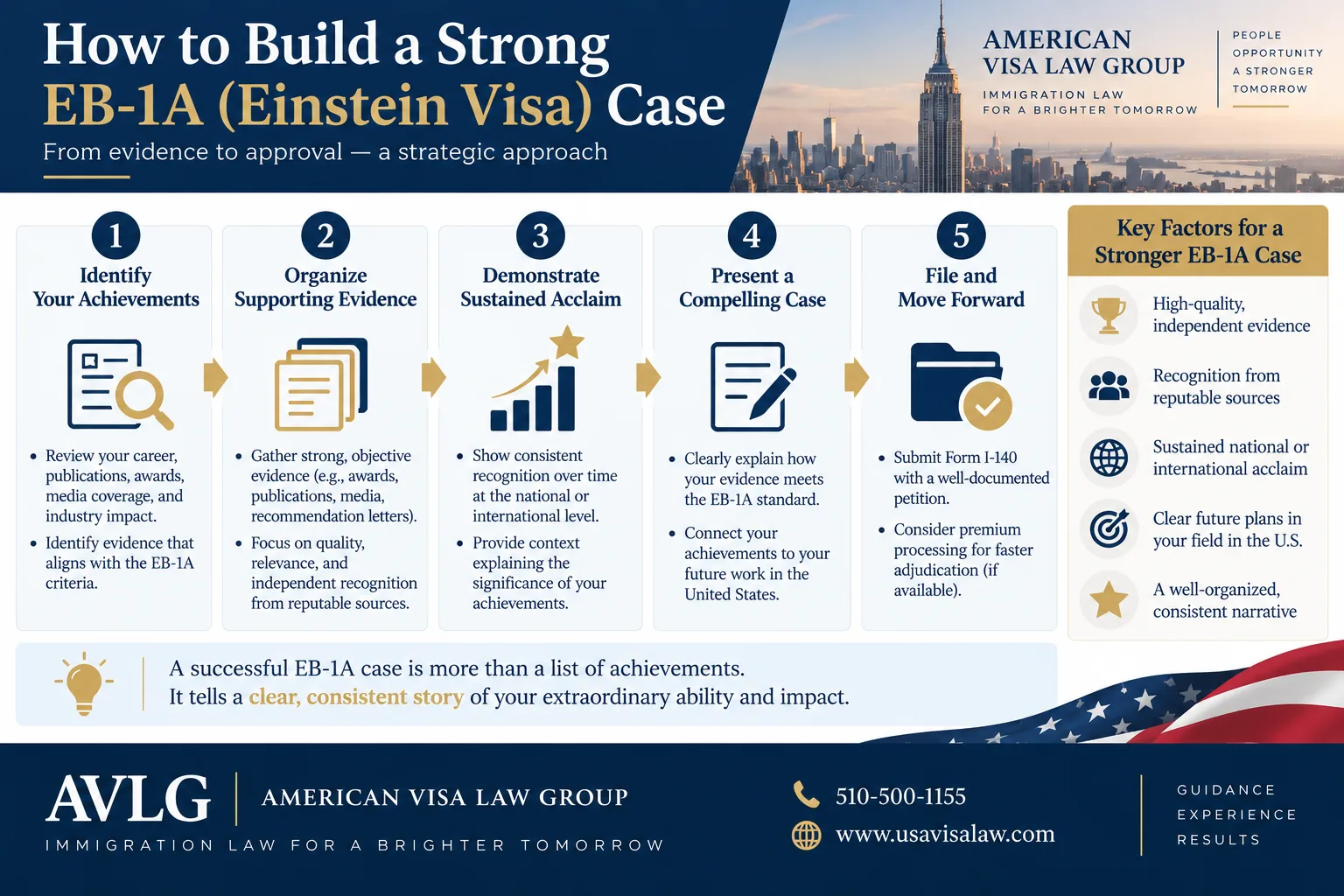
Applicants building a petition should therefore focus on the quality, significance, and context of the evidence, not simply on accumulating as many criteria as possible. AVLG’s EB-1A extraordinary ability guidance provides a broader overview of how these requirements fit into the overall petition strategy.
Meeting at least three of the EB-1A evidentiary criteria is important, but it does not automatically mean USCIS will approve the petition.
USCIS uses a two-step analysis for extraordinary ability cases. First, the officer determines whether the applicant has submitted evidence of a major internationally recognized award or satisfies at least three of the regulatory criteria. If that threshold is met, USCIS then conducts a final merits determination and evaluates the record as a whole. The USCIS Policy Manual on extraordinary ability explains this broader review. (USCIS)
At the final merits stage, USCIS looks at whether the evidence actually demonstrates:
That means an applicant could technically satisfy three criteria and still fall short if the evidence is weak, routine, poorly documented, or does not show the required level of distinction.
For example, serving as a judge, appearing in media, or holding a leading role may help satisfy individual criteria, but USCIS still considers the quality, significance, and context of that evidence in the overall record.
This is why strong EB-1A cases should be built around the total evidentiary picture, not simply around checking three boxes. Applicants should focus on how the evidence works together to demonstrate extraordinary ability under the EB-1A legal standard.
No. You do not need a Nobel Prize, or another single world-famous award, to qualify for the Einstein visa, or EB-1A.
USCIS allows two principal ways to establish the initial evidentiary threshold. An applicant may present evidence of a one-time achievement, such as a major internationally recognized award, or more commonly, show that they satisfy at least three of the EB-1A regulatory criteria.
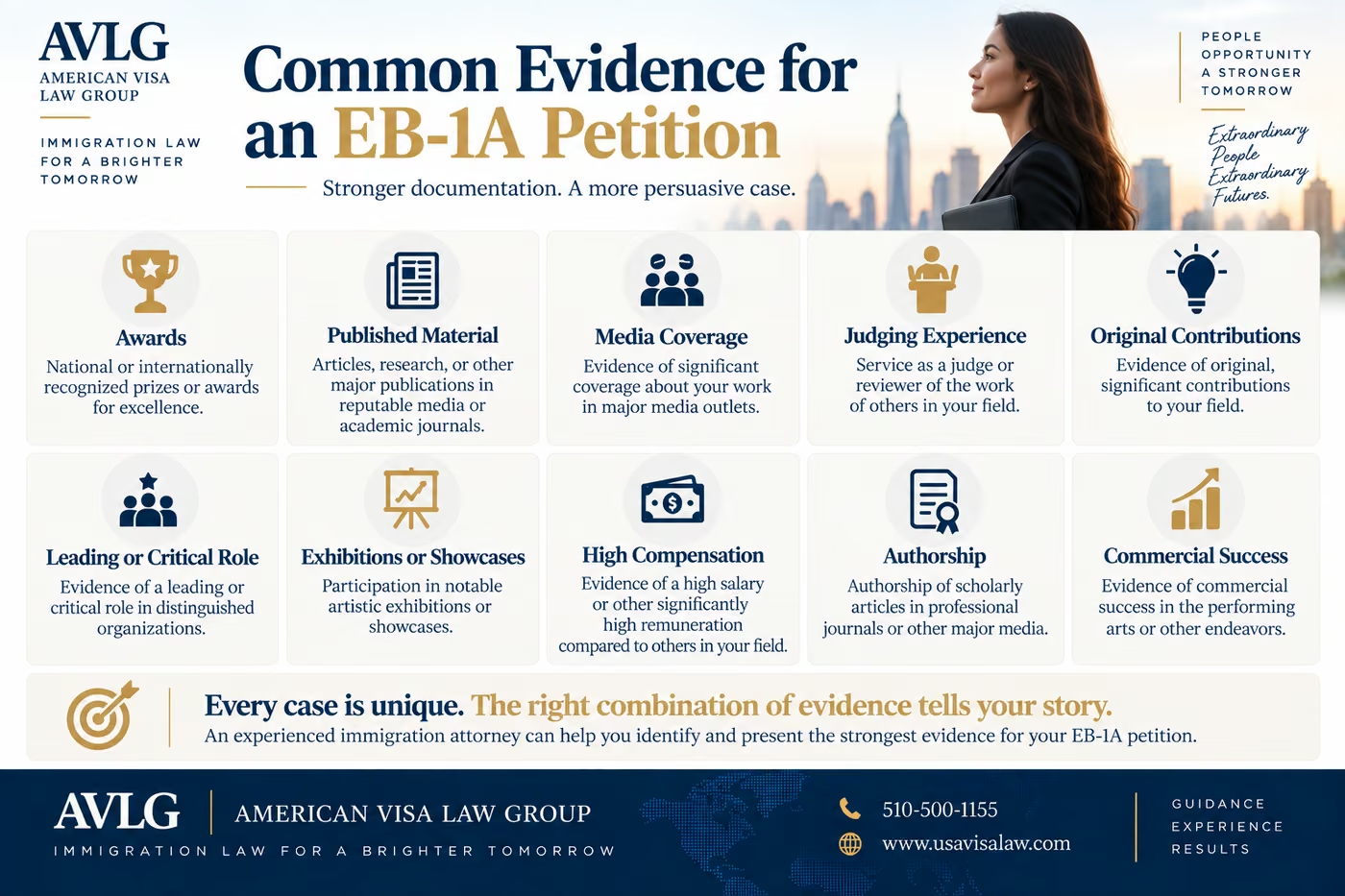
The USCIS Policy Manual on extraordinary ability explains that applicants without a qualifying one-time achievement may rely on evidence such as recognized awards, published material, judging the work of others, original contributions, scholarly authorship, leading or critical roles, high remuneration, or other applicable criteria.
A Nobel Prize is therefore one possible example of extraordinary recognition, not a requirement.
In practice, many EB-1A applicants build their cases through a combination of achievements rather than one defining award. A researcher might rely on influential publications, citations, peer review, and original contributions, while an entrepreneur or artist may present a very different evidentiary record.
The key question is not whether an applicant has won a famous prize. It is whether the evidence, taken together, demonstrates the level of sustained acclaim and extraordinary ability required by USCIS.
Yes. EB-1A is not limited to one type of profession. USCIS recognizes extraordinary ability in the sciences, arts, education, business, and athletics, so the strongest evidence can look very different from one field to another.
The USCIS EB-1 extraordinary ability guidance makes clear that applicants are evaluated based on achievements and recognition within their own field.
For example:
These are examples of potentially relevant evidence, not automatic paths to approval.
A researcher with thousands of citations is not evaluated in exactly the same way as a fashion photographer, founder, or professional athlete. USCIS considers whether the evidence is meaningful within the applicant’s particular field and whether the record as a whole demonstrates sustained acclaim and recognition at the required level.
That is why applicants should focus on the strength and significance of their own record, rather than trying to copy the evidence used by a famous Einstein visa recipient.
For a broader breakdown of possible evidence, see AVLG’s EB-1A extraordinary ability guidance.
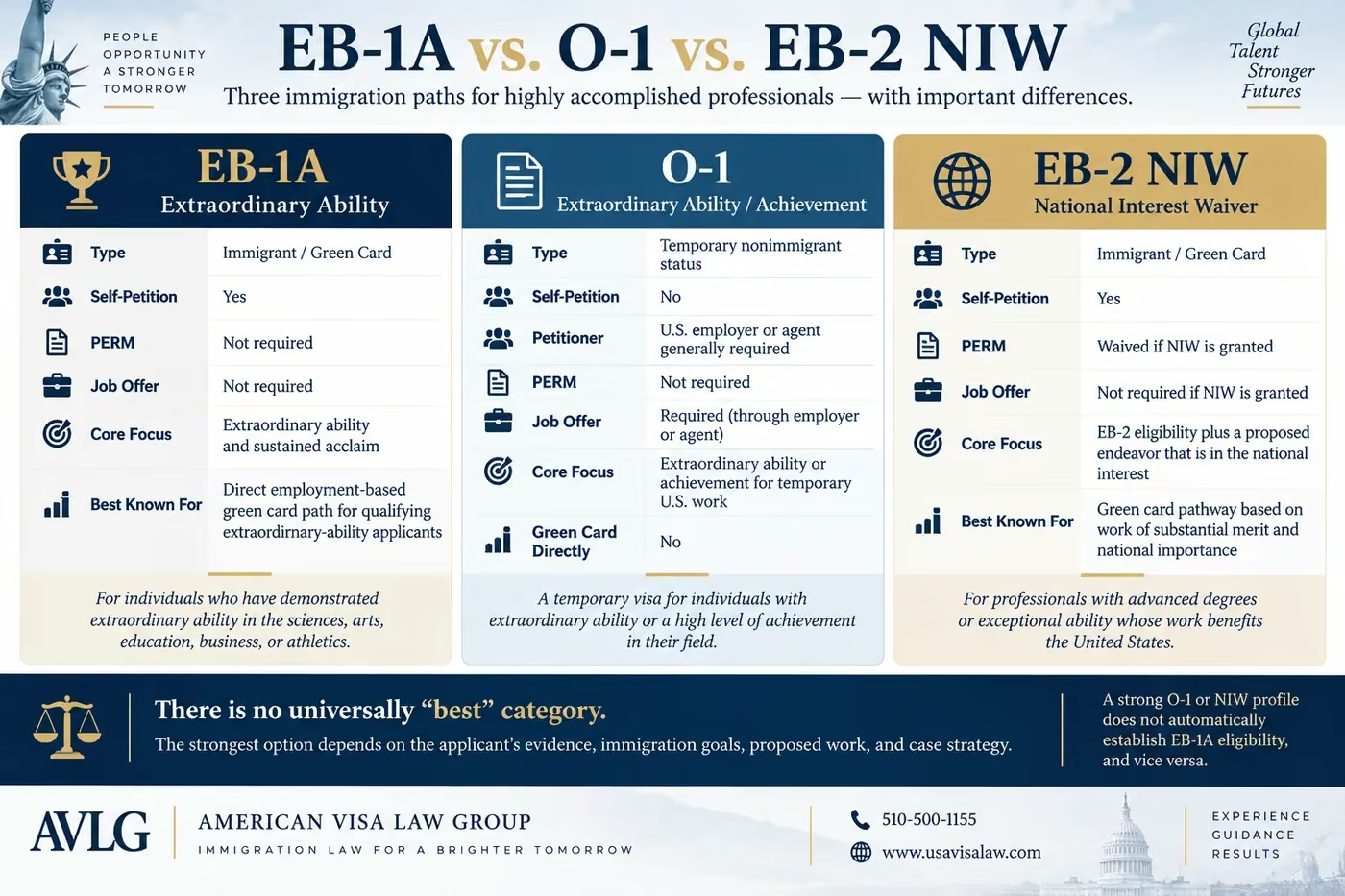
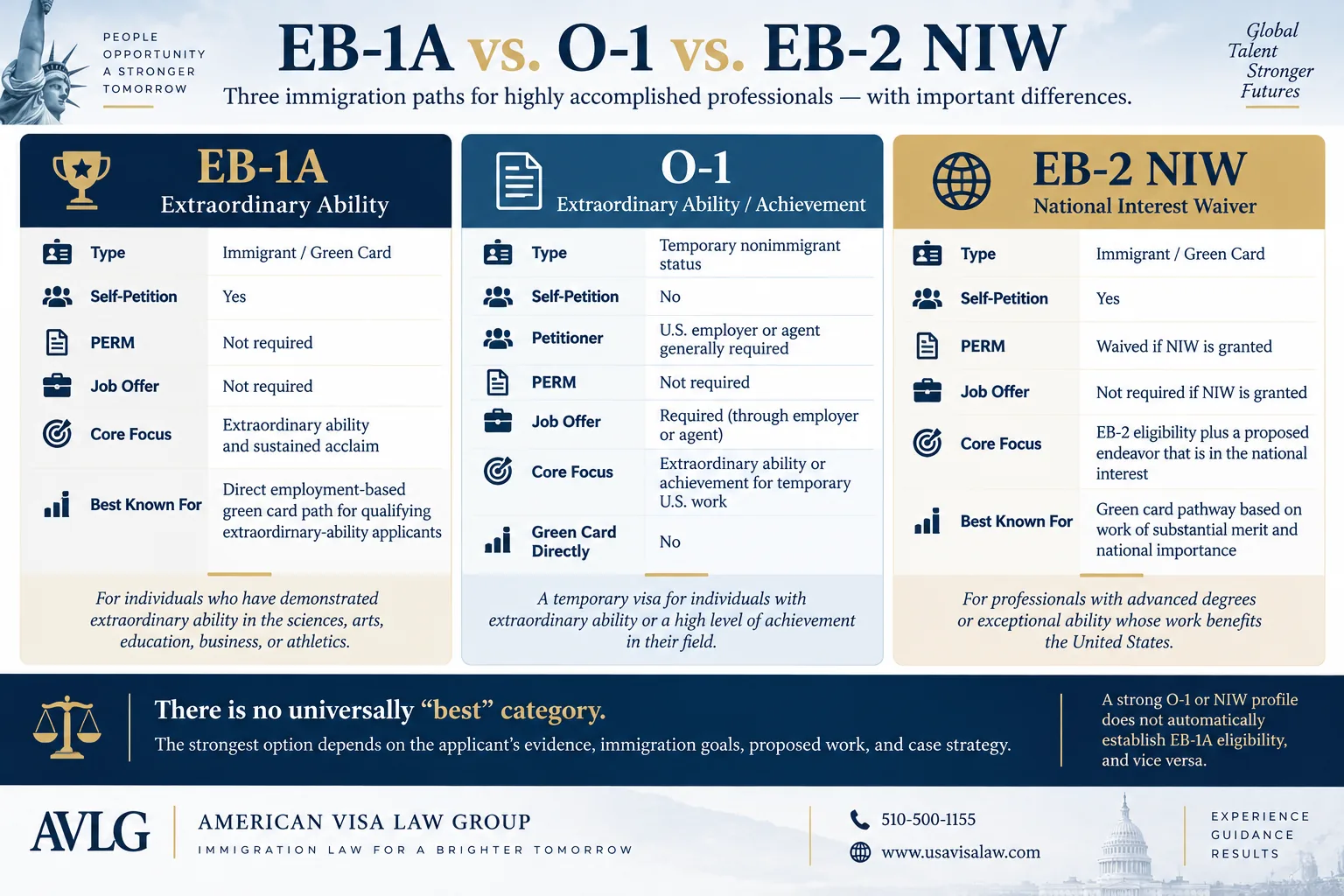
Applicants considering the Einstein visa often also evaluate the O-1 visa or EB-2 National Interest Waiver. All three can serve highly accomplished professionals, but they are different immigration classifications with different standards and purposes.
EB-1A is an immigrant classification for individuals with extraordinary ability. A qualifying applicant may self-petition without a permanent job offer or PERM labor certification. The USCIS EB-1 extraordinary ability guidance explains the evidentiary requirements and extraordinary-ability standard.
The O-1 visa is temporary rather than a direct green card category. It is available to qualifying individuals with extraordinary ability or achievement who are coming to the United States to work in their area of expertise. A U.S. employer or agent must generally file the petition on the beneficiary’s behalf under the USCIS O-1 classification rules. (USCIS)
The EB-2 National Interest Waiver is another employment-based green card path that can permit self-petitioning. Before USCIS reaches the NIW analysis, however, the applicant must first qualify for the underlying EB-2 category as an advanced-degree professional or person of exceptional ability. USCIS may then waive the job-offer and labor-certification requirements if the applicant satisfies the National Interest Waiver framework. (USCIS)
The best option depends on the applicant’s evidence, immigration goals, proposed work, and whether they are seeking temporary status or permanent residence. A strong O-1 or NIW profile does not automatically establish EB-1A eligibility, and the reverse is also true.
A list of Einstein visa recipients can show the range of fields and accomplishments associated with extraordinary ability, but it should not be used as a checklist for whether another applicant will qualify.
Publicly reported recipients may include athletes, artists, researchers, entrepreneurs, and other highly accomplished professionals. Their careers can help illustrate the breadth of the EB-1A extraordinary ability classification, but USCIS evaluates each petition on its own evidence.
The more useful question is not:
“Am I as famous as this recipient?”
Instead, applicants should ask whether their own record can demonstrate:
This distinction matters because two people in the same profession may have very different evidence. One researcher may rely heavily on citations and peer review, while another may have major awards, original contributions, and a critical role at a distinguished institution.
Famous cases are therefore best viewed as examples of what extraordinary careers can look like, not templates for approval.
Applicants who want to understand how their own accomplishments fit the category can review AVLG’s EB-1A extraordinary ability requirements rather than relying on comparisons with publicly known recipients.
An EB-1A case review can be useful when an applicant has a strong professional record but is unsure whether the evidence is sufficient to meet the extraordinary ability standard.
A review may be especially worthwhile if you have several of the following:
The USCIS Policy Manual on extraordinary ability makes clear that officers do not evaluate EB-1A petitions by simply counting criteria. USCIS also considers whether the record as a whole demonstrates sustained acclaim and recognition at the top of the field.
That is why case strategy can matter as much as the quantity of evidence. An applicant may have an impressive résumé but still need to show why the achievements are significant within the field and how the evidence supports the broader EB-1A standard.
Applicants evaluating whether EB-1A is realistic can review AVLG’s EB-1A extraordinary ability legal services for additional guidance on eligibility, evidence, and petition strategy.
The “Einstein visa” is an informal name commonly used for the EB-1A extraordinary ability immigrant classification.
There is no complete official public list of every EB-1A recipient, so famous examples should be described as publicly reported recipients when reliable sourcing exists.
The most important points for prospective applicants are:
For applicants considering the category, the better question is not “Am I famous enough?” but whether the evidence can demonstrate sustained acclaim and recognition at the top of the field under the EB-1A extraordinary ability standard.
The “Einstein visa” is an informal nickname commonly used for the EB-1A extraordinary ability immigrant classification. It is a green card category for individuals who can demonstrate extraordinary ability in the sciences, arts, education, business, or athletics. The official USCIS EB-1 guidance explains the requirements for extraordinary ability cases.
Generally, yes. In current immigration discussions, “Einstein visa” usually refers to EB-1A, although the term itself is not an official USCIS classification. EB-1A is one of three categories within the broader EB-1 employment-based first-preference classification.
There is no complete official public list of EB-1A recipients. Some individuals have been identified through credible media reports, interviews, biographies, or public case descriptions. Well-known publicly reported examples include Melania Trump, Tanith Belbin, Bettina May, Mangesh Ghogre, and Paola Kudacki, although the level of public documentation varies by case.
No. USCIS does not publish a searchable public directory containing every EB-1A recipient. For that reason, lists of Einstein visa recipients should rely on credible public reporting and clearly distinguish between confirmed EB-1A cases and broader EB-1 claims.
No. Fame is not an EB-1A requirement. USCIS focuses on whether the evidence demonstrates sustained national or international acclaim and recognition at the top of the applicant’s field. A researcher, entrepreneur, artist, athlete, physician, or other professional may potentially qualify without being widely known to the general public.
An applicant may qualify through a major internationally recognized award or, more commonly, by satisfying at least three of the EB-1A regulatory criteria. USCIS then evaluates the record as a whole. The USCIS Policy Manual on extraordinary ability explains this two-step analysis.
No. A Nobel Prize is one example of a major internationally recognized award, but it is not required. Many applicants qualify by presenting a combination of evidence such as awards, published material, judging, original contributions, scholarly authorship, leading roles, high remuneration, or other qualifying evidence.
Yes. EB-1A permits self-petitioning, so a permanent job offer and PERM labor certification are not required. However, the applicant must still demonstrate that they meet the extraordinary ability standard and intend to continue working in their area of expertise in the United States. Applicants evaluating this path can review AVLG’s EB-1A extraordinary ability guidance.
For official guidance on the Einstein visa, EB-1A eligibility, extraordinary ability evidence, and employment-based green cards, these resources are especially useful:

Hasan Abdullah, Esq. is the Founder and Managing Attorney of American Visa Law Group. His practice focuses on U.S. immigration law, including family-based immigration, employment-based immigration, adjustment of status, consular processing, waivers, PERM labor certification, NIW, EB-1, H-1B, O-1, and complex immigration strategy.
Through American Visa Law Group, Mr. Abdullah helps individuals, families, professionals, investors, and employers understand their immigration options and plan around changing government policies, USCIS procedures, and Visa Bulletin movement. His work emphasizes practical legal analysis, realistic expectations, and strategy tailored to each applicant’s immigration history and long-term goals.


