Author: Hasan Abdullah, Esq.
Updated: August , 2026
Seeing “Case Is Being Actively Reviewed by USCIS” in your online account can feel encour go aging, but it can also raise immediate questions about what USCIS is actually doing and how close your case may be to a decision.
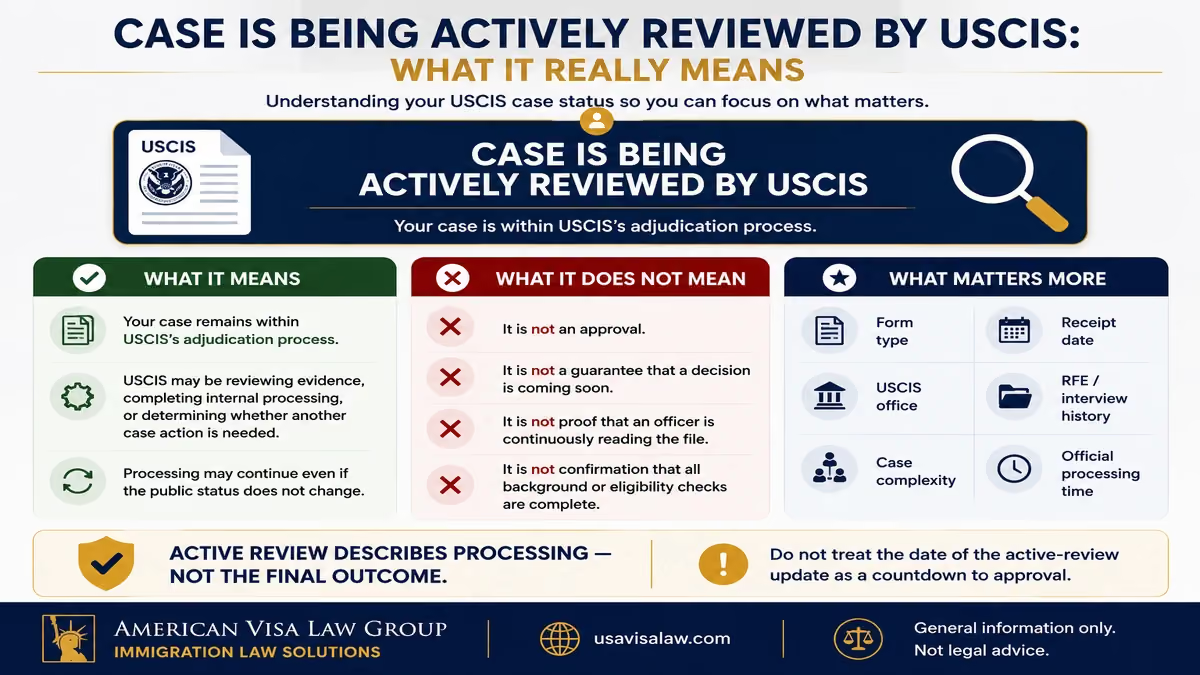
In general, this status means your application or petition is within USCIS’s review or adjudication process. It does not mean your case has been approved, that a decision is imminent, or that an immigration officer is continuously reviewing the file every moment the status appears.
The message can appear in many types of immigration cases, including family petitions, adjustment of status applications, employment-based petitions, and naturalization matters. The next step depends on the specific case and may involve continued review, approval, an interview, a Request for Evidence, or another USCIS action.
American Visa Law Group assists individuals, families, professionals, and employers with a range of USCIS immigration matters.
This guide explains what active review means, how long it may last, what can happen next, and when contacting USCIS or seeking individualized legal guidance may be appropriate.
“Case Is Being Actively Reviewed by USCIS” generally means USCIS is processing your application or petition within its adjudication workflow. It is not a guarantee of approval or a prediction that a decision will arrive soon. Depending on the case, the next update could be approval, an RFE, an interview notice, continued review, or another case action.
When USCIS displays “Case Is Being Actively Reviewed by USCIS,” it generally means the application or petition is within the agency’s review and adjudication process. USCIS may be evaluating the information already submitted, completing internal processing, or determining whether another action is necessary before reaching a decision.
However, the status provides only a limited view of what is happening inside USCIS. The agency’s Case Status Online tool is designed to provide updates on a pending application, petition, or request; it is not a real-time activity log showing every action taken on a case.
Depending on the type and stage of the filing, USCIS may still need to review supporting evidence, complete background or security checks, evaluate eligibility, schedule an interview, request additional evidence, or complete other adjudication steps.
Not necessarily.
The wording should not be interpreted to mean that an immigration officer is continuously reading the file while the status remains displayed.
A case can remain under active review for an extended period while USCIS completes different parts of the adjudication process. The online message may remain unchanged even while internal activity occurs.
For that reason, the status itself cannot reliably tell an applicant how close the case is to a final decision.
It is generally reasonable to view active review as an indication that the case is moving through USCIS processing, but the status is neutral regarding the eventual outcome.
It does not by itself mean that:
The important distinction is between case movement and case outcome. Active review tells you something about the processing stage, but it does not predict the final decision.
The more useful question for many applicants is therefore not whether active review is “good” or “bad,” but how long the status can reasonably remain unchanged before additional action may be appropriate.
There is no fixed USCIS timeline for how long a case will remain under active review. The status may remain unchanged for days, weeks, or longer depending on the type of application or petition and the circumstances of the individual case.
More importantly, the date when the status changed to “actively reviewed” should not be treated as a countdown to approval. USCIS processing times are generally measured from the filing or receipt date—not from the date an online status message appears.
Factors that can affect the overall timeline include:
USCIS publishes official case processing times by form, category, and office where applicable. Those estimates provide more useful context than the amount of time the online account has displayed “actively reviewed.”
Two applicants can have the same form and the same online status but receive decisions at very different times.
Online forums and case-tracking communities may be useful for understanding other applicants’ experiences, but another person receiving approval three days after active review does not mean your case should follow the same timeline.
USCIS processing data looks at completed cases across particular workloads rather than predicting the decision date of an individual filing. The agency also uses a case inquiry date to help determine when a pending case may be taking longer than expected.
If your receipt date has passed the point at which USCIS permits an inquiry, you may be able to submit a case inquiry through USCIS.
The key distinction is therefore between how long the active-review message has appeared and how long the case itself has been pending. For most applicants, the overall USCIS processing time is the more meaningful measure.
The next question is what USCIS may actually do once a case is under review, and which status updates can come next.
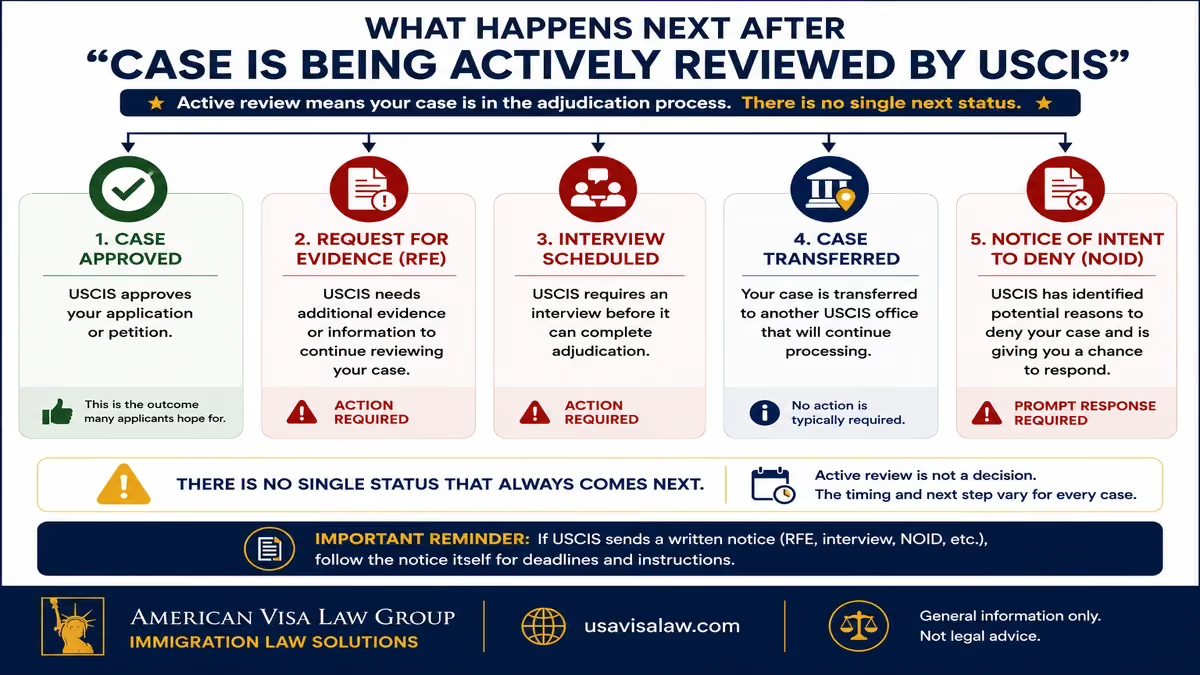
There is no single status that always comes after “Case Is Being Actively Reviewed by USCIS.” The next update depends on the type of application or petition, the evidence already submitted, and whether USCIS needs anything else before making a decision.
Possible next developments include:
Applicants should therefore avoid assuming that active review automatically means an approval notice will appear next. The status tells you that the case remains within USCIS processing, but it does not disclose the final outcome.
Yes. USCIS can issue a Request for Evidence, commonly called an RFE, after a case enters active review if the officer determines that additional evidence is needed to establish eligibility.
An RFE is not the same as a denial. It identifies specific information or documentation USCIS believes is missing or insufficient and provides a deadline for responding.
If USCIS issues an RFE, the applicant or petitioner should follow the notice itself rather than relying only on the online status. The response should address the requested evidence within the stated deadline.
Some applicants see “Case Is Being Actively Reviewed by USCIS” more than once, sometimes with a new update date.
A second active-review update may reflect additional internal case activity, for example, review following biometrics, an interview, an RFE response, a transfer, or another adjudication step. However, the online message alone generally does not reveal exactly what occurred internally.
Most importantly, a second active-review update is not a reliable prediction of approval or denial.
Applicants can continue monitoring their case through USCIS Case Status Online and their USCIS online account, where available. The meaning of active review can also vary somewhat depending on which immigration form USCIS is adjudicating, which is why an I-130, I-485, H-1B petition, and N-400 should not all be interpreted identically.
The meaning of “Case Is Being Actively Reviewed by USCIS” is broadly similar across case types: the filing remains within USCIS’s adjudication process. However, what USCIS may be evaluating depends heavily on the form and immigration benefit involved.
The status itself does not identify a particular concern or confirm that every part of the case has already been reviewed.
.avif)
For a Form I-130, active review may involve determining whether the petitioner qualifies to file and whether the evidence establishes the required family relationship.
In a marriage-based petition, for example, USCIS may review marriage records, prior marital history, and evidence relevant to whether the marriage qualifies under immigration law. An active-review status by itself does not indicate that USCIS has found a problem with the relationship.
For Form I-485, USCIS may need to evaluate several issues before granting permanent residence, including the applicant’s underlying eligibility, admissibility, immigration history, required documentation, and applicable background checks.
Depending on the case, USCIS may also need to determine whether an interview is required and, in preference categories, whether an immigrant visa is available.
Active review therefore should not be interpreted as confirmation that a green card is about to be approved.
Form I-129 covers several employment-based nonimmigrant classifications, including H-1B.
For an H-1B petition, review may involve the petitioning employer, specialty-occupation position, Labor Condition Application, beneficiary’s qualifications, wage and employment arrangement, and other classification-specific requirements.
Employers dealing with an H-1B filing can review AVLG’s H-1B visa requirements and petition process for a more detailed discussion of those requirements.
For Form I-140, the issues under review depend on the employment-based immigrant category.
USCIS may be examining the beneficiary’s qualifications, the requirements of the requested classification, employer evidence where applicable, or category-specific evidence for petitions such as EB-1 or EB-2 National Interest Waiver cases.
An active-review update does not indicate whether USCIS has accepted any particular piece of evidence or whether an RFE will be necessary.
For Form N-400, USCIS evaluates whether the applicant satisfies the requirements for naturalization. Depending on the case, that can include permanent-resident status, continuous residence, physical presence, good moral character, background processing, and information reviewed during the naturalization interview.
The main point is that the same online status can represent very different adjudication work depending on the underlying form. Applicants should interpret “actively reviewed” in the context of their own filing rather than assuming that another person with the same status is at the same stage of the process.
USCIS uses different online status messages as an application or petition moves through processing. Some simply confirm that an event occurred, while others indicate that USCIS needs the applicant or petitioner to take action.
The wording can be useful, but a case status should always be read together with any official USCIS notice.
Request for Evidence Was Sent
USCIS needs additional information or documentation before continuing adjudication.
Interview Was Scheduled
USCIS has scheduled an interview related to the application or petition.
Case Was Approved
USCIS approved the application or petition reflected in that case record.
These two messages are easy to confuse, but neither should be treated as a prediction of when USCIS will decide a case.
“Case Is Being Actively Reviewed by USCIS” reflects a review-related status event. It does not necessarily mean an officer is continuously working on the file or that approval is imminent.
“Case Is Still Being Processed” is better understood as a broader pending-case message: USCIS has not completed adjudication, but the status itself does not identify a particular review step.
Readers seeing that message can review AVLG’s separate guide, Case Is Still Being Processed by USCIS? What Your Case Status Means, for a more detailed explanation.
In either situation, the most important information comes from USCIS notices, the case’s filing history, and the applicable processing time—not from trying to read approval odds into a short online status message.
The next practical question is what applicants should actually do while USCIS continues reviewing the case.
In most cases, “Case Is Being Actively Reviewed by USCIS” does not require you to take immediate action unless USCIS has separately issued a notice requesting something from you.
The best approach is to monitor the case carefully, keep your information current, and respond promptly if USCIS asks for additional evidence or schedules an appointment.
Use USCIS Case Status Online and your USCIS online account, if available, to watch for new updates.
USCIS online accounts may also display notices and other case documents electronically, which can help applicants identify an RFE, biometrics appointment, interview notice, or decision without relying solely on the short status message.
The formal notice is more important than the online case-status wording.
If USCIS issues an RFE, interview notice, biometrics appointment, or other request, follow the instructions and deadline stated in the notice. Missing a required response or appointment can delay the case and, in some circumstances, affect eligibility.
If you move while the case is pending, update your address with USCIS.
USCIS specifically warns that failing to maintain a current address can result in missed correspondence, delays, or other problems with a pending case. You can use the agency’s Change of Address tool when required.
Save:
These records become especially important if the case later requires follow-up.
A common mistake is assuming that a long period of active review means USCIS needs more documents.
Unless USCIS requests additional evidence, or there is a specific legal reason to supplement the record, uploading unsolicited documents may be unnecessary and can complicate an otherwise organized filing.
The appropriate next step is usually to monitor the case and compare its overall processing time with USCIS’s published timelines. If the case moves beyond the point when USCIS permits an inquiry, then contacting the agency may become appropriate.
You generally do not need to contact USCIS simply because your case has displayed “Case Is Being Actively Reviewed” for a certain number of days or weeks. The more important question is whether the case has passed the point at which USCIS considers an inquiry appropriate.
Start with the USCIS Processing Times tool using the relevant form, category, and USCIS office where applicable.
USCIS processing times provide better context than counting the days since the active-review status appeared.
If the case appears to be taking longer than expected, use USCIS’s Check Case Processing tool to determine whether an inquiry can be submitted.
USCIS specifically notes that it may still consider a case to be actively processing when, within the previous 60 days, the applicant or petitioner received a case notice, responded to an RFE, or received an online case-status update.
If the case is eligible for an inquiry, keep the resulting service request or confirmation number for your records.
For case-specific questions that cannot be resolved through online self-service tools, applicants and petitioners can contact the USCIS Contact Center.
Have the receipt number and relevant case information available. A Contact Center inquiry does not guarantee faster adjudication, but it may help document the delay or identify whether additional follow-up is available.
If a case is well beyond the applicable processing period and ordinary USCIS inquiries have not resolved the issue, additional options may be worth evaluating.
In appropriate circumstances, those may include a request for assistance from the DHS CIS Ombudsman, an expedite request when USCIS criteria are genuinely met, or other case-specific escalation options.
These mechanisms should not be treated as shortcuts to approval. The appropriate response depends on why the case is delayed, what USCIS has already done, and whether any action or deadline is currently pending.
If routine inquiries have failed, that is also when the circumstances of the delay may justify a more individualized legal review.
An actively reviewed USCIS case does not automatically require an immigration attorney. In many cases, the appropriate response is simply to monitor the case, follow USCIS instructions, and wait until the filing reaches the applicable inquiry date.
Legal review becomes more useful when the delay or case history involves issues that the online status cannot explain.
Consider a closer review when:
The important question is not simply how long the case has displayed “actively reviewed,” but whether there is a legal or procedural issue affecting the underlying application or petition.
For unusually prolonged cases, additional remedies may sometimes be evaluated after ordinary USCIS inquiry channels have been used. Depending on the circumstances, that can include Ombudsman assistance, congressional inquiry, an expedite request when the criteria are met, or—in particularly delayed cases—whether federal court relief such as a mandamus action is legally appropriate.
Those options are highly case-specific and should not be treated as guaranteed ways to accelerate adjudication.
If your case involves a prolonged delay, an RFE or NOID, a complicated immigration history, or another issue that cannot be resolved through routine USCIS tools, you can contact American Visa Law Group to discuss the circumstances of the filing and possible next steps.
“Case Is Being Actively Reviewed by USCIS” means your application or petition remains within USCIS’s adjudication process. It does not guarantee approval, confirm that an officer is continuously reviewing the file, or predict when a decision will arrive.
The amount of time a case remains under active review varies by form type, USCIS office, case complexity, background processing, interviews, RFEs, and other case-specific factors.
Applicants should focus on the overall USCIS processing time, not simply how long the active-review message has appeared. Continue monitoring your USCIS account, read every notice carefully, keep your address current, and respond promptly if USCIS requests additional information.
If the case moves beyond normal processing times or involves an RFE, NOID, unusual delay, or other legal complication, a more individualized review may be appropriate.
No. Active review means the case remains within USCIS’s adjudication process, but it does not guarantee approval or indicate that a decision is imminent. USCIS may still approve the case, request additional evidence, schedule an interview, continue reviewing the filing, or take another adjudicative action.
There is no fixed timeline between active review and a USCIS decision. Some cases move quickly, while others remain pending much longer depending on the form, USCIS office, workload, case complexity, background processing, interviews, RFEs, and other factors. The official USCIS Processing Times tool provides better context than the date of the active-review update.
It can reasonably be viewed as evidence that the case is moving through USCIS processing, but the status itself is neutral regarding the final outcome. It does not mean USCIS has found the case approvable, nor does it indicate that USCIS has identified a problem.
A second active-review update may reflect another processing event, such as review after biometrics, an interview, an RFE response, case routing, or another internal action. However, the status alone does not tell you exactly what happened inside USCIS. A second update is not a reliable prediction of approval or denial.
Yes. USCIS may issue a Request for Evidence (RFE) if it determines during adjudication that additional information or documentation is needed to establish eligibility. An RFE is not a denial, but the response should address the specific request and be submitted by the deadline stated in the USCIS notice.
After an interview, active review generally means USCIS has not yet completed adjudication. The officer may still need to evaluate interview information, review evidence, complete required checks, obtain additional internal review, or determine whether further evidence is necessary. The status does not establish that approval will be the next update.
Not necessarily. First compare the case receipt date with the applicable USCIS processing time and determine whether the case is eligible for an inquiry. USCIS provides a Check Case Processing tool for determining when a pending case may be taking longer than expected.
If the case is eligible, an online inquiry or other USCIS follow-up may be appropriate.
Not necessarily. The online active-review message does not confirm that every background, security, eligibility, or other required review has been completed. Different parts of USCIS processing can occur at different stages, and the public case-status message provides only limited information about the agency’s internal adjudication process.
For readers who want to better understand USCIS case tracking, processing times, case inquiries, and options when a case remains pending, the following official resources provide reliable additional guidance.
Readers dealing with a USCIS delay, complicated filing history, RFE, NOID, or another case-specific concern may also find these AVLG resources useful:

Hasan Abdullah, Esq. is the Founder and Managing Attorney of American Visa Law Group. His practice focuses on U.S. immigration law, including family-based immigration, employment-based immigration, adjustment of status, consular processing, waivers, PERM labor certification, NIW, EB-1, H-1B, O-1, and complex immigration strategy.
Through American Visa Law Group, Mr. Abdullah helps individuals, families, professionals, investors, and employers understand their immigration options and plan around changing government policies, USCIS procedures, and Visa Bulletin movement. His work emphasizes practical legal analysis, realistic expectations, and strategy tailored to each applicant’s immigration history and long-term goals.


