Hasan Abdullah, Esq.
The O-1 visa cost in 2026 is not a single filing fee. For a regular petitioner, the basic USCIS charges may total $1,655: a $1,055 Form I-129 filing fee and a $600 Asylum Program Fee. Qualifying small employers and nonprofit organizations may pay reduced amounts. Attorney fees, optional premium processing, evidence preparation and consular expenses can increase the overall cost.
Because an O-1 case depends heavily on the petitioner’s structure and the quality of the supporting evidence, applicants and employers may find it helpful to review AVLG’s O-1 visa lawyer services when estimating the complete cost of a petition. The budget can differ depending on whether the case involves O-1A or O-1B classification, a direct employer or agent petitioner, multiple engagements, an advisory opinion or accompanying O-3 family members.
O-1 attorney fees also depend on the scope of representation. A legal fee may cover much more than preparing Form I-129, including eligibility analysis, evidence strategy, employer or agent documentation, the petition letter and exhibit organization. Services such as translations, expert evaluations, premium processing, RFE responses and consular assistance may be included or priced separately.
This guide separates the mandatory government fees from the optional and case-specific expenses so petitioners and beneficiaries can build a realistic O-1 budget before filing.
The O-1 visa cost in 2026 generally begins at $1,655 in mandatory USCIS fees for a regular petitioner. This amount consists of the $1,055 Form I-129 O filing fee and the $600 Asylum Program Fee. Qualifying small employers and nonprofit organizations may pay lower government fees.
The total cost can increase when the case includes O-1 attorney fees, optional premium processing, an advisory opinion, translations, evidence-related services, consular processing or O-3 family members.
Using AVLG’s published initial legal fee, a regular O-1 petitioner could expect an estimated petition-stage total of $7,455 without premium processing. Adding premium processing would increase that estimate to $10,420. These examples exclude visa stamping, reciprocity fees, O-3 dependents, translations, advisory opinions, travel and other case-specific expenses.
Not every charge applies to every petition. The petitioner’s size and nonprofit status affect the basic government fees, while the filing strategy, evidence requirements and processing route shape the remaining budget. Current amounts should always be checked against the official USCIS fee schedule, the Department of State visa-fee schedule and AVLG’s published immigration attorney fees before filing.
The total O-1 visa cost generally has four parts: mandatory USCIS petition fees, optional processing fees, legal and evidence-preparation expenses, and costs connected to visa stamping or family members. Separating these categories makes it easier to identify which expenses are unavoidable and which depend on the filing strategy.
Most O-1 cases begin with Form I-129, Petition for a Nonimmigrant Worker. The U.S. employer or agent petitioner files this form with USCIS on behalf of the O-1 beneficiary.
The petition normally requires two separate government charges: the applicable Form I-129 O filing fee and the Asylum Program Fee. The amount depends on whether the petitioner is a regular employer, a qualifying small employer or a qualifying nonprofit organization. These fees apply at the petition stage even if the beneficiary will later attend a visa interview outside the United States.
Premium processing is the principal optional USCIS expense. A petitioner can submit Form I-907 and pay the additional premium-processing fee to receive faster USCIS action within the applicable processing period.
Premium processing may be useful when the beneficiary has an approaching employment start date, performance, production, competition or travel deadline. However, it does not improve the legal strength of the petition or guarantee approval. It also does not expedite a later consular appointment or prevent administrative processing after a visa interview.
O-1 attorney fees are separate from USCIS filing fees. Legal representation may include evaluating the beneficiary’s qualifications, identifying the strongest O-1 criteria, reviewing the proposed employment, coordinating with an employer or agent petitioner, preparing Form I-129 and developing the legal argument that connects the evidence to the applicable standard.
Additional evidence expenses can arise from certified translations, expert evaluations, publication retrieval, compensation data, business records or professional documentation. Many cases also require a written advisory opinion from an appropriate peer group, labor organization or management organization. The issuing organization may charge its own consultation or expedited-service fee.
Applicants comparing legal quotes should review AVLG’s published immigration attorney fee schedule and confirm which services are included. A lower quote may cover only form preparation, while another may include more extensive evidence analysis, recommendation-letter assistance and exhibit organization.
Beneficiaries applying from outside the United States may also pay a nonimmigrant visa application fee, a nationality-based reciprocity fee and expenses associated with attending the consular interview. Travel, lodging, passport delivery, photographs and document translation are separate from the USCIS petition cost.
A spouse or unmarried child under 21 seeking O-3 status will usually have separate expenses. These may include an individual visa application fee at a U.S. consulate or a Form I-539 filing fee for certain extensions or changes of status inside the United States.
For that reason, a realistic O-1 budget should cover the complete immigration route—not simply the amount submitted with Form I-129.
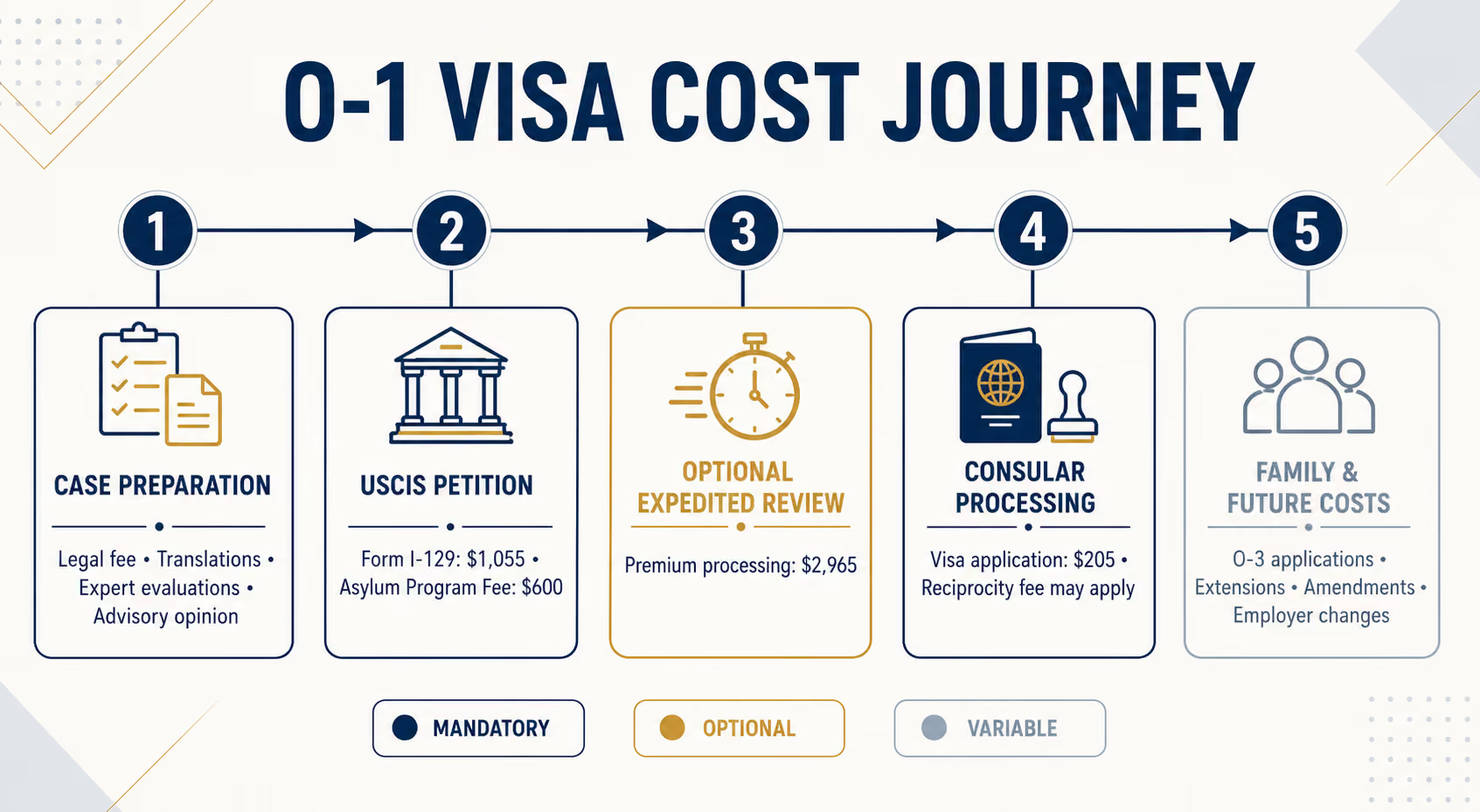
For most O-1 petitions, the mandatory USCIS cost consists of the Form I-129 O filing fee and the applicable Asylum Program Fee. A regular petitioner generally pays $1,655 in combined USCIS fees, while qualifying small employers and nonprofit organizations may pay less.
The beneficiary’s achievements or O-1 classification do not determine these filing amounts. The relevant factors are primarily the type and size of the petitioner submitting the case.
A U.S. employer or agent normally files Form I-129 to request O-1 classification for the beneficiary. In 2026, the standard filing fee for an O petition is $1,055.
This fee covers USCIS’s processing of the petition. It does not include premium processing, legal representation, an advisory opinion, evidence-related services or a later visa application at a U.S. consulate.
The same basic filing route generally applies to O-1A and O-1B petitions. Differences between those classifications are more likely to affect the evidence and legal preparation than the standard government filing fee.
Qualifying small employers and nonprofit organizations may pay a reduced Form I-129 O fee of $530. For small-employer treatment, USCIS generally looks at whether the petitioner has 25 or fewer full-time-equivalent employees.
The reduced fee is not automatic simply because the beneficiary works for a startup, small team, individual agent or charitable project. The petitioner must meet the applicable USCIS definition and accurately provide the requested information about its size or nonprofit status.
The filing party should confirm eligibility before submitting the reduced amount. Paying the wrong fee can result in rejection and may create serious timing problems when a petition is connected to a scheduled performance, project or employment start date.
The Asylum Program Fee is charged in addition to the Form I-129 filing fee. The amount generally depends on the petitioner:
This produces three common mandatory USCIS totals. A regular petitioner generally pays $1,655, a qualifying small employer pays $830, and a qualifying nonprofit pays $530.
These totals do not include the optional $2,965 premium-processing fee or any legal, evidence or consular expenses. Petitioners should verify the amount and payment instructions through the official USCIS fee schedule immediately before filing because government fees and form requirements can change.
AVLG’s published O-1 lawyer cost is $5,800 for an initial petition and $4,200 for an extension. These legal fees are separate from the Form I-129 filing fee, Asylum Program Fee, optional premium processing and third-party evidence expenses.
O-1 attorney fees can vary because an O-1 petition is not simply a form-filing exercise. Counsel must evaluate the beneficiary’s qualifications, identify the strongest regulatory criteria and explain how the evidence establishes extraordinary ability or achievement. The amount of work required depends on the classification, petitioner structure, proposed employment and quality of the available documentation.
Applicants can review AVLG’s current immigration attorney fee schedule for its published O-1 legal fees and applicable terms.
Representation for an initial O-1 petition may include an eligibility assessment, a review of the employer or agent arrangement and a detailed analysis of the beneficiary’s professional record. The attorney may also help determine which evidence is persuasive, which documentation needs further development and which materials add little legal value.
The work can include preparing Form I-129, coordinating petitioner documents, reviewing contracts or itineraries, developing the petition letter and organizing the exhibits. In an agent-filed case involving multiple engagements, counsel may also need to review deal memos, employer authorizations and the relationship among the agent, beneficiary and end clients.
A substantial portion of the legal work happens before the forms are completed. Awards, media coverage, publications, judging activity, critical roles, commercial success and compensation evidence must be evaluated in context. Simply collecting a large volume of documents does not establish eligibility unless the petition explains how those records satisfy the relevant O-1 standard.
Not every legal quote covers the same work. Recommendation-letter assistance, advisory-opinion coordination, certified translations, expert evaluations and document-retrieval expenses may be included in one arrangement but charged separately in another.
Applicants should also determine whether the quoted fee includes:
The engagement agreement should identify the immigration stage covered and explain which government and third-party expenses remain the client’s responsibility. When comparing O-1 attorney fees, the scope of representation is usually more informative than the quoted price alone.
O-1 attorney fees vary because cases can require very different levels of legal analysis, evidence development and coordination. Two beneficiaries may have equally impressive careers, but one case may arrive with organized, verifiable documentation while the other requires extensive work to identify, obtain and explain the relevant evidence.
The visa classification alone does not reveal how much preparation a petition will require.
A strong professional background does not automatically produce a straightforward O-1 petition. Awards, media coverage, publications, commercial results and critical-role evidence must be documented in a form that USCIS can evaluate.
Legal preparation may take longer when records are incomplete, written in another language or difficult to connect to the beneficiary. For example, a well-known project may support the petition, but the evidence must still establish the beneficiary’s individual role and explain why that role was important.
An attorney may also need to distinguish useful documentation from impressive-looking material that does not directly support an O-1 criterion. That evidence analysis can significantly affect the amount of work involved.
O-1 petitions are evaluated under specific regulatory criteria. Counsel must identify which criteria are supported and develop a coherent explanation of how the evidence fits the beneficiary’s field and proposed work.
Some cases rely on familiar forms of evidence, while others require comparable evidence or a more detailed explanation of industry practices. The USCIS policy guidance for O nonimmigrants provides the governing framework, but applying that framework to an individual career can require substantial judgment.
Trying to claim every possible criterion may increase the volume of the petition without improving its strength. A focused filing strategy can sometimes be more persuasive than an oversized record with weak or repetitive exhibits.
A petition filed by one direct employer may involve a defined position, worksite and set of responsibilities. An agent-filed petition can require additional contracts, deal memos, authorization documents and an itinerary covering several employers or engagements.
The legal work may therefore increase when counsel must coordinate information from multiple parties, reconcile inconsistent documents or explain how the proposed activities form a qualifying O-1 assignment.
O-1A and O-1B petitions do not always rely on the same types of evidence. A scientist, entrepreneur or business professional may present publications, patents, judging activity, compensation data or critical-role evidence. An artist or entertainment professional may rely more heavily on lead roles, reviews, commercial success, distinguished productions and industry recognition.
The applicable advisory-opinion process can also differ by field. These distinctions affect the evidence strategy even when the government filing fees are the same.
A short deadline may require counsel to review documents, coordinate third parties and prepare the filing on an expedited schedule. Prior O-1 approvals, RFEs or denials can also affect the work if the earlier record must be reviewed and the current petition must address changed facts or previous concerns.
Extensions may cost less than initial petitions when the prior filing is complete and the employment remains consistent. However, an extension can require additional work when the petitioner changes, new engagements are added or the previous petition is unavailable. For this reason, the most reliable O-1 lawyer quote is one based on the actual filing structure and evidence—not only the visa category.
An O-1A petition does not automatically cost more or less than an O-1B petition. The basic USCIS filing fees are generally the same because both classifications use Form I-129, but attorney, evidence and advisory-opinion expenses can differ depending on the field and structure of the case.
O-1A classification generally covers individuals with extraordinary ability in the sciences, education, business or athletics. O-1B covers extraordinary ability in the arts and extraordinary achievement in the motion-picture or television industry. USCIS provides an overview of these distinctions on its O-1 visa classification page.
An O-1A case may require substantial work to document technical achievements, explain citation evidence, establish the significance of a patent or compare the beneficiary’s compensation with others in the field. Business cases can also require detailed evidence about company reputation, revenue, funding, market impact or the beneficiary’s critical role.
An O-1B case may involve a different kind of document-intensive preparation. Counsel may need to review contracts, deal memos, production records, performance schedules, reviews and evidence showing the reputation of the productions or organizations involved. Cases filed through a U.S. agent can require additional coordination when the beneficiary will work on several projects for different employers.
Consultation expenses can also vary. The appropriate peer group, labor organization or management organization may have its own procedures, processing time and fee schedule. An expedited consultation may add another cost when a production or performance date is approaching.
The more useful question is therefore not whether O-1A or O-1B is generally cheaper. It is whether the particular case requires multiple engagements, extensive evidence development, third-party evaluations, translations or an unusually short preparation schedule. Those factors are more likely to affect the final O-1 lawyer cost than the classification label by itself.
.avif)
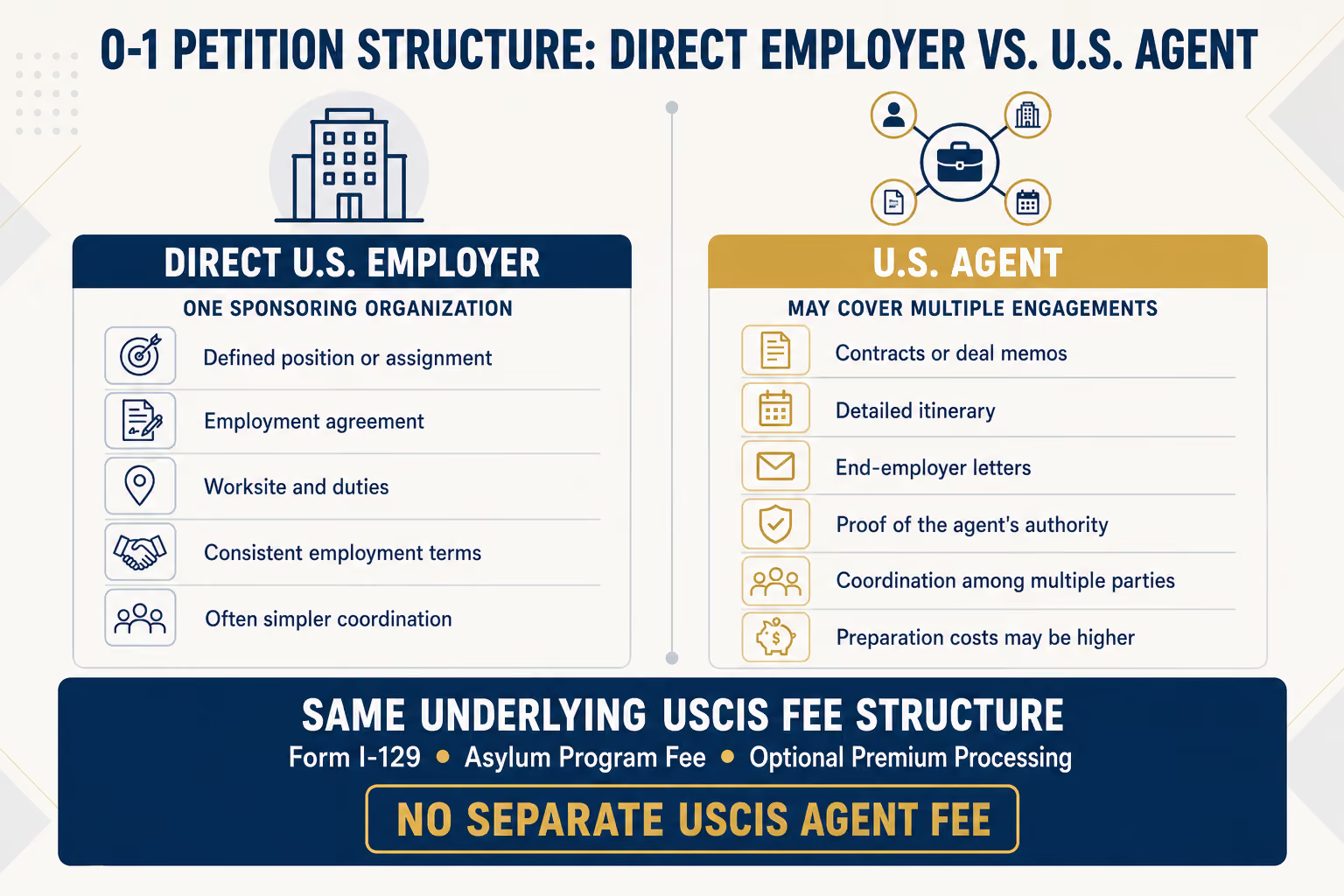
The USCIS filing fee does not increase simply because an O-1 petition is filed through a U.S. agent. Direct-employer and agent petitions generally use the same Form I-129 fee structure, Asylum Program Fee and optional premium-processing fee. The cost difference usually comes from the additional legal preparation and coordination an agent case may require.
An O-1 beneficiary cannot ordinarily file the petition personally. A qualifying U.S. employer or U.S. agent must serve as the petitioner. The correct structure depends on who will employ the beneficiary, how many engagements are planned and which party has authority to represent the employers involved.
A direct-employer petition usually involves one sponsoring organization and a defined position or assignment. The evidence commonly includes the employment agreement, job or project description, work location, requested period of stay and documentation showing the employer’s operations.
This structure can be more straightforward when the beneficiary will work exclusively for one company under consistent terms. The petitioner generally pays the applicable Form I-129 and Asylum Program fees, while the engagement agreement or company policy determines responsibility for attorney fees, premium processing and other expenses.
However, a direct-employer case is not automatically simple. A startup, beneficiary-owned company or organization with an unusual corporate structure may need additional documentation to establish that the petitioner is a genuine legal entity with qualifying work available for the beneficiary.
A U.S. agent may file an O-1 petition in several authorized arrangements, including certain cases involving multiple employers or engagements. This structure is frequently relevant to artists, performers, consultants, entrepreneurs and other professionals whose U.S. work is divided among different projects.
Agent petitions may require:
These requirements can increase O-1 attorney fees because counsel must review documents from multiple parties and ensure that the itinerary, contracts and petition narrative describe a consistent arrangement. The Form I-129 instructions should be reviewed carefully when determining the required petitioner and supporting documentation.
There is no separate USCIS “agent fee.” A qualifying agent petitioner pays the same underlying government fees that would apply based on its size and organizational status. Any additional cost generally reflects the work required to document the agent relationship and proposed engagements.
An agent petition should not be selected merely because the beneficiary does not have a traditional full-time employer. The arrangement must reflect the actual work and relationships among the petitioner, beneficiary and end employers. Choosing the proper structure early can prevent inconsistent documents, unnecessary legal work and avoidable filing delays.
Many O-1 petitions require a written advisory opinion, commonly called a consultation letter, from an appropriate U.S. peer group, labor organization, management organization or qualified expert in the beneficiary’s field. This is separate from the Form I-129 filing fee, and the issuing organization may charge its own processing fee.
The consultation is intended to provide an industry-informed opinion about the nature of the proposed work and the beneficiary’s qualifications. The correct source depends on whether the petition seeks O-1A or O-1B classification and on the beneficiary’s particular profession or industry.
For an O-1A or O-1B arts petition, the consultation may come from an appropriate peer group, including a labor organization, or another qualifying person with expertise in the field. Motion-picture and television cases can involve more specific consultation requirements, including opinions from an appropriate labor organization and management organization.
USCIS explains these requirements in its O-1 documentation and evidence guidance. It also maintains an address index for O and P consultation letters, although inclusion in that index does not replace the need to confirm that an organization is appropriate for the particular case.
There is no universal advisory-opinion fee. Each organization may establish its own procedures, document requirements, standard processing time and expedited-service charge. Some organizations issue consultations without a substantial fee, while others charge based on the visa category, number of beneficiaries or requested turnaround time.
Possible consultation-related expenses include:
The petitioner should begin the consultation process early. A rushed request may cost more, and submitting the request to the wrong organization can delay the petition even when the remainder of the evidence is ready.
USCIS recognizes limited circumstances in which the normal consultation requirement may not apply, such as when an appropriate peer group does not exist. A waiver may also be requested in certain cases involving readmission to perform similar services within two years of a previous consultation.
These exceptions should not be assumed. The petition must explain why the exception applies and provide the required supporting documentation. When relying on a prior consultation, the earlier advisory opinion and related petition history may need to be included.
Before comparing the total O-1 visa cost, applicants should confirm whether the attorney fee includes consultation coordination and whether the peer group or labor organization will charge separately. This prevents a required industry review from becoming an unexpected late-stage expense.
Evidence preparation can be one of the least predictable parts of the O-1 visa cost. USCIS does not charge a separate fee for submitting more exhibits, but collecting, translating, evaluating and organizing those records can create substantial third-party and legal expenses.
The goal is not to build the largest possible petition. The evidence should help establish the applicable O-1 criteria and support a coherent explanation of the beneficiary’s standing in the field. The USCIS guidance for O-1 beneficiaries provides the relevant evidentiary framework.
Any foreign-language document submitted to USCIS generally requires a complete English translation accompanied by the translator’s certification of accuracy and competence.
Translation expenses may apply to awards, media coverage, contracts, recommendation letters, professional memberships and business records. Costs can increase when documents are technical, lengthy or needed under a short deadline. Translating an entire publication may not always be necessary when only certain portions are relevant, but the filing must still provide enough context for USCIS to understand the evidence.
Some petitions benefit from an expert evaluation explaining technical work, industry practices, compensation levels or the importance of a professional contribution. O-1A business and science cases may require analysis of patents, citations, funding, commercial results or critical roles. O-1B cases may require context about productions, venues, industry recognition or commercial success.
An expert letter should serve a clear evidentiary purpose. Paying for multiple opinions that repeat the same general praise can increase the budget without materially strengthening the petition. Objective records usually remain important even when an expert provides useful context.
Applicants may need to retrieve historical articles, archived webpages, publication records, certified awards or official business documents. Some archives and industry databases charge subscription, access or certification fees.
Media evidence can also require proof of the publication’s identity, audience and circulation. If an article discusses a company, production or research team rather than naming the beneficiary prominently, additional evidence may be needed to establish the beneficiary’s individual contribution.
High-remuneration and critical-role arguments may require more than payroll records or a job title. The petition may need reliable compensation comparisons, industry salary data, organizational charts, company financial information or evidence of the reputation of the organization involved.
Obtaining market reports, company records or professional evaluations can add to the total cost. The value of that expense depends on whether the material makes a meaningful comparison and directly supports the legal argument.
Recommendation letters can help explain achievements that are difficult to understand from raw documents alone. Attorney fees may include guidance on selecting recommenders, identifying the purpose of each letter and reviewing drafts for consistency with the supporting evidence.
Applicants should confirm whether this work is included in the quoted O-1 lawyer fee. They should also avoid relying almost entirely on letters. Independent documentation—such as awards, publications, contracts, judging records or measurable business results—typically provides a stronger foundation than praise unsupported by objective evidence.
A practical evidence budget should focus on documentation that advances a specific criterion or strengthens the petition’s overall explanation. Spending more does not necessarily create a stronger O-1 case; strategic relevance matters more than volume.
O-1 premium processing costs $2,965 in 2026. The petitioner requests this optional service by filing Form I-907 in addition to the underlying O-1 petition. This fee is separate from the Form I-129 fee, Asylum Program Fee and O-1 attorney fees.
For qualifying O-1 petitions, premium processing generally requires USCIS to take adjudicative action within 15 business days. That action may be an approval, denial, Request for Evidence, Notice of Intent to Deny or another qualifying response. Premium processing guarantees faster USCIS action—not approval.
The petitioner can submit Form I-907 with the initial petition or add premium processing to a pending eligible case. The current fee and filing instructions are available on the official USCIS Form I-907 page.
Premium processing may be worth considering when the beneficiary has a time-sensitive employment start, performance, production, competition or professional engagement. It can also provide faster initial clarity when the beneficiary needs to schedule travel or begin the consular process after petition approval.
The decision should account for the entire timeline. Paying for premium processing may have limited practical value if the petition is not ready, the required advisory opinion is still pending or a consular appointment is unavailable.
.avif)
Applicants should also avoid filing a weak or incomplete petition simply to meet a deadline. Premium processing gives USCIS less time to issue its first action, but it does not lower the evidentiary standard. If significant documentation is missing, the result may be a faster RFE rather than a faster approval.
If USCIS issues a Request for Evidence or Notice of Intent to Deny, the premium-processing period generally stops. A new applicable period begins after USCIS receives a complete response.
The government does not charge another premium-processing fee merely because it issued an RFE. However, the response may create additional attorney, translation, expert or evidence-retrieval costs. Whether legal work for the response is included depends on the representation agreement.
Premium processing applies to USCIS’s handling of the qualifying petition. It does not accelerate every other step connected to the case.
It does not necessarily speed up:
A regular petitioner using AVLG’s published initial legal fee would have an estimated petition-stage total of $10,420 with premium processing. That estimate includes the $1,055 Form I-129 fee, $600 Asylum Program Fee, $2,965 premium-processing fee and $5,800 legal fee, but excludes consular, dependent and evidence-related expenses.
An approved O-1 petition does not always complete the immigration process. If the beneficiary is outside the United States—or must obtain a new visa for international travel—the next stage may involve submitting Form DS-160 and applying for an O-1 visa at a U.S. embassy or consulate.
The government visa application fee is $205 per applicant. This fee generally applies separately to the O-1 principal beneficiary, qualifying O-2 support personnel and each O-3 spouse or child applying for a visa.
A beneficiary whose Form I-129 was approved with a change or extension of status inside the United States may not immediately need to pay the visa application fee. The expense typically arises when the person applies for a visa at a U.S. consulate for future entry.
The $205 nonimmigrant visa application fee is paid for processing the DS-160 and consular application. It is separate from every amount previously paid to USCIS, including the Form I-129 fee, Asylum Program Fee and premium processing.
The fee is generally nonrefundable, even if the visa is refused or the applicant does not complete the process. Payment procedures and appointment availability vary by embassy or consulate. The current amount can be confirmed through the official Department of State visa-fee schedule.
Petition approval is important, but it does not guarantee visa issuance. The consular officer conducts a separate review of the visa application, identity, admissibility and consistency of the proposed activities with the approved petition.
Some O visa applicants must pay an additional issuance fee after approval. This reciprocity fee depends on the applicant’s nationality, visa classification, number of permitted entries and reciprocity arrangements between the United States and the applicant’s country.
Many applicants will have no reciprocity fee, while others may owe an additional amount. Applicants should check the official U.S. visa reciprocity schedules rather than assuming that the fee will be the same for every nationality.
The $205 application fee does not cover the practical costs of attending the interview and obtaining the visa. Depending on the applicant’s location and circumstances, the budget may also include:
Administrative processing after the interview can also affect timing, although it does not have one standard applicant fee. Applicants should avoid purchasing nonrefundable travel until the visa has been issued and the passport returned.
For budgeting purposes, the consular stage should be treated separately from the USCIS petition. An O-1 case that appears complete after Form I-129 approval may still involve individual visa fees, nationality-based charges and travel expenses before the beneficiary can enter the United States in O status.
An O-1 beneficiary’s spouse and unmarried children under 21 may qualify for O-3 status. Their expenses are separate from the principal beneficiary’s Form I-129 petition and depend on whether the family applies through a U.S. consulate or requests an extension or change of status from inside the United States.
O-3 status allows qualifying family members to accompany the O-1 beneficiary, but it does not provide employment authorization. Families should therefore consider both the filing expenses and the financial effect of the spouse being unable to work in O-3 status.
Each O-3 applicant generally completes a separate DS-160 and pays the $205 nonimmigrant visa application fee. A spouse and every qualifying child are treated as individual visa applicants, even when the family attends the interview together.
These examples include only the visa application fees. A nationality-based reciprocity fee may also apply to each family member. Photographs, translations, travel, lodging and passport delivery can further increase the family’s consular-processing budget.
The O-3 applicants should also be prepared to document their relationship to the O-1 beneficiary, typically through marriage and birth records. Foreign-language civil documents may require complete English translations.
An eligible spouse or child already in the United States may use Form I-539 to request an extension or change of status. The current filing fee is generally $520 for a paper application or $470 for an eligible online filing.
Family members requesting the same action may sometimes be included in one filing package, with additional applicants providing the required supplemental information. However, eligibility to file together or online depends on the circumstances and current USCIS procedures.
If the O-1 employer files an extension through Form I-129, the family may need to coordinate the accompanying Form I-539 carefully. Approval of the principal beneficiary’s petition should not be assumed to extend the family members’ status automatically.
AVLG’s published legal-fee schedule lists $800 for a nonimmigrant dependent extension or change of status, or $550 when filed with the principal petition, with an additional charge for each further dependent. The engagement agreement should confirm the exact scope and fee for the particular family.
O-3 costs can become significant when several family members apply separately at a consulate, require translations or need individual immigration filings. A complete O-1 budget should therefore calculate dependent expenses per person and by processing route—not treat the principal beneficiary’s petition fee as the cost for the entire family.
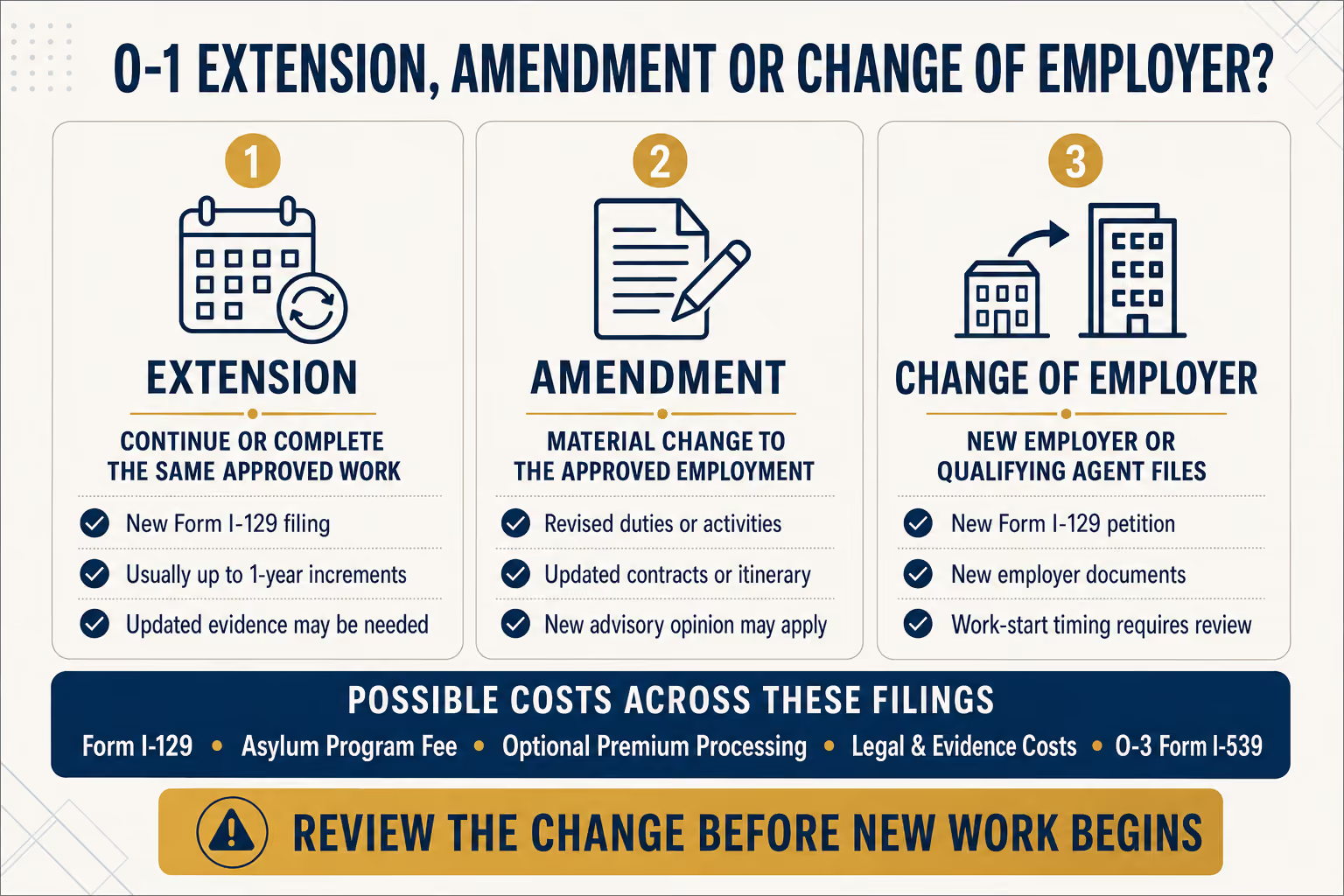
An O-1 extension, amended petition or change of employer can create a new round of government and legal fees. In many situations, the petitioner must file another Form I-129, pay the applicable Asylum Program Fee and decide whether to add premium processing. Updated evidence, an advisory opinion and O-3 dependent applications may also be required.
The precise filing obligation depends on what is changing. A continuation of the same approved work is different from a new employer, a substantially revised itinerary or a material change in the terms of employment.
An initial O-1 petition may be approved for the period needed to complete the event or activity, up to three years. Extensions to continue or complete the same event or activity are generally available in increments of up to one year.
The government fees for an extension ordinarily follow the same petitioner-based structure as other O petitions:
AVLG’s published immigration attorney fee schedule lists $4,200 for an O-1 extension. Using that legal fee, a regular petitioner would have an estimated extension-stage total of $5,855 without premium processing or $8,820 with premium processing.
These examples exclude updated consultations, evidence expenses and O-3 family filings. An extension can also require more legal work when the prior petition is unavailable, another firm prepared it or the new filing differs substantially from the original case.
An amended petition may be necessary when a material change occurs in the terms and conditions of the approved employment. Examples may include significant changes to the position, petitioner relationship, proposed activities or other facts on which USCIS based the approval.
Not every scheduling adjustment or additional engagement automatically requires an amended petition. The practical question is whether the change is material to the approved filing. Petitioners should review the change before the beneficiary performs work that may fall outside the authorization.
When an amendment is required, the budget may include:
The official USCIS O-1 guidance provides information about material changes and amended petitions.
If an O-1 beneficiary in the United States changes employers, the new employer or qualifying agent generally must file a new Form I-129. O-1 classification does not provide the same broad employer-portability rules associated with certain H-1B changes, so the timing of the new employment must be reviewed carefully.
The new petition may require a complete examination of the proposed work, new employer documents, updated contracts and evidence showing that the beneficiary will continue working in the area of extraordinary ability. If the original petition was filed through an agent, the new arrangement may also affect the itinerary and agent documentation.
USCIS discusses these requirements in its policy guidance on O-1 extensions and employer changes.
When the principal beneficiary extends or changes O-1 employment, accompanying O-3 family members may need separate Form I-539 filings to maintain their status. Those dependent costs should be added to the employer-change or extension budget rather than treated as part of the principal Form I-129 fee.
USCIS does not charge a separate government filing fee simply because it issues a Request for Evidence. However, preparing an effective O-1 RFE response can create additional attorney, translation, expert and document-retrieval expenses that were not included in the original filing budget.
An RFE does not automatically mean that the petition will be denied. It means the officer believes additional information or clarification is needed before a decision can be made. The response should address every issue identified in the notice and be submitted by the stated deadline.
An O-1 RFE can concern the beneficiary’s evidence, the proposed employment or the petitioner’s filing structure. USCIS may request clarification about:
USCIS explains when officers may issue RFEs and Notices of Intent to Deny in its official policy guidance on evidence.
The government does not normally charge another Form I-129 fee for an RFE response. The petitioner also does not pay a second premium-processing fee merely because USCIS requested additional evidence.
The main expense is the work required to analyze the notice and develop the response. Possible costs include:
Whether RFE representation is included in the original O-1 lawyer fee depends on the engagement agreement. Applicants should confirm this before filing rather than assume that every post-filing response is covered.
When an O-1 petition is filed with premium processing, USCIS may issue an RFE within the premium period. The applicable processing clock generally stops when the RFE is issued and begins again after USCIS receives a complete response.
Premium processing can therefore produce a faster initial action without necessarily producing a final decision within the first 15-business-day period. The time required to collect new evidence and prepare the response remains outside USCIS’s control.
A Notice of Intent to Deny is generally more serious than a routine request for missing evidence. A NOID identifies reasons USCIS intends to deny the petition while giving the petitioner an opportunity to respond.
There is generally no separate USCIS response fee, but the legal and evidentiary work may be substantial. Counsel may need to review the full record, address specific factual or legal concerns and obtain reliable documentation within a limited response period.
A practical O-1 budget should include a contingency for post-filing work. The objective is not to assume that USCIS will issue an RFE, but to understand that a response can add meaningful costs even when no new government filing fee is required.
The O-1 petitioner is generally responsible for filing Form I-129 with the correct government fees. However, responsibility for attorney fees, premium processing, evidence preparation, visa stamping and family expenses may be allocated differently depending on the employment agreement and company policy.
Unlike H-1B cases, O-1 petitions do not use a Labor Condition Application with the same category-specific fee and wage rules. That does not mean every O-1 expense should automatically be transferred to the beneficiary. The parties should confirm the arrangement in writing and consider any applicable wage, employment and contract requirements.
The petitioner files Form I-129 and must ensure that USCIS receives the correct filing fee and Asylum Program Fee. The amounts depend on the petitioner’s size and nonprofit status, not on which party ultimately provides or reimburses the funds.
Employers and agents should confirm the applicable amounts through the official USCIS fee schedule. A petition can be rejected if it is submitted with an incorrect payment, even when the error results from misunderstanding who was expected to cover the expense.
Many employers pay the legal fees for preparing an O-1 petition because the employer or agent is the petitioner. Other arrangements may require the beneficiary to pay some or all of the attorney, translation or evidence-preparation costs.
The engagement agreement should identify who the law firm represents, who is responsible for payment and which services are included. AVLG’s published immigration attorney fees provide a starting point, but the individual agreement controls the actual scope and payment terms.
If the beneficiary pays petition-related expenses, the parties should consider whether those payments affect compensation, reimbursement obligations or other employment terms. The arrangement should also match the information presented in the petition and underlying contracts.
Premium processing is sometimes paid by the employer when faster adjudication is needed for a business deadline. A beneficiary may pay when the expedited decision primarily serves personal travel or timing needs, subject to the parties’ agreement and any applicable legal requirements.
Visa application fees, reciprocity charges and O-3 family expenses are more commonly treated as personal costs, although some employers reimburse them as part of a relocation or immigration-benefits package.
There is no single cost-allocation model for every O-1 case. The safest approach is to decide responsibility before filing, document it clearly and avoid assumptions about which expenses are included in the attorney fee or employer sponsorship.
The following examples show how the O-1 visa cost can change based on the petitioner’s size and the decision to use premium processing. Each estimate uses AVLG’s published $5,800 initial O-1 legal fee and the government fees currently applicable in 2026.
These are petition-stage estimates, not guaranteed quotes for every case.
A regular employer or agent petitioner paying the standard Form I-129 fee, the full Asylum Program Fee and AVLG’s initial O-1 legal fee would have an estimated petition-stage total of $7,455.
This represents the minimum combined government and published AVLG legal fees in this example. It does not include an advisory opinion, translations, expert services or consular processing.
Adding the optional $2,965 premium-processing fee increases the estimated total to $10,420. Premium processing changes the USCIS adjudication timeline, but it does not eliminate evidence expenses or guarantee approval.
A qualifying small employer may have an estimated total of $6,630 without premium processing, while a qualifying nonprofit may have an estimated total of $6,330. The difference comes from the reduced Form I-129 fee and the reduced or waived Asylum Program Fee.
The petitioner must establish that it qualifies for the lower government fees. Startup status, a small project team or an agent arrangement does not automatically establish eligibility.
The estimates above do not include:
Applicants can review AVLG’s published immigration attorney fee schedule for current legal-fee information. The final budget should be based on the actual petitioner, evidence, processing route and scope of representation rather than the table total alone.
The O-1 and EB-1A categories both serve individuals with significant professional achievements, but they lead to different immigration outcomes. O-1 is a temporary nonimmigrant classification filed by a qualifying U.S. employer or agent, while EB-1A is an immigrant classification that permits self-petitioning and can form the basis of a Green Card case.
The petition-stage costs can appear similar, but an EB-1A applicant must also budget for adjustment of status or immigrant visa processing after Form I-140 approval.
The O-1 estimate uses the standard government fees for a regular petitioner. A qualifying small employer or nonprofit may pay lower Form I-129 and Asylum Program fees. The EB-1A estimate assumes a typical individual self-petitioner paying the reduced $300 Asylum Program Fee.
O-1 approval authorizes temporary employment under the approved petition. The beneficiary may need to obtain a visa abroad, maintain the qualifying employment arrangement and file future extensions or amended petitions as circumstances change.
EB-1A approval does not, by itself, grant permanent residence. The applicant must complete adjustment of status through Form I-485 or employment-based immigrant visa processing. Visa availability, medical examinations, dependent applications and other Green Card expenses can make the complete EB-1A process more expensive than the initial petition total suggests.
Readers can review AVLG’s complete EB-1A cost guide for those later expenses.
O-1 and EB-1A cases may use overlapping evidence, including awards, publications, media coverage, judging activity, critical roles, compensation and original contributions. The legal standards and immigration objectives are nevertheless different.
An O-1 petition must document qualifying U.S. work through an employer or agent and may require contracts, an itinerary and an advisory opinion. An EB-1A petition does not require a permanent job offer, but it must establish eligibility for immigrant classification and show that the applicant will continue working in the area of expertise.
AVLG’s O-1 and EB-1A comparison explains the broader differences between the two categories.
The lower initial cost should not be the only factor in choosing a strategy. The more important questions are whether the applicant satisfies the relevant standard, needs temporary work authorization or permanent residence, has a qualifying O-1 petitioner and can complete any later immigration stage.
The most useful way to compare O-1 attorney fees is to examine the scope of representation, not only the quoted price. Two law firms may describe their service as “O-1 petition preparation” while providing very different levels of legal analysis, evidence development and post-filing support.
A quote should identify the immigration stage, the services included and the circumstances that may result in additional charges.
An initial O-1 petition generally requires more preparation than an extension based on substantially similar employment and a complete prior filing. The quote should specify whether it covers:
A price based on a straightforward single-employer extension may not be comparable to a quote for an initial agent petition involving several projects and contracts.
Applicants should ask whether the attorney will only review documents provided by the client or will help develop the evidence strategy. Meaningful O-1 representation may include identifying the strongest criteria, explaining documentation gaps and organizing exhibits so that the evidence supports a coherent legal argument.
The quote should clarify whether it includes:
Applicants unfamiliar with the distinction between legal strategy and form preparation may find AVLG’s explanation of what an immigration lawyer does helpful when evaluating the proposed service.
The engagement agreement should explain whether premium-processing preparation, expedited work, consular assistance and post-filing responses are included or billed separately.
In particular, confirm the treatment of:
A flat fee does not necessarily include every stage of the case. Similarly, a higher quote is not automatically more comprehensive unless the agreement describes the additional work.
Because a U.S. employer or agent files the O-1 petition, the representation agreement should identify the law firm’s client and explain how communications with the beneficiary will be handled. This can matter when the petitioner and beneficiary have different questions about strategy, payment or access to the petition file.
Before signing, applicants should also review the payment schedule, refund terms, termination provisions and responsibility for government and third-party expenses.
AVLG publishes its immigration attorney costs and legal fees so petitioners can review the starting price before requesting representation. The final comparison should still be based on the written engagement terms and the actual complexity of the proposed O-1 case.
The cheapest quote may be appropriate for a well-documented, straightforward petition. A more comprehensive service may be useful when the case involves an agent, several engagements, unusual evidence or unclear eligibility. The key is knowing exactly what is—and is not—included.
A complete O-1 budget should identify the mandatory petition fees, optional processing costs, legal and evidence expenses, consular charges and dependent applications. Reviewing these items before preparation begins can reduce unexpected costs and help the petitioner choose a realistic filing timeline.
Use the following checklist before filing:
The objective is not to predict every possible expense. It is to understand which stages apply, what the attorney fee covers and where additional charges may arise before the petition is submitted. A written budget organized by immigration stage is more reliable than treating the Form I-129 fee as the complete O-1 visa cost.
The most accurate O-1 cost estimate begins with the structure of the proposed case. The petitioner, O classification, employment arrangement, evidence, advisory-opinion requirements, processing route and number of dependents can all affect the final budget.
American Visa Law Group assists employers, agents, professionals, artists and individuals with O-1A and O-1B petition strategy. An attorney can review the proposed work, evaluate the available evidence and explain which government, legal and third-party expenses are likely to apply.
Before proceeding, applicants should receive a clear explanation of the anticipated scope of representation, the services included in the legal fee and the costs that may arise separately. This provides a more useful estimate than relying on the Form I-129 fee alone.
To discuss an initial O-1 petition, agent arrangement, extension, amendment or change of employer, schedule a consultation with American Visa Law Group or call 510-500-1155. A consultation can help identify the likely filing stages and cost considerations, but no attorney can guarantee a particular USCIS or consular outcome.
For a regular petitioner using AVLG’s published initial legal fee, the estimated petition-stage cost is $7,455 without premium processing or $10,420 with premium processing.
These estimates include the Form I-129 fee, Asylum Program Fee and $5,800 AVLG legal fee. They exclude advisory opinions, translations, evidence expenses, visa stamping, reciprocity fees, dependents and possible post-filing work.
The standard Form I-129 O filing fee is $1,055. Qualifying small employers and nonprofit organizations may pay a reduced fee of $530.
The petitioner should verify its eligibility for the reduced amount and review the current USCIS fee schedule before filing.
No. A regular petitioner generally pays $600, while a qualifying employer with 25 or fewer full-time-equivalent employees generally pays $300. A qualifying nonprofit organization generally pays $0.
The Asylum Program Fee is charged in addition to the Form I-129 filing fee.
AVLG’s published legal fee is $5,800 for an initial O-1 petition and $4,200 for an O-1 extension. The actual scope and fee are controlled by the representation agreement.
Applicants should confirm whether the quote includes recommendation-letter assistance, advisory-opinion coordination, exhibit preparation, premium-processing submission and RFE responses. Current pricing is available through AVLG’s immigration attorney fee schedule.
Premium processing costs $2,965. It is requested through Form I-907 and is paid in addition to the underlying petition fees.
For a qualifying O-1 petition, USCIS generally must take adjudicative action within 15 business days. That action may include approval, denial, an RFE, a NOID or another qualifying response.
No. Premium processing is optional.
It may be useful when the beneficiary has a time-sensitive project, performance, competition, employment start or travel plan. However, it may provide limited practical benefit if the petition is not ready or the applicant must still wait for a consular appointment.
No. Premium processing affects the time USCIS has to take action; it does not lower the O-1 evidentiary standard or improve the legal merits of the petition.
An incomplete or weak filing may result in a faster RFE rather than a faster approval.
The Department of State visa application fee is $205 per applicant. It generally applies to the O-1 principal beneficiary, O-2 support personnel and each O-3 family member applying through a U.S. consulate.
A nationality-based reciprocity fee and expenses for travel, photographs or passport delivery may also apply. The current amount is listed on the Department of State visa-fee page.
The basic Form I-129, Asylum Program Fee and premium-processing structure is generally the same for O-1A and O-1B petitions.
The total cost may still differ because the classifications can require different evidence, advisory opinions, contracts, itineraries and industry documentation.
USCIS does not charge a separate fee simply because a petition is filed through an agent. The Form I-129 and Asylum Program fees depend primarily on the petitioner’s size and organizational status.
An agent petition may have higher attorney or preparation costs when it involves several employers, engagements, contracts, deal memos or a detailed itinerary.
Each O-3 spouse or child applying through a U.S. consulate generally pays a $205 visa application fee, plus any applicable reciprocity, travel and document expenses.
For certain eligible extensions or changes of status inside the United States, the Form I-539 fee is generally $520 for paper filing or $470 for eligible online filing. Attorney fees may be separate.
The U.S. employer or agent petitioner generally submits the Form I-129 and applicable petition fees. Responsibility for attorney fees, premium processing, evidence preparation and consular expenses can vary by agreement and company policy.
O-3 family expenses are often treated as personal costs unless the employer agrees to reimburse them.
It may. AVLG’s published legal fee is $4,200 for an extension, compared with $5,800 for an initial petition.
An extension may require additional work when the prior petition is incomplete, another law firm prepared it, the petitioner or employment changes, or updated evidence and consultations are necessary.
Not necessarily. USCIS does not normally charge a separate filing fee for an RFE response, but the attorney and evidence-preparation costs may be billed separately.
The engagement agreement should explain whether RFE and NOID representation is included, subject to a fixed additional fee or billed according to the work required.
The following official resources provide additional information about O-1 eligibility, evidence, government fees, premium processing and consular applications:

Hasan Abdullah, Esq. is the Founder and Managing Attorney of American Visa Law Group. His practice focuses on U.S. immigration law, including family-based immigration, employment-based immigration, adjustment of status, consular processing, waivers, PERM labor certification, NIW, EB-1, H-1B, O-1, and complex immigration strategy.
Through American Visa Law Group, Mr. Abdullah helps individuals, families, professionals, investors, and employers understand their immigration options and plan around changing government policies, USCIS procedures, and Visa Bulletin movement. His work emphasizes practical legal analysis, realistic expectations, and strategy tailored to each applicant’s immigration history and long-term goals.


