Author: Hasan Abdullah, Esq.
Edited: On the 20st of October 2026.
The U.S. visa ban in 2026 imposes different restrictions depending on a person's nationality, visa category, and immigration circumstances. Under Presidential Proclamation 10998, effective January 1, 2026, the United States fully or partially restricted visa issuance and entry for nationals of 39 countries, as well as individuals using certain travel documents issued or endorsed by the Palestinian Authority.
However, being a national of an affected country does not automatically mean every visa or immigration pathway is unavailable. The restrictions differ by country and visa classification, and specific exceptions apply. For individuals pursuing family-based immigration, employment sponsorship, or other U.S. immigration options, understanding these distinctions is essential. Lawful permanent residents, for example, are expressly excepted, and visas valid on January 1, 2026, were not revoked under this proclamation.
A separate policy has also created confusion. The State Department's January 2026 pause on immigrant visa issuance to nationals of 75 countries ended effective August 21, 2026, following a federal court order. That change did not eliminate the restrictions imposed by Presidential Proclamation 10998.
This guide explains the U.S. travel ban in 2026, identifies affected countries, distinguishes full and partial restrictions, examines available exemptions, and outlines what applicants, existing visa holders, and green card holders should consider before applying for a visa or traveling to the United States.
The U.S. visa ban in 2026 refers to nationality-based restrictions on entry into the United States and visa issuance under Presidential Proclamation 10998. The measures apply differently depending on the country involved, the applicant's visa classification, and whether an exception applies.
The restrictions are not a universal prohibition on immigration from every listed country. Some nationalities face broad suspensions covering immigrant and nonimmigrant visas, while others face restrictions limited to particular categories. Understanding these distinctions is essential for applicants, employers, and families evaluating their immigration options.
Signed on December 16, 2025, Presidential Proclamation 10998 took effect on January 1, 2026, at 12:01 a.m. Eastern Standard Time. It expanded and modified restrictions originally established under Presidential Proclamation 10949 in June 2025.
The proclamation invokes authority under Section 212(f) of the Immigration and Nationality Act and establishes country-specific restrictions based on stated national security, screening, and information-sharing considerations.
Importantly, the proclamation's entry restrictions generally apply to affected foreign nationals who were outside the United States on the applicable effective date and did not hold a valid visa on that date, subject to its specific exceptions and provisions.
The full legal framework is available in the official text of Presidential Proclamation 10998.
A critical distinction is that visa issuance and admission into the United States are separate immigration decisions.
The U.S. Department of State, through American embassies and consulates, determines whether an applicant qualifies for visa issuance under applicable law. U.S. Customs and Border Protection separately evaluates admissibility when a traveler seeks entry at a U.S. port of entry.
Similarly, approval of an immigration petition by USCIS does not automatically authorize visa issuance or guarantee admission.
For example, an individual may have an approved family-based immigrant petition or employer-sponsored petition but still face restrictions when applying for a visa abroad.
Applicants should therefore evaluate their nationality, existing visa documentation, immigration classification, and any applicable exceptions before assuming that an approved petition or scheduled consular interview permits travel.
The next question is which countries face full restrictions, which face partial restrictions, and how those classifications affect specific visa categories.
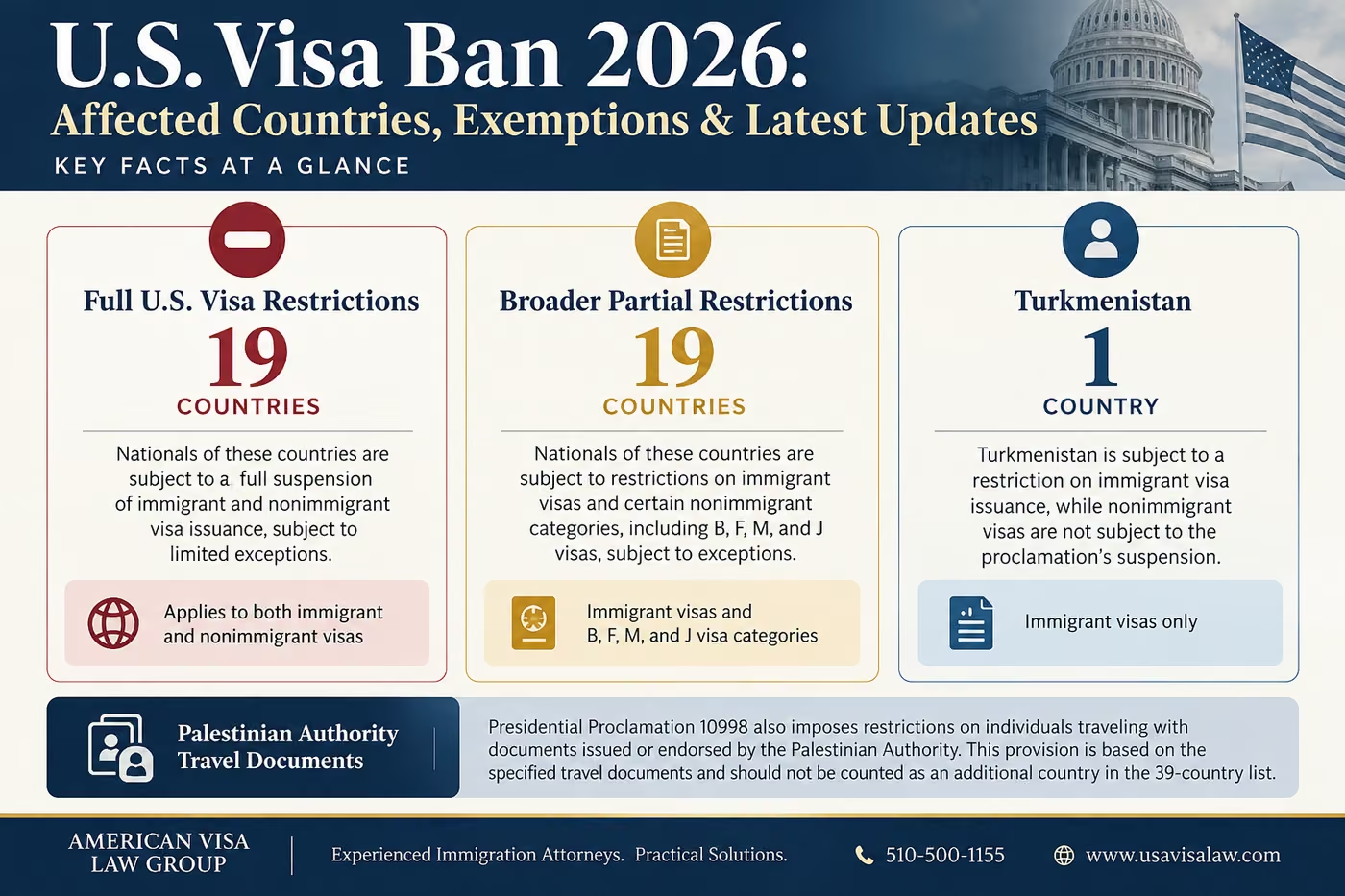
The U.S. visa ban in 2026 covers nationals of 39 countries, with 19 subject to full restrictions and 20 subject to partial restrictions. Presidential Proclamation 10998 also imposes restrictions on individuals traveling with documents issued or endorsed by the Palestinian Authority.
The restrictions took effect on January 1, 2026, and differ according to nationality, visa classification, and the proclamation's applicability provisions. A country's inclusion does not necessarily mean that every national is prohibited from applying for a visa or entering the United States. Existing visa holders and individuals qualifying for specific exceptions may be treated differently.
The following country lists reflect the U.S. Department of State's guidance on Presidential Proclamation 10998.
Under Proclamation 10998, 19 countries are subject to a full suspension of immigrant and nonimmigrant visa issuance and entry, subject to the proclamation's scope and applicable exceptions.
“Fully restricted” describes the general country-based suspension, not an absolute prohibition covering every individual. The proclamation provides exceptions and case-by-case national-interest determinations.
These restrictions generally encompass immigrant visas, such as family-based and employment-based immigrant visas, as well as nonimmigrant classifications including B-1/B-2 visitor visas, F-1 student visas, and certain employment-based temporary visas.
For example, an individual from one of these countries may have an approved family-based immigration petition but still be subject to the proclamation when seeking an immigrant visa through a U.S. consulate. Approval of the underlying petition does not itself establish an exception to the entry restrictions.
Another 19 countries face partial restrictions affecting immigrant visas and certain nonimmigrant categories.
For these countries, the proclamation generally suspends immigrant visa issuance and entry as immigrants, as well as entry and visa issuance under the B-1, B-2, B-1/B-2, F, M, and J nonimmigrant classifications, subject to applicable exceptions.
Other nonimmigrant visa classifications, including certain employment-based categories, are not subject to the same categorical suspension under the partial-restriction provisions. However, the proclamation directs consular officers to reduce the validity of other nonimmigrant visas issued to nationals of these countries to the extent permitted by law.
This distinction matters for applicants from countries such as Nigeria. A Nigerian national applying for a B-1/B-2 visitor visa faces different restrictions under the proclamation than someone seeking an H-1B visa. The latter classification is not subject to the same category-wide suspension under the partial restrictions, but the applicant must still satisfy all applicable visa requirements and may be affected by other immigration policies.
Turkmenistan is the twentieth country subject to partial restrictions, but its treatment differs from the other 19.
Under Proclamation 10998, the suspension affecting Turkmen nationals seeking B-1/B-2, F, M, and J nonimmigrant visas was lifted effective January 1, 2026.
The restriction on immigrant visas, however, remains in effect, subject to applicable exceptions.
The proclamation separately imposes full restrictions on individuals traveling with documents issued or endorsed by the Palestinian Authority.
These restrictions apply to immigrant and nonimmigrant categories, subject to the proclamation's scope and available exceptions.
The Palestinian Authority provision is based on the specified travel documents and should not be presented as an additional country in the 39-country list.
Being from a listed country is only the starting point of the legal analysis. The outcome can also depend on whether an applicant was outside the United States on the applicable effective date, held a valid visa at that time, possesses lawful permanent resident status, holds another nationality, or qualifies for an exception.
The official text of Presidential Proclamation 10998 establishes these distinctions. Importantly, visas valid on the applicable effective date were not revoked solely because of this proclamation.
Applicants should therefore avoid treating the U.S. visa ban country list as a final determination of their individual eligibility. The relevant questions are which restrictions apply to their circumstances, whether an exception exists, and how those rules affect visa issuance or admission to the United States.
Presidential Proclamation 10998 provides specific exceptions to the U.S. visa ban in 2026, including lawful permanent residents, certain dual nationals, qualifying diplomatic travelers, and individuals covered by narrowly defined exceptions. However, an applicant's eligibility for an exception depends on their immigration circumstances and the requirements established in the proclamation.
Importantly, an exception to the travel restrictions does not automatically establish eligibility for a visa or guarantee admission into the United States. Applicants must still satisfy all other applicable immigration requirements.
U.S. lawful permanent residents (green card holders) are expressly exempt from the entry restrictions under Proclamation 10998, regardless of whether their country of nationality appears on the restricted list.
However, green card holders remain subject to ordinary immigration inspection and applicable reentry requirements. The exception does not eliminate issues involving extended absences, admissibility, or the maintenance of permanent resident status.
The proclamation also provides an exception for dual nationals of restricted countries when they travel using a passport issued by a country that is not subject to the designated restrictions.
For example, a person holding both Nigerian and Canadian citizenship may fall within this exception when traveling on a valid Canadian passport. Their eligibility must still be evaluated under the applicable entry and visa requirements.
Additional categorical exceptions apply to specific individuals and visa classifications.
The proclamation exempts travelers holding valid nonimmigrant visas in designated diplomatic and official classifications, including A-1, A-2, certain C and G classifications, and specified NATO visa categories.
It also provides an exception for qualifying athletes, coaches, essential support personnel, and immediate relatives traveling to participate in the World Cup, Olympics, or other major sporting events designated by the Secretary of State.
Certain Special Immigrant Visas for U.S. government employees under 8 U.S.C. § 1101(a)(27)(D) are also excepted.
A separate exception covers immigrant visas for ethnic and religious minorities facing persecution in Iran. Applicants must meet the specific conditions of that exception; Iranian nationality or membership in a minority group alone should not be treated as automatic proof of eligibility.
Family relationships do not automatically exempt applicants from the 2026 U.S. visa ban.
Presidential Proclamation 10998 removed several broad categorical exceptions that existed under the earlier 2025 restrictions, including those for immediate-relative immigrant visas, certain adoption visas, and Afghan Special Immigrant Visas.
As a result, approval of Form I-130 or a qualifying relationship with a U.S. citizen does not, by itself, overcome the applicable nationality-based restrictions.
This distinction is particularly important for U.S. citizens sponsoring spouses, parents, or children abroad. Although an immigrant petition may be approved, visa issuance remains a separate determination subject to the rules in effect and any applicable exceptions.
Proclamation 10998 authorizes certain case-by-case national interest exceptions, but these determinations are discretionary rather than automatic.
Depending on the circumstances, the Secretary of State, Secretary of Homeland Security, or Attorney General may authorize an exception under the specific authority and procedures established by the proclamation.
An applicant's employment, family relationship, professional qualifications, or urgent personal circumstances do not independently guarantee that an exception will be granted.
The proclamation also generally applies to affected individuals who were outside the United States and did not hold a valid visa on the applicable effective date. It separately states that the restrictions do not apply to individuals already granted asylum or refugees already admitted to the United States.
The full scope of the exceptions is established in Section 6 of Presidential Proclamation 10998.
The central question is not simply whether an applicant comes from a restricted country, but whether the proclamation applies to their specific circumstances and whether a legally recognized exception is available.
No. Lawful permanent residents (green card holders) are expressly exempt from the nationality-based entry restrictions imposed by Presidential Proclamation 10998. This exception applies even when a permanent resident is a citizen of one of the countries subject to full or partial restrictions under the U.S. travel ban in 2026.
For example, an Iranian or Nigerian national who already holds U.S. lawful permanent resident status is not barred from returning to the United States solely because their country appears on the restricted list.
However, exemption from the travel ban does not guarantee admission to the United States. Returning permanent residents remain subject to applicable immigration laws, documentation requirements, and inspection by U.S. Customs and Border Protection (CBP).
The distinction is established in Section 6 of Presidential Proclamation 10998, which expressly excludes lawful permanent residents from the proclamation's restrictions.
Before departing the United States, permanent residents should review their travel documents, anticipated length of absence, and circumstances that could affect their ability to return.
Extended travel abroad can raise questions about whether an individual has maintained U.S. permanent residence. Absences exceeding one year may also create additional documentation requirements, potentially involving a reentry permit or returning resident visa, depending on the circumstances. A reentry permit does not automatically resolve every admissibility or residence-related issue.
Travelers should also confirm that their green card or other acceptable evidence of permanent residence will satisfy applicable boarding and reentry requirements.
One further distinction matters: having an approved immigrant petition is not the same as already holding a green card. An applicant with an approved Form I-130 or employment-based immigrant petition who has not yet become a lawful permanent resident cannot rely on the permanent-resident exception solely because the petition was approved.
For green card holders, the central concern is therefore not the nationality-based restriction itself, but whether they meet the ordinary legal requirements for returning to the United States.
A U.S. visa issued before January 1, 2026, is not automatically invalid because of the 2026 travel ban. Under Presidential Proclamation 10998, the nationality-based restrictions generally apply to affected individuals who were outside the United States on the effective date and did not hold a valid visa at that time.
The U.S. Department of State's official guidance confirms that visas valid on January 1, 2026, were not revoked under the proclamation. However, travelers must still satisfy applicable immigration and admission requirements.
Individuals who held valid visas on the proclamation's effective date are not subject to its restrictions solely because their nationality appears on the affected-country list.
For example, a Nigerian national holding a valid B-1/B-2 visa issued before January 1, 2026, is not automatically barred under Proclamation 10998 merely because Nigeria is subject to partial restrictions.
However, visa validity does not guarantee admission. U.S. Customs and Border Protection (CBP) independently determines admissibility at the port of entry, and other immigration restrictions may still apply.
No. Visa issuance and admission are separate legal determinations.
A valid visa generally permits a traveler to seek admission in the appropriate classification, but it does not establish an unconditional right to enter.
Similarly, approval of a USCIS immigration petition does not automatically authorize international travel or guarantee that a consular officer will issue a visa.
An individual who needs a new visa after their existing visa expires should determine whether the current restrictions apply to the requested visa classification.
For nationals of partially restricted countries, eligibility may differ between visitor, student, exchange, and employment-based visa categories. Applicants from fully restricted countries generally face broader limitations, subject to applicable exceptions.
The key distinction is between holding a visa that was valid on the proclamation's effective date and seeking a new visa after the restrictions took effect. Before traveling or applying for renewal, applicants should review their nationality, visa classification, existing documentation, and any applicable exceptions.
The U.S. visa ban in 2026 affects tourist, student, work, and immigrant visas differently depending on the applicant's nationality and the restrictions imposed under Presidential Proclamation 10998. Nationals of fully restricted countries generally face suspensions across immigrant and nonimmigrant visa categories, while those from partially restricted countries face more targeted limitations.
The distinction matters because two applicants from the same country may face different rules depending on whether they seek temporary employment, study, tourism, or permanent residence. The proclamation's applicability provisions and exceptions must also be considered.
Nationals of countries subject to full restrictions generally face suspended issuance of B-1 and B-2 visitor visas. These classifications cover temporary business activities, tourism, and certain personal visits.
The suspension also applies to B-1/B-2 visas for nationals of the 19 countries subject to the broader partial restrictions, including Nigeria, Senegal, and Venezuela.
However, Turkmenistan is treated differently. Its previous restrictions on B-1/B-2 and certain other nonimmigrant classifications were lifted effective January 1, 2026.
Applicants should distinguish between seeking a new visitor visa and traveling with a visa that was valid on the proclamation's applicable effective date.
The restrictions also affect students and exchange visitors applying for F-1, M-1, and J-1 visas.
These categories are generally suspended for affected nationals of fully restricted countries and the 19 countries subject to the broader partial restrictions.
For students already studying in the United States, an important distinction is that a visa restriction does not automatically terminate an individual's existing lawful immigration status. However, international travel can introduce additional complications if the student must obtain a new visa before returning.
Students should therefore evaluate their current immigration status, visa validity, travel documents, and potential consular processing requirements before departing the United States.
Employment-based nonimmigrant visas require a more individualized analysis.
Nationals of fully restricted countries generally face restrictions covering employment-based nonimmigrant classifications, subject to applicable exceptions.
For nationals of the 19 countries subject to broader partial restrictions, however, the proclamation does not impose the same categorical suspension on H-1B, L-1, O-1, and certain other employment-based visa classifications.
This does not mean those applications are automatically unaffected. The proclamation directs consular officers to reduce the validity of other nonimmigrant visas issued to nationals of these partially restricted countries to the extent permitted by law.
An employer may also obtain approval of a petition through USCIS without that approval resolving every issue related to consular visa issuance or admission.
For example, an approved H-1B petition does not independently guarantee that the beneficiary will receive a visa or be admitted into the United States.
Immigrant visa restrictions generally apply more broadly than the nonimmigrant restrictions imposed on partially restricted countries.
Under Proclamation 10998, immigrant visa issuance is generally suspended for affected nationals of both fully and partially restricted countries, including Turkmenistan, unless an applicable exception is established.
This can affect individuals pursuing permanent residence through approved family petitions, employment-based immigrant petitions, or other immigrant visa categories.
Importantly, the 2026 proclamation removed the earlier broad categorical exceptions for certain immediate relatives of U.S. citizens. Having an approved Form I-130, for example, does not independently establish an exemption from the restrictions.
The distinction between consular processing and adjustment of status within the United States is also significant. The proclamation's entry restrictions should not be treated as an automatic prohibition on every immigration benefit adjudicated domestically by USCIS.
Ultimately, the effect of the U.S. visa ban cannot be determined from nationality alone. Applicants must consider the specific visa classification, where they are applying, whether they already possess valid immigration documents, and whether an applicable exception changes the analysis.
The governing distinctions are set out in Presidential Proclamation 10998 and the U.S. Department of State's visa restriction guidance.
The U.S. government's 75-country immigrant visa issuance pause ended effective August 21, 2026, following a federal court order. However, this change did not eliminate the separate nationality-based restrictions imposed under Presidential Proclamation 10998.
The distinction matters because both policies affected visa processing in 2026, but they had different legal foundations, country lists, and consequences for applicants.
On January 21, 2026, the U.S. Department of State implemented a pause on immigrant visa issuance for nationals of 75 countries, citing concerns about potential reliance on public benefits and the need to review screening procedures.
The measure primarily affected individuals seeking permanent residence through immigrant visa processing abroad, including certain family-sponsored and employment-based applicants.
Unlike the broader travel restrictions established under Presidential Proclamation 10998, this pause did not directly apply to tourist, student, or other nonimmigrant visa categories.
Affected individuals could generally continue submitting applications and attending consular interviews, although immigrant visa issuance was paused under the policy.
According to the U.S. Department of State's August 28, 2026 update, the pause was no longer in effect as of August 21, 2026, in accordance with the federal court's order in CLINIC et al. v. Rubio et al.
Ending the pause removed that particular restriction on immigrant visa issuance. It did not guarantee approval of pending applications, eliminate standard eligibility requirements, or prevent other immigration restrictions from applying.
Applicants completing consular processing at a U.S. embassy or consulate must still satisfy the requirements of their immigration classification, including any applicable grounds of inadmissibility.
No. Presidential Proclamation 10998 remains a separate legal measure, with its own country-specific restrictions and exceptions.
For example, an applicant from a country covered by both policies would no longer be subject to the former 75-country issuance pause but could still face restrictions under the 2026 travel proclamation.
This is why applicants should not assume that a court order affecting one visa policy automatically removes every restriction on their immigration case.
The practical question is which rules remain applicable to the applicant's nationality, visa category, and individual circumstances—not simply whether a widely reported visa pause has ended.
Yes. Nationals of countries affected by the U.S. visa ban in 2026 may still submit visa applications and schedule consular interviews, even when the applicable restrictions prevent visa issuance. The U.S. Department of State expressly confirms this distinction in its official guidance on Presidential Proclamation 10998.
However, the ability to apply should not be confused with eligibility to receive a visa. The outcome depends on the applicant's nationality, requested visa classification, the proclamation's applicability provisions, and any available exceptions.
Applicants who are subject to the restrictions may attend scheduled interviews where consular services are available. The consular officer must then assess the application under the applicable immigration laws, including any restrictions imposed by the proclamation.
For applicants from fully restricted countries, the suspension generally covers both immigrant and nonimmigrant visa categories. Those from partially restricted countries may face different outcomes depending on whether they are applying for a visitor, student, employment-based, or immigrant visa.
An interview does not guarantee issuance, and completing the ordinary application requirements does not independently overcome a nationality-based restriction. Applicants should therefore understand the legal limitations before committing substantial resources to travel or other arrangements that depend on receiving a visa.
An approved USCIS petition does not automatically exempt an applicant from the U.S. visa ban.
For example, a U.S. citizen may obtain approval of Form I-130 for a spouse abroad, but that approval does not guarantee the spouse can receive an immigrant visa if the applicable restrictions prevent issuance.
Similarly, an employer's approved Form I-129 petition establishes neither automatic visa eligibility nor a right to enter the United States.
These distinctions matter because petition approval, consular visa issuance, and admission at a U.S. port of entry are separate legal decisions.
For applicants affected by the restrictions, the practical question is whether proceeding with consular processing is appropriate under the current rules, particularly when an exception might apply or additional immigration considerations could affect the case.
Applicants affected by the U.S. visa ban in 2026 should first determine which restrictions apply to their nationality and visa category before making decisions about immigration applications or international travel. Being listed under Presidential Proclamation 10998 does not necessarily mean that every immigration option is unavailable. The appropriate next step depends on the applicant's legal status, location, existing documents, and eligibility for an exception.
The first consideration is whether the applicant's nationality is subject to full or partial restrictions and whether the intended visa classification falls within the suspension.
For example, a Nigerian national seeking a visitor visa faces different restrictions from someone applying for an H-1B work visa. Dual nationality may also change the analysis when the individual travels using a passport from a country that is not designated under the proclamation.
Applicants should review the official State Department visa restriction guidance rather than relying solely on generalized country lists or outdated announcements.
Before beginning a new application or making travel arrangements, applicants should examine their existing immigration documentation.
A visa that was valid on January 1, 2026, may be treated differently from a new visa application. Similarly, an approved Form I-130 or Form I-129 does not independently overcome restrictions affecting consular visa issuance.
Location also matters. The proclamation's entry restrictions should not be confused with the rules governing immigration benefit applications filed from within the United States. Individuals maintaining lawful immigration status should evaluate the potential consequences of leaving the country before arranging international travel.
The proclamation establishes exceptions for certain lawful permanent residents, dual nationals, diplomatic travelers, and other specifically designated individuals. It also permits limited case-by-case national interest determinations.
An exception must be supported by the applicable legal requirements, not merely by the applicant's personal circumstances or the importance of their travel.
For instance, an approved family petition or employment offer does not automatically qualify an applicant for a national interest exception. Supporting documentation and the precise authority for any requested exception should be carefully evaluated.
Applicants from restricted countries may still be permitted to submit visa applications and attend consular interviews, but completing those steps does not guarantee issuance.
Before committing to nonrefundable travel expenses, employment start dates, or relocation arrangements, applicants should understand whether the applicable restrictions could prevent the visa from being issued.
When an applicant has an approved petition, an existing U.S. immigration status, or a potentially applicable exception, an individualized legal review may help identify practical options and avoid unnecessary complications.
American Visa Law Group assists individuals, families, and employers with immigration eligibility and consular processing questions. Applicants facing uncertainty about the restrictions can consult an immigration attorney to evaluate how the current rules apply to their circumstances.
The U.S. visa ban in 2026 imposes full or partial restrictions on nationals of 39 countries, including Afghanistan, Iran, Nigeria, Somalia, Venezuela, and Yemen. The restrictions also extend to individuals using certain travel documents issued or endorsed by the Palestinian Authority.
However, the affected countries do not face identical restrictions. Nineteen countries are subject to broad suspensions covering immigrant and nonimmigrant visas, while the remaining 20 face more limited restrictions. Turkmenistan, for example, is subject to an immigrant visa suspension but not the same visitor and student visa restrictions imposed on other partially restricted countries.
Applicants should consult the country comparison tables above and the State Department's official visa restriction guidance to determine which rules apply to their nationality and visa classification.
Yes. Nigeria is among the countries subject to partial U.S. travel restrictions under Presidential Proclamation 10998. The restrictions generally cover immigrant visas and B-1/B-2 visitor, F-1 student, M-1 vocational student, and J-1 exchange visitor classifications.
However, the proclamation does not impose the same category-wide suspension on certain employment-based nonimmigrant visas, including H-1B and L-1 classifications. Other visa eligibility requirements and restrictions may still apply, and consular officers are directed to reduce the validity of other nonimmigrant visas to the extent permitted by law.
Nigerian nationals with existing visas, lawful permanent resident status, or potentially applicable exceptions should not assume that the restrictions affect them in precisely the same way as new visa applicants.
Yes. Lawful permanent residents are expressly exempt from the entry restrictions imposed by Presidential Proclamation 10998, even if they hold citizenship from a country subject to full or partial restrictions.
This exception does not eliminate normal immigration requirements for returning residents. U.S. Customs and Border Protection may still examine travel documentation, admissibility, and circumstances suggesting that an individual has abandoned permanent residence.
An approved immigrant petition is not equivalent to lawful permanent resident status. Individuals who have not yet received permanent residence cannot rely on the green card holder exception solely because their immigration petition was approved.
The effect on H-1B applicants depends on their nationality and whether their country is subject to full or partial restrictions.
Nationals of fully restricted countries generally face restrictions covering H-1B visa issuance and entry, subject to the proclamation's applicability rules and exceptions.
For nationals of countries subject to the broader partial restrictions, H-1B visas are not included in the same categorical suspension imposed on B-1/B-2, F, M, and J visas. Nevertheless, reduced visa validity, other immigration requirements, and separate policies may affect an application.
An approved Form I-129 petition does not independently guarantee visa issuance or admission into the United States.
Yes. A U.S. citizen may generally still file Form I-130 for a qualifying spouse from a restricted country. However, approval of that petition does not necessarily mean the spouse can receive an immigrant visa while the applicable restrictions remain in effect.
Presidential Proclamation 10998 removed the broad categorical exception for certain immediate relatives that existed under the earlier 2025 proclamation. Consequently, marriage to a U.S. citizen does not automatically exempt a foreign national from the current restrictions.
The appropriate immigration strategy depends on the spouse's nationality, location, immigration history, and whether a specific exception may apply. Petition eligibility and consular visa eligibility must be evaluated separately.
Visas valid on the applicable effective date were not automatically revoked under Presidential Proclamation 10998. For the restrictions introduced or modified effective January 1, 2026, this distinction protects individuals who held valid visas on that date from the proclamation's entry suspension.
However, holding a valid visa does not guarantee admission into the United States. Other grounds of inadmissibility, independent visa revocation decisions, and ordinary inspection requirements may still apply.
An individual whose visa expires and who must apply for a new visa may face different restrictions. Before traveling or pursuing renewal, applicants should confirm their documents remain valid and determine whether the current rules affect their circumstances.
No. The separate pause on immigrant visa issuance to nationals of 75 countries ended effective August 21, 2026.
The U.S. Department of State confirmed this change in its August 28, 2026 immigrant visa processing update, following a federal court order in CLINIC et al. v. Rubio et al.
The termination of that pause did not repeal Presidential Proclamation 10998. Applicants whose nationality is also covered by the 39-country restrictions may therefore remain subject to separate limitations on visa issuance or entry.
This distinction is particularly important when reviewing older immigration news reports that discuss the two policies as though they were interchangeable.
Certain applicants may qualify for an established exception or receive a discretionary, case-by-case national interest exception under Presidential Proclamation 10998. However, exceptions are limited and are not automatically granted because an applicant has an approved petition, U.S. family members, or a compelling personal reason for travel.
The proclamation authorizes designated federal officials to make national interest determinations under specified conditions. The relevant authority, procedures, and supporting evidence depend on the particular circumstances.
Applicants should distinguish between a categorical exception, which applies when the legal requirements are satisfied, and a discretionary national interest determination, which requires an authorized decision.
Before pursuing an exception, the applicant should identify the precise restriction that applies and establish the legal basis for requesting relief. A favorable decision cannot be presumed merely because the proposed travel would be beneficial to the applicant, an employer, or a family member.
The U.S. visa ban in 2026 imposes nationality-based restrictions affecting 39 countries, but its impact varies according to visa classification, immigration status, and applicable exceptions. Nineteen countries face broad restrictions on immigrant and nonimmigrant visas, while 20 are subject to more limited measures.
Lawful permanent residents are expressly exempt under Presidential Proclamation 10998, and visas valid on the applicable effective date were not automatically revoked by the proclamation. However, approved immigration petitions, existing family relationships, and employment sponsorship do not independently guarantee visa issuance or admission.
The separate 75-country immigrant visa issuance pause ended on August 21, 2026, but that change did not eliminate the restrictions under Proclamation 10998.
Applicants should therefore evaluate their nationality, existing immigration documents, visa category, and potential exceptions before making travel or consular processing decisions. Because immigration restrictions can change through executive action, agency guidance, or litigation, relying on current official information is essential.
The U.S. visa ban in 2026 can create significant uncertainty for applicants whose immigration plans involve international travel, consular processing, or family and employment-based sponsorship. Although Presidential Proclamation 10998 establishes country-specific restrictions, determining how those rules apply to an individual case often requires examining more than nationality alone.
Legal guidance may be particularly valuable when an applicant has an approved immigration petition but cannot obtain a visa, holds an existing visa and plans to travel, or believes a specific exception may apply. Timing, immigration history, current status, and the distinction between visa issuance and admission can materially affect the available options.
For families separated by immigration restrictions and employers coordinating international hiring, evaluating these questions before making travel or relocation commitments may help avoid unnecessary complications.
American Visa Law Group assists individuals, families, and employers with immigration eligibility, consular processing, and complex immigration matters. Applicants seeking case-specific guidance can schedule a consultation with an immigration attorney to assess the restrictions, identify relevant legal considerations, and evaluate available immigration options.
The following official government resources provide additional information about the 2026 U.S. visa restrictions, applicable exceptions, visa processing, and international travel.

Hasan Abdullah, Esq. is the Founder and Managing Attorney of American Visa Law Group. His practice focuses on U.S. immigration law, including family-based immigration, employment-based immigration, adjustment of status, consular processing, waivers, PERM labor certification, NIW, EB-1, H-1B, O-1, and complex immigration strategy.
Through American Visa Law Group, Mr. Abdullah helps individuals, families, professionals, investors, and employers understand their immigration options and plan around changing government policies, USCIS procedures, and Visa Bulletin movement. His work emphasizes practical legal analysis, realistic expectations, and strategy tailored to each applicant’s immigration history and long-term goals.


