Author: Hasan Abdullah, Esq.
The L-1B visa cost in 2026 is not a single filing fee. Employers considering an L-1B visa petition should separate mandatory USCIS charges from conditional fees, optional premium processing, attorney fees, and consular expenses. For an initial individual petition, mandatory USCIS fees generally total $1,195 for a qualifying nonprofit, $1,495 for a qualifying small employer, or $2,485 for an employer that does not qualify for a reduced fee.
The total can increase if the employer requests $2,965 premium processing or is subject to the additional $4,500 Public Law 114-113 fee. L-1B lawyer fees, visa stamping, dependent applications, travel, translations, and other case expenses are separate.
The USCIS L-1B classification allows a qualifying U.S. employer to transfer an employee with specialized knowledge from a related foreign organization. Preparing the case therefore involves more than submitting Form I-129. The employer must document the corporate relationship, the employee’s qualifying foreign employment, and why the employee’s knowledge meets the L-1B standard.
The final budget depends on the employer’s size and nonprofit status, whether the filing is an initial petition, extension, or amendment, and whether the employee applies through an individual petition or the blanket L process. Consular processing and L-2 applications for a spouse or children can add further costs. Evidence-intensive cases, new-office transfers, corporate restructuring, or prior immigration complications may also require more legal and document preparation.
This guide separates mandatory government fees, conditional charges, optional premium processing, L-1B attorney fees, consular expenses, and dependent costs. It also explains which fees may apply to different employers and how to build a realistic filing budget before proceeding.
Employers evaluating eligibility as well as filing costs can review our L-1B visa attorney and eligibility guide.
For an initial individual petition, the L-1B visa cost generally includes between $1,195 and $2,485 in mandatory USCIS fees before attorney fees, premium processing, visa stamping, or dependent expenses. The amount depends primarily on whether the petitioner is a nonprofit, a qualifying small employer, or an employer subject to the standard filing fees.
The USCIS G-1055 Fee Schedule should always be checked before filing because government fees and payment instructions can change.
For a qualifying nonprofit, the initial mandatory government fees generally total $1,195: a $695 Form I-129 fee, no Asylum Program Fee, and the $500 Fraud Prevention and Detection Fee.
A small employer with 25 or fewer full-time-equivalent employees generally pays $1,495: a $695 Form I-129 fee, a $300 Asylum Program Fee, and the $500 fraud fee.
An employer that does not qualify for a reduced fee generally pays $2,485: a $1,385 Form I-129 fee, a $600 Asylum Program Fee, and the $500 fraud fee.
These examples assume an initial individual L-1B petition. They exclude premium processing, the possible $4,500 Public Law 114-113 fee, attorney fees, consular expenses, reciprocity fees, and L-2 dependent costs. Extensions, amendments, and blanket L cases may follow a different fee structure.
The government cost of an L-1B petition is made up of several separate charges. Filing Form I-129 does not automatically cover the Asylum Program Fee, the Fraud Prevention and Detection Fee, or any other fee that may apply. Each charge must be evaluated separately based on the employer and the type of filing.
Using the wrong fee can cause USCIS to reject the petition before reviewing the L-1B eligibility evidence. Employers should therefore verify the amounts and payment instructions in the current USCIS guidance for H and L petition filing fees immediately before submitting the case.
An employer filing an individual L-1B petition generally begins with Form I-129, Petition for a Nonimmigrant Worker, together with the L Classification Supplement.
The standard Form I-129 filing fee for an L petition is $1,385. A qualifying small employer or nonprofit organization pays a reduced fee of $695. For this purpose, USCIS generally treats an employer with 25 or fewer full-time-equivalent employees as a small employer.
The reduced amount is not applied automatically simply because a company considers itself a small business. The petitioner must correctly identify its status and provide the information or supporting evidence required by the form instructions.
The Asylum Program Fee is charged in addition to the Form I-129 filing fee, even though the L-1B petition itself is unrelated to an asylum application.
An employer that does not qualify for a reduction generally pays $600. A qualifying small employer pays $300, while a qualifying nonprofit organization pays $0.
This fee is tied to the employer’s classification rather than the employee’s salary, nationality, or specialized-knowledge position. It can apply to initial petitions, extensions, and other Form I-129 filings, so employers should not assume it is a one-time charge.
A $500 Fraud Prevention and Detection Fee generally applies when an employer files an initial L-1B petition for a particular employee. It may also apply when a new petitioner seeks to employ an L-1 worker who is currently working for another employer.
The fee generally does not repeat for a routine extension filed by the same employer for the same employee. However, the correct treatment depends on what the petition is requesting. An extension, amendment, change of employer, and blanket L application should not automatically be treated as having the same fee structure.
For blanket L cases, the $500 fraud fee is normally collected from the principal applicant during consular processing rather than through an individual Form I-129 petition.
Certain employers must pay an additional $4,500 fee when filing an L-1 petition. This is sometimes described as the Border Security Act fee or the Public Law 114-113 fee.
The fee generally applies when both of the following conditions are met:
A company does not owe the fee merely because it has 50 or more employees. Both the workforce-size test and the H-1B/L-1 percentage test must be satisfied. The fee generally arises in connection with an initial L-1 filing or certain changes of employer, not every extension or amendment.
The current USCIS Policy Manual guidance on L-1 filing requirements states that this fee remains in effect until September 30, 2027, unless Congress changes or extends the law.
Premium processing is optional. An employer can request expedited USCIS processing by filing Form I-907 and paying a separate fee of $2,965.
For most L-1B petitions, premium processing requires USCIS to take adjudicative action within 15 business days. That action may be an approval, denial, Request for Evidence, Notice of Intent to Deny, or another qualifying agency action. Premium processing does not guarantee approval and does not eliminate the possibility of additional evidence requests.
The decision to use premium processing should be based on the employee’s intended start date, travel plans, current immigration status, business needs, and the readiness of the evidence. Paying for faster processing before the petition is fully documented can produce a quicker decision, but not necessarily the decision the employer wants.
USCIS publishes current eligibility rules and payment instructions on its Form I-907 premium processing page. Because the premium-processing fee is added to all other applicable charges, it should be budgeted separately from the basic L-1B filing cost.
American Visa Law Group’s published legal fee for an initial L-1B petition is $6,200. The firm lists a fee of $5,100 for qualifying subsequent cases and $4,600 for extensions. These figures are attorney fees, not total case costs. USCIS filing fees, premium processing, consular fees, dependent applications, translations, expert services, and other third-party expenses are generally separate.
The current amounts can be reviewed on AVLG’s immigration attorney fee schedule. The final fee and scope of representation should always be confirmed through the written engagement agreement because an L-1B case may require services beyond a standard petition.
An L-1B petition is not simply a form-filing exercise. The legal work usually begins with assessing whether the U.S. and foreign companies have a qualifying relationship and whether the employee satisfies the foreign-employment requirement. The attorney must then evaluate whether the employee’s knowledge is sufficiently specialized for the L-1B classification.
For a standard petition, legal representation may include developing the filing strategy, preparing the immigration forms, reviewing corporate and employment documents, identifying evidentiary weaknesses, and organizing the supporting record. It may also involve drafting a detailed employer support letter that explains the employee’s knowledge, how it was acquired, and why it is important to the company’s U.S. operations.
The filing package must connect the evidence to the legal standard. A large collection of technical documents is not necessarily persuasive if it does not explain what distinguishes the employee’s knowledge from skills commonly found in the industry or within the employer’s workforce.
Routine case monitoring and review of standard USCIS notices may also fall within the agreed scope. Services such as responding to a complex Request for Evidence, preparing a new-office business plan, completing consular forms, representing dependents, or handling an amendment may be included, excluded, or priced separately depending on the agreement.
The amount of work required often depends on how clearly the company can document the employee’s specialized knowledge. Some employers have organized training records, product documentation, project histories, and internal comparisons available at the beginning of the case. Others may need to reconstruct the employee’s experience across several teams, countries, or affiliated companies.
The attorney may need to work with managers, human resources personnel, technical teams, and foreign-company representatives to explain the employee’s role accurately. Proprietary information may also need to be presented carefully so the petition is detailed enough for USCIS without unnecessarily disclosing confidential business material.
This evidentiary development is one reason L-1B legal fees may be higher than the cost of preparing a routine immigration form. The value lies largely in evaluating the facts, identifying the strongest evidence, and presenting the corporate and specialized-knowledge issues coherently.
A case may require additional work when it involves multiple corporate entities, a recent reorganization, missing ownership records, a new U.S. office, or a complicated employment history. Prior denials, status violations, inconsistent immigration filings, third-party worksites, and urgent deadlines can also expand the necessary analysis.
Translations, expert opinions, business plans, corporate-document retrieval, and extensive financial evidence may create separate expenses. A later RFE, amendment, consular filing, dependent application, or material change in the proposed employment may also fall outside the original scope.
When comparing L-1B lawyer fees, employers should examine more than the quoted number. They should confirm which filing stage is covered, whether government fees are separate, how RFEs and amendments are handled, and whether consular or L-2 assistance is included. A transparent comparison depends on comparing the same services, not simply choosing the lowest initial quote.
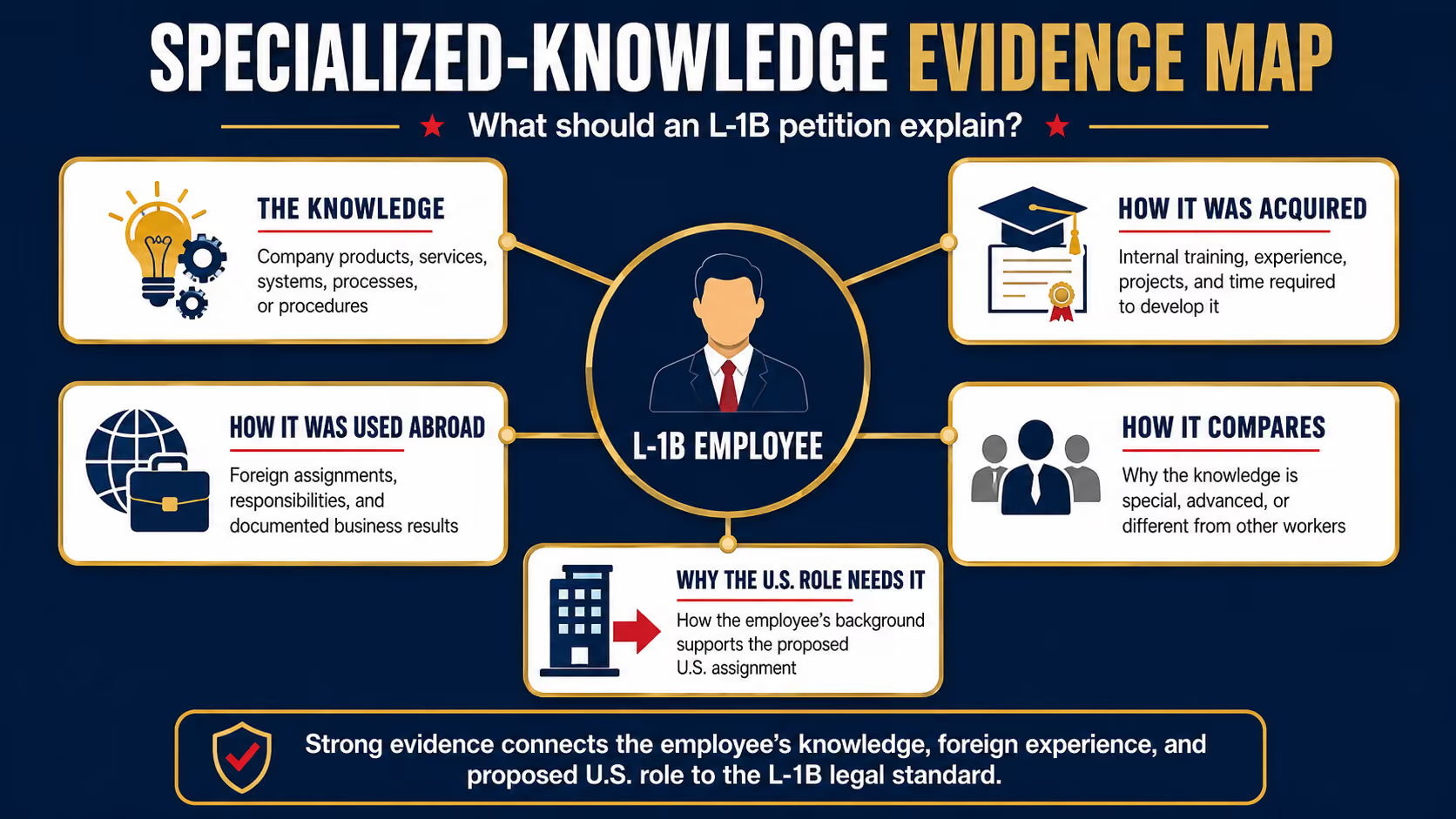
The central issue in an L-1B petition is not simply whether the employee is experienced or technically skilled. The employer must show that the employee possesses knowledge that qualifies as special or advanced under the L-1B standard and that this knowledge is relevant to the proposed U.S. position.
That distinction makes the evidence more demanding. A résumé, job description, and statement that the employee is “essential” will rarely explain the full basis for eligibility. The petition must identify the knowledge with precision, show how the employee acquired it, and demonstrate how it relates to the company’s products, services, processes, procedures, or international operations.
USCIS recognizes two related forms of specialized knowledge. “Special” knowledge generally concerns an organization’s products, services, research, equipment, techniques, management, or other interests and their application in international markets. “Advanced” knowledge refers to a high level of expertise in the organization’s processes and procedures.
An employee may qualify through either form of knowledge or through a combination of both. USCIS evaluates the evidence under the totality of the circumstances rather than relying on one job title, degree, or number of years with the company. The agency explains these standards in its Policy Manual chapter on L-1B specialized-knowledge beneficiaries.
The employee’s knowledge does not necessarily have to be unique or held by only one person. It also does not have to involve a patented or proprietary system. However, the petition still needs to establish why the knowledge is uncommon, sophisticated, advanced, or meaningfully different from knowledge ordinarily found within the industry or the employer’s workforce.
The strongest explanation usually answers several practical questions: What exactly does the employee know? How was that knowledge acquired? How has the employee applied it abroad? How does the employee’s knowledge compare with that of other workers? Why does the proposed U.S. assignment require this particular background?
These questions are closely connected. Evidence showing that an employee completed internal training may be helpful, but it becomes more persuasive when the petition also explains the length and difficulty of the training, how few employees completed it, and how the employee later applied that knowledge to significant company projects.
Specialized knowledge often must be established through records from different departments, corporate entities, and countries. The immigration forms themselves capture only a small portion of this information.
Depending on the case, supporting evidence may include:
The employer may also need to explain technical material in language that a USCIS officer can understand. Internal product names, abbreviations, and company-specific processes can be clear to the employer but meaningless to an outside reviewer. Effective evidence must translate that internal knowledge into a coherent legal and factual explanation.
Confidentiality creates another practical issue. Companies may be reluctant to disclose proprietary systems, customer information, pricing structures, or unreleased products. The filing strategy may therefore require carefully selected records, redactions, summaries, or declarations that document the employee’s knowledge without exposing more confidential information than necessary.
Foreign-language records may require certified translations. Corporate reorganizations, acquisitions, or changes in the employee’s position may require additional documentation to connect older records with the current company structure and proposed U.S. role.
This is why two L-1B petitions with similar job titles can require very different levels of preparation. The cost is influenced not only by the number of documents but by the work required to identify, interpret, compare, and present them. A well-organized evidentiary record should allow the officer to understand what the employee knows, why that knowledge qualifies, and how it will be used in the United States.
An individual L-1B petition and a blanket L application can involve different government fees because they follow different procedures. An individual case is generally filed with USCIS for a specific employee. A blanket L approval, by contrast, allows a qualifying multinational organization to transfer eligible employees under a previously approved corporate framework.
A blanket approval does not automatically classify every transferred employee as L-1B. The individual must still establish eligibility, and a consular officer generally reviews the application before issuing the visa.
For an individual petition, the U.S. employer files Form I-129 and the L Classification Supplement with USCIS for a specific employee. The filing generally requires the applicable Form I-129 fee, Asylum Program Fee, and $500 Fraud Prevention and Detection Fee.
The employer may also request premium processing for an additional $2,965. If the employee will apply for an L-1B visa abroad after USCIS approves the petition, the employee generally pays a separate $205 visa application fee and any nationality-based reciprocity fee.
This route allows USCIS to review the employee’s specialized knowledge, qualifying foreign employment, proposed U.S. role, and the relationship between the corporate entities before the employee proceeds to a consular appointment.
A blanket L petition is available only to organizations that satisfy specific corporate and operational requirements and have received blanket approval from USCIS. It is generally used by established multinational companies that transfer qualifying employees regularly.
Once the blanket petition is approved, an eligible specialized-knowledge professional may apply using Form I-129S. USCIS provides the current form and instructions on its Form I-129S page.
For a typical consular blanket L application, the principal applicant generally pays the $205 visa application fee and the $500 Fraud Prevention and Detection Fee. The additional $4,500 Public Law 114-113 fee may also be collected if the employer satisfies the workforce-size and H-1B/L-1 percentage requirements. A reciprocity fee may apply after approval depending on the applicant’s nationality.
The employee must present the required documents and establish individual eligibility during the consular process. The Department of State confirms that blanket L applicants must bring Form I-129S and pay the applicable L-related charges in its temporary-worker visa guidance.
The fee structure can differ when an employee already in the United States requests a change or extension of status based on a blanket approval. In that situation, a USCIS filing may still be required, so employers should not assume every blanket case follows the consular cost model.
Blanket processing can reduce the need for a separate USCIS petition for each employee applying abroad. For a company making frequent transfers, that may reduce repeated filing costs and create a more efficient corporate process.
However, the blanket route is not available to every employer or employee. The organization must first qualify for blanket approval, and an L-1B applicant under the blanket must generally be a specialized-knowledge professional. Other specialized-knowledge employees may need to proceed through an individual petition.
Cost should therefore follow the correct filing strategy, not determine it. The employer should first confirm which route is legally available and then calculate the government, legal, consular, and dependent expenses connected to that route.
An employee applying for an L-1B visa through a U.S. embassy or consulate generally pays a $205 nonimmigrant visa application fee. This cost is separate from the fees the employer pays for the underlying petition. A spouse or child applying for an L-2 visa must submit a separate application and pay a separate fee.
Consular processing may also involve a nationality-based reciprocity fee, document expenses, travel, and legal assistance. The total therefore depends on the applicant’s nationality, family composition, interview location, and whether the employer is using an individual or blanket L petition.
The $205 application fee is paid as part of the consular visa process. The applicant generally completes Form DS-160, follows the payment instructions for the relevant embassy or consulate, and schedules an interview when required.
The fee is normally nonrefundable and is not returned simply because the application is refused, delayed, or placed in administrative processing. Payment procedures and local-currency amounts can vary by consular post, even though the Department of State publishes the fee in U.S. dollars.
Each applicant pays separately. For example, an L-1B employee traveling with an L-2 spouse and one L-2 child would generally pay $615 in visa application fees:
This example excludes reciprocity charges, travel, passport delivery, translations, and legal assistance. Blanket L applicants may also owe the $500 Fraud Prevention and Detection Fee and, when applicable, the $4,500 Public Law 114-113 fee discussed earlier.
Some applicants must pay a visa issuance fee after the application is approved. This is commonly called a reciprocity fee.
The amount depends on the applicant’s nationality and visa classification. The applicable reciprocity schedule can also affect the number of permitted entries and the visa’s validity period. Two employees sponsored by the same company may therefore face different issuance fees because they hold passports from different countries.
Applicants should check the Department of State’s visa fees and reciprocity tables for the country that issued the passport. The fee should not be estimated based only on the location of the interview or the applicant’s country of residence.
A reciprocity fee is different from the $205 application fee. The application fee is generally paid to submit and process the visa application, while a reciprocity fee is collected only when the relevant country and visa classification require it.
Government charges are only part of the consular budget. Applicants may also need to pay for passport photographs, certified translations, document delivery, transportation, lodging, or international travel to attend the interview.
Additional costs can arise if an applicant must return to the consulate, obtain replacement corporate documents, or remain near the interview location while the passport is being processed. Administrative processing does not ordinarily create a separate visa fee, but the delay can produce additional travel, accommodation, or rescheduling expenses.
Legal assistance with Form DS-160, document review, interview preparation, or consular follow-up may also be priced separately from the L-1B petition. Employers and employees should review the engagement agreement to confirm whether the legal fee covers only the USCIS petition or also includes the visa-stamping stage.
An approved L-1B petition does not guarantee visa issuance, and an issued visa does not guarantee admission at a U.S. port of entry. The petition, consular application, and admission process are related but legally distinct stages. A complete budget should account for each stage separately.
The spouse and unmarried children under 21 of an L-1B employee may qualify for L-2 status. Their expenses are separate from the principal employee’s petition costs and can include visa application fees, reciprocity charges, Form I-539 fees, legal assistance, and travel.
The total family cost depends largely on whether the dependents apply through a U.S. consulate or request an extension or change of status from inside the United States.
Each L-2 family member applying through a U.S. embassy or consulate generally completes a separate Form DS-160 and pays a $205 nonimmigrant visa application fee.
A spouse and child do not pay the employer’s Form I-129 or Asylum Program Fee. The $500 Fraud Prevention and Detection Fee and possible $4,500 Public Law 114-113 fee generally relate to the principal L applicant rather than each dependent.
However, an L-2 applicant may have to pay a visa reciprocity fee after approval. The amount depends on the applicant’s nationality and the applicable Department of State schedule. Travel, lodging, passport delivery, photographs, and translations can add to the family’s total expense.
Children who are included in a parent’s passport still require separate visa applications and fees. Families should also check the instructions of the specific embassy or consulate because appointment procedures and local payment methods may differ.
An eligible spouse or child already in the United States may use Form I-539 to request an extension of L-2 status or a change from another nonimmigrant classification.
The current Form I-539 filing fee is generally $470 for a paper application or $420 for an eligible online application. Online filing has separate eligibility requirements and may not be suitable when several family members need to apply together. USCIS provides the current filing options and instructions on its Form I-539 page.
A spouse and unmarried children under 21 may be included as co-applicants in certain paper filings when they request the same immigration action for the same period. Form I-539A may be required for each additional applicant. The family should confirm the correct form structure before filing rather than assuming that each relative needs a completely separate I-539.
The timing should also be coordinated with the principal employee’s L-1B petition. Approval of the employer’s L-1B extension does not automatically extend the status of family members. The dependents must submit the appropriate application when an extension is required.
Legal fees for preparing Form I-539 applications are normally separate from the principal L-1B petition fee unless the engagement agreement states otherwise. Adding several dependents, correcting status issues, or responding to a USCIS request may increase the cost.
Certain L-2 spouses are employment authorized incident to valid status. An unexpired Form I-94 showing the classification L-2S can serve as evidence of employment authorization, so a separate Form I-765 may not always be necessary for the spouse to work.
USCIS explains the rule in its guidance on employment authorization for L-2 spouses. A spouse may still choose to request an Employment Authorization Document in some circumstances, but the filing fee and processing time should be considered before doing so.
L-2 children are not employment authorized incident to status. The employment-authorization rule applies to qualifying spouses, not dependent children.
For one L-1B employee traveling with a spouse and one child, the visa application fees would generally be:
This example covers only the three visa application fees. It does not include reciprocity charges, a blanket-L fraud fee, the possible Public Law 114-113 fee, travel, lodging, passport delivery, translations, or legal assistance.
Family expenses should therefore be added to the employer’s petition budget rather than treated as part of the basic L-1B filing fee.
USCIS does not charge a separate “new-office fee” for an L-1B petition. A new-office case generally uses the same Form I-129, Asylum Program Fee, Fraud Prevention and Detection Fee, and optional premium-processing structure as another initial L-1B petition.
The overall cost can nevertheless be higher because a recently established U.S. operation may need substantially more corporate, financial, and operational evidence. The initial approval is also limited to a maximum of one year, which means the employer may need to budget for an extension sooner than it would in a standard L-1B case.
For an initial individual L-1B new-office petition, the mandatory USCIS fees generally begin at:
These totals include the applicable Form I-129 fee, Asylum Program Fee, and $500 Fraud Prevention and Detection Fee. They exclude the optional $2,965 premium-processing charge and the possible $4,500 Public Law 114-113 fee.
A newly formed U.S. company may qualify as a small employer because it has 25 or fewer full-time-equivalent employees, but that status should not be assumed. The petitioner must confirm its workforce classification and provide the required information when filing.
USCIS generally considers an operation a new office when the U.S. organization has been doing business for less than one year. Forming a legal entity alone is not necessarily enough. The petition should show that the company has secured sufficient premises and has the financial and operational ability to conduct business and employ the L-1B worker.
Evidence may include a lease, bank records, capitalization documents, financial projections, contracts, invoices, corporate formation records, and proof of planned or existing business activity. A business plan may be useful when the company’s operations, staffing, revenue model, or expected growth cannot be understood from the existing records alone.
The company must also establish the qualifying relationship between the U.S. and foreign organizations. If the ownership structure involves several entities, investors, holding companies, or recent reorganizations, additional corporate records and legal analysis may be necessary.
These supporting materials can create expenses beyond the immigration filing itself. The employer may need assistance from accountants, business-plan professionals, translators, corporate counsel, or other specialists. Foreign corporate and financial records may also require certified translations or additional documentation to show ownership and control clearly.
USCIS provides further details about the evidence expected in L-1 petitions through its Policy Manual guidance on L-1 documentation and evidence.
An employee entering the United States to establish a new office may receive an initial L-1B stay of no more than one year. The employer should therefore plan for the extension while building the U.S. operation, rather than waiting until the initial approval is close to expiring.
At the extension stage, USCIS may expect evidence that the company is actively doing business and that the employee continues to perform qualifying specialized-knowledge duties. Payroll records, tax filings, contracts, invoices, staffing evidence, office records, and documentation of the employee’s work may become important.
The extension creates another round of USCIS and legal fees. AVLG’s currently published legal fee for an L-1B extension is $4,600, although additional work may be priced separately depending on the case. Government fees and optional premium processing are also separate.
A realistic new-office budget should therefore account for both the initial petition and the likely extension within the following year. The immediate filing cost may resemble another L-1B case, but the evidence-development and near-term renewal expenses can make the overall first-year cost significantly higher.
An L-1B extension or amendment generally requires a new Form I-129 filing, which means the employer must budget for another Form I-129 fee and Asylum Program Fee. However, some charges associated with an initial petition, including the $500 Fraud Prevention and Detection Fee, usually do not repeat in a routine extension filed by the same employer.
The total depends on what the employer is requesting. An extension continues previously approved employment, while an amendment reports a material change to the position, company, or terms on which USCIS approved the original petition.
For a routine extension filed by the same employer, the mandatory USCIS fees generally total:
These totals include the applicable Form I-129 fee and Asylum Program Fee. They assume that the $500 fraud fee and the $4,500 Public Law 114-113 fee do not apply.
Premium processing remains optional and adds $2,965. An employer may choose it when the employee’s status expiration, travel plans, project schedule, or continued work authorization creates a legitimate timing concern.
AVLG’s published legal fee for an L-1B extension is $4,600. Its fee schedule also notes that an additional charge may apply when the firm did not prepare the previous petition and the client cannot provide a complete copy. Government filing fees and separately requested services remain additional expenses.
An extension is not automatically approved because USCIS approved the initial case. The employer must show that the qualifying corporate relationship continues, the company remains operational, and the employee continues to perform specialized-knowledge duties.
USCIS generally grants L-1B extensions in increments of up to two years, subject to the category’s five-year maximum period of stay. Time spent outside the United States may sometimes be recaptured if properly documented.
An amended L-1B petition generally carries the same Form I-129 and Asylum Program Fee structure as another filing. For an amendment by the same employer, the fraud fee and Public Law 114-113 fee ordinarily do not apply unless the filing also involves circumstances that independently trigger those charges.
The legal cost depends on the nature of the change. A narrow amendment supported by clear records may require less work than a filing involving a corporate reorganization, substantial change in job duties, new employment arrangement, or movement to an unrelated worksite.
An amendment may require updated forms, a revised support letter, new organizational documents, and evidence explaining how the employee continues to meet the specialized-knowledge standard after the change. The original petition remains relevant, but the employer must clearly identify what has changed and why the amended position remains eligible.
USCIS explains that an amended petition supplements the original filing and generally does not require the employer to resubmit every unchanged document. The agency’s L-1 documentation and evidence guidance provides additional information about amended, new, and extended petitions.
Not every business or employment change requires an amended petition. The key question is whether the change is material to the facts and eligibility USCIS previously approved.
Potentially material changes may include:
Employers should review planned changes before implementing them. Discovering the need for an amendment after the employee has already moved into a materially different role can create more complicated status and compliance questions.
For budgeting purposes, an employer should treat an extension or amendment as a new filing event rather than a minor administrative update. Even when some initial fees do not repeat, the case still requires government charges, updated evidence, legal review, and possibly premium processing.
The quoted L-1B filing and attorney fees may not represent the full amount an employer spends. Additional costs often arise from the evidence needed to prepare the case, changes that occur after filing, and expenses connected to consular processing or family members.
These expenses are not required in every case, but they should be considered when building the budget.
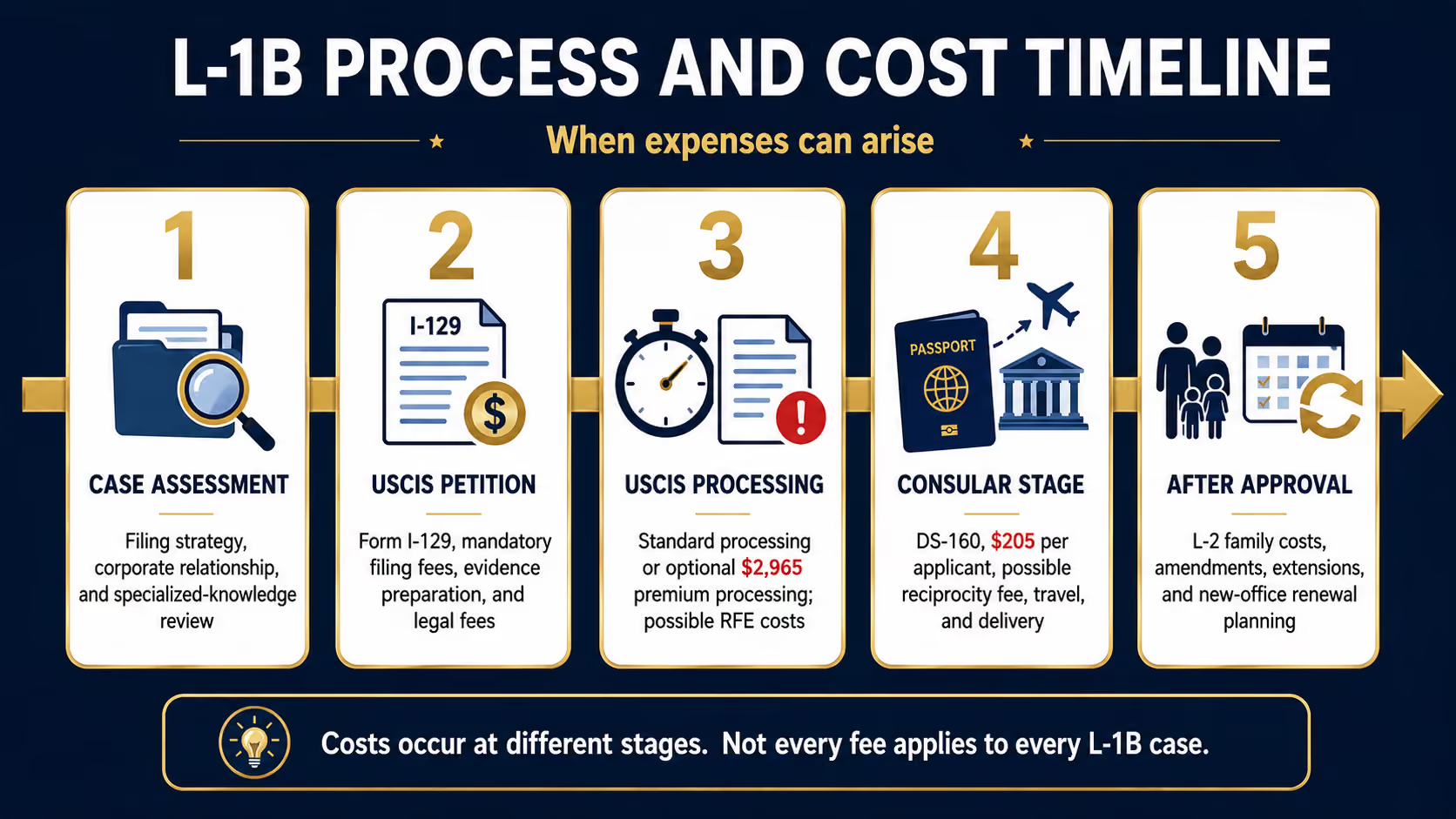
Translations and foreign corporate records. Documents issued outside the United States may require certified English translations. The employer may also need to obtain corporate registrations, ownership records, payroll documents, tax filings, or employment records from foreign authorities or affiliated companies. Retrieval, certification, and translation costs vary by country and document volume.
Technical and specialized-knowledge documentation. An L-1B petition may require detailed product information, training records, project histories, technical explanations, or statements from managers and subject-matter experts. Preparing these materials can require time from the company’s legal, human resources, engineering, or operations teams. If an outside expert or technical writer is needed, that work may be priced separately.
Business plans and financial evidence. New-office cases may require a business plan, financial projections, market information, lease documentation, capitalization records, and evidence of planned U.S. operations. Fees charged by accountants, business-plan professionals, corporate attorneys, or consultants are normally separate from the immigration lawyer’s fee.
Requests for Evidence and other USCIS responses. USCIS may issue a Request for Evidence when it needs more information about specialized knowledge, the corporate relationship, foreign employment, the U.S. position, or another eligibility issue. The cost of responding depends on the engagement agreement and the amount of new factual or legal work required. Routine responses may be included in some legal-fee arrangements, while complex L-1B responses may require an additional fee.
Changes after the petition is prepared or filed. A new worksite, revised job description, corporate restructuring, delayed start date, or change in the employee’s assignment may require additional legal review. If the change is material, the employer may need an amended petition and another set of filing fees.
Urgent preparation and premium processing. Premium processing accelerates USCIS action after the case is filed, but it does not shorten the time needed to prepare the petition. An employer requesting last-minute case preparation may face a separate expedited legal-service charge in addition to the $2,965 USCIS premium-processing fee.
Consular and travel expenses. Employees applying abroad may incur visa fees, reciprocity charges, transportation, lodging, passport delivery, and appointment-related expenses. Administrative processing or a second interview can also create indirect costs through delayed travel or extended accommodation.
L-2 family expenses. Each spouse or child may have separate visa, Form I-539, travel, and legal costs. These amounts can become significant when several dependents apply together.
Printing, international courier services, duplicate petition copies, and secure delivery of a large filing package can create smaller additional charges. Employers should also consider the internal cost of collecting records and coordinating with teams in different countries and time zones.
A realistic L-1B budget should include a reasonable allowance for evidence preparation and unexpected case developments. That does not mean assuming that every possible expense will occur. It means identifying which costs are fixed, which are optional, and which depend on how the case develops.
The U.S. employer generally pays the costs connected to preparing and filing the L-1B petition, including Form I-129, the Asylum Program Fee, the Fraud Prevention and Detection Fee, and employer-side legal fees. The employee and family members often pay their own visa application, reciprocity, travel, and personal-document expenses, although an employer may choose to reimburse them.
The exact allocation should be confirmed in writing. Company policy does not override federal or state wage laws, and employers should review any repayment or cost-shifting arrangement before deducting immigration expenses from an employee’s wages.
The employer is the petitioner in an individual L-1B case. It signs Form I-129, requests authorization to employ the transferred worker, and submits the petition to USCIS. For that reason, the filing costs tied directly to the employer’s petition are normally treated as business immigration expenses.
USCIS states that the L-1 petitioner must pay the $500 Fraud Prevention and Detection Fee when it applies. The same employer-centered approach generally applies to the Form I-129 fee, Asylum Program Fee, and additional Public Law 114-113 fee.
The USCIS Policy Manual on L-1 filings explains which petition events trigger the fraud fee and other L-related charges.
Attorney fees for preparing the employer’s petition are also ordinarily paid by the company. The legal work involves the employer’s corporate structure, business records, proposed position, and request for authorization to employ the beneficiary. An employee may obtain separate legal advice at personal expense if individual immigration concerns fall outside the employer’s representation.
The $205 visa application fee, possible reciprocity fee, passport expenses, and interview travel are often paid initially by the employee. Some companies reimburse all or part of these expenses, particularly when international travel is required for the transfer.
L-2 spouses and children may also have separate visa, Form I-539, legal, and travel costs. Whether the employer covers dependent expenses usually depends on the company’s relocation or immigration policy rather than the principal L-1B petition itself.
A blanket L case follows a slightly different collection process. The principal applicant generally pays the $500 fraud fee at the consulate, along with the $205 visa application fee and any applicable reciprocity charge. The employer may later reimburse those expenses.
Premium processing can fall into either category. An employer requesting faster adjudication for a project deadline or business need will often pay the fee. If the request is primarily for the employee’s personal travel or convenience, the company may use a different arrangement. The payment decision should be documented before the request is filed.
L-1B cases do not use the same Labor Condition Application and wage-fee framework that applies to H-1B petitions. That does not mean an employer can automatically shift every immigration expense to the employee.
A deduction or reimbursement agreement may still be affected by federal and state minimum-wage rules, payroll laws, contract principles, and restrictions on penalties for leaving employment. The analysis may also differ depending on the fee involved and whether the expense primarily benefits the employer or employee.
Employers should be particularly cautious about requiring repayment of statutory petition fees, the fraud fee, the Public Law 114-113 fee, or employer-side legal costs. A repayment provision should not be treated as a routine clause without review of the governing law and the employee’s work location.
The safest budgeting approach is to identify, before filing, which costs the company will pay directly, which personal expenses it will reimburse, and which dependent expenses remain the employee’s responsibility. Clear allocation reduces disputes and prevents unexpected deductions after the immigration process has begun.
L-1B, L-1A, and H-1B cases can all involve Form I-129, premium processing, attorney fees, and consular expenses. Their full cost structures differ because each category has separate eligibility rules and statutory charges.
L-1A and L-1B petitions generally use the same government fee structure. H-1B petitions have a lower Form I-129 fee but may involve additional costs such as the H-1B registration fee and ACWIA training fee.
The government fees for an individual L-1A and L-1B petition are generally the same. Both categories use the L-specific Form I-129 fee, Asylum Program Fee, and $500 Fraud Prevention and Detection Fee for a qualifying initial petition. The $4,500 Public Law 114-113 fee and $2,965 premium-processing fee apply under the same general rules.
AVLG currently publishes the same standard legal fees for both classifications: $6,200 for an initial petition, $5,100 for qualifying subsequent cases, and $4,600 for extensions.
The main difference is not the filing fee but the evidence. An L-1A case must establish that the employee will work in a primarily managerial or executive capacity. An L-1B case must document specialized knowledge and show how that knowledge qualifies under the legal standard.
A new-office L-1A case may require extensive evidence about the company’s staffing plan and its ability to support a managerial or executive position within one year. A new-office L-1B case focuses more heavily on the company’s operations, physical premises, financial capacity, and need for the employee’s specialized knowledge. The amount of preparation can therefore differ even when the quoted government and legal fees begin at the same level.
L-1A status can generally be held for up to seven years, while L-1B status is generally limited to five years. That difference may affect long-term extension and immigration-planning costs. Readers can review the complete figures in AVLG’s guide to the L-1A visa cost in 2026.
The H-1B fee structure is different. The standard Form I-129 fee for an H-1B petition is $780, or $460 for a qualifying small employer or nonprofit. Those amounts are lower than the corresponding $1,385 and $695 L-petition fees.
However, many H-1B employers must pay additional charges that do not apply to L-1B petitions. These may include:
An L-1B employer does not pay an H-1B registration fee or ACWIA training fee. The L-1B process also does not require a Labor Condition Application. However, the L-specific Form I-129 fee is higher, and the petition may require extensive corporate and specialized-knowledge evidence.
AVLG’s published legal fee is $6,200 for an initial L-1B petition, compared with $2,750 for a standard H-1B petition, subject to possible additional charges for urgency, RFEs, or case-specific complications. The difference reflects the usual scope of work, but an individual quote still depends on the facts and services required.
The H-1B category is generally based on a specialty-occupation position and the employee’s qualifying education or equivalent experience. It may also be subject to the annual H-1B cap and selection process. The L-1B category has no annual lottery, but it requires a qualifying relationship between the U.S. and foreign organizations and qualifying employment abroad.
A detailed breakdown of the separate charges is available in AVLG’s H-1B visa cost guide for 2026.
An employer should not select L-1B, L-1A, or H-1B status solely because one category appears less expensive. The employee and proposed position must satisfy the requirements of the classification used.
An H-1B petition cannot replace an L-1B case when the position does not qualify as a specialty occupation or the employer cannot meet the H-1B wage and filing requirements. Similarly, an employee cannot qualify for L-1B status without the required foreign employment, qualifying corporate relationship, and specialized knowledge.
Cost becomes relevant after the viable options are identified. The better comparison considers eligibility, timing, period of stay, evidence, long-term immigration plans, government fees, and legal preparation together.
A reliable L-1B budget should separate required government fees from conditional charges, optional services, attorney fees, and personal expenses. Adding every possible fee together can overstate the likely cost, while counting only Form I-129 can substantially understate it.
A practical formula is:
Total L-1B budget = mandatory USCIS fees + conditional fees + optional premium processing + legal fees + evidence costs + consular and dependent expenses.
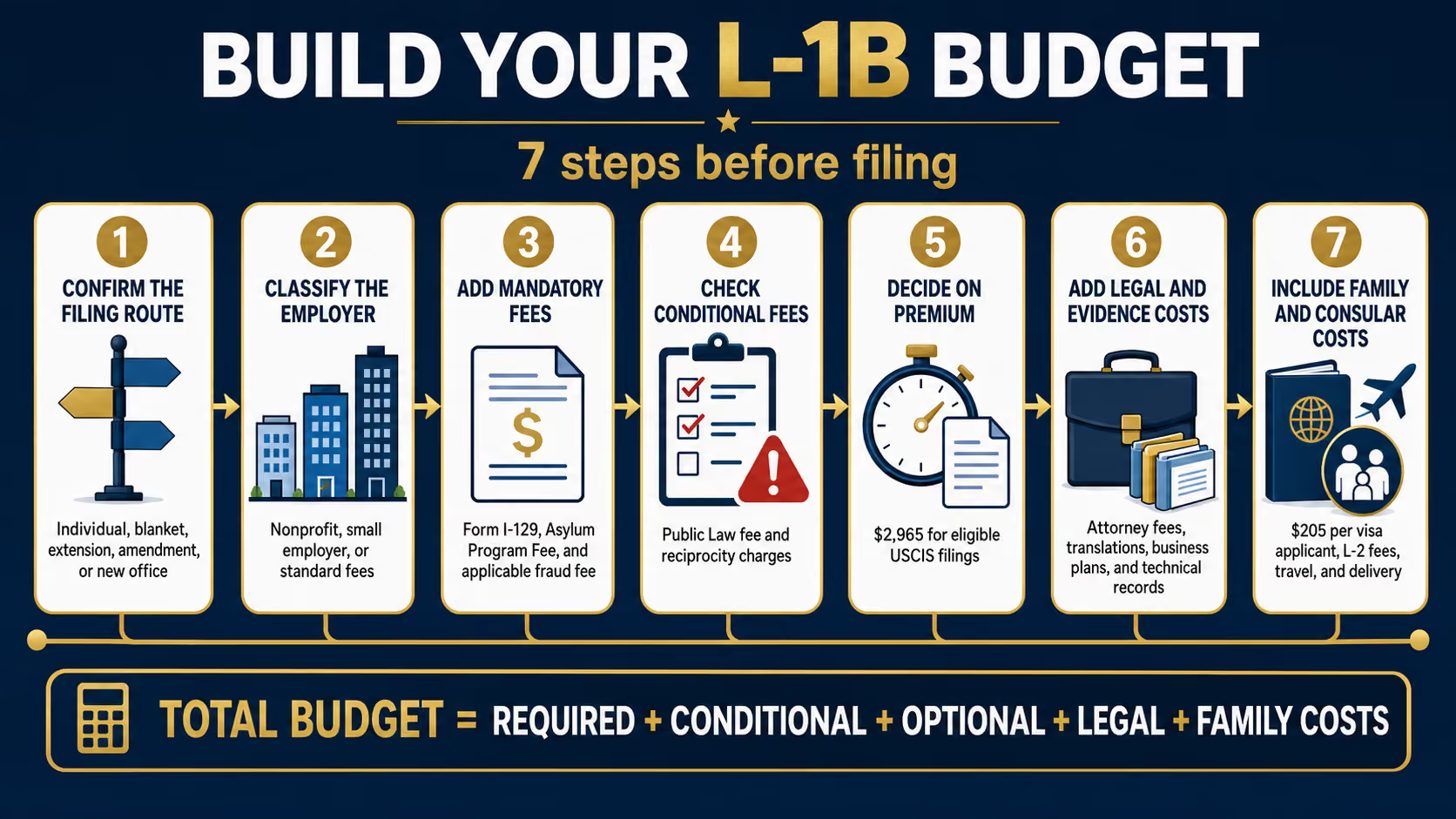
Begin by determining whether the employee will use an individual L-1B petition or apply under an existing blanket L approval. An individual petition generally involves Form I-129 and several USCIS fees. A blanket applicant applying abroad generally follows a consular fee structure using Form I-129S.
Also determine whether the case is an initial petition, extension, amendment, change of employer, or new-office filing. Each filing type can trigger a different combination of fees.
Confirm whether the petitioner is a qualifying nonprofit, a small employer with 25 or fewer full-time-equivalent employees, or an employer subject to the standard fees.
This classification affects both the Form I-129 fee and the Asylum Program Fee. The employer should also review whether it has at least 50 U.S. employees and whether more than 50% hold H-1B or L-1 status. Those workforce facts determine whether the additional $4,500 Public Law 114-113 fee may apply.
For an initial individual L-1B petition, start with the applicable Form I-129 fee, Asylum Program Fee, and $500 Fraud Prevention and Detection Fee.
Then add conditional charges only when the facts trigger them. The $4,500 fee does not apply to every large employer, and the $500 fraud fee generally does not repeat for a routine extension filed by the same petitioner.
Keeping required and conditional fees in separate lines makes the budget easier to verify.
Premium processing adds $2,965. It can be useful when the employee’s start date, current status, travel schedule, or project timing requires faster USCIS action.
The employer should decide whether the timing benefit justifies the cost. Premium processing does not strengthen the evidence or guarantee approval. It can also be requested after filing if the case later becomes urgent.
Include the attorney fee for the specific filing type and confirm what the engagement agreement covers. Employers should ask whether the quoted fee includes consular assistance, dependents, an RFE response, an amendment, or urgent preparation.
The budget should also account for possible translations, business plans, technical documentation, corporate-record retrieval, expert assistance, and international courier services. New-office cases and complicated ownership structures may require more third-party work than a standard petition.
If the employee will apply for a visa abroad, add the $205 application fee, any nationality-based reciprocity charge, and expected travel or passport-delivery costs.
Each L-2 spouse or child may have a separate $205 visa fee. Dependents applying inside the United States may instead require Form I-539 and the corresponding USCIS and legal fees.
The company should decide in advance which employee and family expenses it will reimburse. That decision affects the employer’s budget even when the fee is initially paid by the applicant.
Government fees, form editions, and payment instructions can change. Recalculate the total shortly before the petition is submitted using the official USCIS Fee Calculator and current form instructions.
The final budget should identify:
The goal is not to predict every possible expense. It is to understand the likely cost of the selected filing strategy and identify the events that could increase it. A clear budget helps the employer plan the transfer without confusing the initial filing fee with the complete L-1B cost.
USCIS does not require an employer to hire an attorney for an L-1B petition. A company may prepare and file the case on its own. However, legal representation can be valuable when the eligibility analysis, corporate structure, or specialized-knowledge evidence requires more than routine form preparation.
The question is not simply whether an attorney can complete Form I-129. The more useful question is whether the employer can independently identify the correct filing strategy, apply the L-1B legal standard, and present a coherent record that addresses the likely areas of review.
An L-1B lawyer can help determine whether the employee’s knowledge is genuinely special or advanced under USCIS standards. This often requires comparing the employee with other workers, explaining company-specific systems or processes, and showing how the knowledge was acquired and used abroad.
Counsel may also examine whether the U.S. and foreign companies have a qualifying relationship. Ownership structures involving holding companies, investors, affiliates, joint ventures, acquisitions, or reorganizations can require more analysis than a straightforward parent-subsidiary relationship.
Legal representation may be particularly useful when the case involves:
The attorney can also help distinguish between a case that needs an individual petition and one that may proceed under an approved blanket L petition. Choosing the wrong route can create unnecessary expense or delay.
The legal work may include evaluating eligibility, identifying missing evidence, reviewing corporate documents, developing the specialized-knowledge explanation, preparing forms and support letters, and organizing the filing package.
A lawyer can also look for inconsistencies across the employee’s résumé, organizational charts, prior visa filings, company records, and proposed job description. Small differences may have reasonable explanations, but unresolved contradictions can weaken the petition.
Counsel may coordinate the USCIS petition with later consular processing, travel, dependent applications, and extension planning. This broader review can be important when a filing decision affects the employee’s current status or the company’s operational timeline.
For employer-sponsored representation, the employer is often the law firm’s client. The employee should understand who the attorney represents and whether separate advice may be appropriate for personal immigration issues that differ from the employer’s interests.
An attorney cannot guarantee that USCIS will approve an L-1B petition. Representation also cannot replace missing corporate records, create specialized knowledge that the employee does not possess, or make an ineligible position qualify.
Hiring counsel does not automatically make USCIS process the case faster. Faster agency action generally requires premium processing or another legally available expedite mechanism. Even with premium processing, USCIS may issue an RFE, NOID, or denial.
The attorney’s role is to identify issues, advise on strategy, develop the record, and reduce avoidable filing errors. The final decision remains with USCIS or, at the visa stage, the Department of State.
A straightforward extension supported by an experienced in-house immigration team may require less outside assistance than an initial petition involving specialized technology, multiple foreign entities, or a new U.S. operation.
Employers should compare the legal fee with the actual scope of work. A lower quote may cover forms and basic document review, while another may include strategy, extensive drafting, corporate analysis, and post-filing support.
Hiring an L-1B lawyer is most likely to justify the cost when the case requires legal judgment, careful evidence development, or coordination across several stages. The decision should be based on the petition’s complexity and business importance, not on an assumption that representation guarantees success.
The L-1B visa cost in 2026 depends on the employer, filing route, employee, and family circumstances. For a typical initial individual petition, mandatory USCIS fees generally range from $1,195 to $2,485. Premium processing adds $2,965, while certain employers may owe the additional $4,500 Public Law 114-113 fee.
Those figures do not include L-1B attorney fees, visa stamping, reciprocity charges, dependent applications, translations, travel, business-plan preparation, or other case-specific expenses.
Before filing, employers should confirm four key points:
The budget should also reflect the evidence required to establish specialized knowledge and the qualifying relationship between the U.S. and foreign companies. A petition involving a new office, complicated ownership structure, missing foreign records, or prior immigration issues may require more preparation than a straightforward extension.
Employers transferring workers with spouses or children should calculate the family’s expenses separately. Each dependent may have a visa or Form I-539 fee, and the company should decide which personal and family costs it will reimburse.
Government fees and legal fees serve different purposes. USCIS and Department of State charges cover agency processing. Attorney fees cover legal analysis, filing strategy, document review, evidence development, forms, and preparation of the petition. Third-party costs, including translations and business services, may fall outside both categories.
The safest approach is to calculate the expected cost based on the actual filing strategy rather than relying on a single online estimate. Government fees, form editions, and payment instructions should be verified immediately before submission.
American Visa Law Group advises multinational employers and specialized-knowledge professionals on initial L-1B petitions, new-office filings, extensions, amendments, blanket applications, and related consular planning. Employers seeking a case-specific review can contact American Visa Law Group or call 510-500-1155 to schedule a consultation.
Legal representation does not guarantee approval, but an individualized review can help the employer identify the correct process, expected fees, evidentiary requirements, and potential filing issues before committing resources to the case.
For a typical initial individual petition, mandatory USCIS fees generally total $1,195 for a qualifying nonprofit, $1,495 for a qualifying small employer, or $2,485 for an employer subject to the standard fees.
These amounts exclude attorney fees, premium processing, visa stamping, reciprocity charges, L-2 dependents, translations, travel, and evidence-related expenses. Certain employers may also owe the additional $4,500 Public Law 114-113 fee.
The standard Form I-129 filing fee for an L petition is $1,385. A qualifying small employer or nonprofit organization pays a reduced fee of $695.
Form I-129 is only one part of the government cost. The employer must separately determine whether the Asylum Program Fee, $500 Fraud Prevention and Detection Fee, $4,500 additional employer fee, or optional premium-processing fee applies.
American Visa Law Group’s published legal fee is $6,200 for an initial L-1B petition, $5,100 for qualifying subsequent cases, and $4,600 for extensions.
Attorney fees vary by firm, case complexity, and scope of representation. Government filing fees, consular applications, dependents, translations, business plans, and complex RFE responses may be separate. The written engagement agreement should explain what is included.
The L-1B premium-processing fee is $2,965 for requests filed on or after March 1, 2026. The employer requests the service by filing Form I-907 with the petition or while an eligible petition is pending.
For most L-1B cases, USCIS must take adjudicative action within 15 business days. That action may be an approval, denial, Request for Evidence, Notice of Intent to Deny, or another qualifying action. Premium processing does not guarantee approval.
No. The $500 Fraud Prevention and Detection Fee generally applies to an initial L-1B petition for a particular employee or when a qualifying new employer files for an L-1 worker.
The fee generally does not repeat for a routine extension filed by the same petitioner for the same employee. Blanket L principal applicants generally pay the fee during consular processing.
The U.S. employer generally pays the petition-related expenses, including Form I-129, the Asylum Program Fee, applicable statutory employer fees, and employer-side legal costs.
The employee or family may initially pay visa application fees, reciprocity charges, and travel expenses. Some employers reimburse these costs. Any wage deduction or repayment agreement should be reviewed for compliance with applicable federal and state law.
It can be, particularly for an established multinational organization that transfers employees regularly. A straightforward blanket applicant applying abroad may avoid a separate Form I-129 petition and Asylum Program Fee for each individual transfer.
However, the principal applicant generally still pays the $205 visa fee and $500 fraud fee, plus any applicable reciprocity or Public Law 114-113 charge. The organization must first qualify for blanket approval, and each employee must independently establish eligibility.
Each L-2 family member applying through a U.S. consulate generally pays a separate $205 visa application fee. A nationality-based reciprocity fee may also apply.
Dependents requesting an extension or change of status inside the United States may need Form I-539. The current fee is generally $470 for a paper filing or $420 for an eligible online application. Legal fees, travel, translations, and passport delivery are separate.
A routine extension is often less expensive because the $500 fraud fee and $4,500 Public Law 114-113 fee generally do not repeat when the same employer continues the same qualifying employment.
The mandatory USCIS fees generally total $695 for a nonprofit, $995 for a small employer, or $1,985 for an employer subject to the standard fees. Premium processing and legal fees remain separate. AVLG’s published legal fee for an L-1B extension is $4,600.
A new-office petition generally uses the same USCIS fee structure as another initial L-1B case. The mandatory government fees ordinarily begin at $1,195, $1,495, or $2,485, depending on the employer’s classification.
The total cost may be higher because the employer may need a business plan, lease evidence, financial projections, capitalization records, translations, and more extensive corporate documentation. The initial new-office approval is limited to one year, so the company should also budget for an earlier extension.
The following government resources provide additional guidance on L-1B eligibility, filing fees, premium processing, and consular procedures. Because immigration fees and policies may change, readers should confirm the latest requirements before filing.

Hasan Abdullah, Esq. is the Founder and Managing Attorney of American Visa Law Group. His practice focuses on U.S. immigration law, including family-based immigration, employment-based immigration, adjustment of status, consular processing, waivers, PERM labor certification, NIW, EB-1, H-1B, O-1, and complex immigration strategy.
Through American Visa Law Group, Mr. Abdullah helps individuals, families, professionals, investors, and employers understand their immigration options and plan around changing government policies, USCIS procedures, and Visa Bulletin movement. His work emphasizes practical legal analysis, realistic expectations, and strategy tailored to each applicant’s immigration history and long-term goals.


