Author: Hasan Abdullah, Esq.
The September 2026 Visa Bulletin closes fiscal year 2026 with sharply different results for family-sponsored and employment-based applicants. According to the official Department of State Visa Bulletin for September 2026, several family-sponsored categories move forward substantially, particularly for applicants from India, China and the Rest of the World. Progress is more limited for Mexico and the Philippines.
Employment-based movement remains cautious. EB-4 advances by two months for every country, but most other Final Action Dates remain unchanged from August. India EB-2 and EB-5 Unreserved remain unavailable, while the Department of State warns that demand could still cause retrogression or unavailability in certain employment-based categories before the fiscal year ends.
USCIS chart selection is also critical. Family-sponsored applicants may use the Dates for Filing chart in September, while employment-based applicants must use the Final Action Dates chart. Filing eligibility does not necessarily mean that a green card can be approved immediately.
This article compares September 2026 with August 2026 and September 2025, explains the country-specific developments and identifies what applicants should monitor as fiscal year 2027 begins. Readers who need individualized help interpreting their priority date can explore AVLG’s immigration legal services.
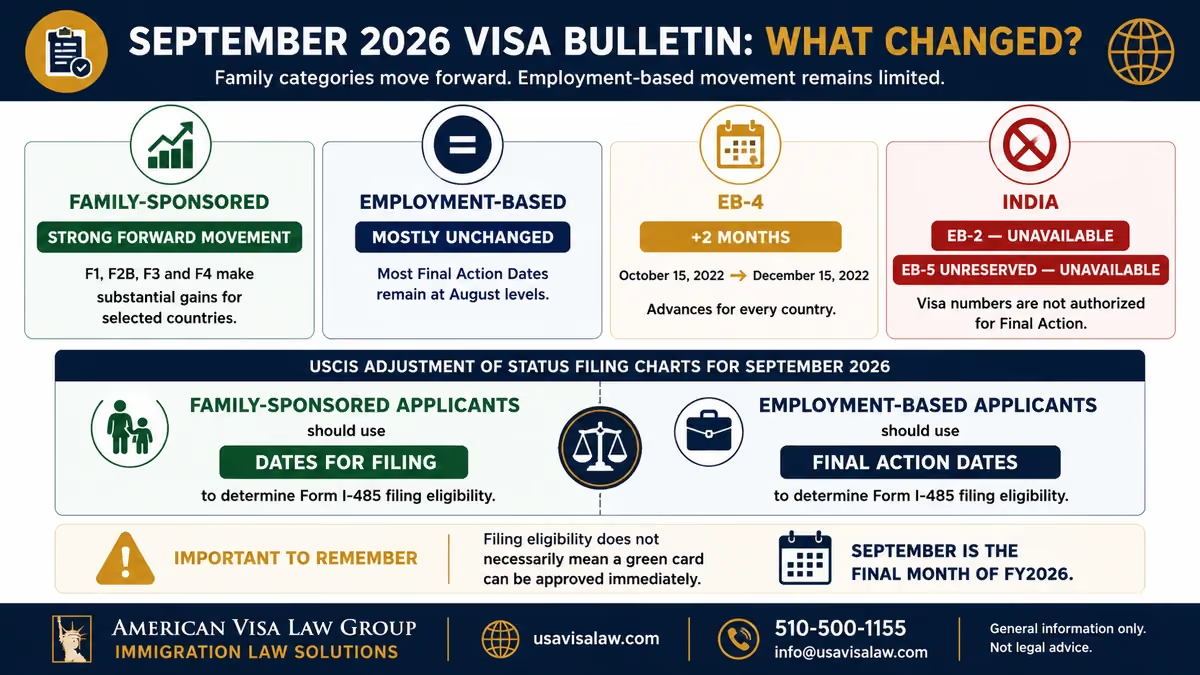
The September 2026 Visa Bulletin brings substantial family-sponsored advancement but very little employment-based movement. The strongest gains affect F1, F2B, F3 and F4 applicants in the Rest of the World, China and India columns.
Family-sponsored applicants receive the clearest improvement. For the Rest of the World, China and India, some Final Action Dates advance by more than a year, while Mexico and the Philippines experience more limited movement. F2A also advances by one month under the Final Action Dates chart and remains current under Dates for Filing for every country.
Employment-based applicants face a more restrained picture. EB-1, EB-2, EB-3, Other Workers and EB-5 Final Action Dates remain unchanged. EB-4 and Certain Religious Workers provide the principal exception, advancing from October 15, 2022, to December 15, 2022.
Applicants should verify the official USCIS adjustment-of-status filing charts before filing. September is the final month of fiscal year 2026, and the Department of State cautions that additional demand could still cause retrogression or make certain categories unavailable before September 30.
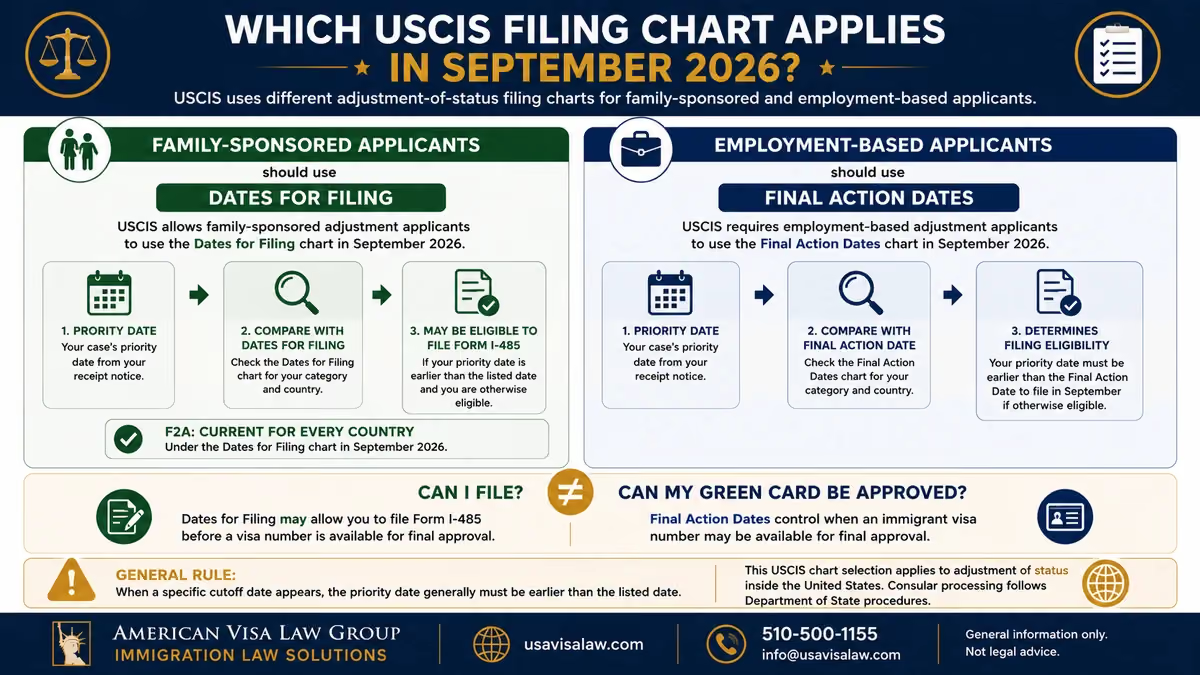
For September 2026, USCIS selected different adjustment-of-status filing charts for family-sponsored and employment-based applicants:
This distinction determines which cutoff date an applicant must compare with the priority date when considering whether Form I-485 may be filed.
Family-sponsored applicants receive the more favorable chart. An otherwise eligible applicant may generally file Form I-485 if the priority date is earlier than the applicable date in the family-sponsored Dates for Filing chart. F2A is current under that chart for every country, meaning the priority date does not create a filing restriction for an otherwise eligible applicant in September.
Employment-based applicants must use the more restrictive Final Action Dates chart. Their priority date generally must be earlier than the cutoff listed for the applicable preference category and country of chargeability. A category marked “U” is unavailable, meaning visa numbers are not authorized for issuance during that period.
The two charts serve different purposes. Dates for Filing may permit an applicant to submit Form I-485 and begin the adjustment process before a visa number is available for final approval. Final Action Dates control when an immigrant visa number may be available and when USCIS may approve the green card.
Using the Dates for Filing chart therefore does not guarantee immediate approval. A family-sponsored application filed in September may remain pending until the priority date becomes current under the applicable Final Action Date.
USCIS chart selection applies specifically to adjustment of status inside the United States. Applicants completing consular processing should follow instructions from the Department of State and the National Visa Center. Because chart selection can change monthly, applicants should confirm the applicable chart before every filing.
Family-sponsored Final Action Dates move forward broadly in September. The largest gains affect F1, F2B, F3 and F4 applicants in the Rest of the World, China and India columns, while movement for Mexico and the Philippines is more limited.
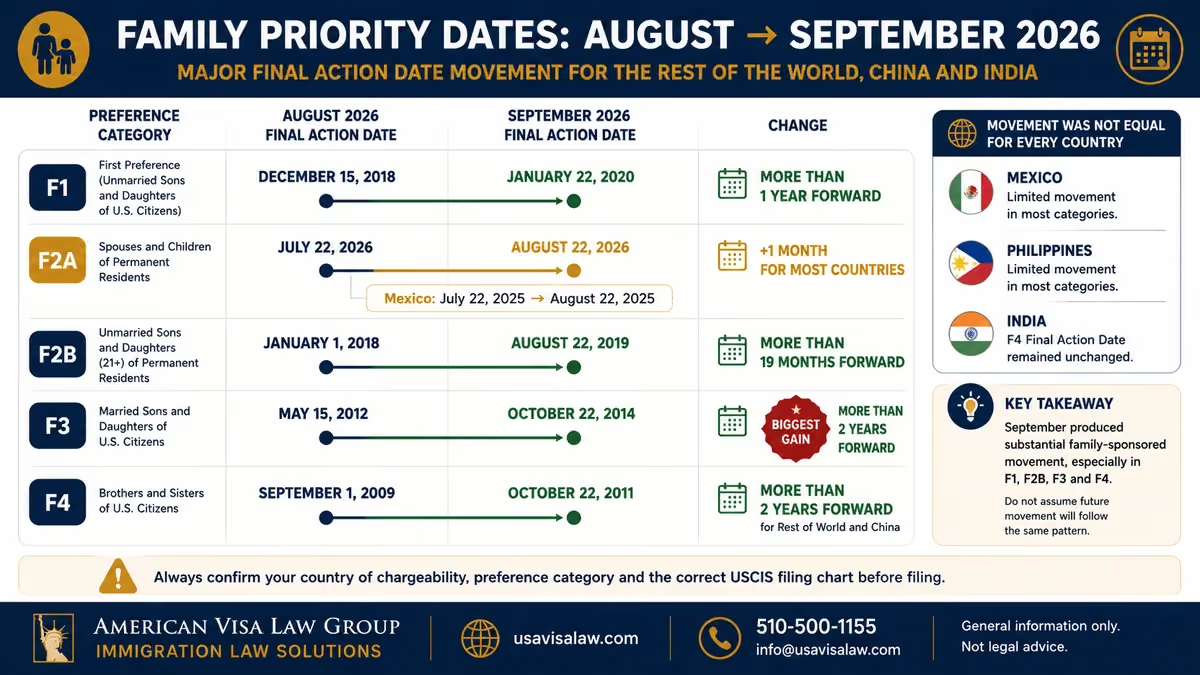
F3 produces the largest advancement for the Rest of the World, China and India, moving forward by more than two years. F4 also advances by more than two years for the Rest of the World and China, while F2B gains more than 19 months in the three shared columns. These changes may allow many applicants with priority dates near the previous cutoffs to become eligible for final action.
F1 advances by more than one year for the Rest of the World, China and India. F2A makes a more modest one-month advance, but that movement is still relevant because the category serves spouses and unmarried children under 21 of lawful permanent residents.
Mexico receives only limited progress in F1 and F2A. The Philippines advances in F2A and receives a 21-day improvement in F4, while its other family-sponsored Final Action Dates remain unchanged.
Applicants must compare their priority date with the correct preference category and country column. For final action, the priority date generally must be earlier than the listed cutoff. Readers seeking additional information about qualifying relationships and preference categories can review AVLG’s family-based immigration services.
USCIS allows family-sponsored applicants to use the Dates for Filing chart in September 2026. Several categories advance significantly, potentially allowing additional applicants to submit Form I-485 if they are otherwise eligible.
F3 receives the strongest Dates for Filing advancement, moving forward by 20 months for the Rest of the World, China and India. F4 advances by more than 16 months for the Rest of the World and China, while F1 and F2B each gain approximately eight months in the shared columns.
F2A remains current for every country. An otherwise eligible F2A applicant seeking adjustment of status may therefore be able to file Form I-485 without a priority-date restriction under the September filing chart.
However, a current or advanced Dates for Filing cutoff does not mean that USCIS can approve the green card immediately. Final approval generally requires the priority date to become current under the applicable Final Action Date.
Applicants should also remember that the country-specific gains are uneven. Mexico and the Philippines receive no movement in the September Dates for Filing chart, while India benefits in F1, F2B and F3 but remains unchanged in F4.
Employment-based movement is limited in the September 2026 Visa Bulletin. EB-4 and Certain Religious Workers advance by two months, while all other employment-based Final Action Dates remain unchanged from August.
Because USCIS requires employment-based applicants to use the Final Action Dates chart in September, these dates also control whether an otherwise eligible applicant may file Form I-485 during the month.
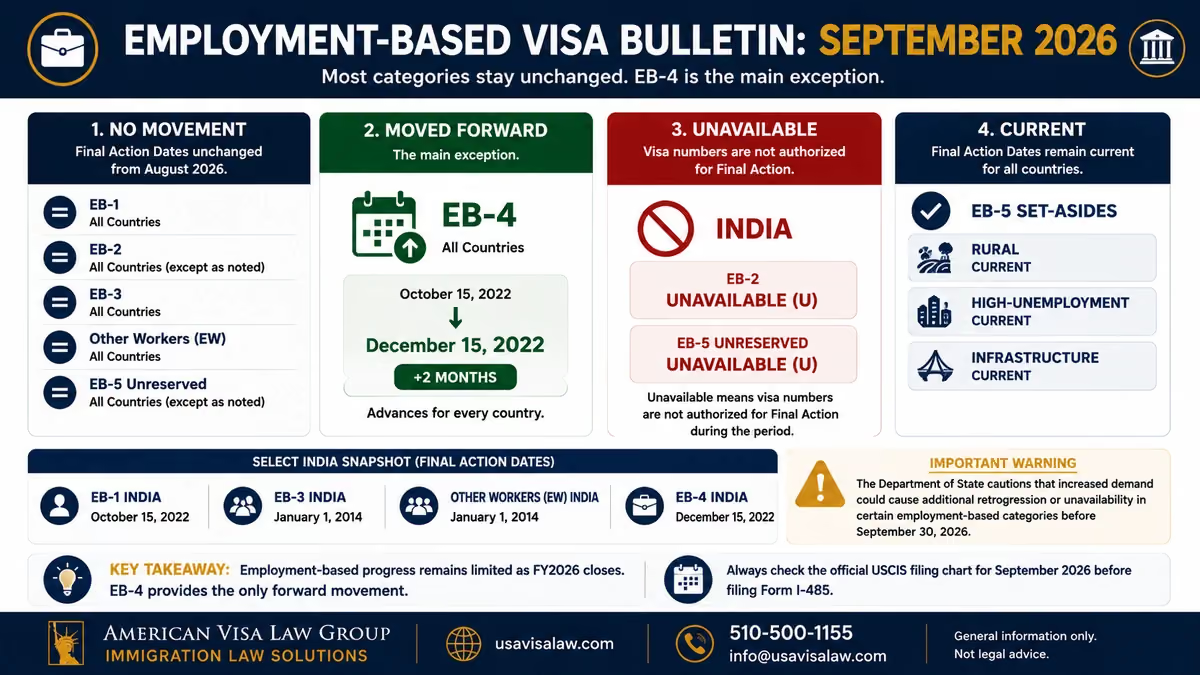
India continues to face the most restrictive employment-based conditions. EB-2 and EB-5 Unreserved remain unavailable, while EB-1 stays at October 15, 2022. The Department of State warns that India EB-1 could also become unavailable if the applicable limit is reached before September 30.
EB-4 provides the only forward movement, advancing to December 15, 2022, for every country. EB-3 and Other Workers remain unchanged, preserving the same backlogs applicants faced in August.
The Department of State also cautions that increased demand could require additional retrogression or unavailability in EB-2 and EB-5 Unreserved before the fiscal year closes. Applicants with priority dates close to a cutoff should therefore monitor visa availability through the end of September. Those seeking broader guidance can review AVLG’s employment-based green card services.
The September bulletin affects each chargeability area differently. Family-sponsored applicants generally receive the strongest gains, while employment-based progress remains limited outside EB-4.
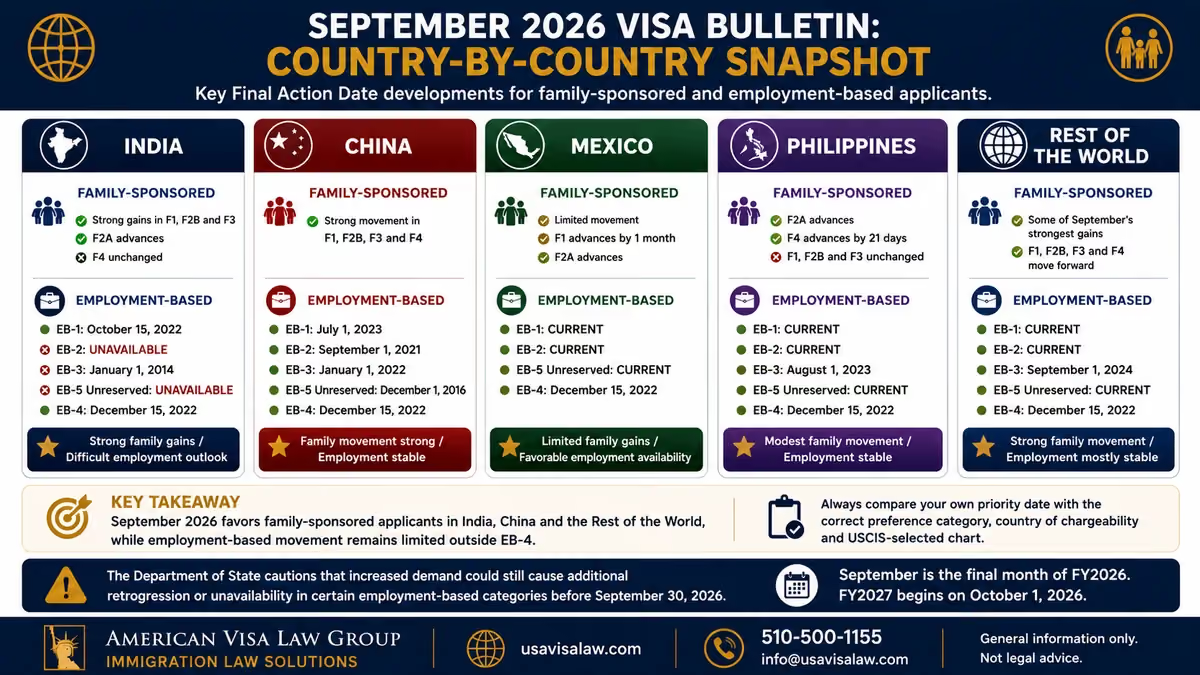
India benefits from substantial family-sponsored advancement. F1 reaches January 22, 2020, F2B moves to August 22, 2019, and F3 advances to October 22, 2014. F2A also moves forward by one month, while F4 remains unchanged at November 1, 2006.
The employment-based outlook remains difficult. EB-1 stays at October 15, 2022, EB-3 and Other Workers remain at January 1, 2014, and both EB-2 and EB-5 Unreserved remain unavailable. EB-4 advances to December 15, 2022, while all three EB-5 set-aside categories remain current.
China receives strong movement in F1, F2B, F3 and F4. Its family-sponsored dates generally match the Rest of the World, including a Final Action Date of October 22, 2011, for F4.
Employment-based dates remain unchanged. EB-1 stays at July 1, 2023, EB-2 at September 1, 2021, and EB-3 at January 1, 2022. EB-5 Unreserved remains at December 1, 2016, while the set-aside categories remain current.
Mexico sees limited family-sponsored progress. F1 advances by one month to January 1, 2008, and F2A moves to August 22, 2025. F2B, F3 and F4 remain unchanged.
The employment-based picture is more favorable. EB-1, EB-2 and EB-5 Unreserved remain current. EB-3 stays at September 1, 2024, Other Workers at April 1, 2022, and EB-4 advances to December 15, 2022.
The Philippines receives a one-month F2A advance and a 21-day improvement in F4. F1, F2B and F3 do not move from their August Final Action Dates.
EB-1, EB-2 and EB-5 Unreserved remain current. EB-3 holds at August 1, 2023, Other Workers at December 1, 2021, and EB-4 moves forward to December 15, 2022.
The Rest of the World column receives some of September’s strongest family-sponsored gains. F1 advances to January 22, 2020, F2B to August 22, 2019, F3 to October 22, 2014, and F4 to October 22, 2011. F2A moves forward by one month.
Employment-based dates are largely stable. EB-1, EB-2 and EB-5 Unreserved remain current, while EB-3 stays at September 1, 2024, Other Workers at April 1, 2022, and EB-4 advances to December 15, 2022.
A comparison with the official September 2025 Visa Bulletin shows substantial family-sponsored progress, but a mixed employment-based picture.
Family-sponsored progress is substantial. F1, F2A, F2B and F3 are considerably further ahead than they were in September 2025 for the Rest of the World, China and India. F4 also improves for several countries, although India remains fixed at November 1, 2006.
Employment-based results are mixed. EB-1 India and EB-3 move forward year over year, and EB-4 is available again after being unavailable in September 2025. By contrast, India EB-2 and EB-5 Unreserved had cutoff dates one year ago but are unavailable in September 2026.
The worldwide employment-based preference limit is also higher in fiscal year 2026, rising from 150,037 to 186,317. That increase does not eliminate category-specific demand or per-country limits, which helps explain why some categories improved while others remain unavailable.
An unavailable category should not be treated as having a later cutoff date. It means immigrant visa numbers are not authorized for final action during that period. The year-over-year comparison provides useful context, but applicants should make filing and case decisions using the current September 2026 chart.
The most responsible short-term prediction is continued volatility rather than guaranteed forward movement. September is the final month of fiscal year 2026, when the Department of State must keep immigrant visa issuance within annual, category-specific and per-country limits.
Additional unavailability remains possible before September 30. DOS specifically warns that high demand could cause India EB-1 to become unavailable if its applicable limit is reached. It also states that EB-2 and EB-5 Unreserved may require retrogression or unavailability before the fiscal year ends. These are official warnings, not confirmed outcomes, and DOS has not announced specific replacement dates.
India EB-2 and EB-5 Unreserved are already unavailable. The broader warnings matter most to applicants in countries where those categories remain current or have active cutoff dates. A category that appears favorable at the beginning of September could still become unavailable if the remaining visa supply is exhausted.
October begins a new fiscal year. Fiscal year 2027 starts on October 1, bringing a new annual allocation of immigrant visa numbers. Categories that became unavailable may receive cutoff dates again, including India EB-2 and EB-5 Unreserved. However, a new allocation does not guarantee that a category will become current or advance substantially. DOS may establish conservative dates while evaluating demand.
Family-sponsored applicants should not assume that September’s large advances will continue at the same pace. DOS explains that several dates moved forward during fiscal year 2026 partly because visa issuance rates were lower than expected. If additional demand appears after those advances, some dates could remain unchanged or retrogress.
Applicants should monitor the October 2026 Visa Bulletin for:
Visa Bulletin predictions are most useful when they identify realistic risks and confirmed government signals. They should not be treated as a substitute for the official monthly charts or as a basis for filing before eligibility is established.
The September 2026 Visa Bulletin may change when an applicant can file or receive final approval, but the appropriate next step depends on the preference category, priority date, country of chargeability and whether the case involves adjustment of status or consular processing.
Family-sponsored adjustment applicants may use Dates for Filing, while employment-based applicants must use Final Action Dates. After selecting the correct chart, find the appropriate category and country column.
A priority date generally must be earlier than the listed cutoff. If the category is current, the priority date does not create a filing restriction. If it is unavailable, visa numbers are not authorized for final action during that period.
A favorable date alone does not establish eligibility. Applicants must also satisfy the underlying petition, adjustment-of-status and admissibility requirements.
Applicants whose priority dates have become eligible should review the official Form I-485 requirements and filing instructions. Supporting records may include civil documents, immigration history, financial evidence and the required medical examination.
Do not submit Form I-485 solely because a date appears favorable. Filing under the wrong chart, using the wrong country column or overlooking another eligibility requirement may result in rejection, delay or more serious complications.
Retrogression or unavailability does not ordinarily cancel a properly filed Form I-485. USCIS may continue processing the application, but final approval generally must wait until an immigrant visa number becomes available.
Applicants with pending cases should continue monitoring USCIS notices, address updates, employment authorization, Advance Parole validity and any employment changes connected to the underlying petition. A pending application does not eliminate the need to respond to deadlines or maintain valid documents.
Applicants completing consular processing should follow instructions from the National Visa Center and the relevant U.S. embassy or consulate. USCIS chart selection applies to adjustment of status inside the United States and does not replace DOS procedures for immigrant visa cases abroad.
Submitting documents or becoming documentarily complete does not guarantee that an interview can be scheduled immediately. Final immigrant visa issuance still depends on the applicable Final Action Date, visa availability and completion of all consular requirements.
Family-sponsored adjustment-of-status applicants may use the Dates for Filing chart. Employment-based applicants must use the Final Action Dates chart. These selections apply only during September and may change in October.
F2A is current under the Dates for Filing chart for every country. It is not current under Final Action Dates: the cutoff is August 22, 2026, for most countries and August 22, 2025, for Mexico. Filing eligibility therefore does not guarantee immediate green card approval.
No. Both categories are marked unavailable in September 2026, meaning visa numbers are not authorized for final action. The EB-5 rural, high-unemployment and infrastructure set-aside categories remain current, but an applicant must qualify for the specific set-aside classification.
Generally, no. The priority date must be earlier than the applicable cutoff date, not equal to it. The applicant must also meet all other requirements for adjustment of status or immigrant visa processing.
Retrogression or unavailability does not ordinarily cancel a properly filed Form I-485. USCIS may continue processing the case, but final approval generally must wait until the priority date is current and an immigrant visa number is available.
October begins fiscal year 2027 and introduces a new annual allocation of immigrant visa numbers. Some unavailable categories may receive cutoff dates again, but substantial advancement is not guaranteed. Applicants should wait for the official October bulletin and USCIS filing-chart selection before making filing decisions.
September 2026 Visa Bulletin — U.S. Department of State
Review the official September 2026 Final Action Dates, Dates for Filing, annual visa limits and Department of State notes.
USCIS September 2026 Adjustment of Status Filing Charts
Confirm which Visa Bulletin chart USCIS permits family-sponsored and employment-based applicants to use in September 2026.
August 2026 Visa Bulletin — U.S. Department of State
Compare the September cutoff dates with the preceding month’s official charts and availability notices.
September 2025 Visa Bulletin — U.S. Department of State
Use the official September 2025 charts to evaluate year-over-year priority-date movement.
USCIS Visa Availability and Priority Dates
Learn how priority dates, country-of-chargeability rules and visa availability affect adjustment-of-status eligibility.
August 2026 Visa Bulletin: Priority Dates and USCIS Filing Charts
Review AVLG’s analysis of the previous month to understand how the September 2026 developments fit into the recent trend.
Green Card Priority Date Explained: How to Read the Visa Bulletin
Understand how to identify a priority date, select the correct chart and determine whether a cutoff date is current.

Hasan Abdullah, Esq. is the Founder and Managing Attorney of American Visa Law Group. His practice focuses on U.S. immigration law, including family-based immigration, employment-based immigration, adjustment of status, consular processing, waivers, PERM labor certification, NIW, EB-1, H-1B, O-1, and complex immigration strategy.
Through American Visa Law Group, Mr. Abdullah helps individuals, families, professionals, investors, and employers understand their immigration options and plan around changing government policies, USCIS procedures, and Visa Bulletin movement. His work emphasizes practical legal analysis, realistic expectations, and strategy tailored to each applicant’s immigration history and long-term goals.


