Author: Hasan Abdullah, Esq.
How long does I-140 processing take in 2026? USCIS processing times for Form I-140 vary by employment-based immigration category, with regular processing potentially taking several months or longer. Premium processing offers a faster USCIS response, generally within 15 business days for eligible EB-1, EB-2, and EB-3 petitions, or 45 business days for EB-1C and EB-2 National Interest Waiver (NIW) petitions.
However, faster processing does not guarantee approval or shorten every stage of the employment-based green card process. Understanding the difference is particularly important for professionals and employers making immigration and employment decisions.
This guide explains current I-140 processing times in 2026, compares regular and premium processing, examines timelines for EB-1A, EB-1C, EB-2 NIW, and EB-3 petitions, and outlines what to do when USCIS processing exceeds expectations.
American Visa Law Group's employment-based immigration attorneys assist individuals and employers with petition preparation, processing concerns, and case-specific immigration strategies.
I-140 processing times in 2026 range from approximately 3 months to more than 30 months under regular processing, depending on the employment-based immigration category. Applicants who qualify for premium processing can request USCIS adjudicative action within 15 or 45 business days, depending on their classification.
These differences make it essential to check the processing estimate for the specific Form I-140 category rather than relying on a general average. An EB-1A extraordinary ability petition, for example, may have a substantially different timeline from an employer-sponsored EB-2 or EB-3 petition.
The following table summarizes Form I-140 regular processing estimates reported from USCIS data published on October 19, 2026. These figures describe how long it took USCIS to complete 80% of recently adjudicated cases within each category. They are not guaranteed processing periods for new or pending petitions.
Data reference: October 19, 2026 USCIS processing-time snapshot, reproduced by independent tracking services. Processing estimates may change. Verify current figures using the official USCIS Case Processing Times tool before making filing decisions.
The differences are significant. While regular EB-2 petitions without a National Interest Waiver showed substantially shorter published processing times, EB-2 NIW and EB-1A petitions had considerably longer estimates.
However, these figures should not be interpreted as predictions of when USCIS will decide an individual petition. Some cases are completed sooner, while others take longer because of case-specific circumstances or additional review.
USCIS generally calculates its published processing times using the period required to complete 80% of adjudicated cases over the preceding six months.
For example, if a category shows a processing time of 15 months, that means USCIS completed approximately 80% of cases adjudicated during the reporting period within 15 months of receipt. It does not mean that every pending case will receive a decision within that timeframe.
USCIS also publishes historical national median processing times, which represent how long it took to complete half of the cases included in the relevant dataset. The national median and the category-specific 80% processing estimate measure different things and should not be used interchangeably.
For applicants and employers, the more useful starting point is the processing estimate for the specific I-140 classification. That estimate can then be considered alongside the petition's receipt date, USCIS case status, and whether premium processing is available.
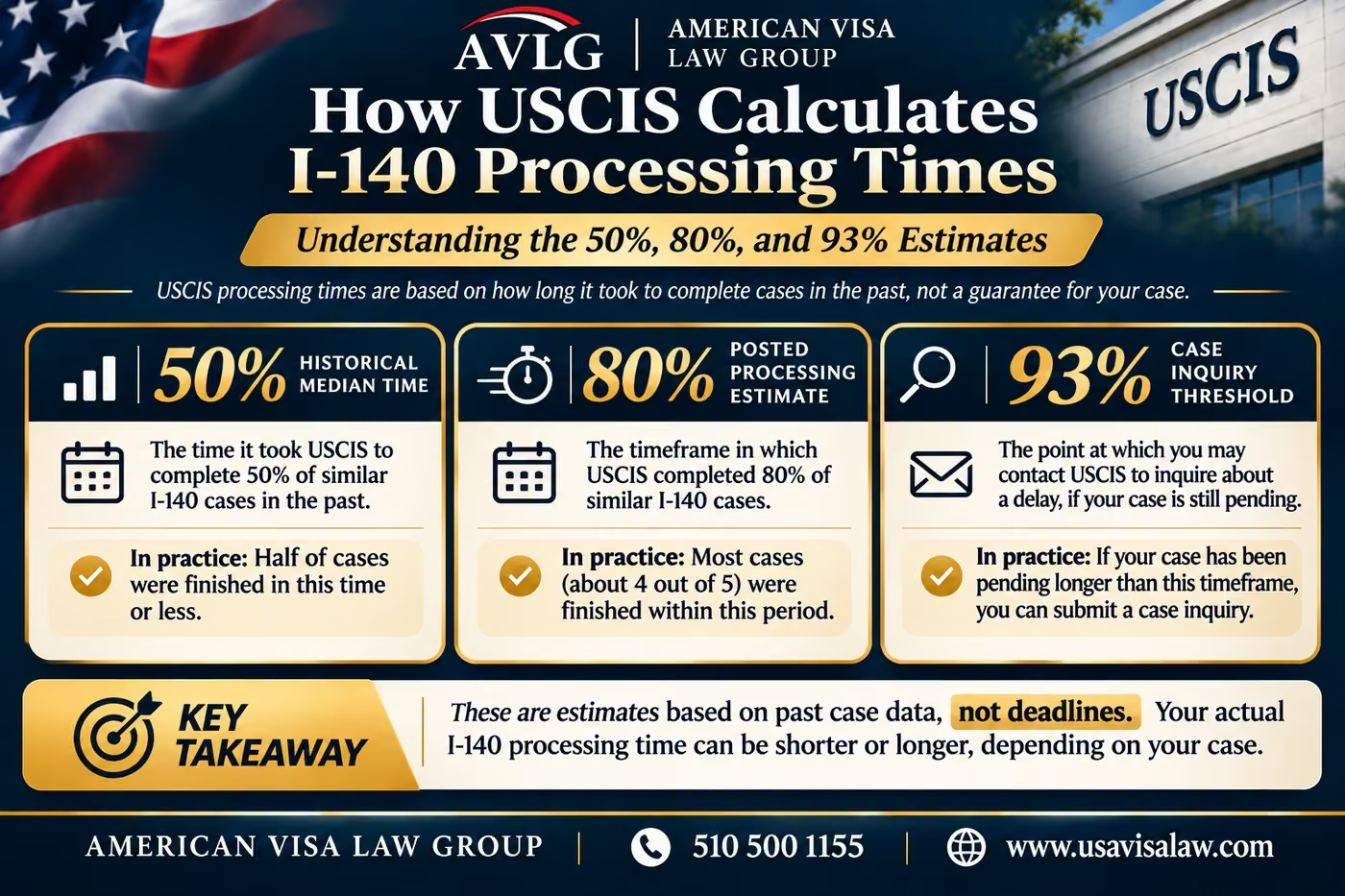
The most reliable way to check current I-140 processing times is through the official USCIS Case Processing Times tool. The tool provides estimates based on the specific Form I-140 classification and the USCIS office or processing operation handling that category.
Because processing times can change, applicants should consult USCIS directly rather than relying exclusively on estimates published by immigration websites or third-party tracking services.
To check the current processing time for your petition:
If you have already filed your petition, use your Form I-797 receipt notice and filing records to verify the relevant case information. Selecting an incorrect I-140 category can produce a misleading estimate, particularly when comparing EB-1A, EB-1C, and EB-2 NIW petitions.
The published processing time should be treated as a reference point, not a guaranteed decision date. For an individual pending petition, USCIS also provides a separate case inquiry date that helps determine when a request about processing delays may be appropriate.
Service Center Operations (SCOPS) is the USCIS directorate responsible for processing certain immigration applications and petitions across multiple service centers. USCIS has updated its processing-time reporting for certain forms to use the SCOPS designation instead of identifying a single service center.
Previously, applicants commonly checked processing times associated with locations such as the Nebraska Service Center or Texas Service Center. However, USCIS explains that processing work may occur at different locations based on operational needs, making a single service center location an incomplete representation of how some cases are handled.
As a result, an I-140 applicant may see Service Center Operations listed in the processing-times tool even when their receipt notice identifies a particular service center.
This does not necessarily indicate that the petition has been transferred or that something is wrong with the case. Applicants should follow the categories and office designations currently provided by USCIS rather than assuming that an older service center reference remains applicable to the published estimate.
USCIS processing-time estimates reflect recently completed cases rather than a fixed schedule for pending petitions. As the agency adjudicates additional petitions, the reported figures may increase or decrease.
For most categories, USCIS's published processing-time measure reflects how long it took to complete 80% of cases adjudicated during the preceding six months. Changes in the types of cases completed, the volume of pending petitions, and the time required for additional review can influence these reported figures.
For example, an increase in the published EB-2 NIW processing time does not necessarily mean that every pending NIW petition has been delayed by the same amount. Similarly, a shorter published estimate does not guarantee that an individual case will be decided sooner.
Applicants should distinguish between a changing USCIS processing estimate and an actual update to their individual petition. The processing-times tool provides general timing information, while the USCIS Case Status Online tool allows petitioners to review available updates using their receipt number.
For petitions that have been pending longer than expected, the next step is to compare the receipt date with USCIS's case inquiry eligibility information rather than relying solely on the published processing-time figure.
I-140 regular processing time in 2026 varies significantly by employment-based category, USCIS workload, and the circumstances of each petition. Unlike premium processing, regular Form I-140 adjudication does not have a guaranteed completion deadline. Some petitions are approved within a few months, while others remain pending considerably longer.
USCIS evaluates petitions according to the requirements of their respective immigration classifications. An employer-sponsored EB-3 petition, for example, may involve a different evidentiary review than an EB-1A extraordinary ability petition or an EB-2 National Interest Waiver (NIW) application.
Processing times may also be affected by USCIS workload distribution, staffing resources, operational adjustments, and requests for additional evidence. If USCIS issues a Request for Evidence (RFE), the overall timeline may extend while the petitioner prepares a response and the agency completes its review.
For employers and beneficiaries, the practical concern is not simply how long the petition has been pending, but whether that wait is consistent with the relevant USCIS processing category. A lengthy pending period does not necessarily indicate a problem with the petition, just as a shorter published estimate does not guarantee a prompt decision.
According to USCIS historical processing-time data, the national median for I-140 petitions filed without premium processing was 3.6 months during fiscal year 2026, based on data through August 30, 2026. This compares with 7.9 months in fiscal year 2025.
However, these figures require careful interpretation.
The historical median represents the time within which USCIS completed half of the non-premium I-140 petitions included in the reporting period. It combines multiple employment-based classifications and does not establish the expected processing time for any particular category.
By contrast, the current USCIS processing-times tool generally reports the time required to complete 80% of recently adjudicated cases within a specified classification.
That distinction explains why the national median may appear relatively short even when published processing times for categories such as EB-1A or EB-2 NIW are substantially longer.
Applicants should not use the national I-140 median as a prediction of when their own petition will be approved. A more meaningful assessment considers the specific immigration category, filing date, available USCIS updates, and whether the case has received an RFE or another notice requiring action.
For individuals facing employment-related deadlines or other immigration timing concerns, understanding these differences can also help determine whether requesting premium processing warrants consideration.
I-140 processing times differ across EB-1, EB-2, and EB-3 classifications because USCIS evaluates different eligibility requirements and reports processing data separately for several petition categories. Applicants should therefore identify their exact immigration classification before comparing timelines or deciding whether premium processing is appropriate.
Although these categories all use Form I-140, their adjudication requirements, supporting evidence, and published processing estimates are not identical. The current USCIS estimates in the comparison table above provide a useful starting point, but individual processing times may differ.
The EB-1 employment-based first preference category includes three distinct classifications: EB-1A for individuals with extraordinary ability, EB-1B for outstanding professors and researchers, and EB-1C for multinational executives and managers.
EB-1 I-140 processing time depends on the specific classification rather than the EB-1 preference category as a whole. USCIS publishes separate regular processing estimates for these petitions, reflecting their respective adjudication histories.
The distinction also affects premium processing. EB-1A and EB-1B petitions qualify for a 15-business-day premium processing period, while EB-1C petitions have a 45-business-day period.
Consequently, an applicant should not assume that the processing timeline reported for one EB-1 classification applies to another.
EB-1A extraordinary ability petitions may experience lengthy regular processing periods, particularly when compared with certain employer-sponsored I-140 classifications. Applicants should review the current estimate under the extraordinary ability category in the USCIS processing-times tool.
EB-1A allows eligible individuals to self-petition without a sponsoring employer or permanent job offer. However, USCIS must still evaluate whether the evidence establishes extraordinary ability, sustained national or international acclaim, and eligibility under the applicable regulatory standards.
Applicants may request premium processing using Form I-907, which provides a 15-business-day period for USCIS to take qualifying adjudicative action.
Premium processing can be useful when a petitioner needs greater certainty about when USCIS will respond. It does not lower the EB-1A evidentiary standard or guarantee approval.
For a closer examination of eligibility and supporting documentation, see our guide to EB-1A requirements and the ten USCIS criteria.
EB-1C applies to qualifying multinational managers and executives seeking permanent residence through a U.S. employer. Unlike EB-1A, the petition requires employer sponsorship and documentation establishing the qualifying organizational relationship, managerial or executive employment, and other applicable requirements.
EB-1C premium processing operates under a 45-business-day period rather than the 15-business-day period available for EB-1A and EB-1B.
This difference matters for employers coordinating executive transfers, long-term assignments, or immigration planning for senior personnel.
Although premium processing provides a defined period for USCIS action, it does not eliminate the agency's authority to request additional evidence concerning the proposed position, the related business entities, or the beneficiary's qualifying employment history.
Employers should therefore consider both the published EB-1C processing estimate and the strength of the supporting documentation when planning a filing.
The EB-2 category generally covers individuals with advanced degrees or exceptional ability. However, the processing timeline can differ considerably depending on whether the petition is employer-sponsored or requests a National Interest Waiver.
A conventional employer-sponsored EB-2 petition generally requires a qualifying job offer and labor certification unless an exception applies. By contrast, an EB-2 NIW petition requests a waiver of the job offer and labor certification requirements based on the proposed endeavor's national importance and other applicable considerations.
USCIS reports regular processing estimates separately for EB-2 petitions requesting a National Interest Waiver and those not requesting one.
The premium processing distinction is equally important. Eligible non-NIW EB-2 petitions have a 15-business-day premium processing period, while EB-2 NIW petitions have a 45-business-day period.
Applicants comparing I-140 processing times for EB-2 should verify whether the published estimate refers to NIW or non-NIW petitions. Using the wrong category can create unrealistic expectations about how quickly a petition may be adjudicated.
EB-2 National Interest Waiver petitions have their own USCIS processing category and may experience substantially different regular processing times from conventional EB-2 petitions.
NIW allows eligible applicants to request a waiver of the job offer and labor certification requirements. Qualified individuals may also self-petition, making the classification particularly relevant to researchers, entrepreneurs, and professionals pursuing work of substantial merit and national importance.
For NIW petitions, premium processing provides a 45-business-day period for USCIS to take qualifying adjudicative action after the applicable requirements are satisfied.
An important consideration is that expedited processing does not mean expedited approval. USCIS may request further evidence addressing the proposed endeavor, the applicant's qualifications, or whether granting the waiver would benefit the United States.
Applicants weighing regular processing against premium processing should consider how the timing of an I-140 decision relates to their broader immigration circumstances rather than assuming that a faster decision necessarily results in faster permanent residence.
For further guidance on the underlying eligibility requirements, review our EB-2 National Interest Waiver guide.
EB-3 includes skilled workers, professionals, and other workers. Although these classifications fall within the same employment-based preference category, USCIS distinguishes skilled workers and professionals from other workers in its processing-time reporting.
Skilled worker positions generally require at least two years of qualifying training or experience, while professional positions ordinarily require at least a U.S. bachelor's degree or its foreign equivalent. Other-worker positions generally involve qualifying work requiring less than two years of training or experience.
The exact classification matters because applicants may encounter different published I-140 processing estimates.
Eligible EB-3 petitions, including skilled worker, professional, and other-worker classifications, qualify for a 15-business-day premium processing period.
For employer-sponsored EB-3 cases, timing decisions should account for the entire immigration process. Form I-140 adjudication is separate from any required PERM labor certification and the subsequent steps toward obtaining permanent residence.
An employer may receive an I-140 approval relatively quickly through premium processing while the beneficiary still faces additional waiting periods associated with immigrant visa availability or adjustment of status.
For that reason, employers and beneficiaries should treat the I-140 processing estimate as one component of a broader immigration timeline, not as the expected date of green card approval.
Across all three employment-based preference categories, the practical distinction is clear: regular processing depends on the applicable USCIS category and current adjudication patterns, while premium processing offers a defined period for USCIS action. Understanding that difference is essential before deciding whether the additional premium processing fee is justified.
I-140 premium processing time in 2026 is 15 business days for most eligible employment-based petitions and 45 business days for EB-1C multinational managers and executives and EB-2 National Interest Waiver (NIW) petitions. This expedited service allows petitioners to request faster USCIS adjudicative action by filing Form I-907, Request for Premium Processing Service, and paying the applicable additional fee.
Unlike regular I-140 processing, which has no guaranteed completion deadline, premium processing requires USCIS to take a qualifying action within the applicable period. However, that action may be an approval, denial, Request for Evidence (RFE), or Notice of Intent to Deny (NOID). Premium processing does not guarantee that a petition will be approved.
The processing period is measured in business days, excluding weekends, federal holidays, and other days when federal government offices are closed. Consequently, 15 business days is not necessarily equivalent to three calendar weeks, and 45 business days can extend beyond nine calendar weeks.
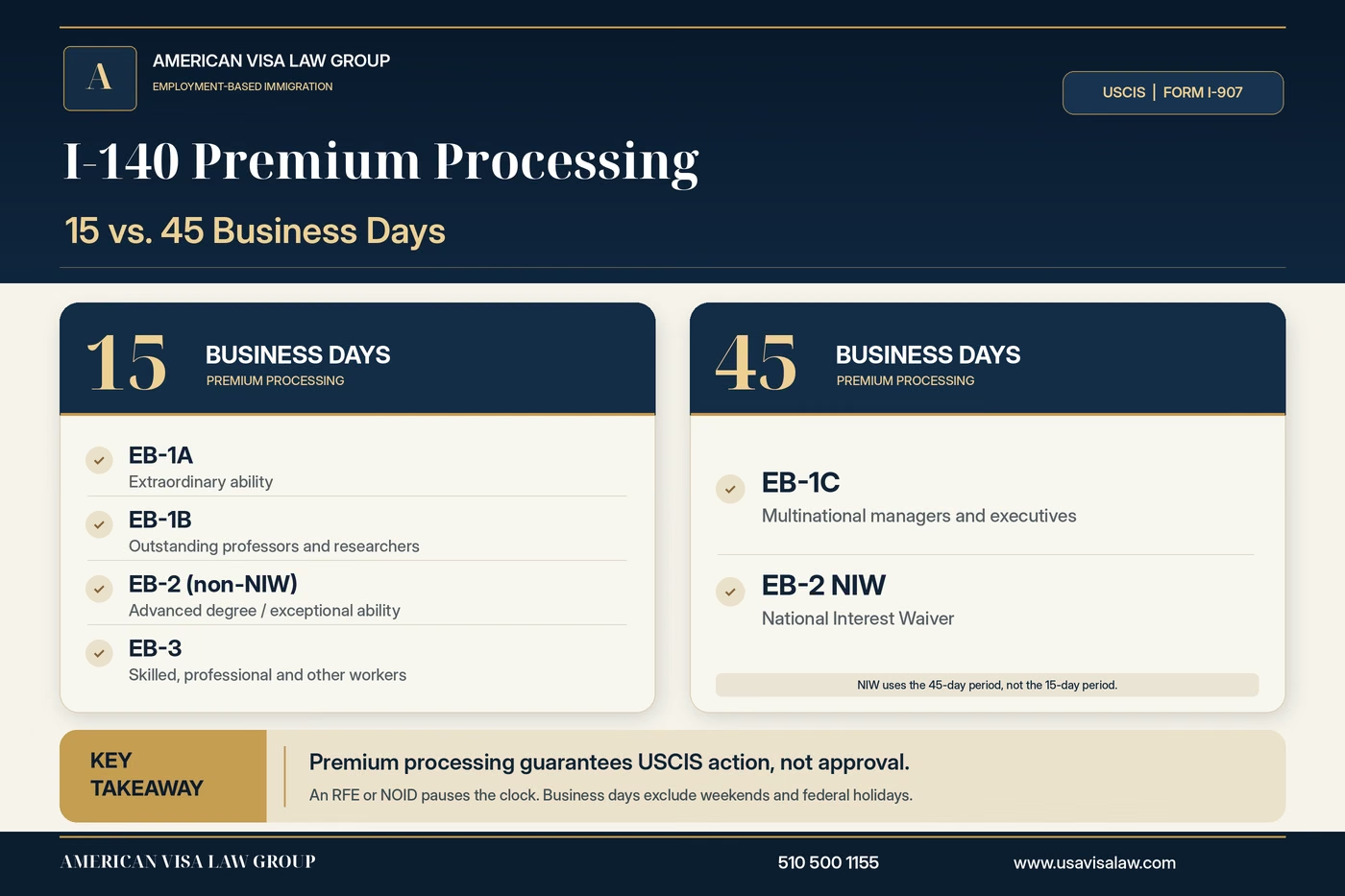
USCIS provides a 15-business-day premium processing period for several employment-based immigrant petition classifications, including:
For these classifications, USCIS must take qualifying adjudicative action within 15 business days after receiving a properly filed premium processing request.
This option may be particularly useful when an employer or self-petitioner needs a more predictable USCIS response for immigration planning. However, the petition remains subject to the same substantive eligibility requirements and evidentiary standards as a regularly processed case.
Two important I-140 classifications have a longer premium processing period of 45 business days:
The 45-business-day period reflects the premium processing timeframe established for these classifications. It should not be confused with the 15-business-day period available to EB-1A, EB-1B, and eligible non-NIW EB-2 petitions.
For example, a researcher filing an EB-1A petition may request 15-business-day premium processing, while a researcher filing an EB-2 NIW petition is subject to the 45-business-day period.
The distinction matters when comparing immigration strategies. Although both classifications may offer pathways to employment-based permanent residence, their eligibility standards and premium processing timelines differ.
Applicants should therefore consider the legal merits of each classification rather than choosing a petition category solely because its premium processing period is shorter.
Once USCIS receives a properly filed Form I-907 at the appropriate filing location, the applicable premium processing period begins.
Within that period, USCIS may approve the I-140 petition, deny it, issue an RFE, issue a NOID, or take another action recognized under the premium processing regulations.
Premium processing guarantees timely USCIS action, not a final decision or favorable outcome within 15 or 45 business days.
If USCIS fails to take the required action within the applicable period, the agency generally must refund the premium processing fee while continuing to process the petition. The regulations provide exceptions, including certain investigations involving potential fraud or misrepresentation.
The additional fee purchases a defined adjudicative-action timeframe; it does not establish stronger eligibility, eliminate requests for evidence, or guarantee that the underlying petition will succeed.
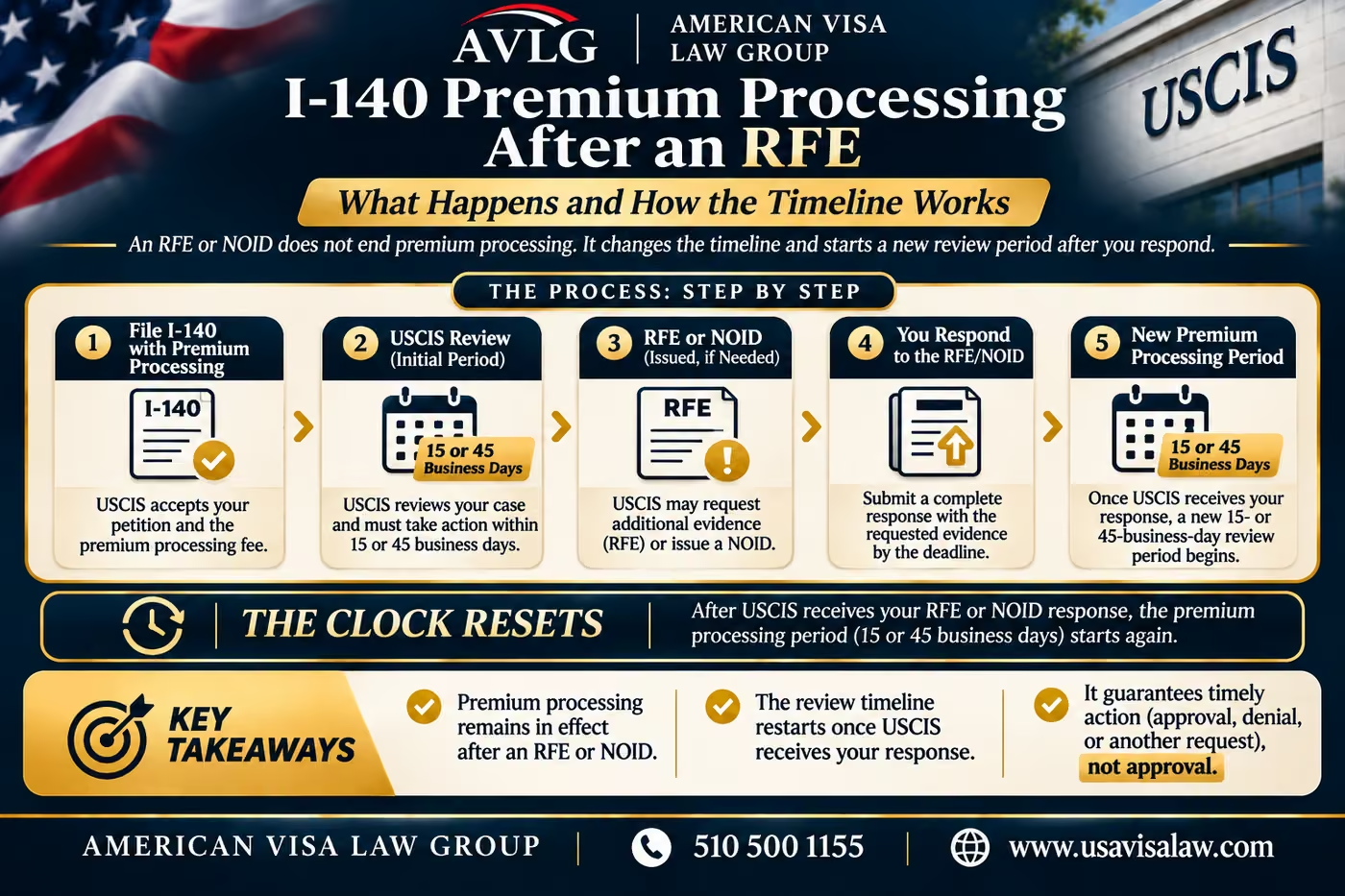
Yes. If USCIS issues a Request for Evidence or Notice of Intent to Deny during premium processing, the premium processing clock stops. A new applicable processing period begins when USCIS receives the response.
For example, an EB-1A petition initially subject to a 15-business-day premium processing period receives a new 15-business-day period after USCIS receives the RFE response. An EB-2 NIW petition similarly receives a new 45-business-day period.
This is an important distinction for applicants who expect an immediate approval after responding to an RFE. Even when a petition is being processed through the premium service, USCIS retains the authority to examine additional documentation before making a final determination.
A timely, complete, and well-supported RFE response can therefore be just as important as the initial premium processing request.
Yes. A pending Form I-140 petition can generally be upgraded to premium processing if its classification is eligible and USCIS has not yet issued a final decision.
The petitioner or authorized representative requests the upgrade by submitting Form I-907 with the applicable fee and information identifying the pending I-140 petition.
For employer-sponsored petitions, the employer is generally the petitioner requesting the service. In a qualifying self-petition, such as EB-1A or EB-2 NIW, the self-petitioner may request premium processing directly or through authorized counsel.
The premium processing period begins when USCIS receives a properly filed request under the applicable filing requirements. It does not begin on the original I-140 receipt date.
Before requesting an upgrade, petitioners should consult the current USCIS Form I-907 instructions to confirm eligibility, the correct filing location, and the applicable fee.
Upgrading may provide a faster response, but whether it is worthwhile depends on the broader immigration circumstances. A petitioner who needs an I-140 decision for a time-sensitive immigration strategy may benefit from premium processing, while someone whose next step depends primarily on immigrant visa availability may gain less immediate practical benefit.
The appropriate decision therefore requires more than comparing 15 or 45 business days against the regular processing estimate. It requires understanding what an earlier I-140 decision would actually change.
Choosing between I-140 regular and premium processing depends on how urgently you need USCIS to act on your petition and whether a faster decision would meaningfully benefit your immigration plans. Premium processing offers a defined adjudicative-action period, while regular processing avoids the additional premium fee but may involve a substantially longer wait.
Premium processing may be worthwhile when an earlier I-140 decision could affect employment planning, another immigration benefit, or an important filing decision.
For example, certain H-1B workers approaching the six-year limit may need to evaluate how an approved employment-based immigrant petition affects their eligibility for additional H-1B time. The applicable requirements depend on their individual circumstances.
However, premium processing does not improve the underlying petition's eligibility or guarantee approval.
Regular processing may be appropriate when there is no immediate need for an I-140 decision, the additional expense is difficult to justify, or another immigration requirement remains the primary obstacle.
An applicant facing a lengthy wait for immigrant visa availability, for example, may not receive an immediate practical benefit from faster I-140 adjudication.
Premium processing can accelerate USCIS action on an eligible I-140 petition, but it does not automatically accelerate the entire green card process.
Immigrant visa availability, adjustment of status, and consular processing involve separate requirements and timelines. Applicants should consider these factors before paying for an expedited I-140 response.
I-140 processing delays may result from Requests for Evidence (RFEs), USCIS workload, petition-specific eligibility questions, or filing deficiencies. A longer-than-expected wait does not necessarily indicate that a petition will be denied.
Understanding the possible reasons for a delay helps employers and applicants determine whether to continue monitoring the case, respond to a USCIS notice, or consider further action.
USCIS may issue an RFE when the initial documentation does not sufficiently establish eligibility for the requested immigrant classification.
For example, an EB-1A petition may require additional evidence demonstrating the significance of the applicant's achievements, while an employer-sponsored I-140 petition may raise questions about the beneficiary's qualifications or the employer's ability to pay the offered wage.
An RFE extends the overall timeline because USCIS must receive and evaluate the response before completing adjudication. The additional time depends partly on how quickly the petitioner responds and whether further review is necessary.
Processing times also depend on the volume and types of petitions USCIS handles.
EB-1A, EB-2 NIW, and employer-sponsored I-140 petitions have different eligibility requirements and may experience substantially different processing patterns.
USCIS may distribute cases across processing locations under Service Center Operations (SCOPS). However, an administrative change or case transfer does not automatically indicate a problem with the petition.
Incomplete forms, incorrect filing fees, missing signatures, or submission to an incorrect filing location may lead to rejection or other filing complications.
Even after a petition has been accepted, USCIS may require additional documentation to resolve eligibility questions.
Petitioners should carefully review their receipt notices, monitor correspondence, and respond to USCIS requests within the stated deadlines.
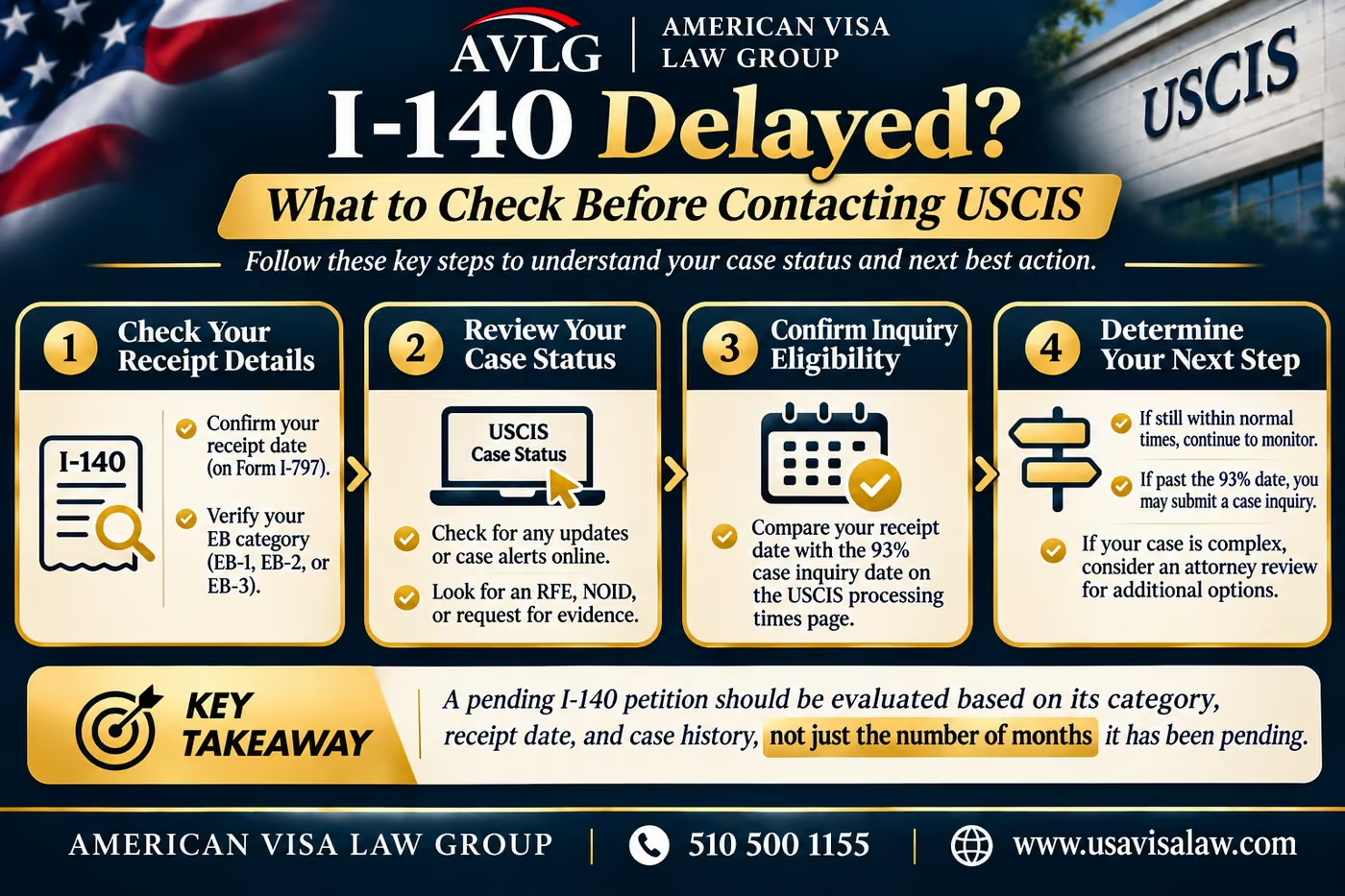
The appropriate response to a delayed I-140 petition depends on its actual status, not simply how many months have passed. Before requesting an update, applicants should compare their receipt date with USCIS's published case inquiry eligibility information.
You can track a pending Form I-140 petition using your USCIS receipt number and determine whether a processing delay qualifies for an inquiry through the official USCIS processing-times tool. These two resources serve different purposes: one shows available case updates, while the other helps establish when contacting USCIS may be appropriate.
After accepting Form I-140, USCIS issues a receipt notice, generally Form I-797, containing a unique 13-character receipt number.
The petitioner can enter this number in the USCIS Case Status Online tool to review available updates, including receipt confirmation, Requests for Evidence, and adjudicative decisions.
However, a case status such as "Case Is Being Actively Reviewed" does not establish when a decision will be issued. USCIS may continue reviewing a petition without displaying frequent public updates.
An I-140 petition may become eligible for a processing-time inquiry when it reaches the case inquiry date calculated by USCIS. This is different from merely exceeding the published processing estimate.
USCIS generally bases its displayed processing-time estimate on the period required to complete 80% of recently adjudicated cases. Its case inquiry eligibility calculation, however, uses the time required to complete 93% of adjudicated cases.
Applicants should enter their receipt date into the USCIS processing-times tool to determine when an inquiry may be submitted.
If an I-140 petition has been pending longer than expected, first verify its current status, review any USCIS correspondence, and check whether the case has reached its inquiry eligibility date.
When eligible, the petitioner or authorized representative may submit an online case inquiry requesting an update. Petitions filed with premium processing may have separate contact procedures identified in the USCIS premium processing instructions or receipt correspondence.
If the delay affects employment authorization planning, immigration status, or another time-sensitive filing, an attorney can assess whether additional action is appropriate.
A pending I-140 petition should be evaluated in the context of its specific immigration category, receipt date, and procedural history—not simply the number of months it has remained undecided.
Approval of Form I-140 confirms eligibility for the requested employment-based immigrant classification, but it does not automatically grant a green card, lawful immigration status, or employment authorization. The next steps depend on the applicant's location, immigration eligibility, and immigrant visa availability.
Eligible applicants in the United States may pursue permanent residence through Form I-485, Application to Register Permanent Residence or Adjust Status. Those applying from abroad generally complete immigrant visa processing through a U.S. embassy or consulate. In certain circumstances, Form I-485 may be filed concurrently with Form I-140.
A critical consideration is the applicant's priority date. Depending on the employment-based category and country of chargeability, visa availability may create additional waiting periods even after I-140 approval.
Premium processing accelerates action on the I-140 petition, not the entire green card process. Applicants should evaluate the remaining immigration steps before assuming that a faster petition decision will lead to faster permanent residence.
I-140 regular processing times vary by employment-based category. Some petitions are processed within several months, while EB-1A, EB-1C, and EB-2 NIW cases may face considerably longer waits. Applicants should check the USCIS processing-times tool for current category-specific estimates rather than relying on a national average.
I-140 premium processing generally provides USCIS adjudicative action within 15 business days for eligible EB-1A, EB-1B, non-NIW EB-2, and EB-3 petitions. EB-1C and EB-2 NIW petitions have a 45-business-day period. Premium processing does not guarantee approval or a final decision within that period.
EB-1A extraordinary ability petitions qualify for 15-business-day premium processing. The 45-business-day period applies to EB-1C multinational managers and executives and EB-2 National Interest Waiver petitions. Applicants must submit Form I-907 and the applicable fee to request premium processing.
EB-2 National Interest Waiver processing times depend on current USCIS workloads and individual case circumstances. Regular processing may take many months or longer. Eligible NIW petitioners may request premium processing, which provides a 45-business-day period for qualifying USCIS action.
EB-3 petitions may have shorter published regular processing estimates than EB-2 NIW petitions, but this varies over time. Eligible EB-3 petitions also have a 15-business-day premium processing period, compared with 45 business days for NIW. These differences do not determine which immigration category is more appropriate for an applicant.
Yes. Petitioners with eligible pending I-140 applications can generally request an upgrade by submitting Form I-907 with the required fee. The premium processing period begins when USCIS receives a properly filed request, not when the original I-140 petition was submitted.
Yes. If USCIS issues a Request for Evidence (RFE) or Notice of Intent to Deny (NOID), the premium processing clock stops. A new applicable 15- or 45-business-day period begins when USCIS receives the requested response.
Check the receipt date on your Form I-797 notice and use the USCIS processing-times tool to determine your case inquiry eligibility date. Exceeding the published processing estimate does not automatically mean an inquiry is available. If eligible, the petitioner or authorized representative can request a case update through USCIS.
For the most accurate I-140 processing times in 2026, applicants should rely on official U.S. Citizenship and Immigration Services (USCIS) resources. Processing estimates, premium processing requirements, and filing procedures may change, so current government guidance should take precedence over older published timelines.
For additional guidance on employment-based immigration, review our articles on EB-1A requirements, EB-2 National Interest Waiver eligibility, and PERM and I-140 costs.
These resources provide further information about eligibility, petition preparation, and filing costs beyond the processing-time estimates discussed in this guide.

Hasan Abdullah, Esq. is the Founder and Managing Attorney of American Visa Law Group. His practice focuses on U.S. immigration law, including family-based immigration, employment-based immigration, adjustment of status, consular processing, waivers, PERM labor certification, NIW, EB-1, H-1B, O-1, and complex immigration strategy.
Through American Visa Law Group, Mr. Abdullah helps individuals, families, professionals, investors, and employers understand their immigration options and plan around changing government policies, USCIS procedures, and Visa Bulletin movement. His work emphasizes practical legal analysis, realistic expectations, and strategy tailored to each applicant’s immigration history and long-term goals.


