Author: Hasan Abdullah, Esq.
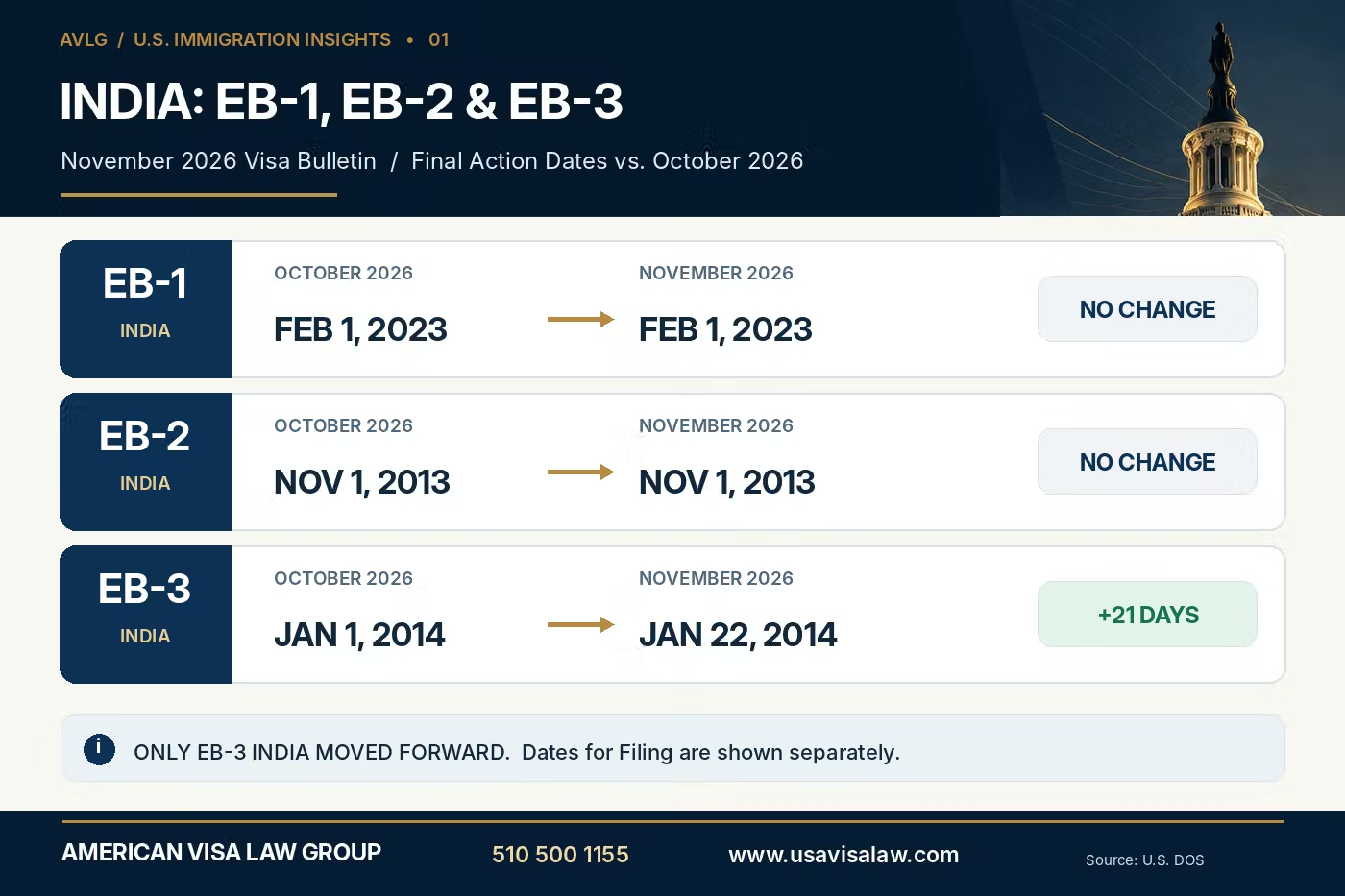
The November 2026 Visa Bulletin for India brings sharply different results for family-sponsored and employment-based green card applicants. While F1, F2B, and F3 family-sponsored Final Action Dates advance by a full year, employment-based movement remains limited. EB-1 India and EB-2 India are unchanged from October, and EB-3 India advances by just 21 days.
For Indian professionals awaiting permanent residence, another important development concerns USCIS filing-chart selection. In November 2026, USCIS permits both family-sponsored and employment-based adjustment-of-status applicants to use the Dates for Filing charts. This may allow otherwise eligible individuals to submit Form I-485 before their priority dates become current for final approval.
This guide examines India's November 2026 priority dates across EB-1, EB-2, EB-3, EB-4, EB-5, and family-sponsored categories. It also compares the latest figures with October 2026 and November 2025, explains the difference between filing and approval eligibility, and identifies practical considerations for applicants pursuing employment-based and family-based immigration.
The central employment-based finding is straightforward. EB-2 India remains at November 1, 2013, EB-1 India remains at February 1, 2023, and EB-3 India advances to January 22, 2014.
India's Other Workers category also advances by 21 days, while EB-4 and EB-5 Unreserved Final Action Dates remain unchanged.
The family-sponsored picture is considerably more favorable. F1, F2B, and F3 each advance one year, and F2A moves forward one month. India's F4 sibling category, however, remains unchanged.
These figures come from the official November 2026 Visa Bulletin.
No India-specific Final Action Date retrogresses between October and November. However, unchanged dates do not mean that every applicant must remain inactive. Individuals whose priority dates qualify under the applicable Dates for Filing chart may still have options, depending on their circumstances.
For November 2026, USCIS permits both family-sponsored and employment-based adjustment-of-status applicants to use the Dates for Filing charts.
This designation is particularly relevant to Indian nationals and other applicants chargeable to India because several employment-based filing cutoffs are substantially later than their corresponding Final Action Dates.
The two charts serve different purposes.
Final Action Dates determine when immigrant visa numbers may be available for final green card adjudication. In oversubscribed categories, applicants generally need a priority date earlier than the published cutoff.
Dates for Filing indicate when qualifying applicants may begin the next stage of immigrant visa processing or submit Form I-485 when USCIS authorizes that chart.
For example, EB-2 India's November 2026 Final Action Date is November 1, 2013, while its Dates for Filing cutoff is January 15, 2015.
An EB-2 India applicant with a qualifying priority date in 2014 may therefore fall within the filing window without yet qualifying for final approval.
The distinction does not eliminate other requirements. The applicant must still be eligible to adjust status, and the underlying immigration petition and case circumstances must support the filing.
The USCIS adjustment-of-status filing charts should be checked before submitting Form I-485.
Importantly, the November filing designation applies to the November filing period. Applicants should not assume that an upcoming month's more favorable cutoff authorizes filing during October.
India's employment-based Final Action Dates show limited month-over-month movement, despite some improvement over the preceding year.
The most important change occurs in EB-3. EB-1 and EB-2 remain unchanged, while EB-5 Unreserved retains the cutoff introduced at the start of fiscal year 2027.
The EB-1 India Final Action Date remains February 1, 2023, in November 2026. There is no movement compared with October.
EB-1 covers priority workers, including individuals of extraordinary ability, outstanding professors and researchers, and qualifying multinational managers and executives.
For Indian applicants with approved or pending EB-1 petitions, the unchanged cutoff means November does not create a new Final Action Date window beyond October's published date.
However, the Dates for Filing cutoff remains July 1, 2024.
This creates a meaningful difference between potential filing eligibility and immigrant visa availability.
For example, an eligible EB-1 India applicant with a priority date in early 2024 may qualify to submit Form I-485 during November even though that priority date is not yet current for final approval.
Applicants considering EB-1A should also understand that the classification requires evidence satisfying its own legal criteria. A more favorable Visa Bulletin position does not compensate for an insufficient extraordinary-ability petition.
The EB-2 India Final Action Date remains November 1, 2013, unchanged from October.
This is one of November's most important findings for Indian professionals, including advanced-degree workers, individuals of exceptional ability, and certain National Interest Waiver applicants.
Although EB-2 Final Action Dates advance for several other chargeability areas, India receives no corresponding movement.
The EB-2 India Dates for Filing cutoff remains January 15, 2015.
This means applicants must distinguish between two separate questions.
First, whether their priority date qualifies them to submit Form I-485 under the November filing chart.
Second, whether their priority date is sufficiently early for final approval under the Final Action Dates chart.
An approved Form I-140 does not eliminate this distinction.
The same principle applies to an approved EB-2 National Interest Waiver. NIW approval addresses eligibility for the immigrant classification and waiver requirements; it does not exempt an applicant chargeable to India from the EB-2 immigrant visa backlog.
For Indian professionals evaluating a different preference category, AVLG's guide to choosing the right employment-based green card category explains why eligibility, supporting evidence, and priority-date implications must be assessed together.
EB-3 India records limited advancement in November 2026.
The Final Action Date for professionals and skilled workers moves from January 1, 2014, to January 22, 2014.
This 21-day movement may benefit applicants whose priority dates now fall before the November cutoff.
However, EB-3 India's Dates for Filing cutoff remains unchanged at January 15, 2015.
For applicants with pending adjustment applications, the Final Action Date advancement may be relevant to visa availability for final adjudication. For otherwise eligible applicants who have not yet filed, the Dates for Filing cutoff may be the more immediate consideration.
Although EB-3 India now has a later Final Action Date than EB-2 India, this does not automatically make EB-3 the preferable strategy for every applicant.
An EB-2-to-EB-3 change can involve a separate immigrant petition, underlying classification requirements, employer sponsorship considerations, and questions about retaining an earlier priority date.
The appropriate strategy depends on the individual's immigration record and the legal basis for the proposed filing.
India's EB-3 Other Workers category also advances by 21 days, reaching January 22, 2014, under Final Action Dates.
Its Dates for Filing cutoff remains January 15, 2015.
Other Workers is a separate classification within EB-3 and is subject to distinct numerical restrictions. Applicants should confirm that they are reviewing the correct classification rather than assuming every EB-3 petition follows the same requirements.
The EB-4 India Final Action Date remains December 15, 2022.
Its Dates for Filing cutoff remains January 1, 2025.
EB-4 covers certain special immigrants and differs substantially from EB-1, EB-2, and EB-3 in eligibility requirements.
An applicant cannot determine eligibility simply by comparing the cutoff dates. The underlying special immigrant classification must also be established.
For November 2026, EB-5 Unreserved India's Final Action Date remains December 1, 2023.
Its Dates for Filing cutoff remains May 1, 2024.
The EB-5 reserved categories for qualifying rural, high-unemployment-area, and infrastructure investments remain current under both charts.
However, an available immigrant visa number does not establish eligibility for EB-5 classification. Petition approval, qualifying investment requirements, job creation, lawful source of funds, and other applicable conditions remain essential.
The following table compares India's employment-based Final Action Dates in the October 2026 Visa Bulletin with November.
The table illustrates why the November bulletin should not be characterized as a broad employment-based advancement for India.
Only EB-3 and Other Workers move forward. The remaining categories retain their October Final Action Dates.
Nevertheless, applicants must consider the accompanying Dates for Filing chart before concluding that no further action is possible.
Although India's employment-based Final Action Dates show limited movement, its Dates for Filing cutoffs remain substantially later in several categories.
USCIS's decision to authorize this chart for November is therefore important for eligible Indian applicants who are physically present in the United States and considering adjustment of status.
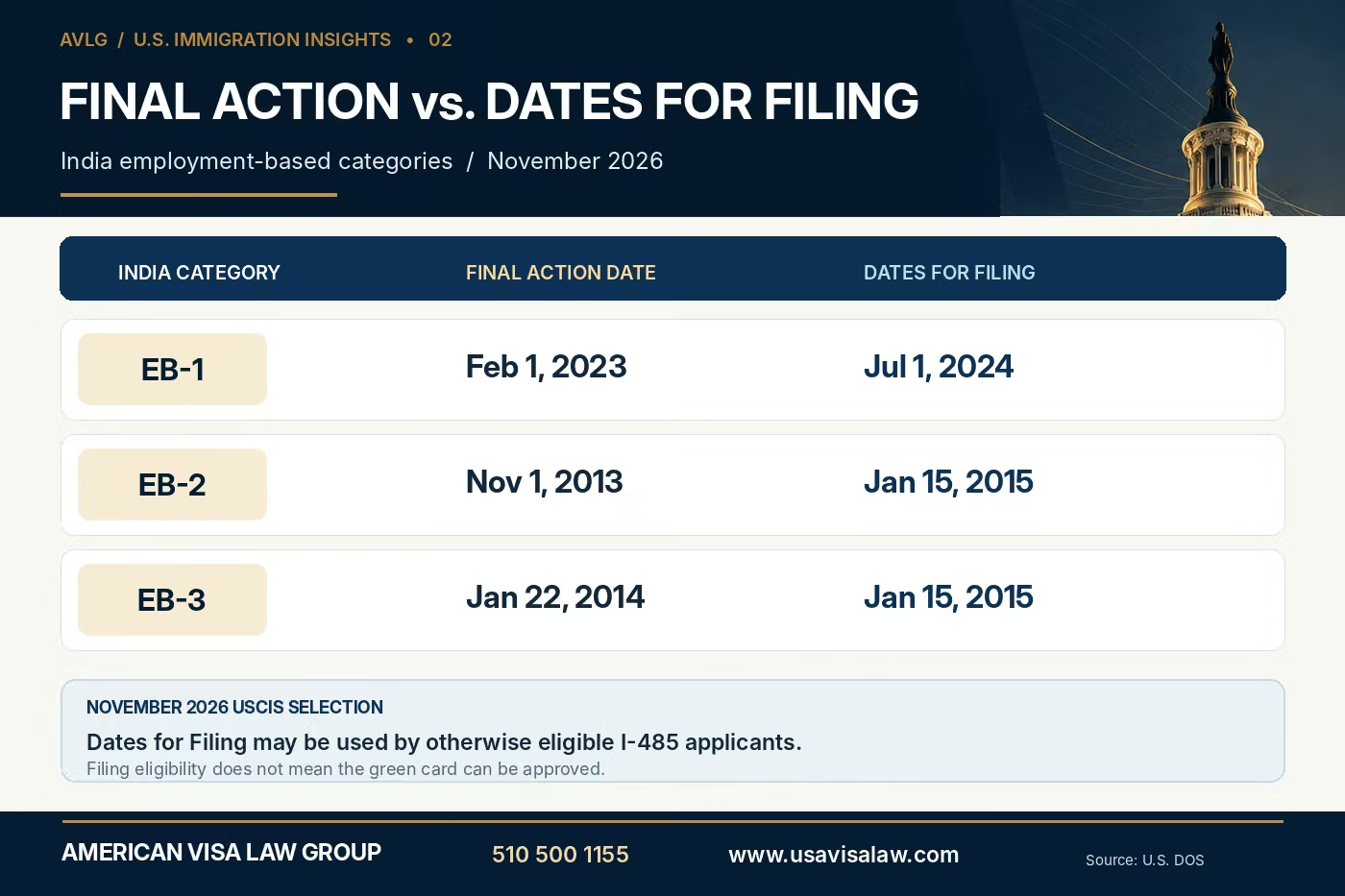
None of India's employment-based Dates for Filing cutoffs change from October to November.
The important development is not a newly advanced filing cutoff. It is the continued authorization to use the Dates for Filing chart.
For some otherwise eligible applicants, this may permit Form I-485 filing even when an immigrant visa number is not yet available for final approval.
Filing Form I-485 may also provide an opportunity to apply separately for employment authorization or advance parole, subject to applicable requirements. Neither benefit is automatic, and filing does not itself authorize employment or international travel.
Applicants should carefully consider their underlying nonimmigrant status and any travel-related consequences before taking action.
The family-sponsored portion of the November 2026 Visa Bulletin brings more substantial movement for India than the employment-based categories.
Three major preference categories advance by a full year under Final Action Dates.
F2A also advances by one month, while F4 remains unchanged.
F1 covers unmarried sons and daughters age 21 or older of U.S. citizens.
For November 2026, F1 India's Final Action Date advances from January 22, 2020, to January 22, 2021.
F2B, covering unmarried sons and daughters age 21 or older of lawful permanent residents, advances from August 22, 2019, to August 22, 2020.
F3, which covers married sons and daughters of U.S. citizens, advances from October 22, 2014, to October 22, 2015.
These gains may expand final-action eligibility for qualifying Indian family-sponsored beneficiaries whose priority dates fall within the newly available ranges.
However, a one-year change in a published cutoff does not guarantee that an individual applicant's remaining wait has shortened by one year.
F2A covers spouses and qualifying unmarried children under age 21 of lawful permanent residents.
The F2A India Final Action Date advances from September 22, 2026, to October 22, 2026.
Importantly, F2A remains current under the Dates for Filing chart.
This means eligible applicants do not face a specific priority-date cutoff under that filing chart, although other adjustment-of-status requirements still apply.
F2A is not current for final action.
An applicant may therefore qualify to file Form I-485 while remaining ineligible for final green card approval until an immigrant visa number becomes available.
The F4 category covers brothers and sisters of U.S. citizens who are at least 21 years old.
For November 2026, F4 India's Final Action Date remains December 15, 2006.
Its Dates for Filing cutoff remains February 1, 2007.
Unlike the substantial advancement in F1, F2B, and F3, F4 India receives no movement in either chart.
This distinction is particularly relevant for families with long-pending sibling petitions. Petition approval alone does not overcome the numerical limits applicable to F4 immigrant visas.
These dates illustrate the uneven impact of November's family-sponsored advancement.
Applicants should also distinguish between family preference classifications and immediate-relative immigrant categories, which operate under different visa availability rules.

Comparing November 2026 with November 2025 provides useful historical context for applicants following India's employment-based green card backlog.
Although several categories show year-over-year progress, movement varies considerably.
EB-1 India's published cutoff has advanced by nearly a year since November 2025. EB-2 India has moved forward by seven months, while EB-3 India has also recorded several months of net advancement.
EB-5 Unreserved India shows a larger difference between the two November bulletins.
However, year-over-year advancement should not be interpreted as a reliable estimate of remaining green card waiting time.
The Department of State adjusts cutoff dates according to demand, numerical limits, and visa allocation considerations. A category may advance substantially during one period, remain unchanged for several months, or retrogress.
For Indian applicants with long-pending cases, the current cutoff and applicable filing chart matter more to immediate eligibility than the amount of historical movement alone.
Some Indian applicants may qualify to file Form I-485 in November 2026 even when their priority dates are not current for final approval.
The answer depends on their individual circumstances.
Consider an applicant chargeable to India who has an EB-2 priority date of June 1, 2014.
The November 2026 EB-2 India Dates for Filing cutoff is January 15, 2015.
Because June 1, 2014, is earlier than that cutoff, the applicant satisfies the priority-date component for filing under the November chart.
However, the Final Action Date remains November 1, 2013.
The applicant's priority date is therefore not current for final approval.
If all other requirements are satisfied, the applicant may qualify to file Form I-485 during November, but USCIS generally cannot approve the application until an immigrant visa number becomes available.
Consider an EB-3 India applicant with a priority date of January 15, 2014.
The November 2026 Final Action Date is January 22, 2014.
Because the applicant's priority date is earlier than the published cutoff, a visa number may be available for final action.
This does not guarantee approval. USCIS must still complete the remaining adjudication requirements.
Indian applicants should carefully review adjustment eligibility where the case involves prior status violations, unauthorized employment, pending immigration proceedings, multiple immigrant petitions, or questions about concurrent filing.
Families with children approaching age 21 may also need to evaluate Child Status Protection Act provisions and applicable deadlines.
The practical question is not simply whether a priority date is earlier than a published cutoff. It is whether the applicant satisfies the full legal requirements for the intended immigration filing.
The November 2026 Visa Bulletin provides different opportunities depending on whether the applicant is awaiting a visa number, preparing an immigrant petition, or considering adjustment of status.
A practical review should include the following steps.
Indian applicants seeking clarification about priority dates can also consult AVLG's guide to how green card priority dates work.
Applicants requiring individualized analysis of their green card category, adjustment eligibility, or petition strategy may request a consultation with American Visa Law Group.
No. EB-2 India's Final Action Date remains November 1, 2013, unchanged from October 2026. Its Dates for Filing cutoff also remains January 15, 2015. Some otherwise eligible applicants may still qualify to file Form I-485 under the November USCIS filing-chart designation.
EB-3 India's Final Action Date is January 22, 2014, advancing 21 days from October. The Dates for Filing cutoff remains January 15, 2015. Applicants must use the appropriate chart for their intended immigration action.
EB-1 India's Final Action Date is February 1, 2023, and its Dates for Filing cutoff is July 1, 2024. Neither cutoff changes from October 2026.
Potentially. USCIS permits employment-based adjustment applicants to use the Dates for Filing chart in November 2026. An EB-2 India applicant generally needs a priority date earlier than January 15, 2015, along with satisfaction of the remaining adjustment-of-status requirements.
F2A India is current under Dates for Filing, but not under Final Action Dates. The November Final Action Date is October 22, 2026. Filing eligibility and immigrant visa availability for final approval remain separate considerations.
No. F4 India's Final Action Date remains December 15, 2006, and its Dates for Filing cutoff remains February 1, 2007. Neither date advances from October.
Yes. The November 2026 Visa Bulletin lists all three EB-5 set-aside categories as current for India under both Final Action Dates and Dates for Filing. Applicants must still meet all underlying petition and immigration eligibility requirements.
The November bulletin does not establish December's cutoff dates. Future movement depends on visa demand, annual numerical limits, and Department of State allocation decisions. Applicants should not treat November's unchanged EB-2 date or limited EB-3 movement as a reliable prediction of future availability.
The November 2026 Visa Bulletin brings limited employment-based advancement for India but more substantial movement in several family-sponsored categories.
The most important distinction is that eligibility to submit Form I-485 does not establish eligibility for immediate green card approval.
Applicants should assess their individual priority date, preference category, chargeability, and immigration history before taking action.
November 2026 Visa Bulletin — U.S. Department of State. Official family-sponsored and employment-based Final Action Dates and Dates for Filing.
USCIS Adjustment-of-Status Filing Charts. Monthly guidance identifying which chart applicants may use for Form I-485 filing.
Form I-485 — USCIS. Official form instructions, eligibility information, and filing requirements.
October 2026 Visa Bulletin — U.S. Department of State. Source for month-over-month priority-date comparisons.
November 2025 Visa Bulletin — U.S. Department of State. Historical source for year-over-year comparisons.
October 2026 Visa Bulletin for India. Analysis of India's EB-1, EB-2, EB-3, and EB-5 priority dates at the beginning of fiscal year 2027.
Green Card Priority Date Explained. How to interpret priority dates, chargeability, and the two Visa Bulletin charts.
How to Choose the Right Employment-Based Green Card Category. A comparison of EB-1, EB-2, EB-3, National Interest Waiver, and employer-sponsored strategies.

Hasan Abdullah, Esq. is the Founder and Managing Attorney of American Visa Law Group. His practice focuses on U.S. immigration law, including family-based immigration, employment-based immigration, adjustment of status, consular processing, waivers, PERM labor certification, NIW, EB-1, H-1B, O-1, and complex immigration strategy.
Through American Visa Law Group, Mr. Abdullah helps individuals, families, professionals, investors, and employers understand their immigration options and plan around changing government policies, USCIS procedures, and Visa Bulletin movement. His work emphasizes practical legal analysis, realistic expectations, and strategy tailored to each applicant’s immigration history and long-term goals.


