Author: Hasan Abdullah, Esq.
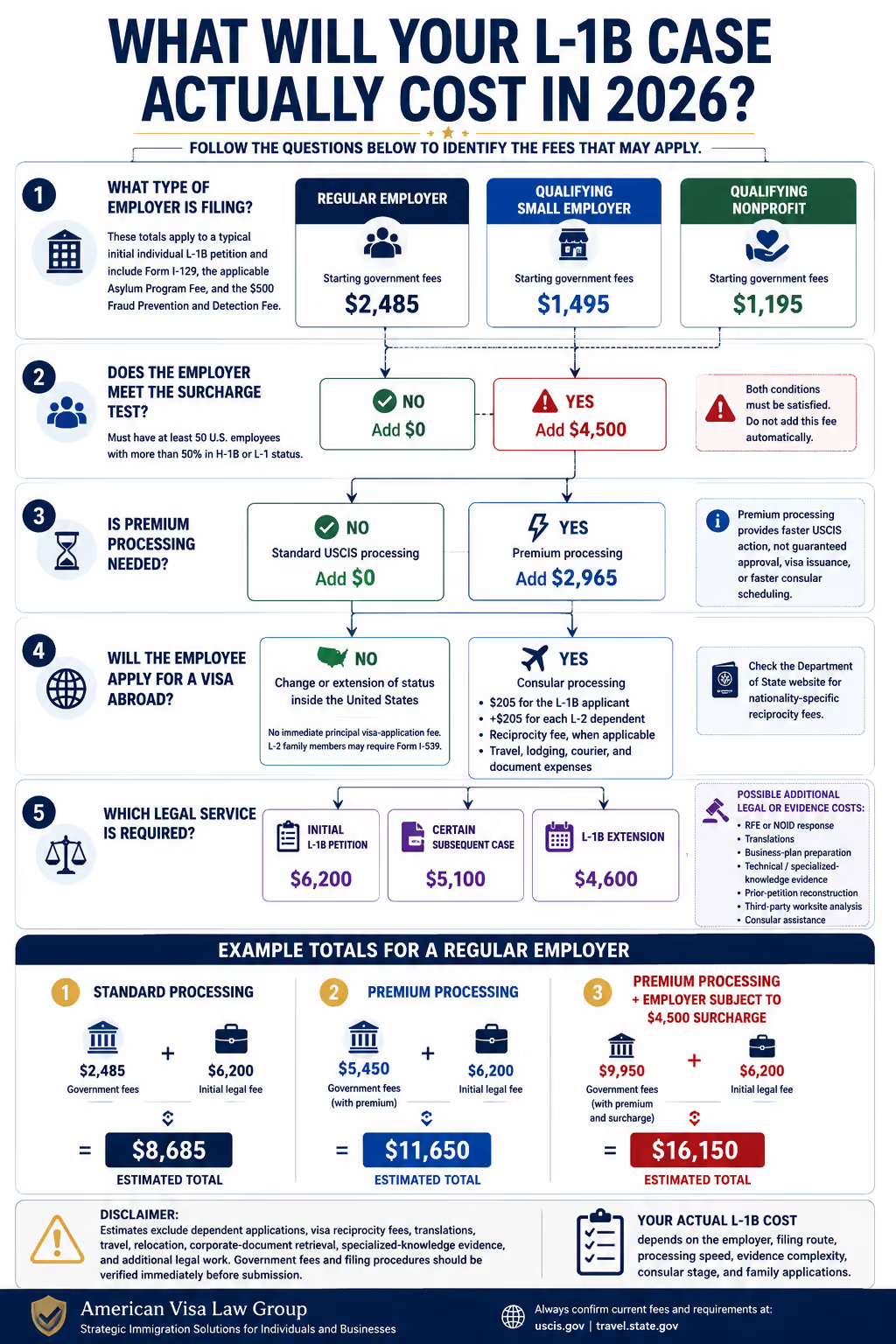
The L-1B visa cost in 2026 is not limited to a single USCIS filing fee. For an initial individual petition, the typical mandatory government fees range from $1,195 to $2,485, depending on whether the petitioner is a qualifying nonprofit, small employer, or regular employer. Adding the optional $2,965 premium-processing fee increases those totals to between $4,160 and $5,450. Certain employers may also owe an additional $4,500 fee under Public Law 114-113.
These amounts generally combine the Form I-129 filing fee, the applicable Asylum Program Fee, and the $500 Fraud Prevention and Detection Fee. They do not include L-1B lawyer fees, visa stamping, nationality-based reciprocity fees, dependent applications, translations, travel, or expenses associated with additional evidence. Employers should review the current USCIS H and L filing-fee guidance immediately before filing because using an incorrect fee or payment structure can result in rejection.
American Visa Law Group’s published immigration attorney fee schedule lists a legal fee of $6,200 for an initial L-1B petition, $5,100 for certain subsequent cases, and $4,600 for an extension. Using the initial fee as an example, a regular employer might budget approximately $8,685 without premium processing or $11,650 with premium processing, before adding consular, dependent, document-related, or conditional employer fees.
The legal and evidentiary costs of an L-1B case can vary considerably. The employer must establish the qualifying relationship between the foreign and U.S. businesses, the employee’s required period of employment abroad, and the specialized or advanced knowledge that the employee will apply in the United States. Cases involving a new office, multiple affiliated companies, work at a client location, confidential technical materials, or a difficult specialized-knowledge argument may require more extensive preparation.
A realistic L-1B budget should therefore separate mandatory government fees from conditional fees, optional processing, attorney fees, consular expenses, family applications, and potential future costs. This guide explains each category so employers and employees can understand where the money goes and what should be confirmed before filing.
An L-1B budget should separate mandatory petition fees from conditional charges, optional premium processing, attorney fees, consular expenses, and dependent costs. Combining everything into one estimated total can be misleading because the amount depends on the employer’s size, nonprofit status, filing history, processing route, and workforce composition.
The following table provides a practical starting point for an individual L-1B petition. Blanket L processing follows a different fee structure and is discussed separately later in this guide.
The government amounts should be checked against the current USCIS H and L filing-fee guidance and Form G-1055 immediately before submission. The Department of State separately publishes the $205 petition-based visa application fee and nationality-specific reciprocity charges.
For an initial individual petition, the most common government-fee calculations are:
These totals combine the applicable Form I-129 fee, Asylum Program Fee, and $500 fraud fee. They do not include the conditional $4,500 Public Law 114-113 fee.
A regular employer subject to that additional fee would generally pay $6,985 without premium processing or $9,950 with premium processing. Because the $4,500 charge depends on the employer’s U.S. workforce and the percentage of workers in H-1B or L-1 status, it should not be added automatically to every L-1B budget.
The totals also exclude visa stamping, reciprocity fees, dependents, translations, travel, corporate-document expenses, and legal work.
American Visa Law Group’s published attorney-fee schedule lists $6,200 for an initial L-1B petition. Using that figure, a regular employer might initially budget:
These examples combine AVLG’s published legal fee with the standard government fees for a regular employer. They assume that the additional $4,500 employer fee does not apply.
The final cost can be higher when the matter requires extensive specialized-knowledge evidence, documentation from several related companies, new-office planning, third-party worksite analysis, translations, dependent applications, or additional legal work following an RFE or NOID. A reliable budget should therefore identify each component separately instead of relying on one headline estimate.
The government cost of an L-1B petition depends partly on the employer’s size, nonprofit status, filing history, and workforce composition. Some charges apply to nearly every initial individual petition, while others arise only when specific statutory conditions are met.
Employers should calculate each fee independently. The Form I-129 fee does not replace the Asylum Program Fee, fraud fee, conditional Public Law 114-113 fee, or optional premium-processing charge.
A U.S. employer generally begins an individual L-1B case by filing Form I-129, Petition for a Nonimmigrant Worker, with the L Classification Supplement.
The 2026 filing fee for an L petition is:
For this purpose, USCIS generally treats an employer with 25 or fewer full-time-equivalent employees as a small employer. The petitioner must determine its category carefully rather than selecting the reduced fee based only on revenue, office size, or the number of employees at one location.
The Form I-129 fee covers USCIS processing of the petition. It does not include the Asylum Program Fee or other L-specific charges described below. The current amounts and employer classifications should be checked against the official USCIS H and L filing-fee guidance.
Most employers filing Form I-129 must also pay an Asylum Program Fee. Although the charge supports USCIS asylum operations, it applies to many employment-based petitions, including L-1B filings.
The amount is based on the petitioner’s category:
The nonprofit exemption does not eliminate the underlying Form I-129 fee or the $500 fraud fee when that fee otherwise applies. A qualifying nonprofit filing an initial individual L-1B petition would therefore generally pay the reduced $695 Form I-129 fee and the $500 fraud fee, producing a government-fee total of $1,195 before premium processing.
Where the petition involves affiliated companies, the filing entity’s status must be evaluated carefully. The size or nonprofit status of a foreign parent, affiliate, or related U.S. business does not necessarily determine the category of the U.S. entity signing Form I-129.
The Fraud Prevention and Detection Fee is generally required when an employer seeks an employee’s initial grant of L-1B status or files for the employee to change to a new L-1 employer. The fee is $500 and is paid in addition to Form I-129 and the Asylum Program Fee.
A straightforward extension filed by the same employer generally does not require another $500 fraud fee. However, changes involving the petitioning entity, corporate ownership, employer identity, or transfer to a different qualifying organization may affect that conclusion.
Blanket L cases follow a different procedure. When an employee applies for an L-1B visa under an approved Blanket L petition, the $500 fraud fee is generally collected from the principal applicant during consular processing rather than through an individual Form I-129 petition. The same fee should not be counted twice without first identifying the actual filing route.
Certain employers must pay an additional $4,500 fee for an L-1 petition. This charge applies when the petitioner:
Both conditions must be satisfied. An employer does not owe the fee merely because it has 50 employees, employs several L-1 workers, or belongs to a multinational corporate group.
The analysis may require more than reviewing the petitioner’s immediate payroll. Related entities, workforce structure, and the identity of the actual petitioning employer can affect how the statutory test is evaluated. Employers near the threshold should document how they calculated their U.S. workforce and H-1B or L-1 percentage.
For a regular employer, this conditional fee increases the typical initial government cost from $2,485 to $6,985 before premium processing. With premium processing, the government total becomes $9,950.
The Department of State may collect the same $4,500 charge in a qualifying Blanket L visa case. It should not be treated as a universal L-1B visa fee.
Premium processing is an optional USCIS service requested by filing Form I-907. For qualifying L-1B petitions filed on or after March 1, 2026, the fee is $2,965.
For most L-1B petitions, premium processing requires USCIS to take adjudicative action within 15 business days. That action may be:
Premium processing guarantees faster action, not approval. If USCIS issues an RFE or NOID, the premium-processing period generally stops and begins again after USCIS receives the response.
The service also applies only to the USCIS petition stage. It does not accelerate a consular interview, visa issuance, administrative processing, or inspection at a U.S. port of entry. An employer should therefore consider whether faster petition action will actually solve the relevant timing problem before adding $2,965 to the case budget.
Premium processing may be useful when a project start date, expiring immigration status, corporate transfer, or international travel creates a genuine timing need. When the evidence is incomplete, however, faster review can simply produce a faster RFE.
An otherwise approvable L-1B petition can be rejected before substantive review when it includes the wrong fee, outdated form edition, incorrect payment authorization, or improper filing location.
Before submission, the employer should verify:
USCIS fees and payment procedures can change. The petition should therefore be checked against the current form instructions and Form G-1055 Fee Schedule immediately before it is sent. A prior petition, saved template, or fee calculation from another employer should not be assumed to remain correct.
L-1B lawyer fees vary by law firm and case complexity. American Visa Law Group’s current published fee schedule lists $6,200 for an initial L-1B petition, $5,100 for certain subsequent cases, and $4,600 for an extension. These are legal fees and do not include USCIS filing fees, premium processing, visa applications, dependent filings, translations, or other outside expenses unless the written agreement expressly provides otherwise.
The cost reflects more than preparing Form I-129. Counsel must evaluate the multinational corporate relationship, qualifying foreign employment, specialized-knowledge standard, proposed U.S. duties, worksite arrangement, and evidence needed to present those elements consistently.
American Visa Law Group publishes the following L-1B prices on its immigration attorney fee schedule:
An additional $500 may apply to an extension when the firm did not prepare the previous petition and the employer cannot provide a complete copy. Reconstructing an earlier filing can require reviewing prior job descriptions, corporate representations, specialized-knowledge arguments, organizational records, and evidence submitted to USCIS.
An approval notice alone is rarely enough for that review. It confirms that USCIS approved the petition but does not show the factual claims, exhibits, or legal theory on which the approval was based. The new filing must remain consistent with the prior record while accurately explaining any genuine changes.
Published fees should be confirmed before signing a representation agreement. The final quote may change when the case involves unusual complexity, urgent preparation, prior immigration problems, missing records, or work beyond the standard petition scope.
L-1B cases are evidence-intensive because “specialized knowledge” is not established simply by giving the employee a technical title or stating that the person is valuable to the company. The petition must explain what the employee knows, how that knowledge was developed, why it is specialized or advanced, and how it will be applied in the United States.
A petition involving a clearly documented proprietary system and an employee with extensive internal training may require a different level of preparation from a case involving commonly used industry skills. The attorney may need to distinguish company-specific knowledge from general professional experience and connect the evidence to the legal standard.
Legal fees may also increase when the case involves:
Third-party worksite cases can be particularly demanding. The petition may need to demonstrate that the employee remains principally controlled and supervised by the petitioning employer and that the assignment primarily involves the employer’s specialized knowledge rather than ordinary labor for an unaffiliated company.
New-office cases create a different challenge. The employer may need to show why a developing U.S. operation requires the employee’s specialized knowledge, how the role fits the proposed business, and how the company will support the position. Business planning and corporate evidence may therefore add to the overall cost even though USCIS does not charge a separate “new-office fee.”
The exact scope depends on the written representation agreement. A standard L-1B legal service may cover eligibility analysis, case strategy, preparation of immigration forms, review of the qualifying corporate relationship, evidence planning, drafting the employer support letter, and assembling the petition for submission.
The most valuable work often occurs before the forms are completed. Counsel may need to identify weak assumptions, reconcile inconsistent records, and decide how to present confidential or technical information in a way that USCIS can evaluate. That process can include reviewing:
Legal preparation may also involve coordinating documents from several departments or countries. Human resources may hold the employee’s personnel records, technical teams may need to explain proprietary knowledge, and corporate personnel may need to establish ownership and control. The attorney’s role is to organize those materials into a coherent petition rather than submit a collection of disconnected documents.
Employers should not assume that every item associated with the case is automatically included. The written agreement should identify the forms, legal arguments, filing stage, communications, and post-filing services covered by the quoted fee.
Government filing fees are normally separate from attorney fees. The same is often true for third-party and post-filing expenses.
Potential additional charges may include:
Whether an RFE response is included deserves particular attention. Some representation agreements include routine follow-up, while others charge separately based on the number and complexity of the issues. An L-1B RFE may require a substantial new factual record, including revised technical explanations, declarations, comparative evidence, or additional corporate documentation.
The employer should also clarify whether the quoted fee includes work after USCIS approval. An approved petition does not complete the visa-stamping process for an employee who must apply abroad. Consular assistance, appointment preparation, and responses to post-interview requests may be treated as separate services.
The lowest advertised price is not necessarily the lowest final cost. A quote covering only forms and basic document assembly cannot be compared directly with one that includes corporate-relationship analysis, specialized-knowledge strategy, support-letter drafting, organizational-chart guidance, and consular assistance.
Before selecting counsel, the employer should ask:
The written agreement should match the answers provided during the consultation. If a service is important to the filing but does not appear in the agreement, the employer should not assume it is included.
A useful comparison focuses on the relationship between the fee, the scope of representation, the case’s evidentiary demands, and the work excluded from the quote. For an L-1B petition, the quality of the specialized-knowledge analysis can matter far more than the amount of paperwork produced.
The most demanding part of an L-1B petition is often not completing Form I-129. It is developing evidence that explains precisely what the employee knows, how that knowledge was acquired, why it qualifies as specialized, and how the employee will use it in the United States.
A technically skilled or highly experienced employee does not automatically qualify for L-1B status. The petition must connect the employee’s knowledge to the petitioning organization, the foreign employment, and the proposed U.S. assignment. That analysis can require substantial coordination among legal counsel, human resources, technical managers, corporate officers, and foreign affiliates.
The L-1B classification covers employees possessing either special knowledge of the organization’s interests or an advanced level of knowledge of its processes and procedures.
Special knowledge may relate to the company’s products, services, research, equipment, techniques, management, or other business interests and their application in international markets. Advanced knowledge generally involves a developed level of expertise in the organization’s processes or procedures.
The knowledge does not necessarily have to be patented, secret, or held by only one employee. However, it must rise above knowledge that is ordinary, commonly found, or easily acquired within the relevant organization or industry. The USCIS L-1B specialized-knowledge framework requires a fact-specific evaluation rather than reliance on a job title.
This distinction affects legal costs because a strong petition must do more than describe the employee as essential or highly qualified. It should explain:
A software engineer, consultant, manufacturing specialist, or product manager may possess impressive professional skills without necessarily having L-1B specialized knowledge. Conversely, knowledge does not have to be purely technical. An employee may qualify based on advanced familiarity with an organization’s proprietary processes, operational methods, client-delivery systems, research, or management procedures.
The petition should identify the relevant knowledge with enough precision that USCIS can evaluate it. Broad statements such as “the employee knows our systems” or “the employee is critical to the project” provide little basis for understanding why the knowledge satisfies the L-1B standard.
Specialized knowledge is usually established through several pieces of evidence that reinforce one another. No single document necessarily proves eligibility.
The record may include internal training histories, product materials, project assignments, technical documentation, performance records, process manuals, organizational charts, manager declarations, and evidence of the employee’s work for the foreign company. The employer may also need to explain how the employee compares with colleagues performing more general roles.
Useful evidence can include:
The purpose is not to create the largest possible filing. A lengthy petition can still be weak when it contains generic corporate materials without explaining how they relate to the employee. The evidence should support a coherent factual argument and remain consistent with the forms, employer letter, job description, organizational charts, and prior immigration filings.
Developing that record can increase the L-1B lawyer cost because the attorney may need to interview technical personnel, translate business terminology into a legally useful explanation, identify missing evidence, and reconcile materials produced by different departments or entities.
The employer also may need to prepare documents that do not already exist in a usable format. Internal teams often understand why an employee’s knowledge is valuable, but their records may not explain the knowledge in language that an adjudicator outside the company can readily evaluate.
L-1B petitions frequently rely on material that an employer considers confidential. Examples include source-code descriptions, product roadmaps, manufacturing methods, customer-delivery systems, research, security procedures, pricing models, or internal operational processes.
Removing every meaningful detail can make the specialized-knowledge argument too abstract. Submitting excessive confidential material, however, may disclose more business information than is necessary to establish eligibility.
A careful evidence strategy may use:
Redactions should not remove the information needed to understand the evidence. For example, a document showing that an employee completed advanced internal training may have little value if the course subject, duration, and level are entirely obscured.
This process can create additional legal and operational costs. Counsel may need to coordinate with technical, compliance, information-security, or executive personnel to determine what can be submitted and how the evidence can be explained without unnecessarily exposing sensitive information.
An L-1B employee may perform services at a customer or third-party location, but those arrangements require careful analysis. The issue is not simply where the employee will sit. The employer must examine who will control and supervise the work and whether the assignment genuinely requires specialized knowledge related to the petitioning organization’s product or service.
A placement can create eligibility problems when the employee will be stationed primarily at an unaffiliated employer’s worksite and either:
The petition may therefore need to document the petitioning employer’s continuing authority over assignments, evaluations, compensation, supervision, and employment. It may also need to explain the project’s purpose and why the employee’s company-specific knowledge is necessary.
Supporting evidence may include contracts, statements of work, project descriptions, reporting structures, communication protocols, work schedules, deliverables, and declarations from the petitioning employer. Customer letters can help when they accurately describe the arrangement, but they should remain consistent with the contract and employer’s petition.
These cases often cost more to prepare because counsel must review commercial documents alongside the immigration evidence. Ambiguous contract language or a statement of work that resembles ordinary staffing can require additional explanation. The legal argument must reflect the actual working arrangement rather than a description created solely for the immigration filing.
USCIS does not ordinarily charge a separate government filing fee for responding to a Request for Evidence or Notice of Intent to Deny. An RFE or NOID can nevertheless create substantial legal and business costs.
In an L-1B case, USCIS may request further evidence concerning:
Responding may require new declarations, additional technical records, revised organizational evidence, contract review, comparative employee information, or a more developed legal analysis. Documents may need to be collected from multiple countries under a firm USCIS deadline.
Whether this work is included in the original L-1B attorney fee depends on the representation agreement. Some legal-service agreements include limited post-filing assistance, while others treat an RFE or NOID as a separate matter based on the scope and complexity of the response.
The best way to control these costs is not to predict whether USCIS will issue an RFE. It is to identify foreseeable evidentiary weaknesses before filing and understand in advance how additional legal work would be billed if USCIS requests more information.
An employer may transfer a specialized-knowledge employee through an individual L-1B petition or, if the corporate group already holds qualifying Blanket L approval, through Blanket L processing. Both routes can result in L-1B classification, but the government fees, adjudication sequence, timing, and legal work are different.
The less expensive route cannot be identified by comparing one filing fee. Employers should consider the cost of maintaining Blanket L approval, the number of employees transferred, the strength of the individual employee’s evidence, consular procedures, and whether an individual USCIS petition provides a better forum for presenting a complex specialized-knowledge argument.
In an individual case, the U.S. employer files Form I-129 with USCIS for the specific employee. USCIS reviews the corporate relationship, qualifying foreign employment, specialized knowledge, and proposed U.S. position before the employee applies for a visa abroad or begins working under an approved change of status.
The typical government fees for an initial individual petition include:
For a regular employer that is not subject to the $4,500 charge, the initial USCIS fees generally total $2,485 without premium processing or $5,450 with premium processing. A qualifying small employer generally pays $1,495, while a qualifying nonprofit generally pays $1,195 before premium processing.
If the employee is outside the United States, USCIS petition approval does not eliminate the consular stage. The employee generally completes Form DS-160 and pays the $205 visa application fee before attending an interview. Each accompanying L-2 spouse or child normally submits a separate application and pays a separate $205 fee.
The individual route can be useful when the specialized-knowledge issue requires a detailed written presentation. The employer can submit a substantial evidentiary record to USCIS and, if necessary, respond to an RFE before the employee proceeds to the consulate.
Premium processing is also available for the USCIS petition. This can provide more predictable petition-stage timing, although it does not accelerate the later consular appointment or guarantee visa issuance.
A Blanket L petition allows a qualifying multinational corporate group to establish its corporate eligibility with USCIS in advance. Once the Blanket L petition is approved, qualifying employees can generally apply for L classification through a U.S. consulate without first obtaining a separate USCIS Form I-129 approval for each transfer.
The employee ordinarily presents Form I-129S, Nonimmigrant Petition Based on Blanket L Petition, the Blanket L approval, Form DS-160 confirmation, and supporting evidence concerning the employee’s eligibility.
For a principal Blanket L-1B applicant, the main consular government charges generally include:
The $500 and conditional $4,500 charges apply to the principal Blanket L applicant, not separately to each L-2 family member. A spouse or child normally pays the $205 visa application fee and any applicable reciprocity charge.
The Department of State identifies the $500 Blanket L fraud fee and the conditional $4,500 employer fee in its official visa service fee schedule.
Although an individual Form I-129 fee is generally avoided for each employee using the approved blanket, the corporate group previously incurred costs to obtain and maintain the Blanket L approval. Those employer-level legal and government expenses should be considered when evaluating the full program rather than assigning the entire cost to one employee.
Blanket processing also does not eliminate employee-specific legal work. Counsel may still need to prepare Form I-129S, review the employee’s foreign employment, develop the specialized-knowledge evidence, analyze the U.S. role, prepare supporting letters, and advise the applicant for the consular interview.
For Blanket L-1B processing, the employee must generally qualify as a specialized-knowledge professional. The employer should not assume that every worker who might qualify through an individual L-1B petition necessarily qualifies under the blanket procedure.
Blanket L processing can be efficient for a multinational organization that regularly transfers qualifying employees. It may reduce the need for repeated individual USCIS petitions and eliminate the Form I-129 adjudication period for each transfer.
That efficiency does not mean it is always the less expensive or strategically stronger route.
First, the employer must qualify for Blanket L approval and pay for its initial preparation, filing, maintenance, and extension. A company transferring only a small number of employees may not receive the same financial benefit as a large multinational using the process repeatedly.
Second, the consular officer makes the employee-specific eligibility determination. Blanket approval confirms that the corporate group satisfies the blanket requirements; it does not establish that a particular employee possesses qualifying specialized knowledge or will perform eligible L-1B duties.
Third, a consular interview may provide less opportunity than an individual USCIS filing to present an unusually complex evidentiary record. An employee with a difficult specialized-knowledge argument, nontraditional role, third-party assignment, or complicated foreign-employment history may benefit from an individual petition that allows the employer to submit a more developed written case to USCIS.
Fourth, premium processing does not accelerate a Blanket L consular adjudication. The applicant remains subject to local appointment availability, interview procedures, visa issuance practices, and possible administrative processing.
The appropriate comparison should therefore include:
For high-volume corporate transfer programs, Blanket L approval can create meaningful operational efficiency. For a single employee or a factually complex case, an individual petition may provide greater control over how the specialized-knowledge evidence is presented. The decision should be based on eligibility, evidence, timing, and overall program costs—not the apparent absence of one Form I-129 fee.
USCIS petition approval and visa issuance are separate stages. When an L-1B employee is outside the United States, or later needs a visa for international travel, the employee generally applies through a U.S. embassy or consulate after the underlying petition is approved.
Consular expenses are not included in the Form I-129 filing fee. They may include the visa application fee, a nationality-based reciprocity fee, travel, lodging, document preparation, passport delivery, and legal assistance. Premium processing of the USCIS petition does not expedite the visa appointment, administrative processing, or visa issuance.
The Department of State charges a $205 nonimmigrant visa application processing fee for petition-based visa categories, including L visas. The principal L-1B applicant and each accompanying L-2 spouse or child normally pay the fee separately.
For example, an employee traveling with a spouse and two children would generally pay:
The applicant completes Form DS-160 before scheduling the visa interview. There is no separate government fee for submitting DS-160; the $205 payment is the visa application processing fee.
The fee is generally nonrefundable. It is not returned merely because the application is refused, placed in administrative processing, or abandoned. Payment methods, appointment procedures, and the period during which a fee receipt remains valid can vary by consular post.
The current amount should be checked on the Department of State’s visa service fee schedule before payment.
An individual L-1B beneficiary whose employer already paid the $500 Fraud Prevention and Detection Fee to USCIS generally does not pay that fee again during ordinary visa stamping. The separate $500 consular fraud fee principally applies to a principal applicant using an approved Blanket L petition.
Some applicants must pay an additional reciprocity or visa-issuance fee after the visa is approved. The amount depends on the applicant’s nationality and the principle of reciprocity between the United States and that country.
The reciprocity schedule may affect:
Two employees approved under similar L-1B petitions may therefore receive visas with different validity periods or pay different issuance fees because they hold passports from different countries.
Applicants should review the Department of State’s visa reciprocity tables for the country that issued the passport used in the application. The reciprocity fee should not be added automatically to every L-1B budget because many nationalities have no additional issuance charge.
The visa’s validity period also should not be confused with the employee’s authorized period of stay. The visa allows the person to request admission at a U.S. port of entry. The employee’s Form I-94 generally controls how long the person is authorized to remain in the United States after admission.
The $205 application fee may represent only part of the consular budget. Other expenses can include:
Employees using Blanket L processing may need a complete Form I-129S package and evidence supporting their specialized knowledge, foreign employment, corporate relationship, and proposed U.S. assignment. Employees applying after an individual petition approval should also understand the petition’s core representations and carry the documents requested by the particular consular post.
A consular officer may ask questions about the employee’s job duties, technical or company-specific knowledge, training, foreign employment, worksite, reporting structure, and proposed activities in the United States. The employee’s answers should remain consistent with the petition and supporting documents.
Administrative processing can create additional indirect costs. The employee may need to postpone travel, remain abroad longer than anticipated, adjust a project schedule, or provide further documentation. These consequences are not government filing fees, but they can materially affect the employer’s transfer budget.
An employee already lawfully present in the United States may request a change to L-1B status through Form I-129. If USCIS approves the change of status, the employee can generally begin working in L-1B status according to the approval notice without immediately applying for an L-1B visa abroad.
A change-of-status approval does not place a visa stamp in the employee’s passport. The distinction is important:
When an employee with an approved change of status later leaves the United States, the person will generally need to obtain an L-1B visa before returning in L status, unless a specific visa exemption applies. At that point, the employee should budget for the $205 application fee, any reciprocity charge, travel, and possible legal or document-preparation expenses.
The timing of international travel should be considered before filing. Departing the United States while a change-of-status request is pending can affect that portion of the petition, even if USCIS may continue evaluating the underlying L-1B classification. The employer and employee should review travel plans before departure rather than assume premium processing resolves every timing issue.
The spouse and unmarried children under age 21 of an L-1B employee may generally accompany or follow the principal applicant in L-2 status. Their expenses are separate from the employer’s Form I-129 petition fees and can materially increase the family’s total immigration budget.
The amount depends largely on where the family members are located. Dependents applying abroad generally pay Department of State visa fees, while family members extending or changing status inside the United States may need to file Form I-539 with USCIS.
Each L-2 family member applying through a U.S. embassy or consulate generally pays a $205 nonimmigrant visa application fee.
For a principal L-1B employee traveling with a spouse and one child, the visa application fees would generally be:
The principal applicant’s employer usually pays the L-1B petition fees to USCIS, but the company’s policy may determine who pays the family’s visa, travel, and document expenses.
An L-2 applicant generally completes a separate Form DS-160 and attends the required consular appointment. Family members applying together may be able to coordinate their appointments, but each applicant remains subject to a separate visa application fee.
Additional dependent expenses may include:
The L-2 application normally relies on the principal applicant’s L-1B documentation, but the spouse or child must also establish the qualifying family relationship. A marriage certificate, birth certificate, or adoption record may need to be translated when it is not in English or another language accepted by the consular post.
The $500 Blanket L fraud fee and conditional $4,500 Public Law 114-113 fee apply to the principal Blanket L applicant when required. Those charges are not normally assessed separately against each L-2 spouse or child.
An L-2 spouse or child already in the United States may use Form I-539 to request an extension of stay or change to L-2 status. The general USCIS filing fees are:
Online filing is not available in every procedural situation. L-2 applications submitted together with the principal employee’s paper-filed Form I-129 petition are commonly filed on paper, making the $470 amount particularly relevant.
The principal employee’s Form I-129 approval does not automatically extend the status of accompanying family members. Each dependent’s Form I-94 should be reviewed, and the necessary Form I-539 filing should be submitted before the dependent’s authorized stay expires.
Eligible family members may sometimes file together, with additional dependents included through Form I-539A. The correct filing structure depends on the family relationships, current classifications, expiration dates, and whether all applicants seek the same action at the same time.
Form I-539 changes or extends immigration status inside the United States. It does not issue a new visa stamp. A dependent who later travels internationally may still need to apply for an L-2 visa before returning.
When Form I-539 is filed with the principal employee’s Form I-129 petition, the applications may be coordinated for administrative purposes. That coordination does not eliminate the dependent filing fee or guarantee that USCIS will decide both filings simultaneously.
Applicants should verify the current amount through the official USCIS Form I-539 page and Form G-1055 Fee Schedule immediately before submission.
American Visa Law Group’s published immigration attorney fee schedule lists the following legal fees for a nonimmigrant dependent Form I-539 matter:
These amounts are attorney fees and do not include the USCIS filing fee, translations, visa applications, courier expenses, or other third-party costs.
The legal scope should be confirmed in writing. A quoted dependent fee may cover Form I-539 preparation and supporting documents but not later visa stamping, a separate Form I-765 application, an RFE response, or correction of a status problem.
Additional legal work may be required when family members have different expiration dates, prior status violations, pending applications, international travel plans, or incomplete admission records. The family should not assume that a dependent extension is purely administrative simply because the principal employee’s L-1B petition is straightforward.
A qualifying spouse admitted in L-2S status is generally employment-authorized incident to that status. This means the spouse does not ordinarily need to wait for a separately issued Employment Authorization Document before beginning employment, provided the spouse has valid L-2S status and acceptable employment-verification documents.
An unexpired Form I-94 showing the L-2S classification can serve as evidence of employment authorization for Form I-9 purposes when presented with the required identity documentation. USCIS explains this treatment in its guidance for L nonimmigrant status.
L-2 children are not employment-authorized incident to status. The L-2S designation applies specifically to qualifying spouses.
Some spouses may still choose or need to file Form I-765 to obtain an EAD as additional documentary evidence or because of an issue with the admission record. If Form I-765 is filed, its government filing fee and any attorney charge become additional expenses. An EAD should not be included automatically in every L-2 budget when the spouse’s valid L-2S status already provides employment authorization.
The family should review every Form I-94 after entering the United States. If a spouse’s admission record shows an incorrect classification rather than L-2S, the discrepancy should be addressed before relying on the document for employment verification.
A new-office L-1B petition generally uses the same government-fee structure as another initial individual L-1B petition. USCIS does not charge a separate filing fee merely because the U.S. operation is new.
The practical cost may nevertheless be higher. A business operating in the United States for less than one year usually has a limited record of revenue, staffing, customers, contracts, and ongoing operations. The petition may therefore require more extensive financial, corporate, operational, and specialized-knowledge evidence.
USCIS generally limits the initial approval of an individual new-office L petition to no more than one year. The employer must then file an extension and demonstrate that the U.S. operation has progressed beyond its original projections.
A new-office L-1B employer should generally budget for:
For an initial petition, the typical government totals remain:
These calculations assume that the additional $4,500 employer fee does not apply. A regular employer subject to that fee would generally pay $6,985 before premium processing or $9,950 with premium processing.
The one-year initial validity period does not reduce the filing fees. A new-office employer may pay the same initial government charges as an established company even though the first petition can receive a shorter approval period.
The employer should also anticipate a second set of Form I-129, Asylum Program, attorney, and optional premium-processing expenses when filing the first extension. The $500 fraud fee is generally not repeated for a straightforward extension by the same petitioner, although changes to the petitioning entity or corporate structure can affect the analysis.
USCIS defines a new office as an organization that has been doing business in the United States for less than one year. Registering a corporation or leasing an address does not, by itself, establish that the business is operating or prepared to support the L-1B transfer.
For a specialized-knowledge employee, the petition generally must show that:
USCIS identifies the premises and financial-capacity requirements in its L-1B new-office guidance.
The legal work may involve reviewing incorporation records, ownership documents, capitalization, bank statements, leases, financial projections, contracts, business plans, hiring plans, and evidence of the foreign company’s operations. Counsel must then connect that business record to the employee’s specialized knowledge and proposed U.S. responsibilities.
A generic business plan may not resolve the central immigration questions. The plan should explain what the U.S. company will actually do, how the employee’s knowledge supports those operations, what resources are available, and how the company expects to become operational during the first year.
The employer may also need to explain why the employee must be transferred at an early stage. The petition should distinguish the specialized-knowledge role from ordinary startup work, general administration, sales activity, or duties that do not require the employee’s company-specific expertise.
Costs may rise when the new office involves:
The expense comes from developing a coherent factual record, not simply producing more pages. Corporate filings, financial projections, job duties, contracts, and specialized-knowledge evidence must describe the same business plan and operational purpose.
The first extension should be considered before the initial petition is filed. USCIS limits an individual new-office petition to a period not exceeding one year, after which the employer must show what happened during that initial operating period. The USCIS Policy Manual’s documentation guidance confirms this one-year limit.
At the extension stage, projections are no longer enough. The employer should be prepared to document actual developments such as:
A new-office petition may predict that the transferred employee will implement a proprietary platform, train U.S. personnel, adapt an internal process, or support the launch of a company-specific product. At extension, the employer should be able to show what work occurred, how the knowledge was used, and why the position continues to qualify.
The company should preserve evidence throughout the year instead of trying to reconstruct it shortly before expiration. Contracts, invoices, payroll records, project reports, training materials, internal communications, organizational charts, and updated job descriptions may all become relevant.
If the company’s actual operations differ from the original plan, the extension should address those differences directly. Not every business develops exactly as projected, but unexplained inconsistencies can raise questions about the credibility of the original filing or the continuing eligibility of the employee.
A realistic new-office budget should therefore include both the initial petition and the first extension. It should also account for business-plan preparation, financial documentation, corporate records, translations, specialized-knowledge evidence, and possible additional legal work if the company’s first-year development differs materially from its projections.
An L-1B extension or amendment normally requires a new Form I-129 filing. The employer should budget for government fees, attorney fees, updated corporate evidence, and separate Form I-539 filings when L-2 family members also need extensions.
A straightforward extension filed by the same employer is usually less expensive than an initial petition because the $500 Fraud Prevention and Detection Fee is generally not repeated. The employer must still prove continuing eligibility rather than rely solely on the previous approval.
For a routine extension filed by the same petitioner, the principal government fees generally include:
Adding the optional $2,965 premium-processing fee increases the totals to:
The $500 fraud fee is generally not required for a simple extension by the same employer. The additional $4,500 Public Law 114-113 fee also is not ordinarily repeated for a routine same-employer extension. A change in the petitioning entity, employer, ownership, or filing classification may produce a different result.
L-2 dependents do not receive extensions automatically when USCIS approves the principal employee’s Form I-129. A spouse or child whose Form I-94 will expire may need a separate Form I-539 filing and filing fee.
American Visa Law Group’s published immigration attorney fee schedule lists $4,600 for an L-1B extension.
Using that figure, a regular employer might budget:
These examples combine the $4,600 legal fee with the regular-employer Form I-129 and Asylum Program fees. They do not include dependent applications, translations, courier expenses, corporate-document retrieval, or additional legal work arising from a material change or USCIS request.
An additional $500 legal charge may apply when the firm did not prepare the previous petition and the employer cannot provide a complete copy. Reviewing the prior filing is particularly important in an L-1B extension because USCIS may compare the new evidence with earlier representations about:
An approval notice does not disclose those representations. Without the complete petition, counsel may need to reconstruct the earlier case before determining whether the extension remains consistent and whether any changes require explanation.
An L-1B extension is not automatically approved because USCIS accepted the initial petition. The employer must show that the qualifying corporate relationship continues, the U.S. and foreign organizations remain actively doing business, and the employee continues to perform specialized-knowledge duties.
The extension filing may require updated:
The petition should explain how the employee has actually used specialized knowledge in the United States. If the initial petition described future implementation, training, product deployment, or process-development work, the extension should document what occurred and why the employee’s continuing services remain eligible.
Changes are not necessarily disqualifying. Businesses evolve, projects change, and employees may assume new responsibilities. The concern is whether the current facts still support L-1B classification and whether the petition accurately addresses differences from the previous filing.
An amended petition may be required when a material change affects the employee’s previously approved eligibility or the terms of employment described to USCIS. Not every business adjustment requires an amendment, but employers should evaluate significant changes before implementing them.
Potential amendment triggers can include:
A worksite change does not automatically require an amendment in every L-1B case. The relevant question is whether the change affects the facts supporting eligibility, particularly when the employee will be stationed primarily at an unaffiliated company’s location.
The employer should examine whether it will continue controlling and supervising the employee and whether the assignment remains connected to a product or service requiring the petitioning organization’s specialized knowledge. A location change that alters those facts may require more than a simple address update.
An amendment can carry the same Form I-129 and Asylum Program fees as another petition. The $500 fraud fee and conditional $4,500 fee depend on the nature of the filing and employer relationship. Attorney fees may also differ from a routine extension because counsel must analyze the changed facts and determine how they affect the original legal theory.
An employee may generally remain in L-1B status for a maximum of five years. An initial petition for an established office may be approved for up to three years, followed by extensions in increments of up to two years. A new-office petition is generally limited to one year initially.
The five-year limit applies to the employee’s time in L status rather than the expiration date printed on one approval notice. The employer should track the beneficiary’s complete U.S. immigration history, including prior periods in H or L status that may affect the remaining time.
Time spent physically outside the United States during the petition’s validity may sometimes be recaptured. A recapture request should be supported by reliable travel evidence, such as:
Recapture does not create an unlimited extension. It restores qualifying time that was not spent in the United States and must be requested and documented.
The USCIS Policy Manual’s L-1 period-of-stay guidance explains the maximum stay and extension framework.
Long-term planning should begin well before the employee reaches the five-year limit. Depending on the employee’s qualifications and the employer’s goals, future options may involve PERM, an EB-2 or EB-3 I-140 petition, NIW, EB-1A, a change to another nonimmigrant category, or departure followed by a new qualifying period abroad.
An L-1B approval does not automatically provide a direct green card path. The employer and employee should evaluate permanent-residence strategy separately and early enough to account for recruitment, petition processing, visa availability, and the remaining L-1B time.
The Form I-129 fee and initial attorney quote do not always represent the complete L-1B visa cost. Additional expenses can arise from foreign-language records, missing corporate documents, technical evidence, confidential materials, an RFE, or later permanent-residence planning.
These costs are not required in every case. They are more likely to become significant when the corporate structure is complicated, the employee’s knowledge is difficult to explain, records must be collected from several countries, or the proposed assignment involves a customer location.
A realistic budget should include both direct expenses and the internal cost of coordinating the case.
Documents submitted to USCIS in a language other than English generally require a complete English translation accompanied by a translator’s certification. The translation should confirm that the translator is competent and that the translation is complete and accurate.
Potentially relevant foreign-language documents can include:
Translation costs depend on the language, document length, technical complexity, urgency, and whether formatting must be reproduced. A short civil record may be inexpensive, while a lengthy technical manual, contract, or corporate filing can require substantial professional work.
The employer should determine whether the entire document is necessary before paying to translate it. In some cases, a carefully selected excerpt or alternative evidence may establish the relevant fact more efficiently. Partial translations should not omit information necessary to understand the document or create a misleading impression.
Other document expenses may include certified copies, government registry searches, notarization, courier services, archive retrieval, and obtaining replacement records. Requirements vary by country and document type, so employers should avoid ordering authentication or legalization services unless they are actually needed.
An L-1B petitioner must establish a qualifying relationship between the U.S. and foreign organizations. Depending on the structure, that relationship may be based on a parent, subsidiary, affiliate, or branch arrangement.
A simple structure may be documented through incorporation records and clear ownership evidence. A more complicated group may require:
Expenses can increase when the companies have several ownership layers, nominee shareholders, trusts, joint ventures, recent restructuring, or inconsistent records. Counsel may need to work with corporate attorneys, accountants, or foreign professionals to understand the structure before presenting it to USCIS.
The employer must also show that the qualifying organizations are doing business. Creating a legal entity without providing goods or services generally is not enough. Evidence may include contracts, invoices, payroll, tax filings, bank records, customer activity, leases, and operational materials.
Collecting these records can consume substantial internal time. Finance, human resources, corporate-secretarial personnel, and foreign managers may each hold different pieces of the evidence. That coordination is an operational cost even when no third party sends an invoice.
A strong L-1B petition often requires technical or operational documents that were not created for immigration purposes. Product teams may use terminology that is difficult for an outside adjudicator to understand. Internal materials may assume familiarity with the company’s systems and fail to explain why the employee’s knowledge is specialized.
The employer may need to develop:
An independent expert letter is not a universal L-1B requirement. In some cases, a knowledgeable company manager can explain the relevant product, process, and employee experience more directly. In other cases, outside technical analysis may help clarify an unusually complex subject. The decision should be based on evidentiary value rather than the assumption that every petition needs an expert.
Confidentiality review can also add expense. Legal, technical, and information-security teams may need to decide which documents can be submitted, what should be redacted, and whether a summary or declaration can establish the same point without disclosing unnecessary trade secrets.
The employer should resist the temptation to replace explanation with volume. Submitting hundreds of pages of technical material can increase preparation and review costs without strengthening the petition if the filing never explains what the evidence proves.
USCIS does not ordinarily charge a separate government filing fee merely to respond to an RFE or NOID. The response can still become one of the most expensive stages of the case.
Counsel may need to analyze the officer’s concerns, develop a new legal argument, coordinate evidence from multiple entities, obtain additional declarations, review technical records, and reconcile inconsistencies in the original filing.
Common L-1B issues may include:
The employer should confirm in advance whether RFE or NOID representation is included in the initial legal fee. Some agreements include routine post-filing work, while others charge based on the number, complexity, and evidentiary demands of the issues raised.
A denial can create additional choices and costs. The employer may consider refiling, filing a motion or appeal, pursuing another visa classification, or changing the transfer plan. A new petition generally requires new government filing fees, and previously paid fees are not normally refunded simply because USCIS denied the case.
The business impact may exceed the legal expense. A delayed or unsuccessful transfer can affect project schedules, customer commitments, staffing plans, travel, and the employee’s personal arrangements. Those operational consequences belong in the risk budget even though they are not immigration filing fees.
An L-1B visa does not automatically convert into permanent residence. A future green card case is a separate legal matter with its own eligibility standards, government fees, attorney fees, evidence, and timing.
Many L-1B employees pursue employer-sponsored residence through the PERM labor-certification process followed by an EB-2 or EB-3 Form I-140 petition. That pathway may involve:
Employers planning that route can review the separate guide to PERM and I-140 costs.
Some employees may independently qualify for another category, such as a National Interest Waiver or EB-1A petition, but L-1B status alone does not establish eligibility. Those classifications require separate evidence and analysis. The NIW cost guide explains the expenses associated with one possible self-petitioning route.
The EB-1C multinational manager or executive category should not be assumed to apply merely because an employee holds L-1B status. EB-1C requires qualifying managerial or executive employment and a permanent U.S. managerial or executive position. Specialized-knowledge employment is a different standard.
Green card planning should begin before the employee approaches the five-year L-1B limit. PERM recruitment, I-140 processing, visa backlogs, and adjustment-of-status eligibility can take substantial time. Waiting until the final extension may leave fewer options for maintaining employment authorization and status.
A complete L-1B budget should therefore distinguish the temporary transfer from later permanent-residence planning. The costs are separate, but the timing and evidence strategies can affect one another.
The U.S. employer is the petitioner in an individual L-1B case and usually pays the petition-related government fees, employer-side legal fees, and corporate evidence expenses. The employee may pay certain personal or consular costs, while premium processing, dependent applications, travel, and relocation expenses often depend on company policy.
There is no single payment arrangement that applies to every L-1B transfer. The employer should identify responsibility for each expense in writing before filing, particularly when the company expects the employee to reimburse any amount after resignation or early departure.
This table describes common arrangements, not a universal legal rule. Employment agreements, wage laws, reimbursement restrictions, and the circumstances of the transfer can change the analysis.
The employer generally controls the L-1B petition and benefits from the employee’s transfer to the U.S. operation. For that reason, petition-stage expenses are commonly treated as business immigration costs.
These expenses typically include:
The employer should pay particular attention to fees legally imposed on the petitioner. The Asylum Program Fee and conditional $4,500 charge are determined by the employer’s characteristics, not the employee’s personal circumstances.
The employer also controls most of the evidence needed to establish eligibility. Corporate ownership records, contracts, financial documents, organizational charts, proprietary materials, and manager declarations are business records. The cost of collecting, reviewing, translating, and protecting that information is generally part of the employer’s petition budget.
In most employment-based matters, the employer is the primary client because it signs and files Form I-129. The employee is the beneficiary of the petition but does not independently file the L-1B petition on the employee’s own behalf. The legal-services agreement should identify whom the attorney represents and whether the representation also covers dependents or consular matters.
The employee may be responsible for expenses that are more personal than petition-related, particularly when the employer’s relocation policy does not cover them.
These can include:
Company practices vary. Some multinational employers cover all consular and travel expenses as part of an international assignment package. Others pay only the U.S. petition fees and require the employee to handle visa application and personal travel costs.
The payment arrangement does not change the employee’s obligation to complete the consular process accurately. Even when the employer reimburses the fee, the employee remains responsible for Form DS-160 information, interview attendance, passport submission, and truthful answers to the consular officer.
For Blanket L processing, the principal applicant may be instructed to pay the $500 fraud fee directly to the consular post. The parties should decide beforehand whether the employer will advance or reimburse that amount. The fact that the applicant physically makes the payment does not necessarily mean the company intends the expense to remain the employee’s responsibility.
Several L-1B expenses do not fall neatly into one category.
Premium processing is a common example. The employer may pay when faster adjudication serves a project deadline, customer need, corporate transfer schedule, or immigration-status requirement. An employee may offer to pay when faster processing is primarily desired for personal travel or convenience. The arrangement should be reviewed before payment rather than decided informally after filing.
Family expenses also vary considerably. A company may cover:
Another employer may limit sponsorship benefits to the principal employee. The offer letter, assignment agreement, or mobility policy should state what is covered.
Translations require a document-by-document analysis. The employer will generally need corporate translations for the petition, while an employee may need translations of marriage or birth records for dependent applications. The company may choose to pay both as part of the transfer package.
RFE expenses can also depend on the cause and the representation agreement. The employer will usually coordinate the response because the petition belongs to the employer, but the law firm may charge an additional fee when the RFE raises issues outside the original scope.
Some employers use repayment agreements when they invest substantially in immigration, relocation, training, or international-assignment expenses. The agreement may require partial repayment if the employee voluntarily leaves within a defined period.
These provisions should be drafted carefully. A repayment arrangement should clearly identify:
The employer should not assume it can deduct immigration expenses from final wages or another paycheck merely because an internal policy mentions reimbursement. Federal, state, and local wage laws may restrict deductions, minimum-wage reductions, training-repayment provisions, or penalties that effectively prevent an employee from changing jobs.
The immigration consequences should also be separated from the financial arrangement. An employer may have the authority to withdraw an L-1B petition after employment ends, but withdrawal should not be used as leverage in a dispute over reimbursement.
A clear payment policy protects both parties. The employer can distinguish immigration compliance costs from relocation benefits, and the employee can understand the financial consequences before accepting the transfer. Any agreement requiring the employee to reimburse petition-related expenses should be reviewed for immigration and employment-law compliance before it is signed.
The L-1B is not automatically less expensive than the L-1A or H-1B. Individual L-1A and L-1B petitions generally follow the same USCIS fee structure, while H-1B petitions have a different combination of government fees. The more important question is which classification the employer and employee can properly support.
For an individual petition, the government fees for L-1A and L-1B cases are generally the same. Both classifications use Form I-129 and may involve the same base filing fee, Asylum Program Fee, Fraud Prevention and Detection Fee, optional premium processing fee and, for certain employers, the additional Public Law 114-113 fee.
Therefore, choosing between L-1A and L-1B usually does not reduce the initial USCIS filing cost. The meaningful difference is the evidence required to establish eligibility.
An L-1A petition must demonstrate that the employee will work primarily in a managerial or executive capacity. The case may require detailed evidence about the company’s organizational structure, staffing levels, reporting relationships, decision-making authority and the employee’s actual duties.
An L-1B petition focuses instead on specialized knowledge. The employer must explain what the employee knows, why that knowledge is special or advanced and how it relates to the organization’s products, services, processes or operations. This can require substantial supporting evidence when the claimed knowledge is difficult to distinguish from knowledge commonly available within the industry.
Legal preparation costs may therefore differ based on the facts, even when the government fees are identical. A heavily documented specialized-knowledge case may require more attorney time than a straightforward managerial petition, while a complicated L-1A case involving a small organization or unclear staffing structure may require more work than an L-1B petition.
The classifications also have different maximum periods of stay. An L-1B employee may generally remain in L-1B status for a maximum of five years, while an L-1A manager or executive may receive up to seven years. These limits are confirmed in the USCIS L-1 period-of-stay rules.
Employers comparing the two classifications can review the separate guide to L-1A visa costs and attorney fees. However, a worker should not be classified as L-1A merely because it offers a longer maximum stay. The proposed position and the employee’s actual responsibilities must satisfy the managerial or executive requirements.
The L-1B and H-1B have substantially different eligibility rules and fee structures.
A major practical advantage of the L-1B is that it is not subject to the annual H-1B cap registration and selection process. A qualifying employer may file an individual L-1B petition when needed, provided the company, position and employee meet the L-1 requirements.
A new cap-subject H-1B case, by comparison, generally begins with electronic registration and the associated $215 registration fee. Registration does not guarantee that the employer will be permitted to file a petition. Many H-1B extensions, changes of employer and cap-exempt cases do not require registration, so this distinction does not apply to every H-1B filing. USCIS explains the current process through its H-1B electronic registration guidance.
The filing-fee structures also differ:
Because exemptions and employer-size rules affect several fees, neither classification is consistently cheaper in every case. Employers can review the complete breakdown in the H-1B visa cost guide and confirm current amounts through the USCIS H and L filing-fee guidance.
The eligibility standards are equally important. L-1B requires a qualifying relationship between the foreign and U.S. organizations, generally one continuous year of qualifying employment abroad and a U.S. position involving specialized knowledge. An individual L-1B petition does not necessarily require a bachelor’s degree.
H-1B does not require previous employment abroad or a related foreign company. Instead, the offered position must qualify as a specialty occupation, and the worker must possess the required degree, equivalent education or qualifying experience. USCIS provides the applicable criteria on its H-1B specialty occupations page.
Cost should not determine the classification. When a worker may qualify for both, the employer should compare eligibility strength, timing, the H-1B cap, documentation requirements, maximum stay, future job changes and long-term immigration strategy. Selecting the category best supported by the facts is more important than saving on one filing fee.
A reliable L-1B budget should separate mandatory government fees from conditional, optional and case-specific expenses. Employers should also account for legal preparation, supporting evidence, visa processing and dependent-family costs instead of budgeting only for Form I-129.
The infographic below provides a practical framework for building an L-1B visa budget based on the employer category, processing method, legal service, and additional expenses.

Begin by determining whether the employee will use an individual L-1B petition or an approved Blanket L petition.
An individual case normally requires the U.S. employer to file Form I-129 with USCIS. A Blanket L case generally shifts more of the individual employee’s process to a U.S. embassy or consulate. These routes have different government fees, processing steps and documentation requirements.
The employer should also determine whether the filing is:
The filing type affects whether fees such as the $500 Fraud Prevention and Detection Fee apply.
The Form I-129 and Asylum Program fees depend partly on the employer’s size and nonprofit status.
Before calculating the total, confirm whether the petitioner is:
Employers should not assume they qualify for a reduced fee without checking the applicable USCIS definition. The company should retain documentation supporting the selected fee category in case the filing is questioned.
The budget should clearly distinguish between costs that must be paid and costs that depend on the employer’s circumstances.
Premium processing should be listed separately because it is optional and does not improve the strength of the petition. It only provides faster USCIS action within the applicable premium-processing period.
L-1B attorney fees should be included from the beginning rather than added after the government-fee estimate. Employers can review AVLG’s published immigration attorney fee schedule when developing the preliminary budget.
The company should also identify any evidence-related expenses. These may include certified translations, foreign corporate records, organizational charts, product documentation, training materials, technical comparisons and records showing how the employee acquired specialized knowledge.
Some of these expenses may appear small individually but become significant when evidence must be collected from several countries or business units.
USCIS petition approval may not be the final expense. An employee applying from outside the United States may need to pay a visa application fee and possibly a reciprocity fee. Travel to the consular interview, document delivery and local transportation may create additional costs.
Each accompanying spouse or child may also require a separate L-2 visa application. Dependents already in the United States may need separate Form I-539 filings. These costs should be calculated per person rather than treated as part of the principal employee’s petition fee.
USCIS and Department of State fees can change. Before submitting the case, the employer or attorney should confirm the current amounts, form editions, filing addresses and accepted payment methods through the official USCIS H and L filing-fee guidance.
The final budget should show what is included, who is expected to pay each expense and which amounts may change. It should also reserve funds for possible developments such as a Request for Evidence, an amended petition, an extension or additional dependent applications.
A complete budget does more than estimate the initial L-1B visa cost. It gives the employer a realistic view of the entire immigration process and reduces the risk of unexpected expenses after preparation has already begun.
For many employers, hiring an L-1B lawyer is worthwhile because the central issue is not simply completing Form I-129. The petition must connect the employee’s foreign experience, specialized knowledge, proposed U.S. duties and the relationship between the foreign and U.S. organizations.
An attorney is not legally required, and legal representation cannot guarantee approval. The value lies in identifying eligibility issues early, organizing the evidence and presenting the case in a way that directly addresses the L-1B requirements.
An experienced L-1B attorney may assist with:
This work can be particularly valuable because specialized knowledge is highly fact-dependent. A strong petition should do more than state that the employee is important or experienced. It should explain what the employee knows, how that knowledge was acquired, why it matters to the organization and why the proposed U.S. assignment requires it.
Legal guidance may be particularly useful when:
These circumstances do not necessarily prevent approval. However, they may require more careful analysis and documentation.
Employers should compare the scope of representation rather than looking only at the lowest quoted price. A low initial quote may exclude substantial work that becomes necessary later.
Before retaining counsel, ask whether the quoted L-1B lawyer fees include:
The engagement agreement should also explain which government fees and third-party expenses are separate. Employers can review AVLG’s published immigration attorney fees and costs when comparing the expected scope and price of representation.
The purpose of hiring counsel is not to make a weak case appear eligible. It is to determine whether the facts satisfy the law and, when they do, present those facts clearly and consistently.
Early legal review may also prevent the employer from investing in the wrong filing route, using an incorrect fee, overlooking essential corporate records or describing the employee’s specialized knowledge too generally.
Employers considering an intracompany transfer can speak with an L-1B visa attorney about eligibility, evidence, expected fees and filing strategy. The decision should be based on the case’s complexity, the employer’s internal immigration experience and the consequences of delay or an unsuccessful filing—not attorney cost alone.
The total L-1B visa cost in 2026 involves more than a single USCIS filing fee. Employers may need to budget for Form I-129, the Asylum Program Fee, the Fraud Prevention and Detection Fee, premium processing, possible employer surcharges, attorney fees and evidence-preparation expenses.
Additional costs may arise from visa stamping, reciprocity fees, international travel, translations, L-2 family applications, extensions, amendments or a Request for Evidence. The final amount depends on the employer’s size, filing route, corporate structure, case complexity and whether expedited processing is requested.
A reliable budget should separate mandatory government fees from conditional and optional expenses. Employers should also confirm whether the case will proceed through an individual petition or Blanket L process and verify every fee immediately before filing.
L-1B attorney fees should be evaluated by examining what the representation includes. A well-prepared case requires a clear explanation of the employee’s specialized knowledge, qualifying foreign employment, proposed U.S. duties and the relationship between the participating companies.
American Visa Law Group publishes its immigration attorney fees and costs to help employers understand expected legal expenses. Companies considering an intracompany transfer can also speak with an L-1B visa attorney to review eligibility, filing options, evidence requirements and the likely case budget.
Because immigration fees and filing requirements can change, every employer should confirm the current amounts and instructions before submitting an L-1B petition. Proper planning cannot guarantee approval, but it can create a clearer, more accurate and better-organized filing process.
For a typical initial individual L-1B petition, government fees generally total $2,485 for a regular employer, $1,495 for a qualifying small employer and $1,195 for a qualifying nonprofit. These estimates include Form I-129, the applicable Asylum Program Fee and the $500 Fraud Prevention and Detection Fee. Attorney fees, premium processing, possible employer surcharges, visa stamping and dependent costs are separate.
The Form I-129 fee for an L petition is generally $1,385. Qualifying small employers and nonprofit organizations may pay the reduced $695 fee. Employers should confirm the correct amount through the current USCIS H and L filing-fee guidance.
L-1B attorney fees vary according to the law firm, filing type and complexity of the specialized-knowledge evidence. American Visa Law Group’s published fee schedule lists $6,200 for an initial L-1B petition, $5,100 for certain subsequent cases and $4,600 for an extension. Additional work, dependents, urgent preparation or an RFE may be priced separately. Employers can review the complete immigration attorney fee schedule.
The premium-processing fee is $2,965 for eligible requests filed on or after March 1, 2026. This optional fee is paid in addition to the regular L-1B filing fees. Premium processing accelerates USCIS action but does not increase the likelihood of approval.
The Fraud Prevention and Detection Fee is $500. It generally applies when an employer seeks initial L-1 status for an employee and in certain change-of-employer filings. It does not ordinarily apply to a straightforward extension filed by the same employer without a change requiring the fee.
No. The Public Law 114-113 fee applies only to certain employers with at least 50 employees in the United States when more than 50% of those employees hold H-1B or L-1 status. The employer must also be filing a type of petition that triggers the fraud fee. Employers should review their workforce carefully before deciding whether the surcharge applies.
For a straightforward same-employer extension where the fraud fee does not apply, typical government fees are approximately $1,985 for a regular employer, $995 for a qualifying small employer and $695 for a qualifying nonprofit. With premium processing, those totals may increase to $4,950, $3,960 and $3,660, respectively. Attorney fees and dependent extensions are separate.
The standard nonimmigrant visa application fee for an L visa is $205 per applicant. A reciprocity fee may also apply depending on the applicant’s nationality. Travel, accommodation, document delivery and dependent visa applications are additional expenses.
Each family member applying for an L-2 visa at a U.S. consulate generally pays a separate $205 visa application fee. Dependents requesting an extension or change of status from within the United States may need to file Form I-539 and pay the applicable filing fee. Legal fees and possible reciprocity fees are separate.
The sponsoring employer usually pays the costs associated with preparing and filing the L-1B petition, including the principal USCIS petition fees and employer legal expenses. The employee may pay certain personal expenses, such as visa stamping, travel or family applications, depending on the employer’s policy and applicable law. Payment responsibilities should be agreed upon before filing.
It may be, but the routes should not be compared on cost alone. A Blanket L applicant generally pays the $205 visa application fee and the $500 fraud fee at the consulate, while the $4,500 employer surcharge may apply in qualifying cases. The employee must also satisfy the stricter specialized-knowledge-professional standard applicable to Blanket L-1B applications.
No. The L-1B classification does not have the annual numerical cap and electronic registration process associated with many new H-1B petitions. A qualifying employer may generally file an individual L-1B petition when the business need arises.
Individual L-1A and L-1B petitions generally use the same government-fee structure. The difference in total cost usually comes from the attorney work and evidence needed to establish managerial or executive capacity for L-1A or specialized knowledge for L-1B.
USCIS does not normally charge a separate government filing fee solely for submitting an RFE response. However, the employer may incur additional attorney fees, translation expenses, expert costs or document-preparation expenses. The legal-services agreement should explain whether RFE work is included.
USCIS filing fees are generally nonrefundable, even when a petition is denied, withdrawn or otherwise unsuccessful. Attorney fees and third-party expenses are governed by the engagement agreement and service provider’s policies. This is one reason employers should evaluate eligibility and evidence before submitting the petition.
For readers who want to review official guidance on L-1B eligibility, government fees, specialized knowledge, premium processing and consular costs, the following resources may be helpful:

Hasan Abdullah, Esq. is the Founder and Managing Attorney of American Visa Law Group. His practice focuses on U.S. immigration law, including family-based immigration, employment-based immigration, adjustment of status, consular processing, waivers, PERM labor certification, NIW, EB-1, H-1B, O-1, and complex immigration strategy.
Through American Visa Law Group, Mr. Abdullah helps individuals, families, professionals, investors, and employers understand their immigration options and plan around changing government policies, USCIS procedures, and Visa Bulletin movement. His work emphasizes practical legal analysis, realistic expectations, and strategy tailored to each applicant’s immigration history and long-term goals.


