Author: Hasan Abdullah, Esq.
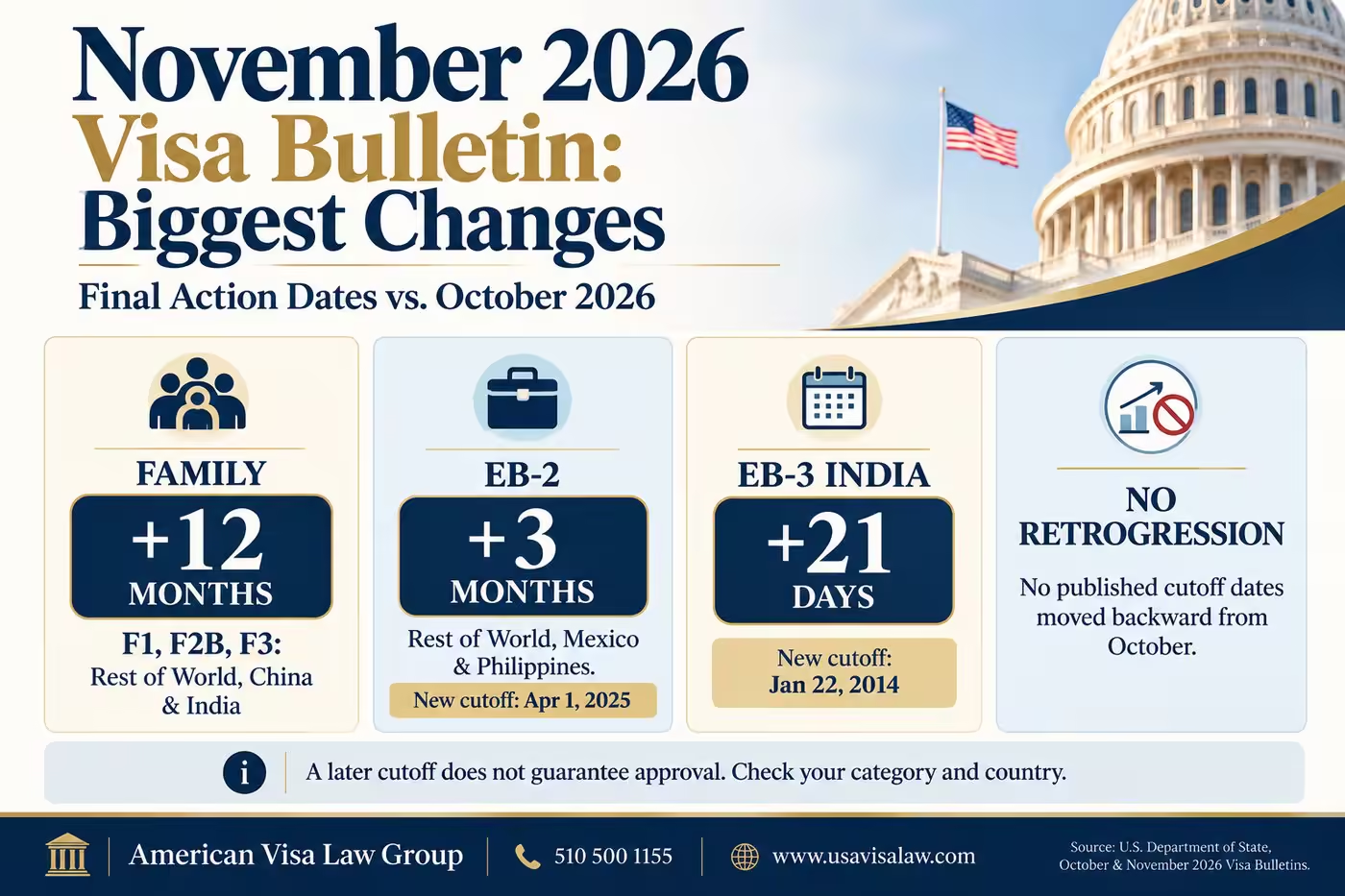
The November 2026 Visa Bulletin brings substantial advancement in several family-sponsored green card categories, while employment-based priority dates show more selective movement. Compared with October 2026, several family preference cutoff dates advance by up to one year, and certain EB-2 and EB-3 categories also move forward. No published cutoff dates retrogress.
For November, USCIS has authorized both family-sponsored and employment-based adjustment-of-status applicants to use the Dates for Filing charts. This may allow otherwise eligible applicants to submit Form I-485 before their Final Action Date becomes current. However, eligibility to file does not guarantee immediate green card approval, and applicants must still satisfy all other immigration requirements.
This guide examines the official November 2026 priority dates, identifies which filing charts apply, and compares changes with October 2026 and November 2025. For individuals pursuing family- and employment-based immigration, understanding these distinctions helps determine when an application may move forward and when further waiting may be necessary.
The November 2026 Visa Bulletin shows substantial advancement in family-sponsored priority dates, more limited employment-based movement, and no month-over-month retrogression. Several family categories advance by one year for Rest of World, China, and India, while employment-based gains are concentrated in selected EB-1, EB-2, EB-3, and Other Worker categories.
For adjustment-of-status applicants, the most important procedural development is that USCIS permits both family-sponsored and employment-based applicants to use the Dates for Filing charts in November 2026. This may allow some individuals to submit Form I-485 before their priority date becomes current for final approval.
These developments are reflected in the official November 2026 Visa Bulletin and should be evaluated alongside the USCIS adjustment-of-status filing chart selection.
The strongest movement occurs in family-sponsored categories, but advancement is not uniform across countries. For example, India experiences substantial gains in certain family categories while EB-2 India regmains at November 1, 2013, under the Final Action Dates chart. Meanwhile, EB-2 applicants chargeable to Rest of World, Mexico, and the Philippines see their Final Action Date advance to April 1, 2025.
A priority date becoming eligible for filing is not the same as becoming eligible for final approval. Applicants must identify the correct preference category, country of chargeability, and USCIS-designated chart before determining whether they can take action under the November bulletin.
For November 2026, USCIS has authorized both family-sponsored and employment-based adjustment-of-status applicants to use the Dates for Filing charts. This means eligible individuals may be able to submit Form I-485 even when their priority date has not yet become current under the Final Action Dates chart.
The distinction is significant because the U.S. Department of State publishes both charts in its monthly Visa Bulletin, but USCIS determines which chart applicants seeking adjustment of status may use. The agency confirmed its November selection through the official USCIS adjustment-of-status filing charts.
However, permission to use the Dates for Filing chart does not mean every applicant can immediately file. Eligibility still depends on the applicable preference category, country of chargeability, priority date, and other adjustment-of-status requirements.
Family-sponsored applicants may use the November 2026 Dates for Filing chart to determine whether their priority date permits them to submit an adjustment-of-status application.
One notable development concerns the F2A category, which covers spouses and unmarried children under 21 of lawful permanent residents. F2A is current across all chargeability areas under the November Dates for Filing chart. This may allow otherwise eligible F2A applicants to file Form I-485 without waiting for an additional priority-date cutoff to advance.
However, F2A is not current under the Final Action Dates chart. Consequently, an applicant may be eligible to file for adjustment of status but still have to wait until an immigrant visa number becomes available for final approval.
Other family-sponsored categories, including F1, F2B, F3, and F4, continue to have country-specific filing cutoffs. Applicants whose categories are not current generally need a priority date earlier than the applicable published cutoff.
Employment-based applicants may also use the November 2026 Dates for Filing chart, including those in the EB-1, EB-2, EB-3, EB-4, and EB-5 preference categories.
This designation is particularly relevant to applicants from countries facing significant employment-based visa backlogs. For example, an EB-2 applicant chargeable to India may qualify to file under the Dates for Filing chart even though their priority date has not yet reached the earlier Final Action Date required for green card approval.
The applicable dates appear in the November 2026 Visa Bulletin's employment-based tables.
Applicants must also distinguish adjustment of status within the United States from immigrant visa processing abroad. USCIS's monthly chart selection governs Form I-485 filing eligibility; consular applicants follow the Department of State and National Visa Center's applicable procedures.
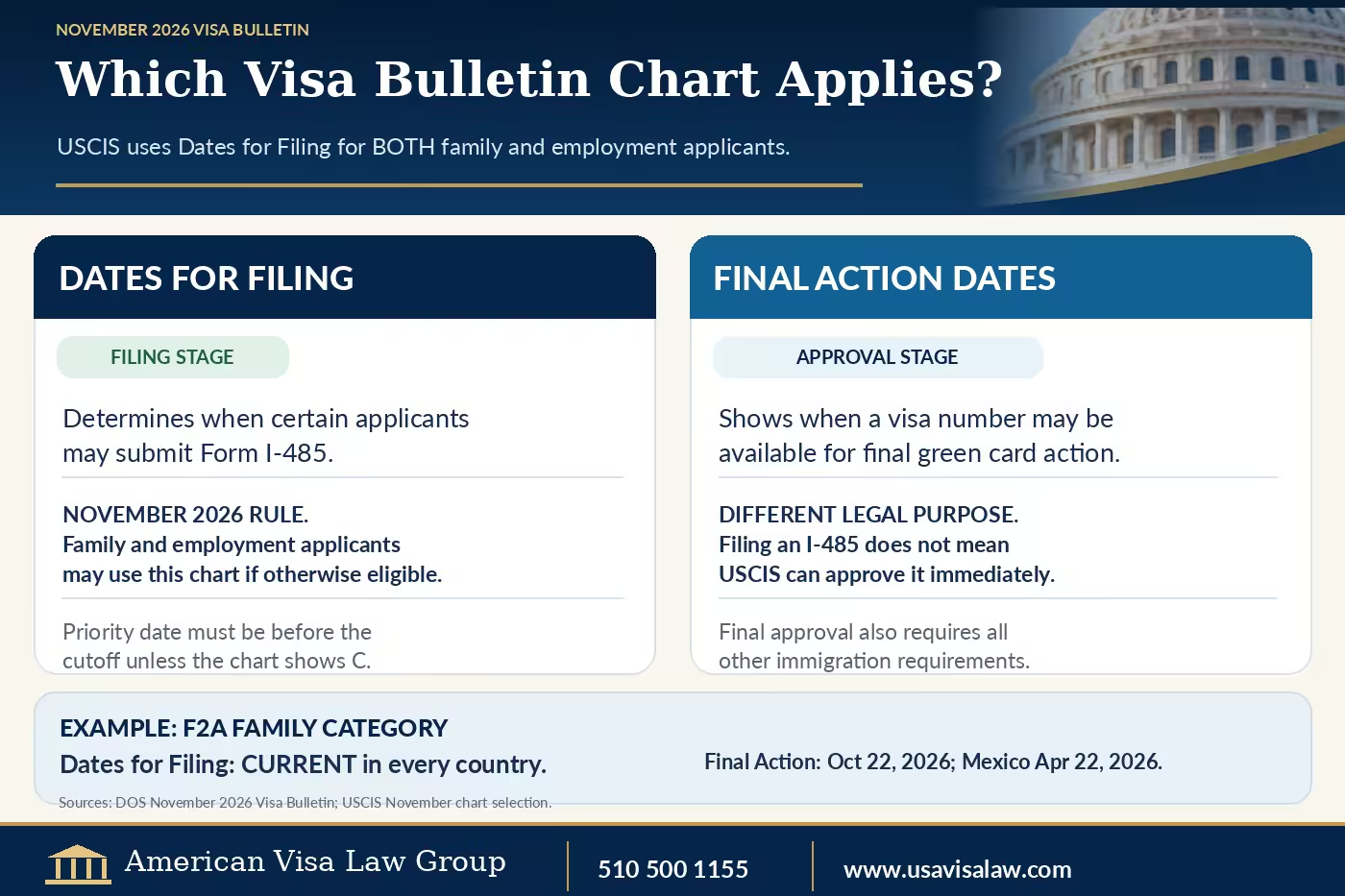
The key distinction is that filing eligibility and final approval are separate stages. Applicants should confirm the correct chart, preference category, and priority date before submitting Form I-485, while recognizing that visa availability alone does not establish eligibility for permanent residence.
Understanding the November 2026 Visa Bulletin priority dates requires identifying three details: the applicant's immigrant visa preference category, country of chargeability, and applicable filing chart. Together, these determine whether a priority date is eligible for filing or final action.
A priority date generally establishes an applicant's place in line for an immigrant visa. Depending on the immigration category, it may be based on the filing date of an immigrant petition or an underlying labor certification. Applicants can find a more detailed explanation in AVLG's guide to how green card priority dates work.
The Final Action Dates chart identifies when immigrant visa numbers may become available for final adjudication. For categories with a published cutoff, an applicant's priority date must be earlier than the listed Final Action Date for a visa number to be available.
For example, the November 2026 Final Action Date for EB-2 India is November 1, 2013. An applicant chargeable to India with an EB-2 priority date earlier than that cutoff may have a visa number available for final action, provided all other requirements are satisfied.
A current Final Action Date does not guarantee immediate approval. USCIS must still complete its adjudication, and consular applicants must satisfy the applicable immigrant visa requirements.
The Dates for Filing chart serves a different purpose. It identifies when qualifying applicants may begin the next stage of immigrant visa processing or, when authorized by USCIS, submit Form I-485 for adjustment of status.
For November 2026, USCIS permits both family-sponsored and employment-based adjustment applicants to use this chart.
This distinction can be particularly important for applicants facing substantial backlogs. A priority date may qualify under Dates for Filing without being current under Final Action Dates, potentially allowing an eligible individual to file for adjustment of status while waiting for a visa number to become available for final approval.
The official November 2026 Visa Bulletin uses two designations alongside calendar dates.
For example, F2A is current under the November 2026 Dates for Filing chart, but it has specific cutoff dates under Final Action Dates. Eligible applicants may therefore be permitted to file Form I-485 even though their cases are not yet eligible for final approval.
The essential distinction is that filing eligibility, visa number availability, and immigration eligibility are separate requirements. Applicants should confirm all three before taking action based on a published priority date.
The November 2026 Visa Bulletin brings significant advancement in family-sponsored Final Action Dates, particularly for applicants chargeable to Rest of World, China, and India. Several preference categories move forward by a full year compared with October 2026, while Mexico and the Philippines experience more limited changes.
According to the U.S. Department of State's November 2026 Visa Bulletin, the strongest gains occur in the F1, F2B, F3, and selected F4 categories. These developments may make immigrant visa numbers available to additional applicants whose priority dates were previously beyond the applicable cutoff.
However, advancement does not mean an entire preference category is current. Family-sponsored immigration remains subject to annual numerical limits, and applicants must have a priority date earlier than the applicable Final Action Date to qualify for visa number allocation.
Four family-sponsored categories show particularly noteworthy movement in November:
These are substantial changes in the published cutoff dates, especially for families waiting under categories that have historically experienced lengthy backlogs.
Nevertheless, a one-year advancement in a Final Action Date does not necessarily reduce an individual applicant's remaining wait by one year. Future movement depends on visa demand, available immigrant visa numbers, and other allocation factors.
Families considering their options should also distinguish between preference-category petitions and immediate-relative classifications, which are not subject to the same annual visa limits. AVLG explains these differences in its guide to family-based green card petitions and eligibility.
The F2A category, covering spouses and qualifying unmarried children under 21 of lawful permanent residents, also advances in November 2026.
For Rest of World, China, India, and the Philippines, the Final Action Date moves from September 22, 2026, to October 22, 2026. Mexico advances from March 22, 2026, to April 22, 2026.
This movement is particularly relevant to families whose priority dates fall between the October and November cutoffs.
However, F2A remains subject to Final Action Date limitations. Although its November Dates for Filing chart is current across all chargeability areas, that designation does not eliminate the separate requirement for an immigrant visa number to become available before final approval.
Unlike the broad advancement affecting several other chargeability areas, Mexico experiences smaller gains in selected family categories.
Mexico's F1 Final Action Date advances by 14 days, from September 8 to September 22, 2008. Its F3 cutoff also advances by 14 days, from July 1 to July 15, 2001. F2A advances by one month, while F2B and F4 remain unchanged.
For the Philippines, F2A is the only family-sponsored Final Action Date category that advances in November. F1, F2B, F3, and F4 retain their October cutoff dates.
These differences highlight why applicants must examine the column corresponding to their country of chargeability, rather than relying on a general headline announcing family-sponsored advancement.
The following comparison highlights the most important changes between the October 2026 Visa Bulletin and November 2026.
Rest of World refers to the Department of State's “All Chargeability Areas Except Those Listed” column. Dates reflect the published Final Action Dates, not Dates for Filing.
The central takeaway is that November 2026 brings meaningful family-sponsored progress, but the benefits are uneven. Applicants should compare their individual priority date against the correct category and country cutoff, while recognizing that visa number availability does not independently establish eligibility for adjustment of status or consular immigrant visa issuance.
The November 2026 Visa Bulletin brings substantial advancement in family-sponsored Dates for Filing, particularly for applicants chargeable to Rest of World, China, and India. Several preference categories move forward by one year compared with October, potentially allowing additional applicants to begin the next stage of their green card process.
The development is especially relevant because USCIS has authorized family-sponsored adjustment-of-status applicants to use the Dates for Filing chart for November 2026. However, a qualifying priority date does not automatically establish eligibility to submit Form I-485. Applicants must also satisfy the applicable adjustment-of-status requirements.
The largest changes affect the F1, F2B, F3, and selected F4 categories.
For Rest of World, China, and India, F1 advances from February 1, 2020, to February 1, 2021. F2B moves from September 1, 2019, to September 1, 2020, while F3 advances from November 1, 2014, to November 1, 2015.
F4 also advances by one year for Rest of World and China, reaching November 1, 2012. However, India's F4 Dates for Filing cutoff remains unchanged at February 1, 2007, reflecting the different visa demand and availability affecting applicants in that category.
These changes create potential filing opportunities for families whose priority dates now fall before the applicable November cutoff. For adjustment-of-status applicants, the next step is to confirm eligibility under the USCIS Visa Bulletin filing chart rules.
The F2A category, covering spouses and qualifying unmarried children under 21 of lawful permanent residents, remains current across all countries under the November 2026 Dates for Filing chart.
This means there is no priority-date cutoff restricting filing under that chart. Eligible F2A applicants may therefore be able to submit Form I-485 without waiting for their priority date to reach a specified filing date.
The distinction between filing and approval remains critical.
Although F2A is current under Dates for Filing, its Final Action Dates are not current. For November 2026, the Final Action Date is October 22, 2026, for most chargeability areas and April 22, 2026, for Mexico.
Consequently, an F2A applicant may qualify to file for adjustment of status but still need to wait for immigrant visa availability before USCIS can approve the green card application.
Unlike the broader advancement affecting Rest of World, China, and India, Mexico and the Philippines experience no changes in their family-sponsored Dates for Filing between October and November 2026.
For Mexico, the F1, F2B, F3, and F4 filing cutoffs remain unchanged. The same is true for the Philippines.
This does not mean that every applicant from these countries must continue waiting. Individuals whose priority dates were already earlier than the applicable filing cutoff may still qualify to proceed, provided they meet the remaining requirements.
The following table compares the major changes published in the October 2026 Visa Bulletin and the official November 2026 Visa Bulletin.
The practical significance of November's family-sponsored filing movement is the potential opportunity to take action sooner—not a guarantee of faster permanent residence. Applicants should confirm their priority date, preference category, country of chargeability, and eligibility before filing, especially when their Dates for Filing and Final Action Dates differ.
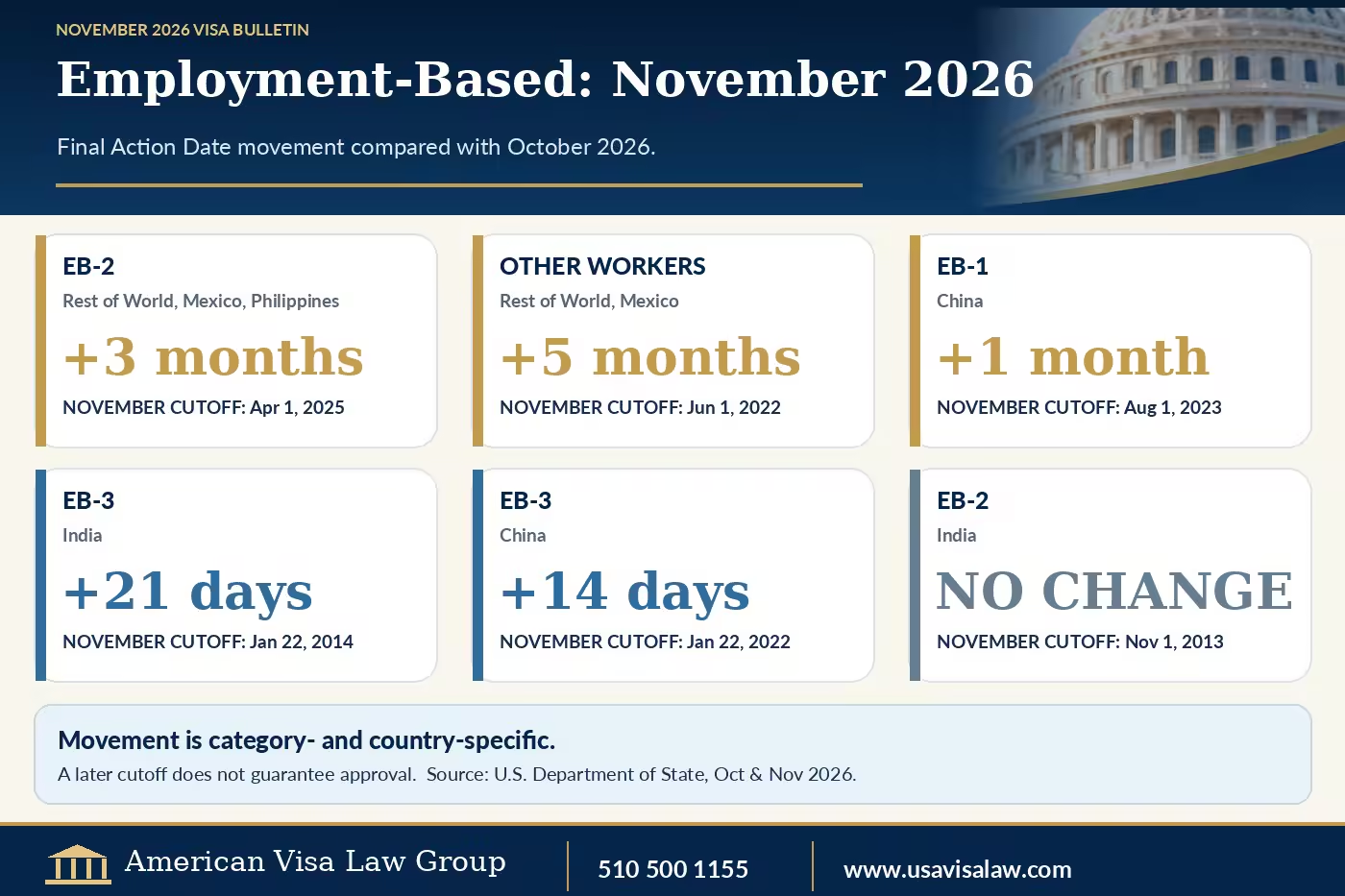
The November 2026 Visa Bulletin brings selective advancement in employment-based Final Action Dates, with movement in EB-1, EB-2, EB-3, and Other Workers. The strongest gains affect EB-2 applicants chargeable to Rest of World, Mexico, and the Philippines, while EB-1 India and EB-2 India remain unchanged.
According to the official November 2026 Visa Bulletin, no employment-based Final Action Date moves backward compared with October. However, progress varies considerably by preference category and country of chargeability.
For applicants awaiting permanent residence, the relevant question is not simply whether a category advanced, but whether their individual priority date is now earlier than the applicable cutoff. Understanding the differences between employment-based green card categories is also essential because EB-1, EB-2, and EB-3 operate under separate eligibility requirements and visa allocations.
The EB-1 category covers priority workers, including individuals of extraordinary ability, outstanding professors and researchers, and qualifying multinational executives and managers.
For November 2026, EB-1 China advances by one month, from July 1, 2023, to August 1, 2023. This may benefit applicants whose priority dates fall within the newly available period.
EB-1 India remains at February 1, 2023, with no movement from October.
Meanwhile, EB-1 remains current for Rest of World, Mexico, and the Philippines, meaning no priority-date cutoff restricts visa number availability in those chargeability areas.
Although EB-1 is generally associated with highly qualified applicants, its preference classification does not eliminate country-specific backlogs. An approved immigrant petition and an available visa number remain distinct requirements.
EB-2, which includes certain advanced-degree professionals and individuals of exceptional ability, shows one of November's most significant employment-based developments.
The Final Action Date for Rest of World, Mexico, and the Philippines advances three months, from January 1, 2025, to April 1, 2025.
By contrast, two heavily backlogged countries experience no movement:
For EB-2 India applicants, the unchanged cutoff means November does not expand Final Action Date eligibility beyond October's published date.
The distinction also matters for individuals pursuing an EB-2 National Interest Waiver. An approved NIW petition establishes eligibility for the immigrant classification but does not bypass the EB-2 visa-number limits applicable to the applicant's country of chargeability.
The EB-3 category covers qualifying professionals and skilled workers, while its Other Workers classification has a separate cutoff.
In November, EB-3 professionals and skilled workers experience movement in several chargeability areas.
For Rest of World and Mexico, the Final Action Date advances one month, from May 15, 2024, to June 15, 2024.
China advances 14 days, from January 8, 2022, to January 22, 2022. India advances 21 days, from January 1, 2014, to January 22, 2014.
The Philippines remains unchanged at August 15, 2023.
These changes may allow additional EB-3 applicants to become eligible for final action, but the improvements are modest compared with the larger movement seen in certain family-sponsored categories.
For applicants evaluating an EB-2-to-EB-3 strategy, cutoff dates alone should not determine whether changing preference categories is appropriate. Petition eligibility, priority-date retention, employer sponsorship, and the procedural consequences of a new petition or transfer request require separate consideration.
The EB-3 Other Workers classification experiences a more substantial change for certain countries.
For Rest of World and Mexico, the Final Action Date advances five months, from January 1, 2022, to June 1, 2022.
India advances 21 days, reaching January 22, 2014. China remains unchanged at October 1, 2019, while the Philippines remains at January 1, 2022.
The Other Workers classification is subject to separate numerical restrictions within the broader EB-3 preference. Consequently, its cutoff dates may differ considerably from those applicable to EB-3 professionals and skilled workers.
Applicants should ensure they are comparing their priority dates against the correct EB-3 classification rather than assuming that all third-preference workers share the same cutoff.
The EB-4 Final Action Date remains December 15, 2022, for all chargeability areas, including the Certain Religious Workers category.
EB-5 Unreserved Final Action Dates are also unchanged:
All three EB-5 reserved visa categories—rural investments, high-unemployment-area investments, and infrastructure investments—remain current across all chargeability areas.
However, current visa availability does not mean that an EB-5 petition will be approved automatically. Applicants must independently satisfy the applicable investment, source-of-funds, job-creation, and immigration requirements.
The following table compares the most significant changes in the October 2026 Visa Bulletin with November's employment-based Final Action Dates.
Rest of World refers to the Department of State's “All Chargeability Areas Except Those Listed” column. The table highlights material changes and high-interest backlogged categories rather than reproducing every published date. “Current” indicates visa number availability, not guaranteed approval.
The November figures demonstrate that employment-based advancement is uneven, with meaningful progress for some applicants and continued delays for others. EB-2 movement outside India and China is particularly notable, while Indian applicants continue to face longstanding EB-1 and EB-2 backlogs.
Importantly, USCIS has authorized the Dates for Filing chart for employment-based adjustment-of-status applications in November 2026. As a result, applicants should examine both charts before determining whether they can submit Form I-485 or whether their cases may become eligible for final approval.
The November 2026 Visa Bulletin shows almost no movement in employment-based Dates for Filing, despite advancement in several Final Action Dates. The only month-over-month change affects the EB-3 Other Workers category for Rest of World and Mexico, where the filing cutoff advances by one month.
All other employment-based filing dates remain unchanged from October 2026, including EB-1, EB-2, EB-3 professionals and skilled workers, EB-4, and EB-5.
This stability is particularly important because USCIS has authorized employment-based adjustment-of-status applicants to use the Dates for Filing chart in November 2026. Applicants whose priority dates are earlier than the applicable cutoff may be eligible to submit Form I-485, provided they meet the remaining legal requirements.
According to the official November 2026 Visa Bulletin, the EB-3 Other Workers filing cutoff advances from June 1, 2022, to July 1, 2022, for Rest of World and Mexico.
China, India, and the Philippines experience no change.
Dates reflect the employment-based Dates for Filing charts published by the Department of State, not the Final Action Dates used to determine visa number availability for final approval.
The one-month advancement may create a new filing opportunity for eligible Other Workers applicants chargeable to Rest of World or Mexico whose priority dates fall within the newly covered period.
However, applicants should not confuse Other Workers with the separate EB-3 classifications for professionals and skilled workers. These categories have different published cutoffs, even though they fall within the broader third employment-based preference.
For applicants in the other employment-based categories, November maintains October's filing cutoffs.
Notable examples include:
EB-5 reserved categories for rural, high-unemployment-area, and infrastructure investments remain current under Dates for Filing for all chargeability areas.
Although these dates are unchanged, eligible applicants may still benefit from the November filing-chart designation. A priority date does not need to advance every month for an applicant to qualify to file; it must fall within the applicable cutoff, and the applicant must satisfy the remaining filing requirements.
A central distinction in the November bulletin is that employment-based Final Action Dates and Dates for Filing do not move together.
For example, EB-2 Rest of World advances three months under Final Action Dates, reaching April 1, 2025. However, its Dates for Filing cutoff remains March 15, 2026.
The movement in Final Action Dates may benefit applicants with pending adjustment applications whose priority dates are now eligible for final adjudication. Meanwhile, the unchanged Dates for Filing cutoff continues to define which additional applicants may qualify to submit Form I-485 during November.
Applicants should therefore review both charts rather than treating an unchanged filing date as evidence that their cases cannot progress.
The USCIS adjustment-of-status filing chart guidance explains how to determine which chart governs Form I-485 filing, while the Department of State's October 2026 Visa Bulletin provides the baseline for comparing month-over-month movement.
The practical takeaway is that November 2026 creates limited new employment-based filing opportunities but allows certain applicants to benefit from advancing Final Action Dates. The correct next step depends on the applicant's preference classification, country of chargeability, priority date, and whether Form I-485 has already been filed.
The November 2026 Visa Bulletin delivers different results for applicants from India, China, Mexico, the Philippines, and Rest of World. While several family-sponsored categories advance substantially, employment-based movement remains more limited and varies by country of chargeability.
These differences matter because applicants in the same immigration preference category may face very different priority-date cutoffs depending on their country of chargeability, which is generally determined by place of birth rather than citizenship.
The following analysis highlights the most consequential developments in the official November 2026 Visa Bulletin.
For Indian applicants, November brings a clear contrast between family-sponsored and employment-based immigration.
Family-sponsored Final Action Dates advance by one year in F1, F2B, and F3. F2A moves forward one month, reaching October 22, 2026. However, the F4 sibling category remains unchanged at December 15, 2006.
Employment-based applicants receive considerably less movement. EB-1 India remains at February 1, 2023, while EB-2 India stays at November 1, 2013. Neither category advances from October.
EB-3 professionals and skilled workers move forward by 21 days, reaching January 22, 2014. The same advancement applies to Other Workers. Meanwhile, employment-based Dates for Filing remain unchanged across all Indian preference categories.
This distinction is especially important for Indian professionals with pending or approved Form I-140 petitions. An unchanged Final Action Date does not necessarily prevent an otherwise eligible applicant from filing Form I-485 under the November Dates for Filing chart.
For additional context on the preceding month's developments, see AVLG's October 2026 Visa Bulletin analysis for India.
China experiences substantial family-sponsored advancement in November 2026. F1, F2B, F3, and F4 Final Action Dates each move forward by one year, while F2A advances one month.
Employment-based movement is more selective.
EB-1 China advances from July 1, 2023, to August 1, 2023, potentially expanding final-action eligibility for applicants whose priority dates fall within the newly available period.
EB-3 professionals and skilled workers also advance by 14 days, reaching January 22, 2022.
However, EB-2 China remains unchanged at October 1, 2021. Other Workers and EB-5 Unreserved also retain their October Final Action Dates.
China's employment-based Dates for Filing remain unchanged. Applicants should therefore distinguish between progress toward final approval and the separate cutoff governing when an adjustment-of-status application may be submitted.
Mexico presents a different pattern, with stronger gains in selected employment-based categories than in family-sponsored immigration.
Family-sponsored Final Action Dates show modest movement. F1 and F3 each advance by 14 days, while F2A moves forward one month to April 22, 2026. F2B and F4 remain unchanged.
The employment-based picture is more favorable.
EB-2 Mexico advances three months to April 1, 2025, while EB-3 professionals and skilled workers move forward one month to June 15, 2024.
The largest change occurs in the Other Workers classification, where the Final Action Date advances five months, reaching June 1, 2022.
Mexico also shares the only employment-based Dates for Filing advancement in November: Other Workers moves from June 1, 2022, to July 1, 2022.
These changes may benefit applicants at different procedural stages. Some may newly qualify for filing, while others with pending cases may become eligible for final adjudication.
For applicants chargeable to the Philippines, November produces relatively limited movement outside EB-2 and F2A.
The F2A family-sponsored Final Action Date advances one month to October 22, 2026. Other family-sponsored Final Action Dates remain unchanged, including F1, F2B, F3, and F4.
The most significant employment-based change occurs in EB-2 Philippines, which advances three months from January 1, 2025, to April 1, 2025.
EB-3 professionals and skilled workers remain at August 15, 2023, while Other Workers stays at January 1, 2022. EB-1 remains current, and EB-5 Unreserved also remains current.
Employment-based Dates for Filing do not change for the Philippines.
For applicants with pending adjustment-of-status cases, EB-2 advancement may create an opportunity for final approval once visa numbers become available and USCIS completes the remaining adjudication requirements. However, the new cutoff does not guarantee that an individual application will be approved during November.
The Rest of World designation refers to the Department of State's “All Chargeability Areas Except Those Listed” column.
Applicants covered by this column receive some of November's strongest family-sponsored movement. F1, F2B, F3, and F4 Final Action Dates each advance by one year, while F2A advances one month.
Employment-based developments are more selective.
EB-1 remains current, while EB-2 advances three months to April 1, 2025. EB-3 professionals and skilled workers move forward one month to June 15, 2024, and Other Workers advances five months to June 1, 2022.
Under Dates for Filing, most employment-based cutoffs remain unchanged. The exception is Other Workers, which advances one month to July 1, 2022.
This creates an important distinction for applicants considering whether to file Form I-485 or awaiting final approval. The applicable USCIS adjustment-of-status filing charts determine which dates may be used for filing, while Final Action Dates determine when immigrant visa numbers may be available for final adjudication.
Across all five country groupings, November 2026's priority-date movement should be interpreted according to the applicant's individual preference category, chargeability, and procedural stage. A category advancing in one country does not establish eligibility for an applicant in another, and movement in a published cutoff should not be treated as a prediction of future visa availability.
Comparing the November 2026 Visa Bulletin with October 2026 reveals a more favorable month for many family-sponsored green card applicants, alongside selective employment-based progress. Unlike October, which introduced several restrictive employment-based cutoffs at the beginning of fiscal year 2027, November brings forward movement without any month-over-month retrogression.
The most significant difference is the strength of family-sponsored advancement. F1, F2B, and F3 Final Action Dates move forward by one year for Rest of World, China, and India. F4 also advances by one year for Rest of World and China, while F2A progresses by one month across all chargeability areas. These changes may expand immigrant visa availability for families whose priority dates now fall before the November cutoffs.
Employment-based movement is more uneven. EB-2 advances three months to April 1, 2025, for Rest of World, Mexico, and the Philippines, while EB-2 China and India remain unchanged. EB-3 advances in several countries, although the movement is generally limited to a few weeks or one month. Other Workers applicants from Rest of World and Mexico experience a more substantial five-month advancement.
For Indian employment-based applicants, the November bulletin offers limited improvement. EB-1 India remains at February 1, 2023, and EB-2 India stays at November 1, 2013. EB-3 and Other Workers advance by 21 days, but their movement does not indicate a broader acceleration across India's employment-based backlog.
Another important finding is the absence of retrogression. No published Final Action Date or Dates for Filing cutoff moves backward between October and November. However, this does not guarantee that future bulletins will maintain the same direction. Visa demand, annual numerical limits, and available allocations can affect subsequent movement.
Finally, employment-based Dates for Filing remain largely unchanged. The only advancement concerns Other Workers for Rest of World and Mexico, while USCIS continues to permit eligible adjustment-of-status applicants to use the Dates for Filing charts in November.
For a detailed comparison with the start of the fiscal year, see AVLG's October 2026 Visa Bulletin analysis. Applicants should also consult the official November 2026 Visa Bulletin and the USCIS adjustment-of-status filing chart guidance before determining eligibility.
The central takeaway: November 2026 brings meaningful family-sponsored advancement and targeted employment-based improvements, but the practical benefit depends on each applicant's preference category, country of chargeability, priority date, and stage of processing.
The November 2026 Visa Bulletin shows substantial year-over-year advancement in several family-sponsored and employment-based green card categories. Comparing the latest cutoff dates with November 2025 provides a broader view of visa availability than month-to-month changes alone, particularly for applicants facing lengthy priority-date backlogs.
The most significant progress appears in family-sponsored categories for Rest of World, China, and India. Employment-based applicants also see improvement, although movement remains uneven, especially for India.
Comparing the November 2025 Visa Bulletin with November 2026 reveals substantial advancement across several family-sponsored Final Action Dates.
For Rest of World, the F1 cutoff moves from November 8, 2016, to January 22, 2021—more than four years of advancement in the published date. F2B, F3, and F4 also show multi-year gains.
F2A advances particularly significantly, moving from February 1, 2024, to October 22, 2026, for most chargeability areas. This development may expand visa availability for qualifying spouses and children of lawful permanent residents.
However, these improvements are not uniform. Applicants chargeable to Mexico, the Philippines, or India in certain oversubscribed categories continue to face different cutoff dates and longstanding backlogs.
Employment-based Final Action Dates also show measurable year-over-year advancement, particularly in EB-2 Rest of World and EB-5 Unreserved India.
EB-2 Rest of World advances from December 1, 2023, to April 1, 2025, while EB-2 India moves from April 1, 2013, to November 1, 2013.
For EB-3 India, the Final Action Date progresses from August 22, 2013, to January 22, 2014. Although this represents forward movement, it also demonstrates the persistent backlog affecting Indian professionals and skilled workers.
EB-5 Unreserved India records a more substantial advancement, moving from February 1, 2021, to December 1, 2023.
A common misunderstanding is that a cutoff date advancing by several years means an applicant's remaining green card wait has decreased by the same amount.
Visa Bulletin movement measures changes in published priority-date cutoffs, not a guaranteed reduction in individual processing times. Cutoff dates respond to visa demand, numerical limits, and the availability of immigrant visa numbers. Future bulletins may show additional advancement, limited movement, or retrogression.
An applicant's remaining timeline also depends on whether the underlying immigrant petition has been approved, the applicable processing route, and any outstanding eligibility or documentation requirements.
The year-over-year comparison therefore offers valuable historical context, but applicants should rely on their individual priority date and the current USCIS filing-chart designation when deciding whether to submit Form I-485 or pursue final immigrant visa processing.
The November 2026 Visa Bulletin creates new opportunities for some family-sponsored and employment-based green card applicants, but an advancing priority date does not automatically establish eligibility to file Form I-485 or receive permanent residence.
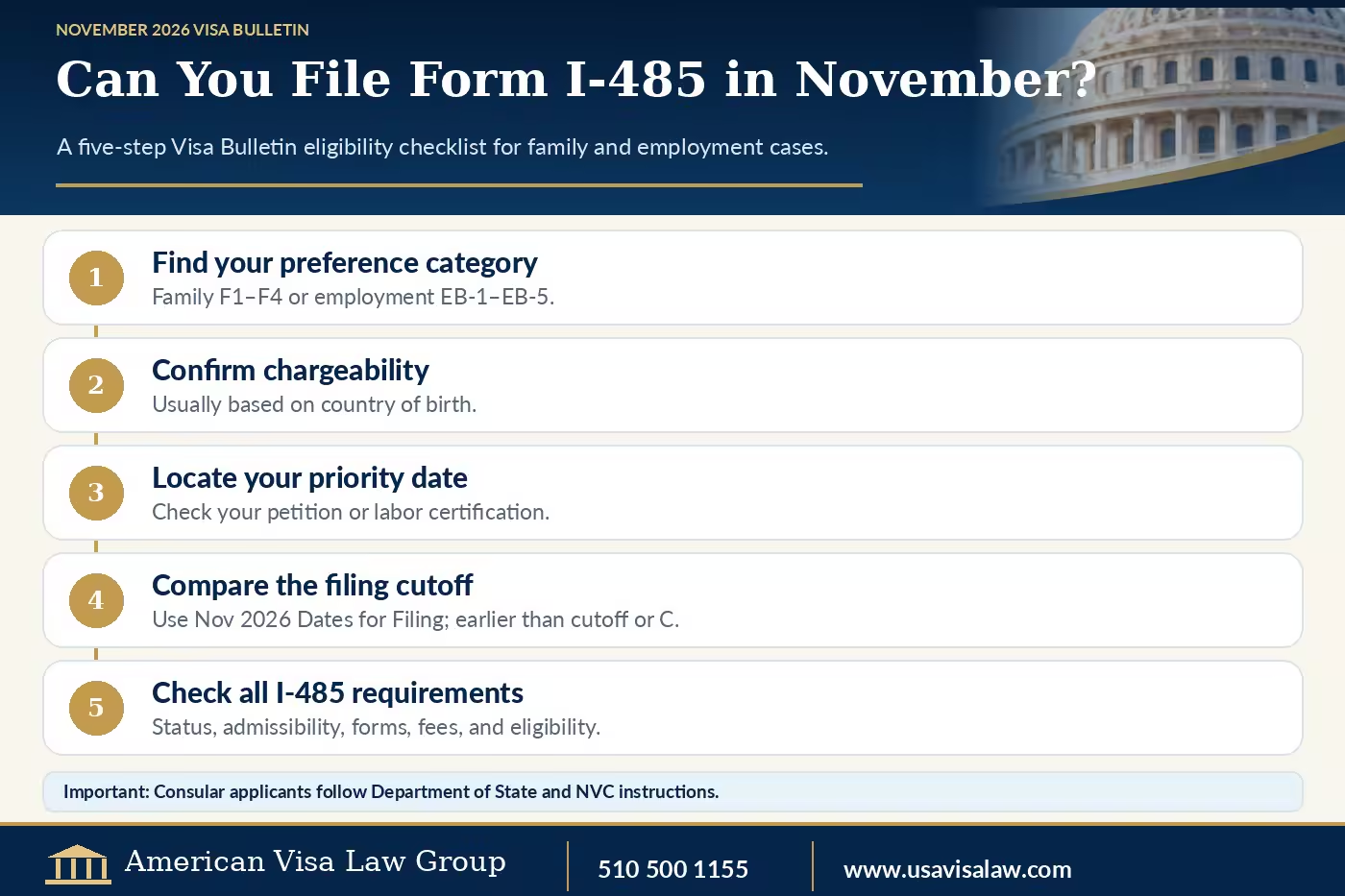
Before taking action, applicants should confirm how the November cutoff dates apply to their individual immigration case. The following steps can help identify filing opportunities, avoid preventable mistakes, and prepare for the next stage of processing.
Certain situations require more than a straightforward comparison of priority dates. Applicants with multiple immigrant petitions, potential priority-date retention, cross-chargeability questions, or employment-based category changes should confirm which date legally applies.
Families with children approaching age 21 may also need to evaluate protections under the Child Status Protection Act (CSPA). Filing at the wrong time or misunderstanding age-related eligibility can have significant consequences.
Likewise, applicants with prior immigration status violations, unauthorized employment, or questions about concurrent filing should confirm that they satisfy the applicable legal requirements before proceeding.
The most effective next step is to determine not only whether a priority date qualifies, but whether the applicant is legally and procedurally ready to act. Applicants who need help evaluating their category, filing eligibility, or immigration history may request an individualized consultation with American Visa Law Group.
The November 2026 Visa Bulletin is the U.S. Department of State's monthly publication identifying immigrant visa availability for family-sponsored and employment-based green card categories. It provides Final Action Dates and Dates for Filing based on preference classification and country of chargeability. The November bulletin shows substantial family-sponsored advancement, selective employment-based movement, and no month-over-month retrogression.
Applicants can review the complete figures in the official November 2026 Visa Bulletin.
USCIS has authorized family-sponsored adjustment-of-status applicants to use the Dates for Filing chart in November 2026.
Applicants whose priority dates are earlier than the applicable cutoff may qualify to submit Form I-485, provided they meet the remaining legal requirements. A qualifying filing date does not necessarily mean an immigrant visa number is available for final approval.
Employment-based adjustment-of-status applicants may also use the Dates for Filing chart for November 2026.
This includes qualifying applicants in EB-1, EB-2, EB-3, EB-4, and EB-5 categories. Applicants must identify their correct preference classification, country of chargeability, and priority date before determining whether they can file. The applicable chart designation is published on the USCIS adjustment-of-status filing charts page.
No. EB-2 India's Final Action Date remains November 1, 2013, unchanged from October 2026.
Its Dates for Filing cutoff also remains January 15, 2015. Although there is no new movement, otherwise eligible applicants whose priority dates qualify under the applicable filing chart may still be able to submit Form I-485 during November.
Yes. EB-3 India's Final Action Date advances by 21 days, from January 1, 2014, to January 22, 2014.
The same movement applies to India's Other Workers classification. However, the EB-3 Dates for Filing cutoff remains unchanged at January 15, 2015. Applicants should distinguish newly available final-action dates from the separate eligibility requirements for filing an adjustment application.
F2A is current under the November 2026 Dates for Filing chart, but not under Final Action Dates.
For most chargeability areas, the F2A Final Action Date is October 22, 2026. Mexico has an earlier cutoff of April 22, 2026.
This means qualifying spouses and unmarried children under 21 of lawful permanent residents may be eligible to file for adjustment of status even when an immigrant visa number is not yet available for final approval.
No published family-sponsored or employment-based cutoff date retrogresses between October and November 2026.
Several categories advance, while others remain unchanged. However, the absence of retrogression in November does not guarantee continued advancement in December or subsequent months. The Department of State may adjust cutoff dates based on visa demand and statutory numerical limits.
No. Dates for Filing determines when certain applicants may begin the next stage of processing or submit Form I-485 when USCIS authorizes that chart.
Final approval generally requires immigrant visa number availability under the Final Action Dates chart, in addition to satisfaction of all other applicable immigration requirements. Filing an adjustment application does not guarantee approval or establish that the case is ready for final adjudication.
Yes. When the Visa Bulletin lists a specific cutoff, an applicant's priority date generally must be earlier than—not equal to—the published date.
For example, if the Final Action Date is April 1, 2025, a priority date of March 31, 2025, falls before the cutoff, while April 1, 2025, does not.
If the category is designated “C,” it is current, meaning no priority-date cutoff applies under that chart. Other eligibility requirements still remain.
No. Although November brings substantial family-sponsored advancement and selective employment-based gains, future Visa Bulletin movement cannot be reliably predicted from one month's cutoff dates.
December's dates will depend on immigrant visa demand, available numerical allocations, and Department of State determinations. Categories that advanced in November may continue moving, remain unchanged, or retrogress in later months.
Applicants should use the November bulletin to assess current eligibility rather than assuming that recent movement guarantees a shorter waiting period.
The November 2026 Visa Bulletin brings meaningful progress for certain family-sponsored and employment-based green card applicants, although the benefits vary by preference category and country of chargeability.
The five most important developments are:
Applicants should consult the official November 2026 Visa Bulletin and USCIS filing-chart guidance when evaluating their next steps.
Applicants reviewing the November 2026 Visa Bulletin should consult official government publications to verify priority dates, filing eligibility, and changes in immigrant visa availability. The following resources provide additional guidance on family-sponsored and employment-based green card processing.
Visa Bulletin information changes monthly. Applicants should verify the applicable cutoff dates and USCIS filing instructions before submitting an immigration application.

Hasan Abdullah, Esq. is the Founder and Managing Attorney of American Visa Law Group. His practice focuses on U.S. immigration law, including family-based immigration, employment-based immigration, adjustment of status, consular processing, waivers, PERM labor certification, NIW, EB-1, H-1B, O-1, and complex immigration strategy.
Through American Visa Law Group, Mr. Abdullah helps individuals, families, professionals, investors, and employers understand their immigration options and plan around changing government policies, USCIS procedures, and Visa Bulletin movement. His work emphasizes practical legal analysis, realistic expectations, and strategy tailored to each applicant’s immigration history and long-term goals.


